


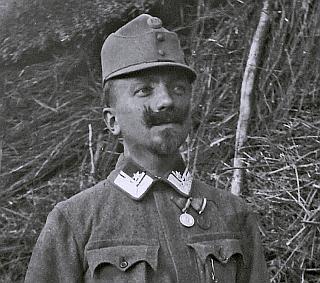
 | Kompit, Zdenko Václav | |
| *5.8.1862 Praha - †18.9.1926 Praha | ||
| SearchŠvejkův slovník | ||
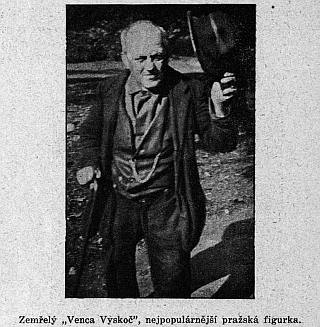
Konec bahna Prahy, , 1927
Zdenko Václav Kompit also known as Venca Vyskoč, is without doubt the prototype for the village idiot Pepík Vyskoč from Putim.
Lifeline
"Venca" was born in Prague III., house no. 321, in Malá Strana, son of Karel Kompit and Agnes. His mother died when he was three so he was raised by his father's second wife, Anna. He originally worked as a waiter; in the 1890 population register and the 1910 police record he is listed as a "cellarman". In 1890 there is a remark "blbý" (stupid) by his name in the police register[a].
When this stupidity actually took hold is not known, but at some stage he started to walk around pubs and cafés, bleated and jumped by the tables and collected money for the spectacle. Venca became a well-known character in the streets of Prague. His main area of operation was around Václavské náměstí and he even frequented U Fleků, a tavern that the author of The Good Soldier Švejk knew very well[b].
Obituaries
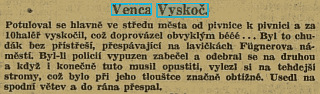
, 19.4.1936
"Venca" was mentioned in newspapers already during his lifetime[c] and when he died on 18 September 1926 at the age of 65, several national and regional newspaper published notices. Lidové noviny even provided a more detailed obituary[b]. The description in this obituary is so close to Jaroslav Hašek's own that there is not even the slightest doubt where the inspiration for the name, the jumping and the bleating came from. Hašek's "deviation" consisted in transferring Vyskoč from Prague to Putim and let Wachtmeister Flanderka hire him as in informer.
Knesl and Kukla
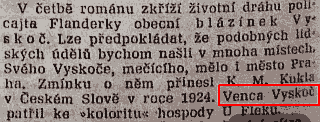
Augustin Knesl, , 1983
Augustin Knesl also noticed the connection between "Venca Vyskoč" and Pepík Vyskoč in his series in Večerní Praha (1983), and refers to a note by Karel Ladislav Kukla in České Slovo from 1924[d].
Credit: Jaroslav Šerák, Sergey Soloukh, Augustin Knesl
Literature
- Pepek Vyskoč, ,2018 - 2023 [a]
- Matrika narozených,
- Matrika mrtvých,
- »Pefél z Moskvy«, ,25.11.1922 [c]
- Soudní síň, ,22.8.1924
- "Venca Vyskoč" už doskákal svoji životní pouť, ,21.9.1926
- "Venca Vyskoč" ✝, ,21.9.1926
- Venca Vyskoč zemřel, ,21.9.1926 [b]
- Postava nedávná, ,27.10.1939
- Josef Švejk a ti druzí. 17., Augustin Knesl,1983 [d]
| a | Pepek Vyskoč | 2018 - 2023 | |
| b | Venca Vyskoč zemřel | 21.9.1926 | |
| c | »Pefél z Moskvy« | 25.11.1922 | |
| d | Josef Švejk a ti druzí. 17. | Augustin Knesl | 1983 |