


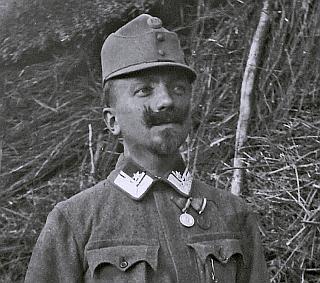
 | Vodička, Josef | |
| *10.3.1878 Čertoryje - †27.4.1961 Újezd | ||
| SearchŠvejkův slovník | ||
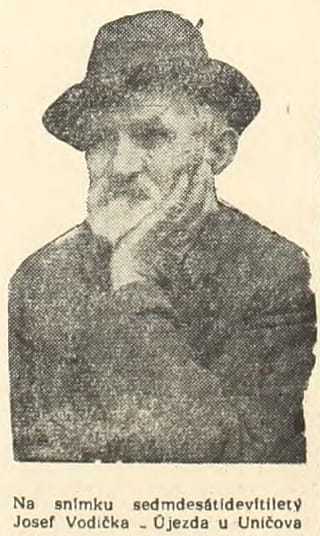
,25.1.1958
Josef Vodička is frequently suggested as a model for Sappeur Vodička, and that he, in part, was the inspiration behind the famous sapper is very likely. Although Josef Vodička never served with a Styrian regiment in Királyhida in 1915 or lived in Na Bojišti in Prague before the war, there are still sufficient similarities to his literary counterpart for him to be classified as a partial "model".
Apart from the surname and the fact that Hašek knew him, there are further connecting points. Vodička was a rebel who was repeatedly disciplined during his military service. His age also fits because he was 38 when he met Hašek in Totskoye. In The Good Soldier Švejk there is also an indication that Sappeur Vodička, like Josef Vodička, had served with k.k. Landwehrinfanterieregiment Nr. 16. See Landwehrsoldat Purkrábek.
Early years
Vodička was born in Čertoryje by Olomouc in 1878[a] and trained as a cooper in Vienna. In the years before the war, he made a living by repairing beer casks across the Dual Monarchy. Per his age group, he would have completed his military service from 1899 to 1901 (to be confirmed). For some unknown reason, he served with k.k. Landwehrinfanterieregiment Nr. 16 (Kraków) and not with k.k. Landwehrinfanterieregiment Nr. 13 as one would expect due to his place of birth. He married in the last few years before the war, and two children were born. In 1913 he left the Catholic church[a].
During the war
Vodička was taken prisoner by Opatów already on 20 August 1914. In late 1915 and early 1916, he was interned with Jaroslav Hašek in the prisoner's camp in Totskoye, and like the author of The Good Soldier Švejk, he volunteered for service with České legie in June 1916[1]. The two were enrolled in the Czechoslovak 1st regiment in Kiev on 29 June 1916, so one must assume they arrived in Kiev with the same transport[b]. Thereafter, their paths split, and Vodička remained in the Legions until he returned home and was demobilised in 1921.
Later years
As a legionnaire, he was entitled to free land and moved with his family to Zakarpatia (now in Ukraine). When Czechoslovakia was partitioned in 1939, he moved back to the Olomouc district and settled in Újezd by Úničov. Here he lived for the rest of his life.
During the 1950s, at least two army newspapers interviewed Vodička, and it appears that he was extremely rebellious. He claimed to have been disciplined 154 times during his two-year military service and also that he deserted soon after the outbreak of war. In the prisoner camp of Totskoye, he got to know Hašek quite well and told the future author of The Good Soldier Švejk many details from his life.
Some of the information he gives should be taken with a pinch of salt as he was known as a story-maker, but there is no reason to doubt the essence of his account: that he knew Hašek relatively well. He was more modest when asked if he considered himself the model for the irate sapper in Királyhida. He stated "perhaps" but that this was difficult to guess and that Hašek was created literary figures [c].
Note
1. Jaroslav Hašek was the organiser of the recruitment campaign in Totskoye and would thus have been the person who recruited Vodička. On 16 June 1916, he convened a meeting of Czechs and Slovaks to encourage them to join the Czechoslovak brigade (later known as the Legions). The news caused outrage, and the next day, the Czechs were attacked by furious Hungarians and only saved by the timely intervention of Russian guards. The small group of volunteers finally left the camp on 7 July and arrived in Kiev on the 11th[d].
Credit: Jaroslav Šerák, Ivo Pejčoch
Literature
- Výpis z matriky, ,2023 [a]
- Detail legionáře - Vodička, Josef, [b]
- Je Josef Vodička sapér Vodička?, ,25.1.1958 [c]
- Upomínky na můj vojenský život, ,2020 [d]
- Sapér Vodička ze Švejka skutečně existoval., ,2.9.2017
| a | Výpis z matriky | 2023 | |
| b | Detail legionáře - Vodička, Josef | ||
| c | Je Josef Vodička sapér Vodička? | 25.1.1958 | |
| d | Upomínky na můj vojenský život | 2020 |