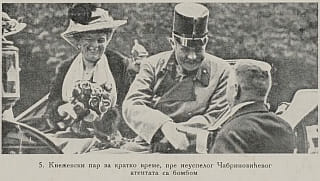
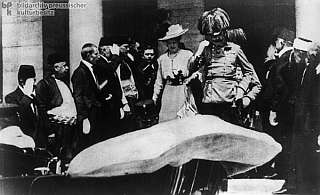
Franz Ferdinand and his wife Sophie leaving Sarajevo Town Hall on 28 June 1914, five minutes before the assassination.
The Good Soldier Švejk is a novel with an exceptionally rich cast of characters. Alongside those who play a direct part in the plot, a great many fictional and real people (and animals) are mentioned throughout the narrative, in Švejk's anecdotes and in the book's idioms and turns of phrase.
This page offers brief entries on the people referred to in the novel, from Napoléon in the introduction to Hauptmann Ságner in the final lines of the unfinished Part Four. The list is sorted in the order in which names first appear. Chapter headings follow Zenny Sadlon's recent translation (1999–2026) and, in most cases, differ from Cecil Parrott's 1973 version.
The Czech quotations are taken from the online version of The Good Soldier Švejk provided by Jaroslav Šerák and link to the relevant chapter. The toolbar provides direct links to Wikipedia, Google Maps, Google Search, svejkmuseum.cz and the novel online.
The names are colour-coded according to their role in the novel, as illustrated by the following examples:
Dr. Grünstein, a fictional character directly involved in the plot.
Fähnrich Dauerling, a fictional character who is not part of the plot.
Heinrich Heine, a historical person.
Note that many seemingly fictional characters are inspired by real people. Examples include Oberleutnant Lukáš, Major Wenzl and many others. These are still listed as fictional, since they are literary creations only partly inspired by their similarly named 'models'.
Military ranks and other titles related to Austrian officialdom are given in German, in accordance with the terms used at the time (explanations in English are provided as tooltips). This means that Captain Ságner is still referred to as Hauptmann, even though the term is now obsolete and has been replaced by Kapitän. Civilian titles denoting profession, etc., are translated into English. This also applies to ranks in the nobility where a direct translation exists.
The Crown Prince and Princess shortly before the unsuccessful attempt by Čabrinović (this first attempt was made with a bomb).
Ratni album 1914-1918, Andra Popović,1926
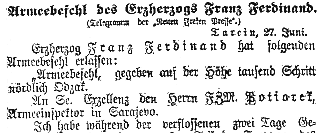
Franz Ferdinand's last ever Army order
Neue Freie Presse,28.6.1914
Franz Ferdinand
was the Ferdinand Švejk did not know. The novel starts with Mrs. Müllerová telling Švejk that "they have killed our Ferdinand". Švejk knows two Ferdinands; one is a servant at a chemist's, and another one collects dog turds. Not until Müllerová reveals that it is the fat religious one from Konopiště do we understand that she is talking about the fateful assassination of Franz Ferdinand and his wife in Sarajevo.
Background
Franz Ferdinand
was a nephew of Emperor Franz Joseph I and, from 1896 to 1914, heir to the throne of Austria-Hungary. He was murdered in Sarajevo on 28 June 1914 together with his wife Duchess Sophie, an event that eventually led to the outbreak of World War I. His full name was FranzFerdinand Carl Ludwig Joseph Maria von Österreich-Este. He owned Konopitště castle by Benešov where the family spent much of their time.
Franz Ferdinand's political views were relatively liberal; he opposed preventive warfare against Serbia, and he advocated making Austria-Hungary a three-pillar federal state where the Slav nations would be put on an equal footing with Germans and Hungarians.
Quote(s) from the novel
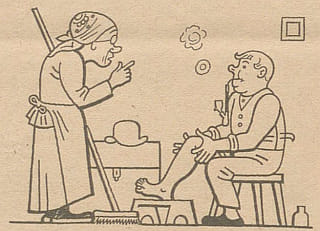
[I.1] „Tak nám zabili Ferdinanda,“ řekla posluhovačka panu Švejkovi, který opustiv před léty vojenskou službu, když byl definitivně prohlášen vojenskou lékařskou komisí za blba, živil se prodejem psů, ošklivých nečistokrevných oblud, kterým padělal rodokmeny.
Müllerová is mentioned 45 times in The Good Soldier Švejk.
Müllerová
was a servant in the house where Švejk lived. The first dialogue in the novel is between the two, they discuss the news of the shots in Sarajevo where Archduke Franz Ferdinand and his wife were murdered by Serbian nationalists. She had read about the shootings in the paper so the conversation surely took place on 29 June 1914 (the evening papers from the previous day were printed before the news had arrived).
Müllerová is not mentioned again until Švejk was set free in [I.6]. Then, his room had already been rented out to someone else.
The next chapter boasts the famous scene where old Müllerová pushes Švejk to the military in a wheelchair. The last time the good soldier is at home [I.10] he discovers that the poor old lady had been arrested the very evening she had rolled him off to the draft board, and she was now in the concentration camp at Steinhof.
Information about the person Müllerová is scarce. It is only revealed that she is/was married, somewhat elderly, and from Nusle. She was the cousin of Mrs. Kejřová.
Background
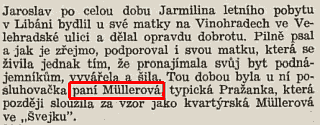
Jaroslav Hašek doma, Václav Menger, 1935
Adresář města Král. Vinohradů,1912
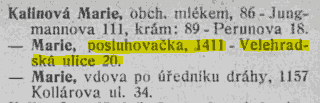
Mrs. Müller has no obvious prototype, so several theories have been proposed. The strongest candidate is put forward by Václav Menger who in his book Jaroslav Hašek doma (1935) stated that a Müllerová was a domestic servant in the house where Hašek's mother lived and where the author often slept over. This was in Velehradská 1411/20 on Vinohrady, where his mother lived from 20 May 1908. Jaroslav and his brother Bohuslav were also registered here, Jaroslav until 9 February 1909 and Bohuslav at least until 1912 (when their mother died). So whoever was servant here: Hašek would have known her well.
There were at least two female home servants registered at this address in 1911, but none were named Müllerová. The two were Marie Kalinová and Josefa Smolčíková. That said, the house servant didn't necessarily live at the address where she worked, although this was the most common arrangement.
Radko Pytlík suggests that the name was borrowed from Marie Müllerová, a friend of the editor Michal Kacha, one of Hašek's companions from the anarchist movement.
More spectacular is the claim that MarieMüllerová was madam at a brothel located in the building U kalicha and that Hašek borrowed the name from her. Allegedly, she was the lover of František Strašlipka and this is how Hašek came to know about her and thus borrowed the name[a].
These are only three of the possibilities. Still, many Müller lived in Prague at the time (7537 entries in the police registers between 1850 and 1914, of them 531 on Marie alone), so there is ample scope for further speculation.
Švejk in Captivity
Müllerová does not figure in the two early versions of The Good Soldier Švejk, but in Dobrý voják Švejk v zajetí, her role is partly taken by Švejk's servant Bohuslav, who pushes his master off to the draft board in a wheelchair. This indicates that Müllerová is little more than a name assigned to a literary role.
Quote(s) from the novel
[I.1] „Tak nám zabili Ferdinanda,“ řekla posluhovačka panu Švejkovi, který opustiv před léty vojenskou službu, když byl definitivně prohlášen vojenskou lékařskou komisí za blba, živil se prodejem psů, ošklivých nečistokrevných oblud, kterým padělal rodokmeny.
Kromě tohoto zaměstnání byl stižen rheumatismem a mazal si právě kolena opodeldokem.
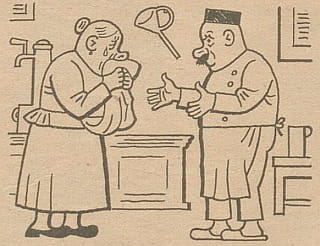
„Kerýho Ferdinanda, paní Müllerová?“ otázal se Švejk, nepřestávaje si masírovat kolena, „já znám dva Ferdinandy.
Credit: Václav Menger, Radko Pytlík, Jaroslav Šerák, Jan Berwid-Buquoy
Ferdinand
was a servant at drogerie Průša and accidentally drank a bottle of hair oil. He was the first Ferdinand that Švejk knew. See drogerie Kokoška.
Background
Ferdinand is probably modelled on a colleague of the author from his time as a chemist's apprentice in 1898 and 1899. He frequently mentions Ferdinand in his collection of stories, "From the Old Pharmacy". In these stories, the pharmacy's owner is a certain Kološka, not drogista Průša. See drogerie Kokoška.
Quote(s) from the novel
[I.1] „Kerýho Ferdinanda, paní Müllerová?“ otázal se Švejk, nepřestávaje si masírovat kolena, „já znám dva Ferdinandy. Jednoho, ten je sluhou u drogisty Průši a vypil mu tam jednou omylem láhev nějakého mazání na vlasy, a potom znám ještě Ferdinanda Kokošku, co sbírá ty psí hovínka. Vobou není žádná škoda.“
Adresář královského hlavního města Prahy a obcí sousedních,1910
Průša
was the owner of the chemist’s shop where servant Ferdinand worked.
Background
Průša
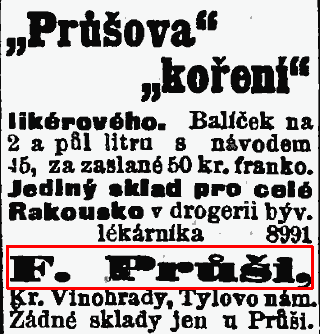
was the owner of drogerie Průša at Tylovo náměstí in Vinohrady. Jaroslav Hašek worked here as an apprentice from March 1898 (or later) until September 1899. Exactly when he started is not known, but it happened after he had been dismissed from drogerie Kokoška.
The pharmacist was born in Votice in 1862, was married to Mathilde (b. 1872), and they had a son, Rudolf. The family moved to Vinohrady in 1893. Otherwise, we know little about him, but newspaper adverts reveal that his shop existed at least until 1915, the year Průša died. In 1916 Čech reported that his widow had been the victim of fraud, but that the culprit had been arrested and sentenced to five months in prison. From the death protocols it transpires that Průša died from a stroke, that he suffered from diabetes, and lived at Vinohrady čp. 603 when he passed away.
Adverts from a chemist’s Fr. Průsa appeared as early as 1890, but then from Kamenice nad Lipou. That said, there is no doubt that this Průša is the same person, as police registers reveal that the son Rudolf was born in Kamenice in 1893.
Průša is the first of countless examples of how the author drew on fragments from his own experiences to create the backdrop for the novel. Even Průša, who appears to be a fictional person, is drawn from real life. This is probably the case with most of the apparently fictional figures in the novel. Their role might have been distorted or mystified, but the names were rarely invented.
Quote(s) from the novel
[I.1] Jednoho, ten je sluhou u drogisty Průši a vypil mu tam jednou omylem láhev nějakého mazání na vlasy, a potom znám ještě Ferdinanda Kokošku, co sbírá ty psí hovínka. Vobou není žádná škoda.“
Credit: Radko Pytlík, Jaroslav Šerák
Literature
Z droguerie, Národní listyJaroslav Hašek,24.3.1904
Ferdinand Kokoška
collected dog turds. He was the second Ferdinand that Švejk knew.
Background
This name is inspired by the identically named Kokoška2, the author's employer at drogerie Kokoška in 1898. Hašek was reportedly dismissed here after repainting a cow's face, so it resembled the proprietor. Here the author makes further fun of him by letting him collect dog turds.
Quote(s) from the novel
[I.1] Jednoho, ten je sluhou u drogisty Průši a vypil mu tam jednou omylem láhev nějakého mazání na vlasy, a potom znám ještě Ferdinanda Kokošku, co sbírá ty psí hovínka. Vobou není žádná škoda.“
Sophie
is never mentioned by name in the novel, just referred to as "the archduchess who was riding in an automobile in Sarajevo with her archduke". Švejk was not aware that she also had been killed as he talks about her as the widow who will have to find another archduke, an even fatter one. Švejk also "promotes" her to archduchess, whereas her title was a duchess.
Background
Sophie
was a Bohemian noble lady, married to the heir to the Austrian and Hungarian thrones, Archduke Franz Ferdinand. She was killed in Sarajevo together with her husband. The Habsburg imperial family never accepted Sophie due to her non-royal background. Therefore, the children of Sophie and Franz Ferdinand had no right to succession to the throne.
Her full name was Sophie Maria Josephine Albina Gräfin Chotek von Chotkowa und Wognin.
Quote(s) from the novel
[I.1] „Práskli ho v Sarajevu, milostpane, z revolveru, vědí. Jel tam s tou svou arcikněžnou v automobilu.“ „Tak se podívejme, paní Müllerová, v automobilu. Jó, takovej pán si to může dovolit, a ani nepomyslí, jak taková jízda automobilem může nešťastně skončit.
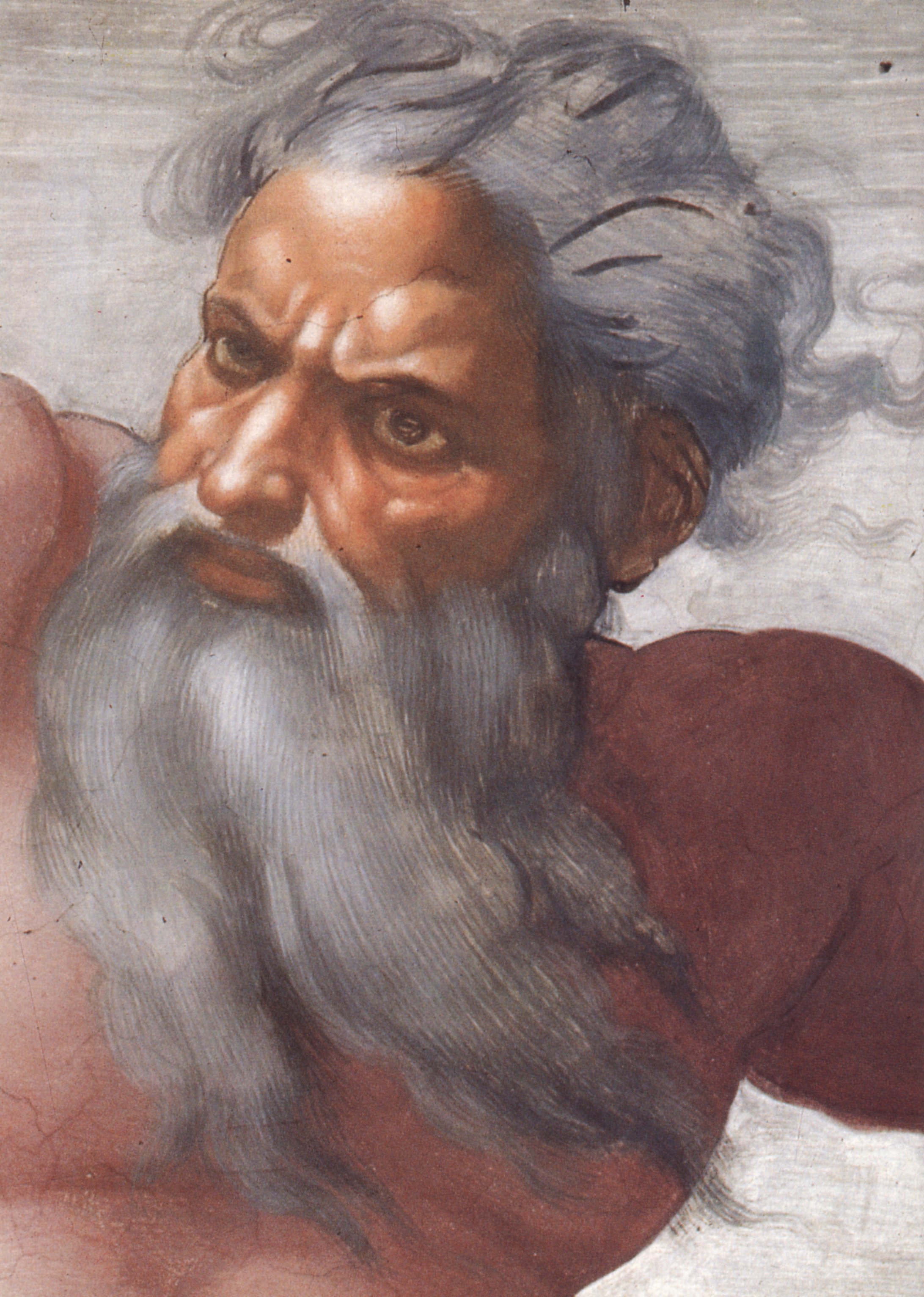
God is mentioned directly or indirectly around 200 times in The Good Soldier Švejk, most often through common expressions such as "My God", "God's will", "Good Lord", and so on. Especially common is pánbůh, literally "Lord God"; in German, "Herr Gott".
In [I.12], the pious field chaplain mentions the Lord no fewer than three times in the same breath, albeit under the influence of alcohol.
Background
God
God is a figure from the Bible and the Qur'an, and the most important symbol in the three monotheistic world religions of Semitic origin: Judaism, Christianity and Islam. The word "God" can also be used in a more general sense, including in polytheistic religions such as the old Nordic Ásatrú.
Quote(s) from the novel
[I.1] „Tak se podívejme, paní Müllerová, v automobilu. Jó, takovej pán si to může dovolit, a ani nepomyslí, jak taková jízda automobilem může nešťastně skončit. A v Sarajevu k tomu, to je v Bosně, paní Müllerová. To asi udělali Turci. My holt jsme jim tu Bosnu a Hercegovinu neměli brát. Tak vida, paní Müllerová. On je tedy pan arcivévoda už na pravdě boží. Trápil se dlouho?“
[I.12] "Já mám pánaboha rád," ozval se nábožný polní kurát, začínaje škytat, "moc ho mám rád. Dejte mně trochu vína. - Já si pánaboha vážím," pokračoval potom, "moc si ho vážím a ctím. Nikoho si tak nevážím jako jeho." Uhodil pěstí do stolu, až láhve poskočily: "Bůh je vznešená povaha, cosi nadpozemského.
czFrantišek Josef I.hrFranjo Josip I.huI. Ferenc JózsefitFrancesco Giuseppe IplFranciszek Józef IroFranz Josef IskFrantišek Jozef I.slFranc Jožef I.uaФранц Йосиф I
Franz Joseph soiled by flies. The picture is a gift from John Rocarek, Zenny Sadlon, and Mary Keenan Sadlon. Cedar Rapids (Iowa), 30 August 2014.
Franz Joseph I
is mentioned in the first chapter as "His Imperial Highness", but crops up several times later in the novel under his real name. He was the subject of the discussion at U kalicha after pubkeeper Palivec revealed that the flies had soiled his portrait.
Background
Franz Joseph I
was Emperor of Austria and, after Ausgleich in 1867, was also crowned King of Hungary. His reign lasted from 1848 to 1916 and is the fourth longest in European history. He ascended the throne at the age of 18, after the revolution of 1848. He was regarded as very conservative during his early years in power. The young emperor was initially unpopular, and in 1853 he survived an attempt on his life. The following year he married his cousin, Empress Elisabeth (Sisi). They had four children.
As noted in The Good Soldier Švejk, the Emperor-King suffered a number of personal tragedies: his eldest daughter died at the age of two, his brother Maximilian was executed in Mexico, his son and heir Crown Prince Rudolf committed suicide, Sisi was murdered, and in 1914 his nephew Archduke Franz Ferdinand was shot in Sarajevo. The Emperor was rather unpopular among Czechs because he refused to be crowned King of Bohemia despite having promised to do so.
The Good Soldier Švejk in Captivity
In Dobrý voják Švejk v zajetí the emperor is mentioned several times, and Švejk has a picture of him hanging on the wall in his cobbler's shop in Vinohrady. The theme of Švejk wanting to serve his emperor until he is torn to pieces is even more prominent than in The Good Soldier Švejk. In addition, the monarch appears in Švejk's dreams on a few occasions. The author also devotes some paragraphs to the emperor's mental and physical condition.[1]
V duchu opustil hradčanský vojenský soud a mysl jeho zaletěla na Vinohrady do malého krámku, svezla se po obraze Františka Josefa a vyhledala pod starou postelí dvě morčata.
A u Františka Josefa nebylo to opět nic jiného než zděděný kretenismus, kterým trpí potomci Habsburků.
Quote(s) from the novel
[I.1] „To se samo sebou rozumí, paní Müllerová,“ řekl Švejk, konče masírování kolen, „kdybyste chtěla zabít pana arcivévodu, nebo císaře pána, tak byste se jistě s někým poradila.
[I.15] Rozebereme-li jeho duševní schopnosti, dojdeme k přesvědčení, že nebyly o nic lepší těch, které proslavily otlemeného Habsburka Františka Josefa jako notorického idiota.
[II.3] I kdyby se k nám chtěl přidat císař pán, tak jste to nesměl dovolit.
[II.5] Kdyby přišlo, vojáci, k vojně a vy jste padli za císaře pána, dobrá, tím by se moc nezměnilo, ale kdyby
napřed pad váš oficír, teprve pak byste viděli, jak jste na něm závislí a jaká je to ztráta.
[III.1] Potom Švejk počal mluvit o známých rozkazech, které jim byly přečteny před vstoupením do vlaku. Jeden byl armádní rozkaz podepsaný Františkem Josefem a druhý byl rozkaz arcivévody Josefa Ferdinanda, vrchního velitele východní armády a skupiny, kteréž oba týkaly se událostí na Dukelském průsmyku dne 3. dubna 1915, kdy přešly dva batalióny 28. pluku i s důstojníky k Rusům za zvuků plukovní kapely.
Přeplněn bolestí nařizuji, aby c. k. pěší pluk čís. 28 pro zbabělost a velezrádu byl vymazán z mého vojska.
Plukovní prapor budiž zneuctěnému pluku odebrán a odevzdán do vojenského musea.
Dnešním dnem přestává existovat pluk, který, otráven mravně z domova, vytáhl do pole,
aby se dopustil velezrády. František Josef I.
Lucheni
is mentioned by Švejk in conversations with Mrs. Müllerová when he reveals his knowledge of royal murders.
Background
Lucheni
was a French-born anarchist of Italian descent who lived most of his life in Switzerland. He murdered Empress Elisabeth of Austria-Hungary in Geneva in 1898. He was given a life sentence (Switzerland had abolished the death penalty) and later committed suicide in prison. The name is often written Luccheni, which is also used by Hašek.
Quote(s) from the novel
[I.1] Hlavní věcí je vyčíhat na ten moment, až takovej pán jede kolem. Jako, jestli se pamatujou, na toho pana Luccheniho, co probod naši nebožku Alžbětu tím pilníkem. Procházel se s ní.
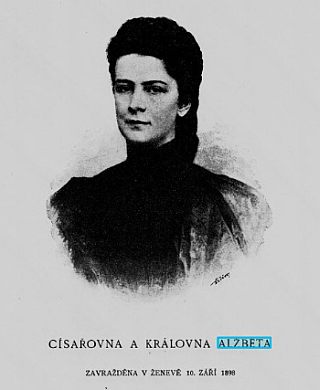
Elisabeth
is mentioned by Švejk when he reels off for Mrs. Müllerová his list of royal assassinations.
Background
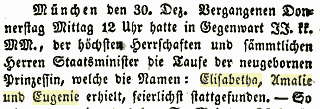
Elisabeth
was Empress of Austria, Queen of Hungary, also called Sisi (later Sissi), and married to Emperor Franz Joseph I. Her full name was ElisabethAmalie Eugenie, Herzogin in Bayern.
Elisabeth was the second eldest daughter of duke Maximilian Joseph av Bayern of the royal Bavarian Wittelsbach dynasty, one of eight siblings. Only 17 years old she married her cousin Emperor Franz Joseph I in what could be described as a dynastically arranged marriage. The couple had four children, but mostly lived separate lives. After Ausgleich she was crowned Queen of Hungary on 8 June 1867.
The Empress-Queen was very popular and has over the years acquired a status as a legend. She has been the focus of countless books, films, plays, and animations.
Murdered
The event that Švejk refers to happened on 10 September 1898 in Genève. The young anarchist Mr. Lucheni (who originally intended to murder the Duke of Orleans) stabbed the empress with a sharpened file at 12:40 PM and at 3:50 PM she was declared dead. The murder was reported in the Vienna newspapers already the next day[a] and caused great consternation worldwide. The killer was arrested and identified the same evening.
Quote(s) from the novel
[I.1] Hlavní věcí je vyčíhat na ten moment, až takovej pán jede kolem. Jako, jestli se pamatujou, na toho pana Luccheniho, co probod naši nebožku Alžbětu tím pilníkem. Procházel se s ní.
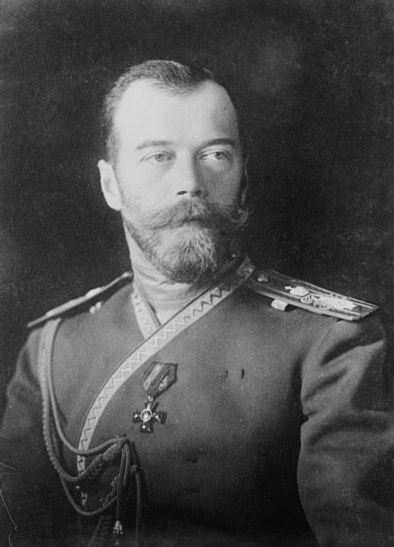
Nicholas II
is mentioned by Švejk as he reels off to Mrs. Müllerová his list of royal murders, adding that it may one day happen even to the Tsar and the Tsarevna.
Background
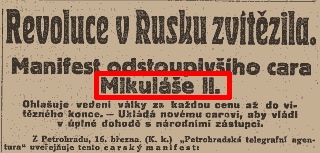
was a tsar (emperor) of the Romanov dynasty and the last monarch of Russia. He reigned from 1894 to 1917, and on March 15 he was forced to step down after the February Revolution. From September 1915 he served as commander-in-chief of Russia's armed forces, having replaced his cousin Nicholas Nikolaevich. On 17 July 1918 he and his family were executed by the Bolsheviks, an event regarded as one of the most significant political murders in recent history.
Nicholas was regarded as a weak and inept ruler, but since 1990 has seen a degree of post-mortem rehabilitation. He was officially buried in 1998 and, in 2000, was declared a saint by the Russian Orthodox Church.
Hašek the monarchist
It is paradoxical that in 1916 and 1917 Jaroslav Hašek supported tsarist rule and even advocated a member of the Romanov dynasty as a future Czech king[a].
Quote(s) from the novel
[I.1] A vono to čeká ještě moc osob. A uvidějí, paní Müllerová, že se dostanou i na toho cara s carevnou, a může být, nedej pánbůh, i na císaře pána, když už to začli s jeho strýcem. Von má, starej pán, moc nepřátel.
Alexandra
is mentioned indirectly by Švejk when he is reeling off for Mrs. Müllerová his list of royal murders, and says it may even happen to the Tsar and the Tsarevna. The good soldier's prophecy was proven true little more than three years later.
Background
Alexandra was empress of Russia from 1894 to 1917, married to Tsar Nicholas II. She was executed together with her family in Yekaterinburg (Екатеринбу́рг) on 17 July 1918.
Geboren: Victoria Alix Helena Louise Beatrice von Hessen und bei Rhein.
Quote(s) from the novel
[I.1] A vono to čeká ještě moc osob. A uvidějí, paní Müllerová, že se dostanou i na toho cara s carevnou, a může být, nedej pánbůh, i na císaře pána, když už to začli s jeho strýcem. Von má, starej pán, moc nepřátel.
Browning
is indirectly mentioned through his pistol brand when Švejk explains to Mrs. Müllerová what he would have used if he were to kill an archduke.
Background
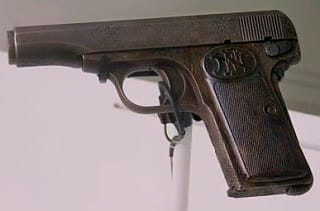
Browning was an American firearms designer. He made pistols, rifles, shotguns and machine guns. Archduke Franz Ferdinand was killed with a Belgian-made Browning semi-automatic pistol (FN Model 1910).
Quote(s) from the novel
[I.1] „To jde náramně rychle, paní Müllerová, strašně rychle. Já bych si na takovou věc koupil brovnink. Vypadá to jako hračka, ale můžete s tím za dvě minuty postřílet dvacet arcivévodů, hubenejch nebo tlustejch.
Carlos I
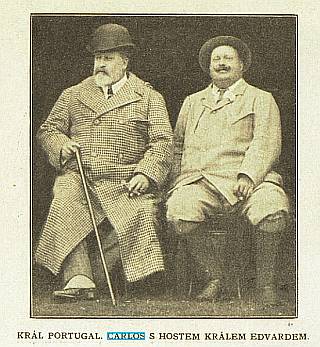
is mentioned indirectly by Švejk when he explains for Mrs. Müllerová what he would have used if he were to kill an archduke. To kill a fat dignitary like the king of Portugal, a good weapon like a Browning was needed.
Background
Even though his name is not mentioned directly there is no doubt that Švejk had King Carlos I in mind. He was King of Portugal from 1889 until he was murdered by republican activists in 1908[a]. The Portuguese state went bankrupt twice during his lifetime, including once during his reign, in 1902.
The King had indeed, as Švejk said, become quite fat in his later years. He was killed by rifle shots.
Nome completo
CarlosFernando Luís Maria Vítor Miguel Rafael Gabriel Gonzaga Xavier Francisco de Assis José Simão de Bragança Sabóia Bourbon Saxe-Coburgo-Gotha.
Quote(s) from the novel
[I.1] Ačkoliv, mezi námi řečeno, paní Müllerová, že do tlustýho arcivévody se trefíte jistějc než do hubenýho. Jestli se pamatujou, jak tenkrát v Portugalsku si postříleli toho svýho krále. Byl taky takovej tlustej. To víte, že král nebude přece hubenej.
Gavrilo Princip
is mentioned indirectly by Švejk and Mrs. Müllerová when they discuss those who carried out the killings in Sarajevo.
Background
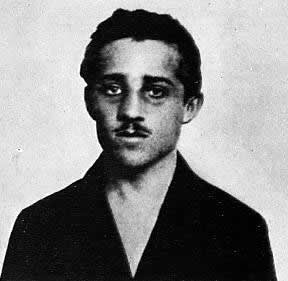
Princip was one of the assassins who took part in the plot to kill Archduke Franz Ferdinand in Sarajevo on 28 June 1914. Princip and his accomplices were trained by and acted on orders from the Serbian nationalist group The Black Hand, a group that had its origin in the Serbian armed forces. Their principal goal was to join all Serb-populated territories in a greater Serbia.
It was Princip who fired the lethal bullets after several attempts had failed in the preceding minutes. Princip unsuccessfully tried to commit suicide and was immediately arrested.
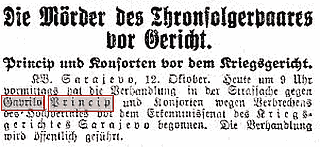
The trial started in Sarajevo on 12 October 1914, and on the 28th, the verdict fell. Some of the conspirators were handed death sentences, but Princip was convicted to life imprisonment as he was too young for capital punishment.
He died in jail in Terezín already in 1918. Thus, he never lived to see the greater Serbia that Yugoslavia, in many ways, became.
Quote(s) from the novel
[I.1] Já si představuju, že se pan arcivévoda Ferdinand také v tom Sarajevu zmejlil v tom člověkovi, co ho střelil. Viděl nějakého pána a myslil si: To je nějakej pořádnej člověk, když mně volá slávu. A zatím ho ten pán bouch. Dal mu jednu nebo několik?“
Bretschneider is mentioned 44 times in The Good Soldier Švejk.
Bretschneider
was an undercover agent working for the state police. He met Švejk at U kalicha and tried to trick him and the host pubkeeper Palivec into compromising themselves in connection with the Sarajevo murders. He succeeded in both cases.
Bretschneider is part of the plot for the last time in [I.6] when Švejk has been released after his arrest. This time he did not get anyone on the hook, and the author sends him out of the story in the most miserable manner by revealing that the detective was devoured by the very dogs he had bought from Švejk. Bretschneider is the only person taking part in the plot who explicitly gets killed.
In the epilogue to Part One the author mentions the now deceased detective and adds that people like him wander about even in Czechoslovakia and are very interested in what people are talking about.
Background
Bretschneider seems to be modelled on a real person in Staatspolizei in Prague. Jaroslav Hašek was kept an eye on due to his connection with the anarchist movement and he knew many in the police force. Emil Artur Longen claims that the real Bretschneider was a certain Vincenc Španda, and that he and Hašek had met in Berlin in 1920 (unlikely). In Longen's book the connection is explained in detail.
The name Bretschneider may have several sources. The policeman Josef Brettschneider lived in Košíře at the same time as Hašek, and according to Milan Báča he emigrated in 1919 and took the name WenzelSpanda[a]. A certain Karel Bretschneider was a policeman who lived in Kinského tř. 31Smíchov in 1891, but the start and end of his active duty is not known.
One person that Hašek definitely knew was the sculptor Vladimír Bretschneider (1886-1951). The two fell out and the use of the name may well have been an act of revenge.
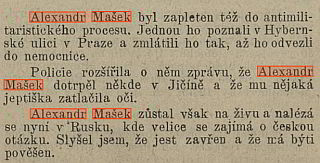
The agent Mašek
Another possible inspiration is Hynek Mašek, an agent provocateur who tried to infiltrate the anarchist movement and also Česká strana národně sociální on several occasions between 1906 and 1909. He was explicitly named in Hašek's story Po stopách státní policie v Praze, printed in Čechoslovan on 21 August 1916. Here Hašek claims that Mašek was an Austrian spy operating amongst the Czechs in Russia, and the article eventually led to Mašek's arrest. When České legie hastily had to leave Ukraine in February 1918 he was shot. Perhaps Jaroslav Hašek alludes to Mašek's fate when he lets Bretschneider be eaten by his own dogs?
Radko Pytlík: Kniha o Švejkovi, s.146
Policejní strážník Josef Brettschneider, uveden ve statu pražské policie roku 1910, bydlel v Košířích č. 177, tedy v rajónu Světa zvířat; sochař Vladimír Bretschneider byl jedním z blízkých Haškových kamarádů.
Quote(s) from the novel
[I.1] V hospodě „U kalicha“ seděl jen jeden host. Byl to civilní strážník Bretschneider, stojící ve službách státní policie.
[I.6] A to byl konec slavného detektiva Bretschneidra. Když měl již ve svém bytě sedm takových ohav, uzavřel se s nimi v zadním pokoji a nedal jim tak dlouho nic jíst, dokud ho nesežraly.
[I.16] Lidí typu nebožtíka Bretschneidera, státního detektiva starého Rakouska, potlouká se i dnes velice mnoho v republice. Neobyčejně se zajímají o to, co kdo mluví.
Palivec is mentioned 24 times in The Good Soldier Švejk.
Palivec
was pub landlord at U kalicha and known for his foul mouth. He was also a man who had read a lot without this having refined his language the slightest. He was arrested by detective Bretschneider, having uttered an unfortunate sentence about flies defiling a portrait of the Emperor. For this he got 10 years hard labour.
The epilogue to Part One reveals that he served his sentence until the end of the war. In the same epilogue the author presents Palivec as a symbol of his right to reproduce tales as they were spoken, without having to embellish it to placate the more sensitive part of the readership, or to satisfy the demands for decent language in literature.
On biographical details it is revealed that Palivec was married and his wife worked in the bar, that he had served with the army in Bosnia, and that he sympathised with the organisation Volná myšlenka (Free Thought).
Background
Palivec quite probably has a real-life model. In his book Die Abenteuer des gar nicht so braven Humoristen Jaroslav Hašek (1989) Jan Berwid-Buquoy claimed that this person was Václav Šmíd who is reported to have been landlord at U kalicha in 1914 and was known for his rough language. The same source claims that a Josef Palivec was a waiter there at the time[c].
Radko Pytlík finds it more likely that a certain Josef Šolc inspired Palivec. Šolc was landlord at a pub nearby, on the corner of Sokolská ulice and Fügnerovo nám. and as opposed to U kalicha, it was a place the author decidedly frequented.
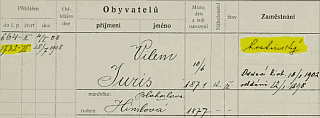
Vilém Juris
What is beyond dispute is that the landlord at U kalicha from 1908 and at least until 1914 (probably until 1917) was Vilém Juris and that two Václav Šmíd were landlords elsewhere in the city. In another book, published in 2011 Berwid-Buquoy changed the landlord's name to Josef Šmída, and added that he ran the pub together with Vilém Jurisch, who allegedly died in the spring of 1914[d]. Police registers reveal 180 entries on Palivec from 1850 to 1914, so there are plenty of candidates.
Juris was, according to the city's population registers, born 10 June 1871 in Velké Lipno, was married to Blahoslava (nee 1877), and they registered at the address of U kalicha on 18 July 1908[a]. In an article in Prager Presse5 December 1929MaximilianHuppert claimed that the former landlord at U kalicha, Ferdinand Juris, was still alive[b]. Whether this is a mix-up with another person is not known. Whatever Huppert and Berwid-Buquoy claim is however contradicted by the fact that Juris died in 1917[e].
Quote(s) from the novel
[I.1] V hospodě „U kalicha“ seděl jen jeden host. Byl to civilní strážník Bretschneider, stojící ve službách státní policie. Hostinský Palivec myl tácky a Bretschneider se marně snažil navázat s ním vážný rozhovor. Palivec byl známý sprosťák, každé jeho druhé slovo byla zadnice nebo hovno. Přitom byl ale sečtělý a upozorňoval každého, aby si přečetl, co napsal o posledním předmětě Victor Hugo, když líčil poslední odpověď staré gardy Napoleona Angličanům v bitvě u Waterloo.
[I.16] Od hostinského Palivce nemůžeme žádati, aby mluvil tak
jemně jako pí Laudová
[I.16] Při této příležitosti upozorňuji, že hostinský Palivec je naživu. Přečkal válku, kterou proseděl v žaláři, a zůstal stále týmž, jako když měl tu aféru s obrazem císaře Františka Josefa.
Victor Hugo
was an author pubkeeper Palivec had read and liked to quote. Palivec put forward Hugo in defence of his vulgar language. Indirectly he referred to a passage in Les Misérables where the famous mot de Cambronne, which is connected to Napoléon's old guard in the battle of Waterloo, is quoted.
General Cambronne is said to have given this simple answer to General Colville when the latter insisted he surrender: Merde!.
Background
Victor Hugo
was a French author and politician who published poetry, drama and novels. In France he is regarded as one of the country's leading poets. His most famous novel is probably "Les Misérables". Hugo was also a political activist and was forced into exile for a number of years. After his return in 1870 he was elected member of the Senate. He was also known as an advocate of human rights.
Quote(s) from the novel
[I.1] Palivec byl známý sprosťák, každé jeho druhé slovo byla zadnice nebo hovno. Přitom byl ale sečtělý a upozorňoval každého, aby si přečetl, co napsal o posledním předmětě Victor Hugo, když líčil poslední odpověď staré gardy Napoleona Angličanům v bitvě u Waterloo.
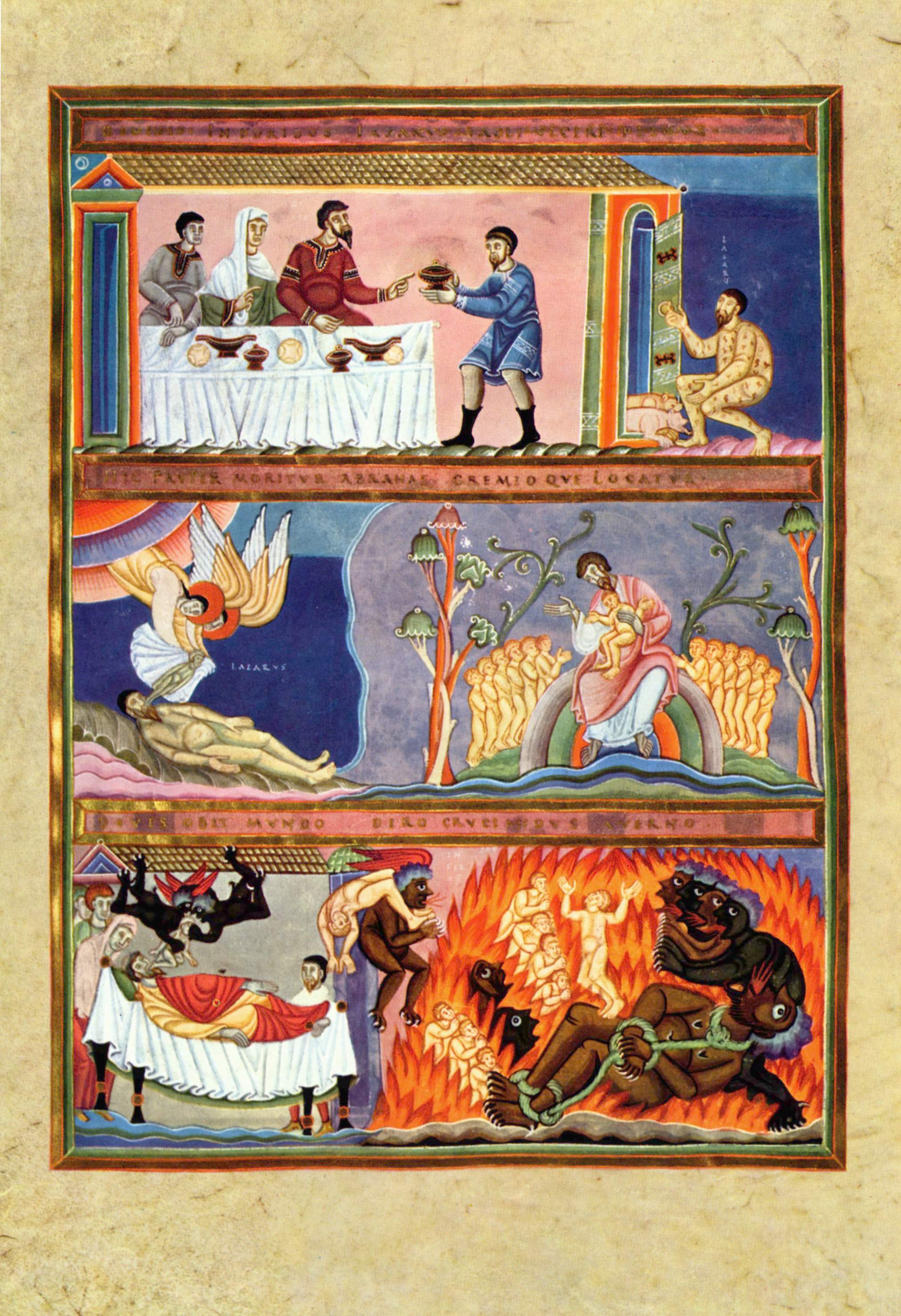
Lazarus
is mentioned in a dialogue in which Švejk tells detective Bretschneider that he was tied up like Lazarus for two days after being arrested for having 20 buttons missing from his uniform.
Background
Lazarus
was the name of two persons in the New Testament. The best known is Lazarus of Bethany, brother of Martha and Mary, who was very close to Jesus. Jesus raised this Lazarus from the dead.
The second was a pauper in St Luke's Gospel, mentioned in the parable The rich man and Lazarus. Based on the context in The Good Soldier Švejk, the reference is no doubt to the latter.
Zenny Sadlon
The Czech lazar is a common noun meaning a wretched, helpless, or half-dead person — a bedridden invalid. It derives from Lazarus the beggar in the parable of Luke 16:20–25, whose ulcerated, prostrate condition gave rise to the word in several European languages. It does not refer to Lazarus of Bethany in John 11 (the man Jesus resurrects), and carries no implication of revival. Hašek uses lazar in the folk-lexical sense: someone lying like a sick, exhausted, or nearly lifeless man.
Quote(s) from the novel
[I.1] Jednou se pamatuji, že mně scházelo při takové přehlídce dvacet knoflíků u munduru a že mě zavřeli za to na čtrnáct dní do ajnclíku a dva dni jsem ležel jako lazar, svázanej do kozelce.
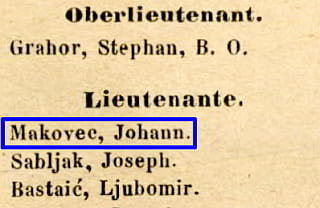
Makovec
was one of Švejk's superiors when he did his compulsory military service. Švejk refers to him as "obrlajtnant Makovec" (senior lieutenant), portraying him as a nasty brute and a fanatic disciplinarian. One of the best-known quotes from the novel stems from Makovec: "Discipline must be enforced, you stupid boys".
Background
There was no Makovec in Infanterieregiment Nr. 91 when Švejk might have done his military service. In the rest of k.u.k. Heer, the name appears very rarely. In 1914 a reserve cadet Wilhelm Makovec is listed but his age and rank does not fit. In 1894, one Johann Makovec served with Infanterieregiment Nr. 33 in Zagreb[a]. From 1886, he held the rank Leutnant (reserve), but to suggest that he was any inspiration for Švejk's superior is very far-fetched.
Quote(s) from the novel
[I.1] Náš obrlajtnant Makovec, ten nám vždycky říkal: ,Disciplina, vy kluci pitomí, musí bejt, jinak byste lezli jako vopice po stromech, ale vojna z vás udělá lidi, vy blbouni pitomí? A není to pravda? Představte si park, řekněme na Karláku, a na každým stromě jeden voják bez discipliny. Z toho jsem vždycky měl největší strach.“
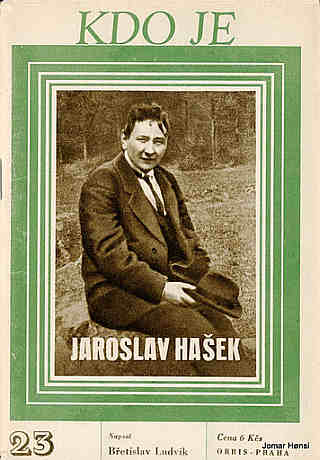
Břetislav Ludvík
was a cattle trader who, according to one of Švejk's numerous and long anecdotes, was stabbed on the square in Budějovice. This story associated cattle traders with the imperial family and contributed greatly to Švejk's arrest by detective Bretschneider.
Background
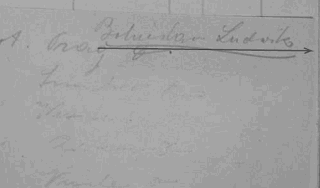
The name is borrowed from a journalist and multi-artist, in police records from 1913 registered as "Schauspieler" (actor)[a]. He was one of Hašek's childhood friends, and in 1946 he published a short book Kdo je Jaroslav Hašek in the series Who is. Here he admits to being angry with the way his name was abused and also that he briefly met Jaroslav Hašek in 1922.
Borrowing names
Břetislav Ludvík is a good example of how the author borrowed names from a person that has nothing in common with the corresponding literary character.
Hašek and Mussolini
One of the more imaginative claims in Ludvík's book is that Hašek met Benito Mussolini in Trento in 1906. The story is inherited from Václav Menger and his book Jaroslav Hašek doma, 1935, but Menger adds that this is a legend that Hašek himself told his friends.[1]
The historian Renzo de Felice even suggests that this meeting inspired the future dictator's interest in Hus, also suggested in Václav Menger's book. As recently as 2013 the Mussolini theme appeared in the film Toulavé house by Vít Olmer.
In 1949 Břetislav Hůla noted that Ludvík once held a talk on Hašek in the pub U Brindů, but adds that he was simply reading aloud from his book, "with all the contained errors and inaccuracies". There was however little damage done as only around 20 people attended and they were charged eight crowns each!
Pavel Helan
Mussolini and Hašek both visited Switzerland and Trentino, but never at the same time. The information about contacts between the two may be found in Břetislav Ludvík’s Kdo je Jaroslav Hašek Historia (Prague, 1946) 15-16, but the source is unreliable, even if Hašek himself was the informant. This tenuous account reached de Felice in a telephone conversation from Claudio Poeta, an Italian student in Prague in the mid-1970s, as Poeta told me in 1999.
Quote(s) from the novel
[I.1] U nás před léty v Budějovicích probodli na trhu v nějaké takové malé hádce jednoho obchodníka s dobytkem, nějakého Břetislava Ludvíka.
In an updated revision of the book from 1946 the information that allegedly was spread by Hašek himself was removed. Václav Menger had by now presumably concluded that they were unreliable.
Bohuslav Ludvík
was the son of LudvíkBr in Švejk's anecdote about cattle traders. He committed suicide by jumping in the Vltava from a bridge. See Most v Krumlově.
Background
Only one single person carried this name according to the Prague police registers (1850 to 1914). He was born in 1883 and resident in Nusle in 1904. He was the same age as Jaroslav Hašek, and the author knew the area well but there exists no knowledge of any contact between the two.
Quote(s) from the novel
[I.1] U nás před léty v Budějovicích probodli na trhu v nějaké takové malé hádce jednoho obchodníka s dobytkem, nějakého Břetislava Ludvíka. Ten měl syna Bohuslava, a kam přišel prodávat prasata, nikdo od něj nic nekoupil a každý říkal: ,To je syn toho probodnutýho, to bude asi také pěknej lump.’ Musel skočit v Krumlově s toho mostu do Vltavy a museli ho vytáhnout, museli ho křísit, museli z něho pumpovat vodu a von jim musel skonat v náručí lékaře, když mu dal nějakou injekci.“
Pinďour
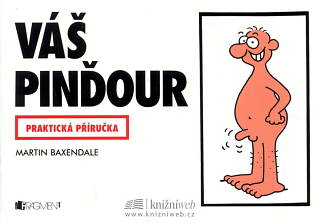
was a game keeper from Zliv. He figured in an inappropriate anecdote that Švejk told detective Bretschneider in U kalicha. In this story water bailiffs and pig gelders are subtly compared to the imperial family. Pinďour was shot by poachers. He had an ugly name according to Švejk. The name actually means "little dick" but this is for obvious reasons not directly stated in the novel. The gamekeeper was shot by poachers and left behind the very widow who this anecdote is constructed around.
Quote(s) from the novel
[I.1] To byl ve Zlivi u Hluboké před léty jeden hajný, měl takové ošklivé jméno Pinďour.
Pepík Šavel
was a gamekeeper from Mydlovary in the anecdote Švejk told at U kalicha (see Pinďour). He got married to the widow of Pinďour, and was like him shot by poachers. The analogy towards the killings of Sarajevo didn't serve Švejk well at all.
Background
Pepík is a Czech nickname for Josef.
Quote(s) from the novel
[I.1] To byl ve Zlivi u Hluboké před léty jeden hajný, měl takové ošklivé jméno Pinďour. Zastřelili ho pytláci a zůstala po něm vdova s dvěma dítkami a vzala si za rok opět hajného, Pepíka Šavlovic z Mydlovar. A zastřelili jí ho taky.
The Prince at Hluboká
is mentioned in Švejk's anecdote about the widow of the gamekeepers who turns up at the prince's office at Hluboká to ask for advice.
Background
The Prince at Hluboká
probably refers to Adolf Joseph Schwarzenberg (1832-1914), the 8th Prince of Schwarzenberg and a major landowner in South Bohemia. Another candidate is his son Johann II (1860-1938) as both were alive at the time the event is said to have taken place ("years ago"). They also held the title Duke ofKrumlov, another of the Schwarzenberg estates. See Fürst Schwarzenberg (st.).
Quote(s) from the novel
[I.1] To se ví, že jí ho zas zastřelili, a to už měla s těmi hajnými šest dětí dohromady. Byla až v kanceláři knížete pána na Hluboké a stěžovala si, že má s těmi hajnými trápení.
Jareš
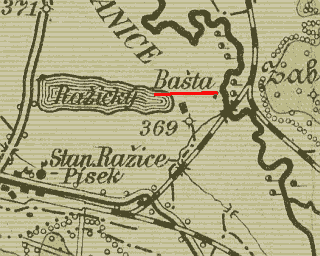
was a pond warden from ražická bašta in a story Švejk told at U kalicha. He was married to the widow of Pinďour and Pepík Šavel but drowned when fishing empty a pond. The widow finally married a pig gelder from Vodňany but was killed by him. The pig gelder uttered the most unsavoury phrases about the Emperor as he was hung in Písek. This anecdote surely contributed to Švejk's arrest.
Background
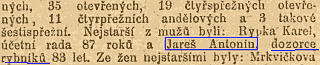
Antonín Jareš (1806-1889) was the grandfather of Jaroslav Hašek and a pond warden by Ražice. The name is re-used on three occasions later in the novel; once in Švejk's conversation with Oberst Kraus's maid, and twice in an anecdote told at Švarcenberský ovčín.
Grandfather Jareš lived the last few years of his life with his daughter's family in Prague, and here he got to know his famous-to-be grandson. There is no doubt that he inspired both the names in this novel, as well as the seven stories centred around ražická bašta that were published before the war[a].
Quote(s) from the novel
[I.1] Tak jí odporučili porybnýho Jareše ražické bašty. A co byste řekli, utopili jí ho při lovení rybníka, a měla s ním dvě děti.
Rudolf suffered from severe mood changes and there is still some debate over whether it really was suicide. The death certificate mentions "spiritual confusion." The drama of Mayerling has been filmed many times, including in a French/British production from 1968 with Omar Sharif in the role as Rudolf.
The free-thinking crown prince lived a dissolute life, got dependent on morphine after treatment for VD and infected his wife with gonorrhoea, which made her sterile. Rudolf was politically liberal and associated with the organisation Free Thought (see Volná myšlenka). His political views prevented him from being included in the influential circles of the court, his father keeping him at distance.
Quote(s) from the novel
[I.1] Syna Rudolfa ztratil v útlém věku, v plné mužské síle.
Johann Orth
was mentioned by Švejk when he listed the tragedies that had hit the emperor during his lifetime.
Background
Johann Orth
was archduke of the house of the House of Habsburg and prince of Tuscany. His real name was Johann Salvator, but he took the common name Orth in 1889 after having reneged on his imperial privileges. This happened after a conflict with the court as Salvator wanted to marry the dancer Ludmilla Schubel, a lady well below his rank. He took the new name after a castle he owned in Salzkammergut. Orth was a good friend of Crown Prince Rudolf and shared his liberal political views. After breaking with the court he was forced to leave the country. Already having obtained a ship captain's certificate he tried his luck in merchant shipping. In 1890 he left for London where he bought a cargo vessel and embarked on a freight mission to Argentina and Chile. Around 12 July 1890 the ship went missing near Cabo Tres Puntas.
His full name was Giovanni Nepomuceno Salvatore Maria Giuseppe Giovanni Ferdinando Baldassares Lodovico Carlo Zenobio Antonino d'Asburgo-Lorena.
Speculations
What really happened is still unclear but rumours that he survived have regularly surfaced. He was officially declared dead in 1911, but in 1945 a certain Alexander Victor Hugo Köhler from Kristiansand claimed on his death-bed that he was Orth. The case appeared in Norwegian courts in 1945 and 2007 and attracted attention in Austria. Still researchers at the university of Bergen have little reason to believe the claims of Köhler and his descendants.
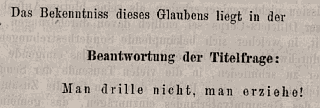
Drill oder Erziehung
Drill oder Erziehung, page 11. When the intelligent soldier feigns dutifulness.
Concluding Drill oder Erziehung
In the novel there is yet another reference to Orth, albeit obscure and indirect. It was first pointed out by Sergey Soloukh in 2012. In Einjährigfreiwilliger Marek's description of Fähnrich Dauerling in [II.3] he mentions a book Drill oder Erziehung where it according to Marek is stated that "terror is fundamental in training of soldiers and that successful training is proportional to the degree of terror". This booklet of 22 pages exists but the content does not fit the description Marek gives and could certainly not have inspired Dauerling's inhuman methods. It is a reprint of a lecture Orth (at the time still ErzherzogJohann) held on 3 November 1883 in Militär-Wissenschaftlichen Vereine zu Wien and was published by the same association. The above-mentioned quote can not be found in the booklet, and it was exactly this type of brutal exercise Erzherzog Johann spoke out against. Nor is Marek's claim that Kriegsministerium was the publisher of the book correct as the publisher was L. W Seidel & Sohn. In Dobrý voják Švejk v zajetí the booklet is even described as a "military textboook".
Drill oder Erziehung is a sharp attack on the practices within k.u.k. Wehrmacht to emphasize drill at the expense of education in military training. The lecture caused considerable resentment and harmed the already strained relation between the liberal-minded archduke and the military establishment. Johann already carried a certain weight besides being a member the House of Habsburg: he was a professional soldier and commander of 25. Infanteriedivision and had participated in the occupation of Bosnia-Hercegovina in 1878. At the time he presented his provocative lecture the 41 year old archduke had already obtained the rank of Feldmarschall-Leutnant.
Quote(s) from the novel
[I.1] Manželku Alžbětu mu propíchli pilníkem, potom se mu ztratil Jan Orth; bratra, císaře mexického, mu zastřelili v nějaké pevnosti u nějaké zdi.
Maximilian I
is referred to by Švejk as the Emperor of Mexico when he tells detective Bretschneider about all the tragedies that had hit Emperor Franz Joseph I. He was executed by some wall in some fortress in Mexico according to Švejk.
Palivcová is mentioned 9 times in The Good Soldier Švejk.
Palivcová
was left crying in U kalicha at the end of [I.1] when her husband, pubkeeper Palivec, was escorted out by detective Bretschneider. Her husband consoled her and told that she need not fear the police just because some flies had defecated on a portrait of the Emperor.
Mrs. Palivec reappears in [I.6] after Švejk was released from prison and drops by U kalicha. In [I.11] she refuses to serve Švejk because she thinks he is a deserter. This is the last time we hear of her.
Quote(s) from the novel
[I.1] A zatímco vedli Švejka do přijímací kanceláře, „U kalicha“ předával pan Palivec hospodu své plačící ženě, těše ji svým zvláštním způsobem:
„Neplač, neřvi, co mně mohou udělat kvůli posranýmu obrazu císaře pána?“
I. In the rear
1. The good soldier Švejk acts to intervene in the world war




 czdeenhuno
SearchŠvejkův slovník
czdeenhuno
SearchŠvejkův slovník