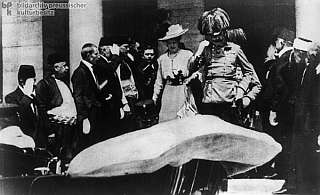
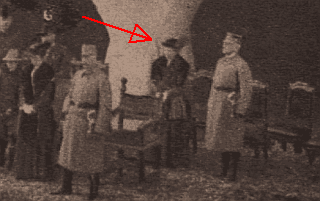
Franz Ferdinand and his wife Sophie leaving Sarajevo Town Hall on 28 June 1914, five minutes before the assassination.
The Good Soldier Švejk is a novel with an exceptionally rich cast of characters. Alongside those who play a direct part in the plot, a great many fictional and real people (and animals) are mentioned throughout the narrative, in Švejk's anecdotes and in the book's idioms and turns of phrase.
This page offers brief entries on the people referred to in the novel, from Napoléon in the introduction to Hauptmann Ságner in the final lines of the unfinished Part Four. The list is sorted in the order in which names first appear. Chapter headings follow Zenny Sadlon's recent translation (1999–2026) and, in most cases, differ from Cecil Parrott's 1973 version.
The Czech quotations are taken from the online version of The Good Soldier Švejk provided by Jaroslav Šerák and link to the relevant chapter. The toolbar provides direct links to Wikipedia, Google Maps, Google Search, svejkmuseum.cz and the novel online.
The names are colour-coded according to their role in the novel, as illustrated by the following examples:
Dr. Grünstein, a fictional character directly involved in the plot.
Fähnrich Dauerling, a fictional character who is not part of the plot.
Heinrich Heine, a historical person.
Note that many seemingly fictional characters are inspired by real people. Examples include Oberleutnant Lukáš, Major Wenzl and many others. These are still listed as fictional, since they are literary creations only partly inspired by their similarly named 'models'.
Military ranks and other titles related to Austrian officialdom are given in German, in accordance with the terms used at the time (explanations in English are provided as tooltips). This means that Captain Ságner is still referred to as Hauptmann, even though the term is now obsolete and has been replaced by Kapitän. Civilian titles denoting profession, etc., are translated into English. This also applies to ranks in the nobility where a direct translation exists.
[III.3] „Poslušně hlásím, pane obrlajtnant, že sem na takovou věc nezapomněl, poněvadž já nejsem nějakej jednoroční dobrovolník Železný. To jsme tenkrát, ještě dávno před válkou, byli v karlínskejch kasárnách a tam byl nějakej obrst Fliedler von Bumerang nebo tak nějank.“
Fliedler
was a brutal colonel at the Karlín barracks who couldn't remember Czech names. Švejk entertained Oberleutnant Lukáš with this story in Sátoraljaújhely. Einjährigfreiwilliger Železný, the main person in the story, was in turn called Olófěný, Cínofý, Médený, with a heavy Teutonic accent. All these are adjectival forms of names of metals: iron (železný), copper (měděný), tin (cínový) and lead (olóvěný).
Later in the anecdote, he had a painful tooth and had to ask Einjährigfreiwilliger Železný to extract it. It also transpires that the colonel had long since died. This story convinced Oberleutnant Lukáš that Švejk did not respect his superiors at all.
Quote(s) from the novel
[III.3] „Poslušně hlásím, pane obrlajtnant, že sem na takovou věc nezapomněl, poněvadž já nejsem nějakej jednoroční dobrovolník Železný. To jsme tenkrát, ještě dávno před válkou, byli v karlínskejch kasárnách a tam byl nějakej obrst Fliedler von Bumerang nebo tak nějank.“
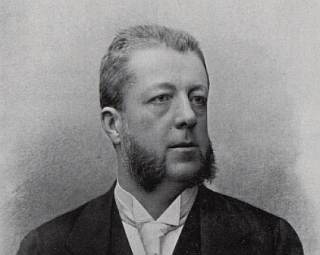
Lobkowicz
is mentioned in passing as he had a full beard like Oberst Fliedler.
Background
Lobkowicz
was a prince of the Czech noble house Lobkovic (often written Lobkowicz or Lobkowitz). He was first and foremost known as a politician and was the last L (Oberstlandmarschall) in Bohemia (1908–1913). He was, for a short period, a member of the lower chamber but later a long-time member of the upper chamber in U (Reichsrat), where he sat from 1892 until the assembly was dissolved in 1918 (see Parlament). Politically, he was conservative and represented the interests of the large estate owners. He was also known as an expert on agricultural matters.
Quote(s) from the novel
[III.3] Nadporučík Lukáš se mimoděk usmál tomu „nějank“ a Švejk dále vyprávěl: „Poslušně hlásím, pane obrlajtnant, že ten náš obrst byl půl vaší vejšky, nosil plnovous jako kníže Lobkovic, takže vypadal jako vopice, a když se rozčílil, vyskakoval dvakrát tak vysoko, jak byl sám vysokej, takže jsme mu říkali kaučukovej dědek.
Saint Martin
(Martin of Tours) is mentioned in the anecdote about Oberst Fliedler.
Background
Saint Martin
was bishop of Tours, later canonised. He is the national saint of France, patron saint of soldiers, and one of the best-known of the Roman Catholic saints.
Quote(s) from the novel
[III.3] „Poslušně hlásím, pane obrlajtnant,“ vpadl mu do toho Švejk omluvným tónem, „dyť von už je pan obrst Fliedler dávno mrtvej, ale když si, pane obrlajtnant, přejete, budu o něm mluvit samou chválu. Von byl vám, pane obrlajtnant, učiněnej anděl na vojáky. Von byl vám tak hodnej jako svatej Martin, kterej rozdával martinský husy chudejm a hladovejm.
Jelínek
was a squad leader who also struggled with the field password of the Pole from Kołomyja. This happened at the railway station in Sátoraljaújhely and perfectly exposed the language problems in the k.u.k. Wehrmacht.
Background
is an example of a figure who appears throughout the novel Švejk: a seemingly fictional person who might have had a real-life model. The incident described might well refer to an episode the author himself experienced, to which he later added an unrelated (but still real) name.
Quote(s) from the novel
[III.3] Objevil se četař Jelínek, který Poláka zaváděl na stráž, a ptal se ho sám po heslu, potom poručík Dub, na kteréž otázky odpovídal zoufalý Polák od Kolomyje křikem, který se rozléhal po nádraží: „kafé, kafé.“
Kraus
was a junior officer who expressed his opinion on the Hungarian state police's mistreatment of the local Ruthenian population in Humenné. According to him, the Ruthenians had committed high treason and ought to be hanged on the spot, although not tortured.
Quote(s) from the novel
[III.3]Fähnrich Kraus mínil, že když už jsou velezrádci, mají se hned na místě oběsit beze všeho týrání, zato však poručík Dub s celým výjevem naprosto souhlasil a převedl to hned na sarajevský atentát a vysvětlil to tak, že ti maďarští četníci na stanici Humenné mstí smrt arciknížete Františka Ferdinanda a jeho choti.
Kalenda
is the protagonist of the anecdote Švejk finds fitting to tell Oberleutnant Lukáš when the senior lieutenant feels unwell after witnessing the harassment of the Ruthenians in Humenné and the approving reaction of Leutnant Dub. Švejk's theory is that Lukáš is far from home, just as Kalenda was, after having been on an impressive pub-crawl from Strašnice across Vinohrady and the whole of Prague, and in the end found himself at Loretánské náměstí, not feeling well at all.
Quote(s) from the novel
[III.3] Strašnickej zahradník, nějakej Josef Kalenda, ten se taky jednou vzdálil z domova, šel ze Strašnic na Vinohrady, stavil se ,Na zastávce’ v hospodě, ale to mu ještě nic nebylo, ale jakmile přišel do Korunní třídy k vodárně, bral v Korunní třídě až za kostel svaté Ludmily hospodu za hospodou a cítil už malátnost.
Houska
was a sergeant from the 12th company who involuntarily became part of Einjährigfreiwilliger Marek's invented battalion history. He was assigned a heroic death; a mine blew his head off, but he still managed to shoot down an enemy aeroplane.
Quote(s) from the novel
[III.3] Jmenujte mně nějakého šikovatele od dvanácté kumpanie. Houska? Dobrá, tak tedy Houska přijde o hlavu s tou minou, hlava mu odletí, tělo však udělá ještě několik kroků, namíří si a sestřelí ještě nepřátelský aeroplán.
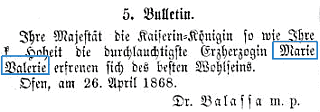
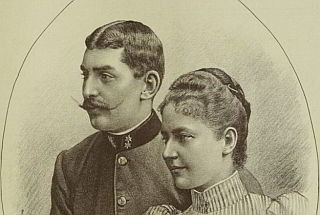
Marie Valerie
is mentioned by Einjährigfreiwilliger Marek when he writes about the Imperial family party at Schönbrunn which is held to celebrate the battalion's heroic deeds.
Background
Marie Valerie
was the daughter of Emperor Franz Joseph I, married to her second cousin Franz Salvator. The couple had 8 children and the family spent most of their time at their palace in Wallsee. She lived out of the limelight, was regarded as rather shy and also very religious. Amongst her entourage were, among others, Gräfin Bombelles and Graf Bellegarde.
Quote(s) from the novel
[III.3] Představuji si to tak, jak vidíte v mých poznámkách, že arcivévodská rodina Marie Valérie přesídlí kvůli tomu z Wallsee do Schönbrunnu.
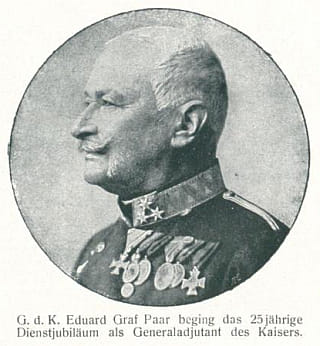
Paar
is mentioned by Einjährigfreiwilliger Marek when he writes about the imperial family party at Schönbrunn which is held to celebrate the battalion's heroic deeds.
Background
Paar
was the general aide to Emperor Franz Joseph I from 1887 until the Emperor's death. He was perhaps the person who was closest to the Emperor. Paar was awarded Signum Laudis on 25 August 1916.
Quote(s) from the novel
[III.3] Musí tam být a bude tam generální adjutant mocnáře hrabě Paar. Poněvadž při takových rodinných a intimních hostinách bývá občas někomu mdlo, čímž ovšem nemyslím, že se hrabě Paar snad poblije, je vyžadována přítomnost osobního lékaře, dvorního rady dra Kerzla.
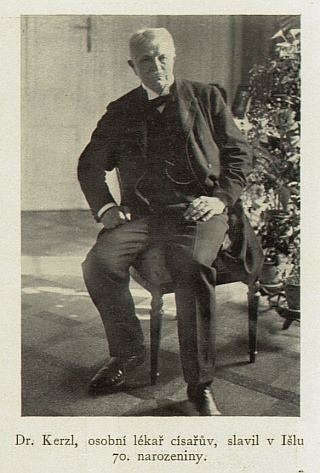
Kerzl
is mentioned by Einjährigfreiwilliger Marek when he writes about the Imperial family party at Schönbrunn which is held to celebrate the battalion's heroic deeds.
Background
Kerzl
was, as the author correctly states, court physician and adviser for Emperor Franz Joseph I. He was born and grew up in Bohemia. His education and background were from the military, and from 1884 he was already in the inner circles at the court in Vienna. He subsequently accompanied Empress Elisabeth on her travels to Corfu and the Riviera.
In 1897 he became the personal doctor of the Emperor, a position he held until the Emperor's death on 21 November 1916 (Kerzl was present). In 1901 he was awarded the title Hofrat (court counsellor), a title that Einjährigfreiwilliger Marek also noted in his "History of the Battalion".
Quote(s) from the novel
[III.3] Musí tam být a bude tam generální adjutant mocnáře hrabě Paar. Poněvadž při takových rodinných a intimních hostinách bývá občas někomu mdlo, čímž ovšem nemyslím, že se hrabě Paar snad poblije, je vyžadována přítomnost osobního lékaře, dvorního rady dra Kerzla.
Lederer
is mentioned by Einjährigfreiwilliger Marek when he writes about the Imperial family party at Schönbrunn which is held to celebrate the battalion's heroic deeds. He is referred to as Baron Lederer.
Background
Lederer
was, according to Einjährigfreiwilliger Marek, Obersthofmeister at the Habsburg Court. This is correct, but his precise role was Obersthofmeister for Franz Salvator, the husband of Erzherzogin Marie Valerie.
In 1890 he was named Kammervorsteher for Franz Salvator. His background was military: he had until then served at k.u.k. Dragoner-Regiment Nr. 3. It has not been possible to establish when he was born or when he died, but newspaper clippings confirm that he was alive as late as 1930.
Quote(s) from the novel
[III.3] Kvůli pořádku, aby si snad dvorní lokajové nedovolili nějaké důvěrnosti ku dvorním dámám přítomným na hostině, objevuje se nejvyšší hofmistr baron Lederer, komoří hrabě Bellegarde a vrchní dvorní dáma hraběnka Bombellesová, která hraje mezi dvorními dámami stejnou úlohu jako madam v bordelu u Šuhů.
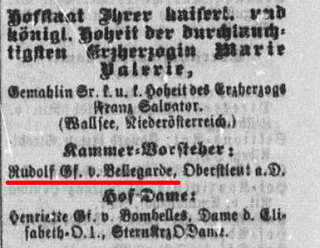
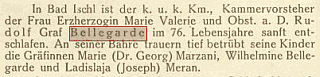
Bellegarde
was, according to Einjährigfreiwilliger Marek, a count serving as chamberlain at the Imperial court. This is part of the story of the Imperial family party at Schönbrunn which is held to celebrate the heroic deeds of the march battalion.
Background
Bellegarde
was a count, officer and chamberlain at the Imperial and Royal court, more precisely Kammervorsteher serving Erzherzogin Marie Valerie and her court.
Hailing from a noble family, he embarked on a military career, serving in Dragoner-Regiment Nr. 2 among others. From here he was transferred to the imperial life guard, starting service on 15 December 1886.
Quote(s) from the novel
[III.3] Kvůli pořádku, aby si snad dvorní lokajové nedovolili nějaké důvěrnosti ku dvorním dámám přítomným na hostině, objevuje se nejvyšší hofmistr baron Lederer, komoří hrabě Bellegarde a vrchní dvorní dáma hraběnka Bombellesová, která hraje mezi dvorními dámami stejnou úlohu jako madam v bordelu u Šuhů.
Bombelles
is mentioned by Einjährigfreiwilliger Marek when he writes about the imperial family party at Schönbrunn which is held to celebrate the battalion's heroic deeds. Countess Bombelles had the same position at the Imperial Court as "madam" has at the brothel U Šuhů.
Background
Bombelles
was a countess and supposed to have been the chief lady-in-waiting at the court. More precisely: she was lady-in-waiting for Erzherzogin Marie Valerie. Personal details are scarce but we know that she served Marie Valerie from 1 January 1898, was married, and was alive as late as 1937 (confirmed by a newspaper note about her sister's death). The spa visitors' lists from Bad Ischl indicate that she served Marie Valerie also after the end of the world war. Bombelles' ancestors were a French noble family who emigrated after the revolution in 1789.
Quote(s) from the novel
[III.3] Kvůli pořádku, aby si snad dvorní lokajové nedovolili nějaké důvěrnosti ku dvorním dámám přítomným na hostině, objevuje se nejvyšší hofmistr baron Lederer, komoří hrabě Bellegarde a vrchní dvorní dáma hraběnka Bombellesová, která hraje mezi dvorními dámami stejnou úlohu jako madam v bordelu u Šuhů.
Karl
was an Austrian field marshal and archduke of the House of Habsburg. He made a name for himself during the Napoleonic Wars, in the battles of Caldiero and Aspern, both of which are mentioned in The Good Soldier Švejk. He was the first army commander to inflict a defeat on Napoléon in battle (Aspern 1809).
Quote(s) from the novel
[III.3] Mohu vám přečíst výňatek z armádního rozkazu, který bude čten po všech oddílech armády, který se velice podobá onomu rozkazu arcivévody Karla, když stál se svým vojskem roku 1805 před Paduou a den po rozkazu dostal slušný nátěr.
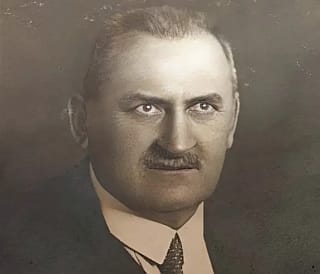
Jaroš
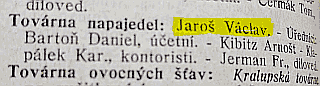
was a pump manufacturer in Kralupy who, according to Švejk, closely resembled watchmaker Lejhanz from Pardubice and Piskora from Jičín. Švejk mentions the three of them while talking in his sleep, still under the influence of the "cognac" he drank in Humenné.
Background
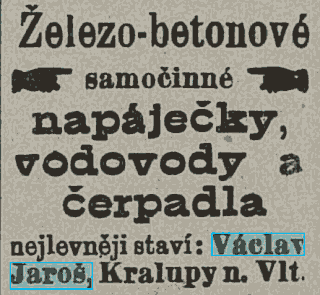
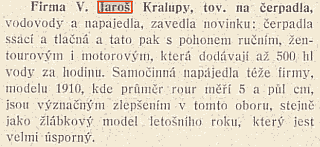
Jaroš
was the owner of a firm in Kralupy that manufactured and installed pumps, water pipes, drains and drinking troughs for animals. The firm's founder, Václav Jaroš, died in 1902, and his son of the same name continued the business. Given the timeline, he is surely the person who appears in Švejk's dream.
To judge by the context, it seems that Hašek knew Jaroš personally, otherwise Švejk would not have dreamed about the visual similarities between him, watchmaker Lejhanz, and Piskora.
Extensive information can be found in the book Historie kralupského průmyslu, řemesel a živností by Josef Stupka (see quotation below).
Svět zvířat
It is highly likely that Hašek drew on information from his time as editor of Svět zvířat when he composed Švejk's dream. Jaroš advertised in the journal, which published at least one news item about the firm[a].
Továrna na čerpadla a vodovody Václava Jaroše
Ke konci 19. století založil zámečník Václav Jaroš (1844-1902) závod na výrobu čerpadel, vodovodů a automatických napajedel. Z malé dílny v Přemyslově ulici pod Hostibejkem se přestěhoval do prostoru mezi dnešní Čechovu ulici a ulici Přemyslovu. Jarošova továrna byla zachycena na četných fotografiích i na pohlednicích. Jméno továrníka Jaroše je dokonce v Haškově románu Osudy ... .
Vodní čerpadla, která Václav Jaroš vyráběl, byla založena na pohyblivém řetězu s korečky obíhajícími ve vodě. Dalšími výrobky Jarošovy továrny, tzv. automatická napajedla, která byla Jarošovým patentem, byly vlastně jednoduché žlaby upravené tak, aby kráva, která se chce napít, sama otevřela přívod vody do žlabu. Na reklamním obrázku z pozdějších let je továrna zobrazena jako veliký podnik.
Podnik prosperoval až do konce první světové války, kdy jej převzala velvarská hospodářská záložna. Na začátku druhé světové války vykoupil syn Václava Jaroše podnik zpět a k čerpadlům se již nevrátil. V továrně zavedl opravy hospodářských strojů. V šedesátých letech minulého století skončila i tato činnost.
Bratr kralupského podnikatele Josef Jaroš, rovněž vyučený zámečník, měl firmu v Plzni. Zhotovil pro kralupský kostel Nanebevzetí Panny Marie a sv. Václava umělecky provedený lustr a pro budovu sokolovny ve Fugnerově ulici vytepal z kovu sochu divokého sokola. Byl umístěn na štítu budovy, jak je patrné ze starých pohlednic.
[III.3] Z místa, kde ležel Švejk, ozvalo se zívnutí a bylo slyšet, jak Švejk mluví ze spaní: „To mají pravdu, paní Müllerová, že jsou si lidi podobný. V Kralupech stavěl pumpy nějaký pan Jaroš a ten se podobal hodináři Lejhanzovi z Pardubic, jako když mu z voka vypadne, a ten zas byl tak nápadně podobnej jičínskýmu Piskorovi a všichni čtyři dohromady neznámýmu sebevrahovi, kterýho našli voběšenýho a úplně zetlelýho v jednom rybníku u Jindřichova Hradce, zrovna pod dráhou, kde se asi vrhnul pod vlak.“
Credit: Josef Stupka, Martina Bittnerová, Václav Gabriel
[III.3] Z místa, kde ležel Švejk, ozvalo se zívnutí a bylo slyšet, jak Švejk mluví ze spaní: „To mají pravdu, paní Müllerová, že jsou si lidi podobný. V Kralupech stavěl pumpy nějaký pan Jaroš a ten se podobal hodináři Lejhanzovi z Pardubic, jako když mu z voka vypadne, a ten zas byl tak nápadně podobnej jičínskýmu Piskorovi a všichni čtyři dohromady neznámýmu sebevrahovi, kterýho našli voběšenýho a úplně zetlelýho v jednom rybníku u Jindřichova Hradce, zrovna pod dráhou, kde se asi vrhnul pod vlak.“
Piskora
from Jičín is mentioned when Švejk talks in his sleep, still strongly affected by the bottle of "cognac" he had to gulp down. In this dream, Piskora visually resembles watchmaker Lejhanz and pump manufacturer Jaroš.
Quote(s) from the novel
[III.3] Z místa, kde ležel Švejk, ozvalo se zívnutí a bylo slyšet, jak Švejk mluví ze spaní: „To mají pravdu, paní Müllerová, že jsou si lidi podobný. V Kralupech stavěl pumpy nějaký pan Jaroš a ten se podobal hodináři Lejhanzovi z Pardubic, jako když mu z voka vypadne, a ten zas byl tak nápadně podobnej jičínskýmuPiskorovi a všichni čtyři dohromady neznámýmu sebevrahovi, kterýho našli voběšenýho a úplně zetlelýho v jednom rybníku u Jindřichova Hradce, zrovna pod dráhou, kde se asi vrhnul pod vlak.“
[III.3] Na víc se nezmohl a opět odešel ke štábnímu vagonu, kde hejtman Ságner právě vyslýchal jednoho nešťastníka od 12. kumpanie, kterého předvedl šikovatel Strnad, poněvadž voják začal již nyní pečovat o svou bezpečnost v zákopech a odněkud ze stanice přitáhl dvířka prasečího chlívku, pobitá plechem.
Kunert
was the servant of Leutnant Dub, subdued and mistreated. Švejk defended him after Dub had hit him and took him to the battalion commander to report the issue. Švejk has now put aside his contented look and is in open rebellion. Courage deserts Kunert, though, but Dub makes it all clear again by shouting: "Do you want another smack!"
It is revealed that Kunert is from Budějovice, has a wife and three children. Švejk met Kunert already in Humenné, but the aforementioned episode took place shortly after, in the Łupków Pass.
Background
There may have been several men named Kunert passing through the ranks of Infanterieregiment Nr. 91 during the war, and one of them, Leutnant Anton Kunert, indeed served together with Hašek. The two were both taken prisoner by Khorupan on 24 September 1915[a], so may have met also after that date. Unlike the literary Kunert, Anton was not from Budějovice (he was from okres Slaný) and he is not explicitly listed as an officer's servant.
Quote(s) from the novel
[III.3] Poručík Dub, aby jaksi ukázal, že nemá s touto scénou nic společného, majestátně vešel do malého krámku u silnice, zmateně ukázal na velkou cívku černých nití, a zastrčiv si je do kapsy, zaplatil a vrátil se do štábního vagonu, kam si dal batalionní ordonancí zavolat svého sluhu Kunerta, kterému odevzdávaje nitě, řekl: „Abych se o všechno staral, já vím, že jste na nitě zapomněl.“
[III.3] V Budějovicích byl za aktiva lajtnant Procházka, ten zas mnoho nenadával, jen svému pucflekovi říkal: ,Ty spanilá krávo.’ Jinou nadávku ten pucflek, nějakej Hibman, vod něho neslyšel.
Hibman
was an officer's servant in Budějovice who was routinely called "you sublime cow" by Leutnant Procházka. Later he re-used this expression uncritically with tragic effects.
Quote(s) from the novel
[III.3] V Budějovicích byl za aktiva lajtnant Procházka, ten zas mnoho nenadával, jen svému pucflekovi říkal: ,Ty spanilá krávo.’ Jinou nadávku ten pucflek, nějakej Hibman, vod něho neslyšel.
Cajthaml
was a lieutenant who headed the requisitioning patrol in Medzilaborce, which was to secure lunch for the troops. A Ruthenian farming family became victims of the patrol.
Quote(s) from the novel
[III.3] Mužstvu bylo oznámeno, že oběd bude za Palotou v Lupkovském průsmyku, a také vyšli do obce Medzilaborce batalionní účetní šikovatel s kuchaři od kumpanií a poručíkem Cajthamlem, který měl na starosti hospodářství batalionu. K nim byli přiděleni čtyři mužové jako patrola.
Das ist wahrscheinlich Katzendreck, Herr Schlager.
České slovo,13.4.1924
Grete Reiner's groundbreaking translation of Švejk is the only widely read version of the novel in which Colonel Schlager still features.
Oberst Schláger is not mentioned in post-World War II Czech editions of The Good Soldier Švejk, an omission that propagated to the two most recent translations into English. In these editions he is replaced with Oberst Schröder.
Schláger
was an officer who, in Bruck, gave a farewell speech to Švejk's march battalion as they set off on their journey to the front. Švejk quoted him in the Łupków Pass when soldiers were pondering some abandoned Russian equipment. Leutnant Dub noticed the gathering, walked over to them, and tried to catch Švejk in some unpatriotic act. The good soldier calmly told the idiotic lieutenant that Schláger had spoken to the departing troops about the need to observe the situation on the battlefield and learn from it.
Background
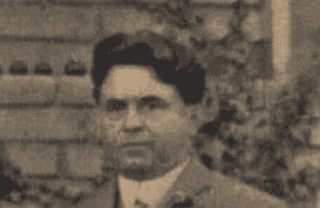
The colonel whom Švejk mentions is no doubt inspired by Karl Schlager, who was commander of Ersatzbataillon IR. 91 from 25 August 1914 until 26 July 1915. Thus, he would have been Hašek's superior in Bruck, where the recruitment battalion of Infanterieregiment Nr. 91 was stationed from 2 June 1915. If the colonel's speech is inspired by the author's experiences, it would almost certainly have taken place on 30 June 1915, the day that Hašek and his XII. Marschbataillon boarded the train that took them to the front.
A non-person
Schláger is one of only two figures who have "disappeared" from The Good Soldier Švejk (the other one is Korporal Říha). Sometime between 1953 and 1955, Schláger fell victim to a "clean-up" of the text. This included correcting spelling mistakes in foreign-language quotations, grammatical errors, updating geographical names to suit current language norms, and also correcting inconsequential and incomprehensible phrases[a]. One of the results of this process was that the literary Schláger was renamed Oberst Schröder and thus consigned to the scrap heap of history. There is, however, no doubt that Švejk actually did refer to the senior colonel who saved his skin and even promoted him to messenger after the affair with Gyula Kakonyi, but it seems that the author had forgotten that he had previously called the colonel "Schröder".
Paul Selver's is the only one of the three translations of Švejk into English that preserves Colonel Schlager for future generations. The reason is that he translated the novel as early as 1930, more than 20 years before Czech editors decided to replace Schlager with Schröder.
Still, Schláger clings to his precarious existence in several translations, namely those that originate from the interwar period or the years immediately following World War II. Examples are primarily those of Paul Selver (English), Grete Reiner (German), and Knuud Bruun-Rasmussen (Danish) (all translated the name as Schlager). Schláger also lives on in Esperanto, but has mutated into Oberst Schröder in newer translations into English, namely those by Cecil Parrott and Zenny Sadlon. The recent translation into German by Antonín Brousek (2014) uses Schröder, and so do the most recent translations into Russian, Polish, Norwegian, and Dutch.
Tripping up švejkologists
For many years the renaming of Schláger tripped up švejkologists in their attempts to identify a model for Oberst Schröder. Not until it was noticed that Jaroslav Hašek already in Dobrý voják Švejk v zajetí (1917) had named the regiment commander plukovník Schlager did one start to suspect that Karl Schlager was indeed the prototype.
Quote(s) from the novel
[III.3] „Poslušně hlásím, pane lajtnant, že je to přání našeho pana obršta Schlágra z Brucku. Když von se s náma loučil, když jsme jeli teď na bojiště, tak ve svý řeči řek, abychom všichni, když budem procházet vopuštěnými bojišti, všeho si dobře všímali, jak se bojovalo a co by nám mohlo bejt na prospěch.
Brynych
is mentioned by Švejk in the anecdote about the chamber pot in Poděbrady. This is a story he told Leutnant Dub in the Łupków Pass as the lieutenant again tried to catch him for unpatriotic behaviour.
Background
Brynych
(born Eduard Josef) was the bishop of Hradec Králové from 1892 to 1902.
Quote(s) from the novel
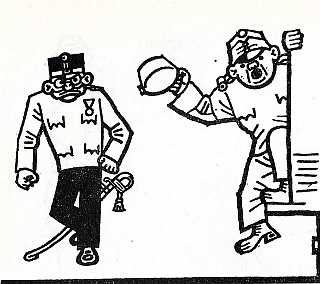
[III.3] A von mu ten jeho kamarád napsal takovej fejton vo takovým jednom sběrateli, jak našel v písku na břehu Labe starej nočník plechovej a myslel, že to přilbice svatýho Václava, a udělal s tím takovej rozruch, že se tam na to přijel podívat biskup Brynych z Hradce s procesím a s korouhvema.
[III.3] Teď ty musíš jít sám k raportu, a jestli nepudeš, tak ti sám nafackuju, abys věděl, co je to disciplina v armádě. V karlínskejch kasárnách bejval ňákej lajtnant Hausner a ten měl taky burše, a taky ho fackoval a kopal.
[III.3] Ale to na celý věci nic nemění,“ pokračoval Švejk, „to je zrovna to samý, vo čem vždycky vypravoval medik Houbička, že je to jedno, rozřezat v patalogickým ústavě ňákýho člověka, který se voběsil nebo votrávil. A já jdu s tebou. Pár facek dělá na vojně moc.“
[III.3] A nebejt mě, tak by se k tomu raportu snad vůbec nedostal, jako ten Kudela z Bytouchova, kterej za aktivní služby tak dlouho chodil k raportu, až byl přeloženej k marině, kde se stal kornetem, a byl na ňákým vostrově potom, v Tichým oceánu, vyhlášenej jako desertýr. Von se tam potom voženil a mluvil taky s cestovatelem Havlasou, kterej vůbec nepoznal, že to není domorodec.
Havlasa
was the traveller who, according to the good soldier, found Kudela on an island in the Pacific Ocean.
Background
Havlasa
(born Jan Klecanda) was a Czech journalist, author, explorer and diplomat. Before World War I he undertook long journeys in Asia, Polynesia and America, and when back home he wrote and gave lectures about his journeys. At the time, he was first and foremost known as an explorer and traveller.
In April 1915 he was sentenced to a seven month prison term because of the brochure Colonial politics and the world war that was published in November the previous year. The case was heard at k.k. Landwehr divisional court at Hradčany and he served the sentence in the neighbouring garrison prison. In February 1916, at the request of the chief state prosecutor, the sentence was extended with one year. In June 1917 he was released and immediately entered military service.
In 1919 he took part in the Versailles peace conference, representing Czechoslovakia. He was later ambassador to Brazil and Chile. After the Nazi occupation of his homeland in 1939, he went into exile and was active in the resistance movement. In 1947 he emigrated to the USA, where he lived for the rest of his life.
Jaroslav Hašek knew Havlasa already from his youth. Both attended the gymnasium at Žitna ulice at the same time (Hašek from 1893 to 1897). Both also contributed regularly to the illustrated weekly Zlatá Praha. Havlasa was the son of the author Jan Klecanda and brother of the Czech legionnaire Jiří Klecanda.
Quote(s) from the novel
[III.3] A nebejt mě, tak by se k tomu raportu snad vůbec nedostal, jako ten Kudela z Bytouchova, kterej za aktivní služby tak dlouho chodil k raportu, až byl přeloženej k marině, kde se stal kornetem, a byl na ňákým vostrově potom, v Tichým oceánu, vyhlášenej jako desertýr. Von se tam potom voženil a mluvil taky s cestovatelem Havlasou, kterej vůbec nepoznal, že to není domorodec.
Karlík
is a businessman who is part of Švejk's anecdote regarding the destroyed Red Cross train near Kulaszne.
Quote(s) from the novel
[III.3] Tam bydlel nějakej pan Karlík v prvním patře. O poschodí vejš moc hodnej člověk, nějakej konservatorista Mikeš. Von měl moc rád ženský a taky mezi jinejma počal chodit za dcerou toho pana Karlíka, kterej měl špeditérství a cukrářství a taky měl někde na Moravě knihařství pod ňákou docela cizou firmou.
Mikeš
is a music conservatory student who is part of Švejk's anecdote regarding the Red Cross train near Kulaszne.
Quote(s) from the novel
[III.3] Tam bydlel nějakej pan Karlík v prvním patře. O poschodí vejš moc hodnej člověk, nějakej konservatorista Mikeš. Von měl moc rád ženský a taky mezi jinejma počal chodit za dcerou toho pana Karlíka, kterej měl špeditérství a cukrářství a taky měl někde na Moravě knihařství pod ňákou docela cizou firmou.