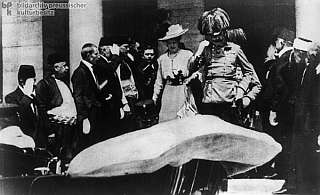
Franz Ferdinand and his wife Sophie leaving Sarajevo Town Hall on 28 June 1914, five minutes before the assassination.
The Good Soldier Švejk is a novel with an exceptionally rich cast of characters. Alongside those who play a direct part in the plot, a great many fictional and real people (and animals) are mentioned throughout the narrative, in Švejk's anecdotes and in the book's idioms and turns of phrase.
This page offers brief entries on the people referred to in the novel, from Napoléon in the introduction to Hauptmann Ságner in the final lines of the unfinished Part Four. The list is sorted in the order in which names first appear. Chapter headings follow Zenny Sadlon's recent translation (1999–2026) and, in most cases, differ from Cecil Parrott's 1973 version.
The Czech quotations are taken from the online version of The Good Soldier Švejk provided by Jaroslav Šerák and link to the relevant chapter. The toolbar provides direct links to Wikipedia, Google Maps, Google Search, svejkmuseum.cz and the novel online.
The names are colour-coded according to their role in the novel, as illustrated by the following examples:
Dr. Grünstein, a fictional character directly involved in the plot.
Fähnrich Dauerling, a fictional character who is not part of the plot.
Heinrich Heine, a historical person.
Note that many seemingly fictional characters are inspired by real people. Examples include Oberleutnant Lukáš, Major Wenzl and many others. These are still listed as fictional, since they are literary creations only partly inspired by their similarly named 'models'.
Military ranks and other titles related to Austrian officialdom are given in German, in accordance with the terms used at the time (explanations in English are provided as tooltips). This means that Captain Ságner is still referred to as Hauptmann, even though the term is now obsolete and has been replaced by Kapitän. Civilian titles denoting profession, etc., are translated into English. This also applies to ranks in the nobility where a direct translation exists.
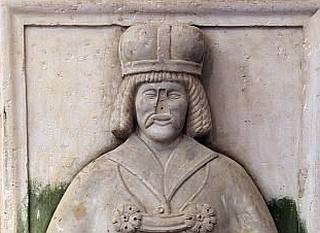
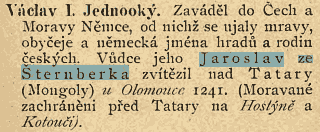
Jaroslav ze Šternberka
is mentioned by Švejk when he tells his fellow prisoner, a Crimean Tatar, how badly his ancestors fared during the battle beneath the mountain Hostýn in Moravia.
Background
Jaroslav ze ŠternberkaJaroslav of Šternberk
was, according to legend, a Czech nobleman who won a battle against the invading Mongols (Tatars) near Olomouc in 1241, or alternatively, against the Hungarians and Cumans in 1253.
Two incursions into Moravia
The legend of Jaroslav appears to be rooted in two actual events. In 1241, the Mongols (Tatars) invaded Moravia, but there is no evidence that any major battle took place. The invaders were content to ravage undefended towns and villages, and soon left. Olomouc, as a fortified city, was not taken.
In 1253, Moravia was invaded again due to a dispute over the succession to the Austrian and Styrian thrones. The Cumans, an Asian people in Hungarian service, won a battle near Olomouc but suffered such heavy losses that they retreated. This war had nothing to do with the Tatars. The Czech commander was Zdeslav z Divišova (1190-1265?), who was awarded large areas around Olomouc as a reward for his efforts. Shortly afterwards, he built the castle and town of Šternberk. One of his sons was Jaroslav (1220-1287), who is probably the basis for the myths that later arose.
Mix-up
It was not until 300 years later that the legend of Jaroslav as a brave warrior against the Tatars was written down. Here, the two battles were apparently conflated, and Jaroslav was promoted to commander. Historians in the 19th century (such as Palacký and Tomek) spread this interpretation further, but over time, questions were raised. This was not least because the so-called Kralodvorské rukopisy, which glorified early Czech history (and contained a poem about Jaroslav), was revealed to be a forgery.
That said, the legend was still widely believed when Hašek was young and received his history education, so it is understandable that he let it slip into The Good Soldier Švejk.
Quote(s) from the novel
[IV.1] „Tak ty seš tedy Tatar,“ soustrastně řekl Švejk, „ty jsi se vydařil. Pak mně máš rozumět a já tobě, když seš Tatar. Hm - znáš Jaroslava ze Šternberka? To jméno neznáš, ty kluku tatarská? Ten vám natřel prdel pod Hostýnem.
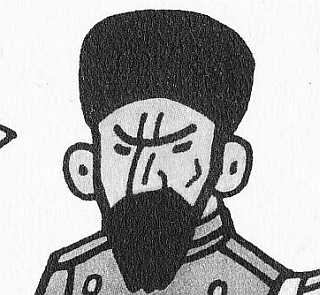
Muhlahalej Abdrachmanov
was one of the prisoners in Švejk's transport.
Quote(s) from the novel
[IV.1] „To mně nikdo nebude věřit,“ pomyslil si Švejk, „že se někdy někdo moh tak jmenovat jako ti Tataři kolem: Muhlahalej Abdrachmanov - Bejmurat Allahali - Džeredže Čerdedže - Davlatbalej Nurdagalejev atd.
Bejmurat Allahali
was one of the prisoners in Švejk's transport.
Quote(s) from the novel
[IV.1] „To mně nikdo nebude věřit,“ pomyslil si Švejk, „že se někdy někdo moh tak jmenovat jako ti Tataři kolem: Muhlahalej Abdrachmanov - Bejmurat Allahali - Džeredže Čerdedže - Davlatbalej Nurdagalejev atd.
Džeredže Čerdedže
was one of the prisoners in Švejk's transport, apparently a Georgian judging by the name.
Quote(s) from the novel
[IV.1] „To mně nikdo nebude věřit,“ pomyslil si Švejk, „že se někdy někdo moh tak jmenovat jako ti Tataři kolem: Muhlahalej Abdrachmanov - Bejmurat Allahali - Džeredže Čerdedže - Davlatbalej Nurdagalejev atd.
Davlatbalej Nurdagalejev
was one of the prisoners in Švejk's transport.
Quote(s) from the novel
[IV.1] „To mně nikdo nebude věřit,“ pomyslil si Švejk, „že se někdy někdo moh tak jmenovat jako ti Tataři kolem: Muhlahalej Abdrachmanov - Bejmurat Allahali - Džeredže Čerdedže - Davlatbalej Nurdagalejev atd.
[IV.1] To mně nikdo nebude věřit,“ pomyslil si Švejk, „že se někdy někdo moh tak jmenovat jako ti Tataři kolem: Muhlahalej Abdrachmanov - Bejmurat Allahali - Džeredže Čerdedže - Davlatbalej Nurdagalejev atd. To u nás máme přeci lepší jména, jako ten farář v Židohoušti, kterej se jmenoval Vobejda.“
Allāh
is mentioned by the Crimean Tatar whom Švejk speaks to in Dobromil. He uses the term "Allāhu Akbar" (God is great).
Background
Allāh
is the Arabic word for God and is commonly used in the context of Islam. The concept of Allah is very similar to Judaism's Jahve and the Christian God, which is natural since these religions share common roots.
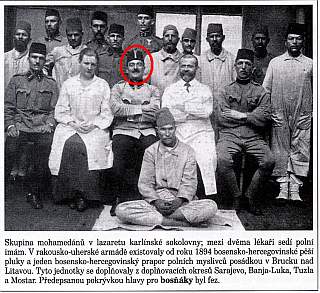
In Austria-Hungary, Islam became part of the diverse spectrum of religions when Bosnia-Hercegovina was incorporated into the empire in 1908. In the Militärseelsorge (military chaplaincy), the Feldimam (Field Imam) had his recognised place alongside the Feldkurat (Field Chaplain) and the Feldrabbiner (Field Rabbi).
The author himself had extensive knowledge of Muslim peoples in Russia, mostly from his stays in Tatarstan and Bashkortostan in 1918 and 1919. Another possible source of inspiration: according to his wife Alexandra Lvova (as retold by Franta Sauer), he employed a group of bodyguards from the Muslim region of Cherkessia during his stay in Irkutsk in 1920.
Quote(s) from the novel
[IV.1] „Ne ponymat, já krymsky Tatárin, Allah achper.“ Tatar sedl si, zkříživ nohy, na zem, složiv ruce na hruď, začal se modlit: „Allah achper - Allah achper - bezmila - arachman - arachim - málinkin mustafír.“
Hans Löfler
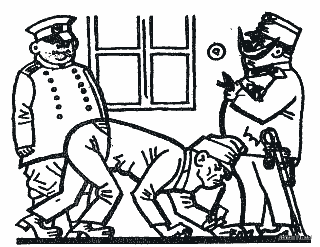
was a cripple from Styria who was routinely humiliated by the corporal who interrogated Švejk in Dobromil after he was captured wearing a Russian uniform. Löfler was ordered to crawl around on the floor with a pipe in his mouth, then he had to bark like a dog.
Quote(s) from the novel
[IV.1] Otevřel dveře do vedlejší místnosti a zavolal: „Hans Löfler!“ Ozvalo se „Hier!“ a dovnitř vstoupil volatý voják, Štajeráček, s výrazem ubrečeného kreténa. To byla na etapě holka pro všecko.
[IV.1] „Že si nepřekousneš jazyk,“ říkal každému z nich s dobráckým úsměvem Švejk. „Jestlipak to není lepší, když se u nás jmenuje někdo Bohuslav Štěpánek, Jaroslav Matoušek nebo Růžena Svobodová.“
Jaroslav Matoušek
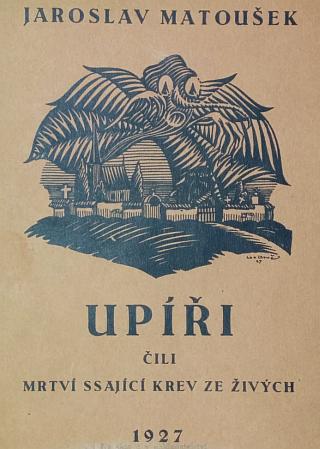
is not directly identifiable, but the author almost certainly borrowed the name from a real person. Antonín Měšťan identifies him as a translator of mythical prose[a]. The person he has in mind was an expert on Gnosticism and Hermeticism, wrote books on the theme and also translated neo-platonic prose.
The most visible trace of him is a book from 1924 on the philosopher Jakub Böhme, which is still widely available. The catalogue of the Czech National Library lists four titles (two of them translations from Greek) by him, published from 1922 to 1925. It is therefore probable that Jaroslav Hašek knew about Matoušek when he wrote those lines at the end of 1922. All four books were reprinted in the 1990s. In 1927 he wrote another book, this time about vampires.
Matoušek seems to have been a part-time author. Police records show that he was a civil servant in the k.k. post- and telegraph authorities. He was married to Marie Kalinova from Vršovice and in 1914 the couple lived in Prague IV., čp. 112 (Hradčany).
Antonín Měšťan
Jaroslav Matoušek war hauptsächlich als Übersetzer mystischer Schriften tätig.
NKČR
Narozen 18 December 1872 v Praze, zemřel 30 March 1946 v Praze. PhDr., práce z okultismu, překlady novoplatoniků.
Quote(s) from the novel
[IV.1] „Že si nepřekousneš jazyk,“ říkal každému z nich s dobráckým úsměvem Švejk. „Jestlipak to není lepší, když se u nás jmenuje někdo Bohuslav Štěpánek, Jaroslav Matoušek nebo Růžena Svobodová.“
Růžena Svobodová
was, according to Švejk, much easier to pronounce than Tatar names like Babamulej Mirzahali.
Background
Růžena Svobodová
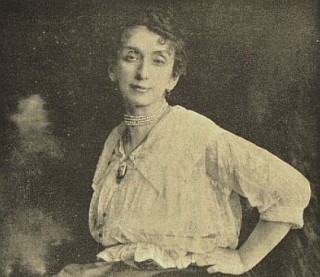
was a Czech writer who specialised in literature about the fate of women. She is vaguely classified as an impressionist.
Quote(s) from the novel
[IV.1] „Že si nepřekousneš jazyk,“ říkal každému z nich s dobráckým úsměvem Švejk. „Jestlipak to není lepší, když se u nás jmenuje někdo Bohuslav Štěpánek, Jaroslav Matoušek nebo Růžena Svobodová.“
Babula Halleje
is an invented name, this time by the author.
Quote(s) from the novel
[IV.1] Když konečně Švejk po hrozném utrpení sepsal všechny ty Babula Halleje, Chudži Mudži, umínil si, že to zkusí ještě jednou a vysvětlí tlumočníkovi-šikovatelovi, že se stal obětí omylu, a jak už několikrát po cestě, když ho hnali mezi zajatci, marně se dovolával spravedlnosti.
Chudži Mudži
is an invented name, this time by the author.
Quote(s) from the novel
[IV.1] Když konečně Švejk po hrozném utrpení sepsal všechny ty Babula Halleje, Chudži Mudži, umínil si, že to zkusí ještě jednou a vysvětlí tlumočníkovi-šikovatelovi, že se stal obětí omylu, a jak už několikrát po cestě, když ho hnali mezi zajatci, marně se dovolával spravedlnosti.
Karolina Dreger
is a name the drunken corporal who interrogated Švejk sings about to the tune of Loreley. He takes the lyrics from a newspaper advert.
Quote(s) from the novel
[IV.1] Přebubnovával si na židli na nápěv „Ich weiß nicht, was soll es bedeuten...“ nový inserát: „Karolina Dreger, porodní babička, doporučuje se ct. dámám v každém případě.“
Wolf
was the major in Przemyśl who discovered that Švejk was a Czech in a Russian uniform. He advocated immediate hanging of the delinquent, preferably following a summary trial.
Quote(s) from the novel
[IV.1] Potom je přejímal major Wolf, vládnoucí tou dobou nad všemi zajatci pracujícími na opravách v pevnosti Přemyšlu a okolí. To byl důkladný člověk. Měl u sebe celý štáb tlumočníků, kteří vybírali ze zajatců specialisty ku stavbám podle jejich schopností a předběžného vzdělání.
Hochverräterische Umtriebe von österr. Čechen im Auslande, K.k. Polizeidirektion Prag,1917
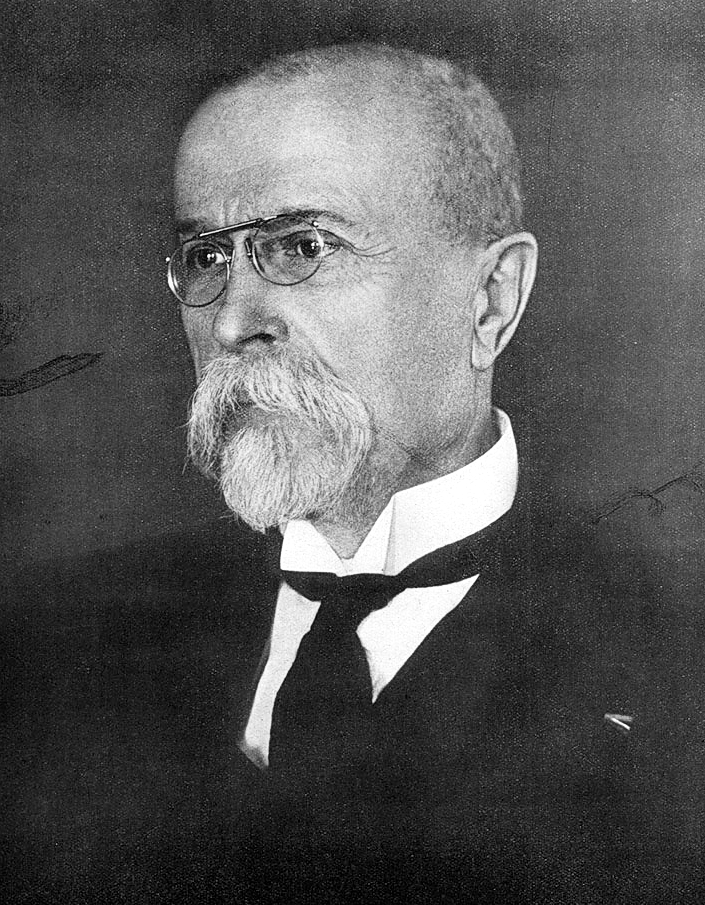
Masaryk is mentioned 1 times in The Good Soldier Švejk.
Masaryk
is mentioned by the narrator in connection with a discussion about Czechs who have joined the enemy. Masaryk is referred to as the former Austrian professor who has moved abroad and is involved in anti-Austrian agitation, being sought in vain by k.k. Innenministerium. The author's personal greeting to the president was removed from the editions of 1951 and 1955.
Background
Masaryk
was a Czech politician and professor of philosophy who is closely linked to the creation of the Czechoslovak state. He was president of the country from 1918 until 1935. He enjoyed enormous respect both at home and abroad, and the term "father of the nation" has rarely been more appropriate.
Until 1914, he was a member of the Reichsrat and was still loyal to Austria-Hungary, but his experiences in the first months of the war changed his outlook, and he decided to work for full Czech/Slovak independence. In December 1914, he moved abroad and campaigned for an independent Czechoslovak state. He directed his efforts towards the Entente politicians, influential journalists and other people in important positions. He soon became the leader of the Czech (and Slovak) independence movement abroad, and during the war he spent time in Switzerland, France, England, the USA and Russia. Within the independence movement, he enjoyed almost unchallenged authority.
Masaryk spent almost a year in Russia at the time when Jaroslav Hašek was there: he arrived in Petrograd on 16 May 1917 and left again in March 1918. The two could have met either in Berezno (HQ of Hašek's regiment from 11 August 1917) or in Kiev in February 1918. During his visit to Berezno in August 1917, Masaryk stayed in the mansion where Hašek worked. The author of The Good Soldier Švejk was at that time the secretary of the staff of the 1st Czechoslovak rifle regiment.
Quote(s) from the novel
[IV.1] Rakouské ministerstvo vnitra tápalo ještě ve tmách, pokud se týkalo zjištění nějaké bojovné organisace z přeběhlíků na ruskou stranu. Neznalo ještě nic určitého o revolučních organisacích v cizině a teprve v srpnu na linii Sokal - Milijatin - Bubnovo obdrželi velitelé batalionů důvěrné reserváty, že bývalý rakouský profesor Masaryk utekl za hranice, kde vede proti Rakousku propagandu. Nějaký pitomeček od divise doplnil reservát ještě tímto rozkazem: „V případě zachycení předvésti neprodleně k štábu divise!“ Toto tedy připomínám panu presidentovi, aby věděl, jaké nástrahy a léčky byly na něho kladeny mezi Sokalem - Milijatinem a Bubnovou.
Credit: Tomáš Masaryk, Josef Kopta, František Langer, Rudolf Medek
Pobytové přihlášky pražského policejního ředitelství,1851 - 1914
Vašák
was a hatter who always caused trouble at Na Zavadilce in Libeň. The guests and the landlord therefore discussed whether they should throw him out as soon as he appeared, or wait until he had had a few beers and spent some money.
Background
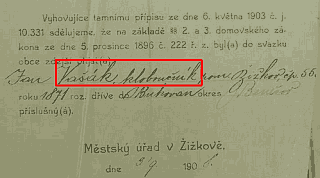
Vašák was possibly inspired by a real person (or two). A certain Jan Vašák, born in Bukovany near Benešov on 17 September 1871, was a hatter who lived in Žižkov from 1907 until at least 1909. Notably, in 1906 he lived at Prague VIII. čp. 524, which is in Libeň, the same area where the literary hatter caused trouble in the pub. Vašák married in Karlín in 1898, so he had probably spent several years in the area.
Quote(s) from the novel
[IV.1] To jsme se vám jednou v hospodě ,Na Zavadilce’ v Libni hádali mezi sebou, jestli máme nějakýho N(kloboučníka Vašáka), kerej vždycky dělal při zábavě neplechu, vyhodit, hned jak se vobjeví ve dveřích, nebo ho vyhodit, až si dá pivo, zaplatí a dopije, nebo mu vyndat boty, až přetančí první kolo.
Znamenáček
is mentioned in Švejk's imaginary anecdote about the judge who went mad and wanted to hang Znamenáček on the spot because he had insulted chaplain Hortík.
Quote(s) from the novel
[IV.1] Nějakej Znamenáček řekl kaplanovi Hortíkovi, kerej při náboženství nafackoval jeho klukovi, když ho potkal na ulici: ,Vy vole, ty černá potvoro, ty nábožnej blbečku, ty černý prase, ty farní kozle, ty przniteli učení Kristova, ty pokrytče a šarlatáne v kutně!’
Hortík
was the chaplain in Švejk's anecdote about the insane judge. See Znamenáček.
Quote(s) from the novel
[IV.1] Nějakej Znamenáček řekl kaplanovi Hortíkovi, kerej při náboženství nafackoval jeho klukovi, když ho potkal na ulici: ,Vy vole, ty černá potvoro, ty nábožnej blbečku, ty černý prase, ty farní kozle, ty przniteli učení Kristova, ty pokrytče a šarlatáne v kutně!’
Horáček
was a guard in an anecdote by Švejk about an insane judge. See Znamenáček.
Quote(s) from the novel
[IV.1] Proti rozsudku není odvolání. Pane Horáček!’ zavolal potom na dozorce, vezmou tady tohodle pána a pověsejí ho tam, vědí, kde se klepají koberce, a potom sem přijdou, dostanou na pivo!’ To se rozumí, že pan Znamenáček i ten dozorce zůstali stát jako zkoprnělí, ale on si na ně dup a rozkřikl se: ,Poslechnou, nebo ne!’
Týnecký
is at the centre of the anecdote Švejk uses against the Polish spy who enters his cell in Przemyśl.
Quote(s) from the novel
[IV.1] „Voni se museli rozhodně napít bahnitý vody,“ řekl Švejk. „jako ten mladej Týneckej od nás, člověk jinak rozumnej, ale jednou se pustil na cesty a dostal se až do Italie. Taky vo ničem jiným nemluvil než vo tej Italii, že jsou tam samý bahnitý vody a nic jinýho památnýho.
Saint Peter
is at the centre of the anecdote Švejk uses against the spy who enters his cell in Przemyśl.
Background
Saint Peter
(Simon Peter) was a leader of the early Christian Church, who features prominently in the New Testament through the Gospels and the Acts of the Apostles. He was one of Christ's twelve disciples. The Catholic Church regards him as the first Bishop of Rome and also the first Pope.
Quote(s) from the novel
[IV.1] A taky dostal z tý bahnitý vody zimnici. Chytalo ho to čtyřikrát do roka. Na Všechny svatý, na svatého Josefa, na Petra a Pavla a na Nanebevstoupení panny Marie.
Saint Paul
is mentioned in the anecdote Švejk uses against the spy who enters his cell in Przemyśl.
Background
Saint Paul
(Paul of Tarsos, born Saul) was a Greek Jew who became one of the early Christian leaders and one of the first missionaries. He is often mentioned in the New Testament and is credited with writing 13 of its 27 books. Paul was executed in Rome during the reign of Emperor Nero.
Quote(s) from the novel
[IV.1] A taky dostal z tý bahnitý vody zimnici. Chytalo ho to čtyřikrát do roka. Na Všechny svatý, na svatého Josefa, na Petra a Pavla a na Nanebevstoupení panny Marie.
Zimmer
was a lieutenant whom Švejk talks about to the spy who enters his cell in Przemyśl.
Quote(s) from the novel
[IV.1] My padneme za císaře pána a jeho rodinu, za kterou jsme vybojovali Hercegovinu. Z našich kostí se bude vyrábět špodium pro cukrovary, vo tom už nám před lety vykládal pan lajtnant Zimmer. ,Vy svinská bando,’ povídá, ,vy nevzdělaní kanci, vy zbytečný, indolentní vopice, vy těma haxnama pletete, jako by neměly žádnou cenu.
Božetěch
was a bookbinder from Příčná ulice no. 16 who, in July 1908, had taken a bath in Zbraslav with a tramp, and the latter had run off with his clothes. This is what Švejk recounts during interrogation in Przemyśl. It also transpires that Božetěch read all the books he bound, and was happy to sit at U Fleků and relate their content. Not to be confused with Božetěch from Košíře.
Quote(s) from the novel
[IV.1] „Vím, vod 91. regimentu mne už jistě hledají, ale jestli dovolíte, pane majore, malou poznámku vo tom, jak se lidi dobrovolně převlíkají do cizích šatů. Roku 1908 někdy v červenci koupal se knihař Božetěch z Příčný ulice v Praze na Zbraslavi ve starým rameni Berounky.
Fink is mentioned 25 times in The Good Soldier Švejk.
Fink
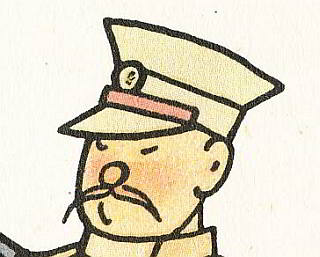
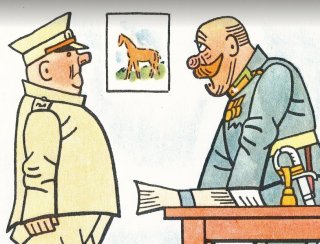
was a general who commanded the garrison in Przemyśl and presided over the trial against Švejk. His greatest pleasure was arranging summary trials, and he had a strong dislike for defence lawyers. In his view, a successful trial should be swift, with the accused preferably hanged within three hours. Fink was such a patriot that he even disregarded his Reichsdeutsche allies. It is revealed that he lived in Vienna, was married, and had a son named Wilhelm.
Background
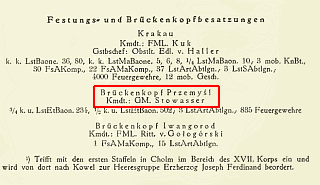
This figure is unlikely to have been directly modelled on a real person, as the fortress commander of Przemyśl from 9 June 1915 (at the latest) was GeneralmajorGustav Stowasser[a].
According to Radko Pytlík, Fink was a real person and documents about him exist in the Vienna war archive[b]. However, it is more likely that the author borrowed the name from the well-known Prussian noble family Finck von Finckenstein. The name Fink was known in Austria's armed forces, but the last high-ranking officer with this name had died long before the First World War broke out[c].
The name Finkvon Finkenstein does not appear in address books of Vienna from 1914 and 1915, although the surname Fink was quite common. Nor is it listed in any Kriegsgliederungen from 1915. We must therefore assume that this figure is a grotesque caricature with a random name, although he may still have borrowed traits from people the author actually met.
Quote(s) from the novel
[IV.1] Potom pokračoval tento podivný soud na způsob náhlého soudu, který aranžoval předsedající generál Fink von Finkenstein. Tento generál říkával, že žádných auditorů nepotřebuje, že to sezve dohromady a za tři hodiny že každý chlap musí viset. Dokud byl na frontě, tak u něho o náhlý soud nikdy nebyla nouze.
Credit: Österreich-Ungarns Letzter Krieg, Band III.
Fink
was the son of General Fink, mentioned in a letter from the front. The author uses the Czech diminutives Vilouš and Viloušek, which are equivalent to the German Willi, Willy, or Willichen.
Quote(s) from the novel
[IV.1] Připadalo mně to tak směšné, že jsem všem odpustil, kteří ho hlídali, a ještě jsem udělal vtip, že se ten učitel patrně sám šel poohlédnout po nějakém stromě. Tak vidíš, má drahá, že se zde nijak nenudíme, a řekni malému Viloušovi, že ho tatínek líbá a že mu brzo pošle živého Rusa, na kterém bude Viloušek jezditi jako na koníčkovi.
Martinec is mentioned 15 times in The Good Soldier Švejk.
Martinec
was field chaplain at the Przemyśl garrison and a good Christian from near Nový Jičín in Moravia. After joining the k.u.k. Heer, his moral standards began to deteriorate. Under the influence of General Fink, he developed a taste for drink and the company of loose women.
His task in the novel is to provide spiritual consolation for Švejk before the impending execution. He never achieved this objective, as the good soldier drowned him in endless anecdotes.
His first name, Jan, appears in the diminutive form Jeníček.
Background
In 1914, there was no Martinec serving in the k.u.k. Heer or k.k. Landwehr according to Schematismus. Nor has it been possible to identify any parish priest named Martinec who lived at the time.
Quote(s) from the novel
[IV.1]Polní kurát Martinec představoval si, že jsa ve službách duchovní útěchy raněným a umírajícím na bojišti, vykoupí i hříchy svého zpustlého faráře, který vraceje se v noci domů, nesčíslněkráte ho vzbudil a vypravoval mu: „Jeníčku, Jeníčku! Macatá děvka - to je můj celý život.“
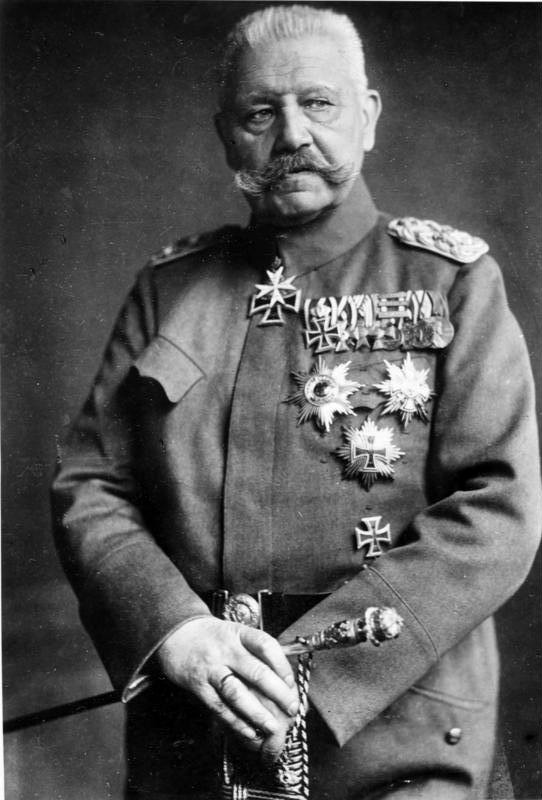
Hindenburg
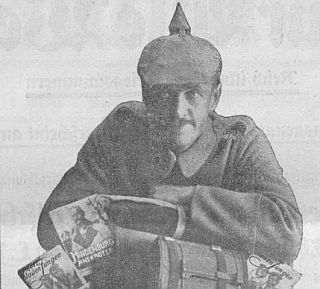
is mentioned by the author in passing; he refers to some idiotic booklets published for the army by Lustige Blätter. General Fink finds them entertaining enough to quote from them to Feldkurat Martinec.
Background
Hindenburg
was a German general who was Commander-in-Chief of the German forces on the Eastern Front at the time of the events in the novel. From 1916, he became head of the entire German army and gradually became the most influential person in the country.
He was elected president of Germany in 1925, a position he also held when Hitler assumed power in 1933, and he remained in office until his death the following year. He is the only German head of state ever to have been directly elected by the people. Politically, he was regarded as conservative.
Hašek here refers to issue no. 2 of the series Illustrierter Tornister-Humor, published by Lustige Blätter from February 1915 onwards.
Quote(s) from the novel
[IV.1] Měl celou knihovnu takových svazečků s pitomými názvy jako „Humor v tornistře pro oči i uši“, „Hindenburgovy anekdoty“, „Hindenburg v zrcadle humoru“, „Druhá tornistra plná humoru, naládovaná Felixem Schlemprem“, „Z našeho gulášového kanonu“, „Šťavnaté granátové třísky ze zákopů“, nebo tyto hovadiny: „Pod dvojitým orlem“, „Vídeňský řízek z c. k. polní kuchyně. Ohřál Artur Lokesch“.
Schloemp
is mentioned by the author in passing; he refers to some idiotic booklets published for the army by Lustige Blätter. General Fink finds them entertaining enough to quote from them to Feldkurat Martinec.
Background
Schloemp
(called Schlemper by Hašek) was a German bookseller, editor and publisher. From 1909 onwards, he published a number of illustrated humorous books.
In 1915, he contributed to Tornister-Humor, a series of humorous propaganda booklets published by Lustige Blätter. Installments no. 1, 2, 3, 8 and 15 are directly mentioned in The Good Soldier Švejk.[a]
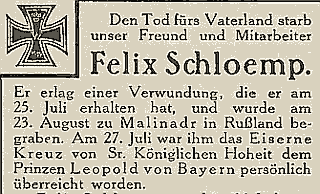
Sometime in late 1915 or early 1916, Schloemp was called up for service. Little about his military exploits is known until he was wounded at the Russian front on 25 July 1916. Two days later, he was personally awarded the Eiserne Kreuz (Iron Cross) by Prince Leopold of Bavaria. Some weeks later, Schloemp died from his injuries and was buried at Malinadr on 23 August. In official casualty lists for Prussia, he was first reported severely wounded on 16 August, then dead on 7 October. It is also revealed that he served in Reserve-Infanterie-Regiment 48, 9. Kompagnie.
Malinadr was, according to Lustige Blätter, the site of his burial, but it has not been possible to locate it. Presumably, it is a misspelling (or rather an erroneous transcription) of some place name in present-day Belarus. Fortunately, the history of his regiment[b] is available and it reveals that on 25 July 1916 they were attacked by Skrobava (Скробава) north of Baranovichi (Баранавічы). That day, the regiment suffered 15 soldiers killed and 46 wounded. We must assume that the severely wounded Schloemp was brought to a field hospital behind the lines, but exactly where this "Malinadr" is remains an enigma.
Quote(s) from the novel
[IV.1] Měl celou knihovnu takových svazečků s pitomými názvy jako „Humor v tornistře pro oči i uši“, „Hindenburgovy anekdoty“, „Hindenburg v zrcadle humoru“, „Druhá tornistra plná humoru, naládovaná Felixem Schlemprem“, „Z našeho gulášového kanonu“, „Šťavnaté granátové třísky ze zákopů“, nebo tyto hovadiny: „Pod dvojitým orlem“, „Vídeňský řízek z c. k. polní kuchyně.
Artur Lokesch
is mentioned by the author in passing; he refers to some idiotic booklets published for the army by Lustige Blätter. General Fink finds them entertaining enough to quote from them to Feldkurat Martinec.
Background
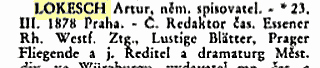
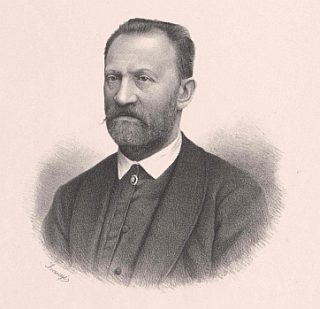
Artur Lokesch
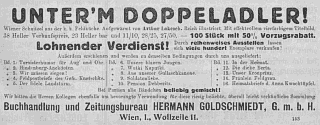
was a writer who, from 1915 onwards, contributed to the series Tornister-Humor published by Lustige Blätter. The novel specifically refers to Unter'm Doppeladler, which was issue No. 15 in the series[1]. The adverts added the explanatory notes Wiener Schnitzel aus der k. k. Feldküche, aufgewärmt von Arthur Lokesch, and Hašek was probably inspired by these adverts rather than the booklets themselves. Lokesch also contributed to several other of these 64-page booklets.
1. Instalment no. 15 seems to have been published in late 1915, so Jaroslav Hašek could therefore not have drawn inspiration from his own time in k.u.k. Heer.
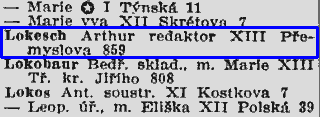
The author of this and other humorous booklets was the youngest son of Prague factory owner EduardLokesch. His factory in Holešovice manufactured buttons, garments and other clothing accessories. Lokesch was born in 1878, at the time the family lived in PrahaI./859 (Kozí plácek). At the time, the factory/workshop was also located here and, according to Egon Erwin Kisch, a certain Mestek worked there for a short period!
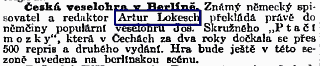
Lokesch graduated from the German commercial academy in Prague in 1898. From police records it transpires that he emigrated in 1906, and this fits well with the 1906 year-book of the commercial academy, which reveals that he was chief editor of Rheinisch-Westphälischen Anzeige in Essen. In the same records, he is listed as "disponent" (managing clerk). In 1910, he is mentioned in Národní politika as a "well-known German editor". He wrote lyrics for songs in theatre plays that from 1912 were performed in Berlin and later across Europe. His most famous contribution is the lyrics of the internationally known vaudeville Der Regimentspapa (1914). He also contributed to Prager Tagblatt, using the pseudonym Tuxl.
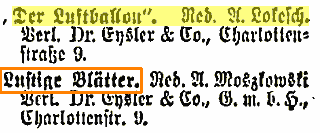
Lokesch moved to Berlin some time before 1909 and was, as late as 1933, listed in the city's address book. He is known to have edited Der Luftballon, a magazine that in 1909 was located in the same building as Lustige Blätter. Both publications were owned by Dr. Eysler & Co.
His name is found in address books and in newspapers also after the war. He is now listed as an editor and dramaturge, and his name appears as far away as Essen (editor-in-chief of Rheinisch-Westphälischen Anzeiger). The Lokesch family were Jewish, but Arthur converted to Protestantism as a young man.
In 1937, he was again living in Prague, so he had obviously left Berlin after the 1933 Nazi takeover. He does not appear in the address book from 1942, but it has so far not been possible to determine if he emigrated or became a victim of the Holocaust. He is, in any case, not on the list of Czech victims.
Quote(s) from the novel
[IV.1] ... nebo tyto hovadiny: „Pod dvojitým orlem“, „Vídeňský řízek z c. k. polní kuchyně. Ohřál Artur Lokesch“. Někdy mu také předzpěvoval ze sbírky veselých vojenských písní „Wir müssen siegen!“
Ignatius of Loyola
is mentioned in passing in the description of Feldkurat Martinec.
Background
Ignatius of Loyola
was a Basque/Spanish nobleman and soldier known for founding the Jesuit Order in 1534 and also as the instigator of the Inquisition. He was declared a saint in 1622. The church kostel svatého Ignáce is named after him.
Quote(s) from the novel
[IV.1] Generál oblíbil si kuráta Martince, který se mu prvně představil jako nějaký svatý Ignác z Loyoly a pomalu přizpůsoboval se generálovu okolí.
Grabowski
is mentioned because Feldkurat Martinec knelt in front of his statue to confess his sins. According to the author, Grabowski was mayor of Przemyśl in the 1880s and rendered great service to the city, being a builder and benefactor.
Background
Grabowski
was, according to Milan Hodík, identical to Bronisław Grabowski, a Polish ethnographer, writer, translator and Slavist. Among other works, he translated the Czech writers Karolina Světlá and Vrchlický.
Radko Pytlík makes no assumptions about Grabowski's identity, and quotes Polish sources stating that there was no such statue of him in Przemyśl at the time. He suggests there may have been a mix-up with a statue of Adam Mickiewicz that was indeed located in the city park (where the author placed the Grabowski monument)[a].
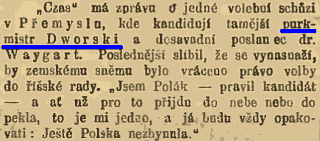
Aleksander Dworski
The author's additional facts, however, are sufficient to allow us to conclude that it was a mix-up of names. The mayor of Przemyśl from 1881 to 1901 was Aleksander Dworski, and his biographical details fit well with the information from The Good Soldier Švejk. No statue of him has been found, but he was (and is) well known in the city and a major street is named in his honour. Dworski, and not Grabowski, was thus clearly the man the author had in mind.
Dworski was born in Lwów and graduated as a doctor of law from the city's university in 1849. He entered politics early, serving as a deputy for Lwów and Grodek in the Reichsrat from 1873 until 1880, in which records show that he was very active. He was known as a Polish patriot and pan-Slavist. Thereafter, he served for 20 years as mayor of Przemyśl, the city where he had lived since 1855. His time in office saw substantial development – the building of schools, sewers, and the introduction of electricity. In 1896, he was named an honorary citizen and a street was named in his honour. From 1889 to 1901, he was also a member of the Galician parliament. Dworski died in 1908 of pneumonia.
Quote(s) from the novel
[IV.1] Potom dlouhou dobu vyčítal si toto zpustlé jednání, ačkoliv to nemohl ani napraviti tím, když tu noc, vraceje se domů, klečel omylem v parku před sochou stavitele a starosty města, mecenáše pána Grabowského, který získal si velké zásluhy o Přemyšl v letech osmdesátých.




 cz
Search
cz
Search