The Good Soldier Švejk mentions numerous institutions and firms, both public and private. Until 15 September 2013, these were categorised as
'Places' on these pages. That categorisation only partly makes sense, because this type of entity cannot always be
tied to geographical coordinates in the way that cities, mountains, and rivers can. This page therefore covers
military and civilian institutions (including army units, regiments, etc.), organisations, hotels, public houses,
newspapers, and magazines.
The boundary between this page and 'Places' is not always clear-cut. Churches, for instance, rarely change location
yet are still included here. By contrast, Prague and Vienna remain in the 'Places' database because they have fixed
coordinates. Institutions, however, may move: Odvodní komise and Bendlovka are not unambiguous geographical terms,
so they are listed on this page.
The names are colour-coded according to their role in the novel, as illustrated by the following examples:
U kalicha, a location where the plot takes place.
k.u.k. Kriegsministerium, mentioned in the narrative.
Čeští vojáci proti válce (1914-1915), Karel Pichlík
Posádková věznice
is apparently the scene of the plot of two entire chapters. Both [I.8] and [I.9] take place in and around the garrison prison. The first part is set in the sick-barrack of the prison, then moves on to cell no. 16. Švejk's escape starts in the chapel when Feldkurat Katz, during holy mass, takes to Švejk and consequently employs him as his officer's servant.
Posádková vězniceGarrison prison
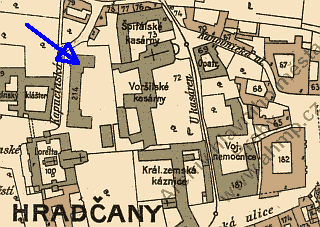
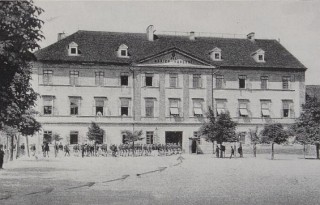
is the author's term for c.a k. vojenská věznice v Praze (k.u.k. Militärgefängnis von Prag), a prison that was part of the garrison complex at Hradčany. It shared the building with Vojenský soud Hradčany and the k.k. Landwehr court. The building is located behind Loreta, and was opened in 1896 and is still in use but not publicly accessible. Its function as a prison and brutal interrogation centre was revitalised during the Nazi and Communist dictatorships.
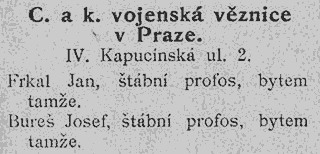
In 1906, there were two Stabsprofusen employed at the prison, but none of them fit the description of Stabsprofus Slavík, Korporal Říha, or Feldwebel Řepa. The two were Jan Frkal and Josef Bureš, and they lived on the premises. Whether any of them was a model for the literary figures is impossible to say, and it cannot be determined if the author had anything to do with the garrison prison at all, so we must assume that the inspiration for those figures came from elsewhere. On the other hand, it is possible that Jaroslav Hašek had heard some story from former inmates of the prison. The description of the conditions in the prison and the brutality of the warders all in all appears strongly exaggerated.
It seems that the author was unfamiliar with the organisation of the prison and adjoining buildings. There is contradictory information on where Švejk actually was: at Vojenská nemocnice Hradčany or in a sick bay within the prison. One passage indicates that the author believed that the military hospital was part of the prison, which it clearly was not. In chapter nine, the reader gets the impression that the garrison actually WAS the prison, which it was not (at most, "garrison" was a colloquial term for the garrison prison).
Antonín Matějovský
Antonín Matějovský
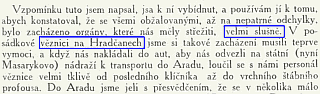
In 1923, a series of publications called "Documents from our national revolution" started to appear. Here one witness, A. Matějovský, gives some insight into the conditions at the prison. He was arrested after having distributed the so-called "Tsar Nicholas II's manifest" in 1914 and given a 10-year term. He spent the first 16 months at Hradčany before being transferred to Arad. His description of the prison is completely at odds with what Švejk experienced. The staff behaved impeccably towards the prisoners and gave them a friendly send-off to Arad, where the conditions were much worse. Matějovský was released in 1917 during the general amnesty issued by the new emperor, Karl I. [a]
Quote(s) from the novel
[I.8] Švejka v posádkové věznici uložili do nemocničního baráku právě mezi takové malomyslné simulanty. „Už to nevydržím,“ řekl jeho soused na posteli, kterého přivedli z ordinačního pokoje, kde mu již podruhé vyplachovali žaludek. Muž ten simuloval krátkozrakost. „Zítra pojedu k pluku,“ rozhodoval se druhý soused po levé straně, který právě dostal klystýr, simuluje, že je hluchý jako pařez.
[II.4] Když jsem seděl na garnizóně, tak tam s námi byt takovej chytrej člověk vzdělanej, profesor na obchodní škole.
Vojenská nemocnice Hradčany
is mentioned by Doctor Grünstein when he asks Švejk if he enjoys his stay at the military hospital. It is, however, unclear if the hospital is part of the plot at all, as the information about Švejk's stay among the malingerers at Hradčany is somewhat contradictory. In other parts of the text, the reader gets the impression that it is a sick bay that is part of the garrison prison. See Posádková věznice for more on this topic.
Background
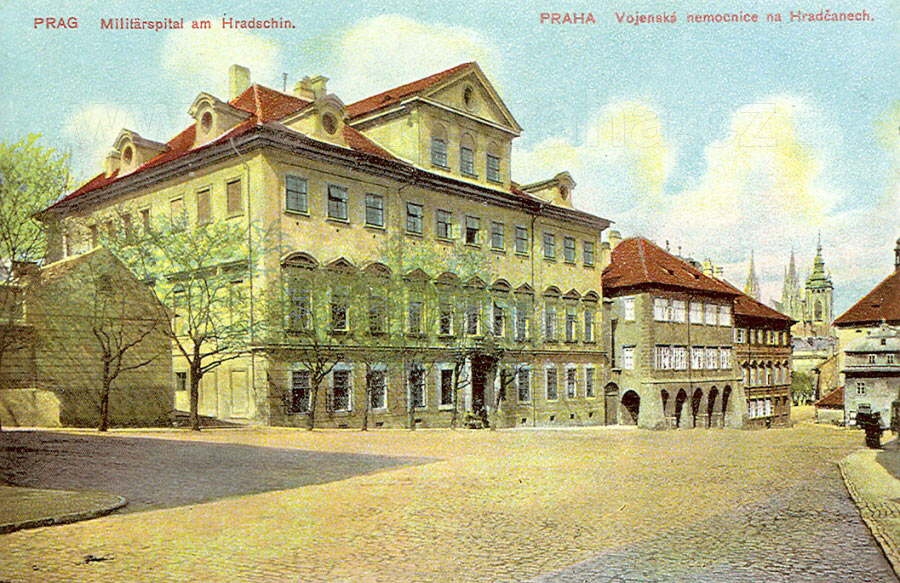
Vojenská nemocnice HradčanyMilitary hospital at Hradčany
refers to a branch of k.u.k. Militärspital nr. 11 in Prague. It was located in the same barrack complex as the garrison prison, the military court, and other army institutions. The main military hospital in Praha was Vojenská nemocnice na Karlově náměstí.
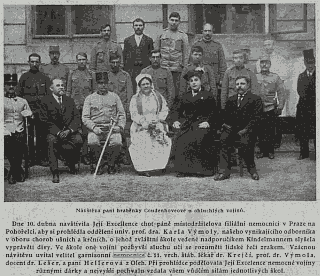
Chief staff doctor in 1916 was dr. Krejčí[a], as revealed when newspapers reported on a visit by Countess Coudenhove, the wife of Bohemia's governor. The visit took place on 10 April 1916, too late to fit chronologically with the visit of Baronesse von Botzenheim, but nevertheless there are interesting similarities.
Quote(s) from the novel
[I.8] Druhého dne při visitě otázal se dr Grünstein Švejka, jak se mu líbí ve vojenské nemocnici. Švejk odpověděl, že jest to podnik správný a vznešený.
Československá Republika
is mentioned during Baronesse von Botzenheim's visit to Hradčany, where she gave Švejk the book Episodes from the Life of our Emperor, written by the future editor-in-chief of this newspaper.
Background
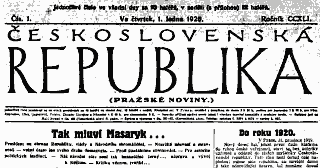
Československá Republika
was the official government daily newspaper of inter-war Czechoslovakia. It was published under this name from 1919 to 1932. In that year it was renamed Pražské noviny and continued publishing until the end of 1938.
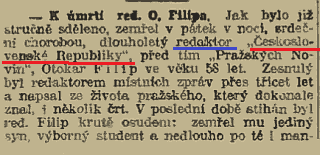
The paper was a direct successor to Pražské úřední noviny (the official paper of the Austrian governor in Bohemia) and was even based in the same offices. The aforementioned editor Filip had also worked for the paper under the old regime. The government newspaper group also issued Úřední List Československá Republika and the evening paper Prager Abendblatt (in German).
In Rudé Pravo
Jaroslav Hašek also wrote a satirical article in Rudé Pravo in which editor Filip and his newspaper are discussed in more detail: What I would advise the Communists if I were the Chief Editor of the Official Government Newspaper Československá Republika. The article was dated 7 April 1921 and printed on 8 May[a], around the time these passages of the novel were written. In the article, he claims that a certain Svátek was editor-in-chief; in the novel, the author of the book about the emperor (i.e. Filip) has this role. According to the 1924 address book, the chief editor was Josef Hevera, and another name mentioned in the Rudé Pravo article, Adolf Zeman, was on the editorial board. The article also suggests that Jaroslav Hašek was still a Communist at heart.
On Hašek
The newspaper wrote about Hašek from time to time, mainly after he became famous, and on 5 January 1923, it printed an obituary. Shortly after his return from Russia, it printed adverts for his appearance at the theatre Červená sedma, where he related stories from his stay in Russia.
Quote(s) from the novel
[I.8] Potom vytáhla z koše tři láhve vína pro rekonvalescenty a dvě krabice cigaret. Vše elegantně rozložila na prázdnou postel vedle Švejka, kam přibyla ještě pěkně vázaná kniha „Příběhy ze života našeho mocnáře“, kterou napsal nynější zasloužilý šéfredaktor naší úřední „Československé republiky“, který se ve starém Frantíkovi viděl.




 czen
SearchMapŠvejkova cestaŠvejkův slovník
czen
SearchMapŠvejkova cestaŠvejkův slovník