The Good Soldier Švejk mentions numerous institutions and firms, both public and private. Until 15 September 2013, these were categorised as
'Places' on these pages. That categorisation only partly makes sense, because this type of entity cannot always be
tied to geographical coordinates in the way that cities, mountains, and rivers can. This page therefore covers
military and civilian institutions (including army units, regiments, etc.), organisations, hotels, public houses,
newspapers, and magazines.
The boundary between this page and 'Places' is not always clear-cut. Churches, for instance, rarely change location
yet are still included here. By contrast, Prague and Vienna remain in the 'Places' database because they have fixed
coordinates. Institutions, however, may move: Odvodní komise and Bendlovka are not unambiguous geographical terms,
so they are listed on this page.
The names are colour-coded according to their role in the novel, as illustrated by the following examples:
U kalicha, a location where the plot takes place.
k.u.k. Kriegsministerium, mentioned in the narrative.
Gimnazjum is mentioned 9 times in The Good Soldier Švejk.
Gimnazjum
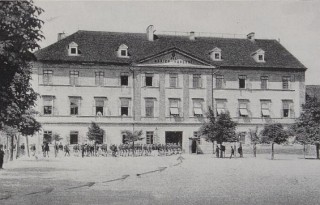
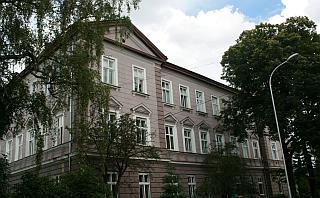
was where the march battalion was meant to be lodged in Sanok. They stayed only for a few hours because the reserves of the German Hanover division soon claimed it.
Background
GimnazjumGymnasium in Sanok
is assumed to be Szkoła Podstawowa nr 8 w Sanoku, a gymnasium (middle school) in the centre of Sanok that is still in use. The name of the school is not explicitly mentioned in The Good Soldier Švejk, but a town the size of Sanok would probably not have hosted more than one gymnasium, at least not in the centre.
Mystification becoming reality
Despite this apparent obviousness, it would be prudent to take the information from The Good Soldier Švejk with a pinch of salt. XII. Marschbataillon of Infanterieregiment Nr. 91 with Jaroslav Hašek surely never set foot here, at least not under the circumstances described in the novel.
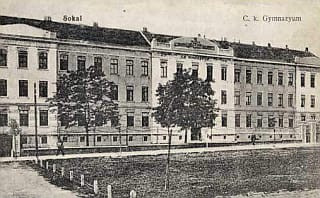
Thus Hašek probably drew from his experiences elsewhere, and the gymnasium in Sokal is the only similar institution where the regiment during Hašek's service is known to have been lodged[a]. There could, of course, have been others, but Sanok was definitely not one of them.
Early history
The school was built in 1880 and until 1922 it had the name Gimnazjum Męskiego (Men's Middle School). In 1906 it catered for 820 pupils, among them 520 Polish, 170 Rusyns and 70 Jewish[b].
Quote(s) from the novel
[III.4] U slečny Elly byl pan poručík Dub, který, když maršbatalion byl už ve svých ubikacích v gymnasiu, zavolal si celý svůj šik a upozorňoval jej v dlouhé řeči, že Rusové při svém ústupu zakládali všude bordely s personálem pohlavně nakaženým, aby způsobili rakouské armádě tímto svým trikem velké ztráty.
Bank Krakowski
was the headquarters of the Eiserne Brigade (Iron Brigade) staff, but they also had to be evacuated to make way for the reserves of the Hanover division.
Background
Bank KrakowskiThe Bank of Krakow
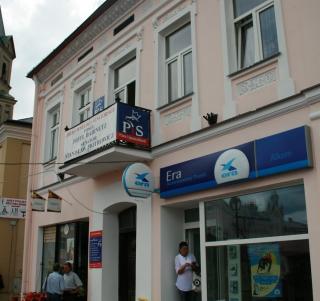
was reportedly a bank at the Sanok town square (Rynek), but the information is not very reliable. The building still exists, but as of 2010, it has other uses.
It should be added that Jaroslav Hašek and XII. Marschbataillon never passed through Sanok, so the inspiration for the events that took place here must be sought elsewhere.
Quote(s) from the novel
[III.4] Plukovník reserv hanoverské divise ukazoval totiž disposice svého štábu, že má ubytovat své mužstvo v gymnasiu, kde právě nyní byli ubytováni jednadevadesátníci. Pro umístění svého štábu žádal vyklizení domu krakovské banky, ve kterém právě byl štáb brigády.
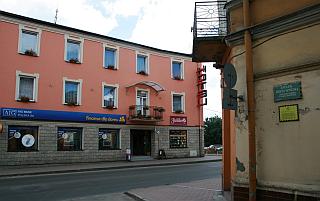
Kawiarnia Miejska
was the café/brothel in Sanok that Leutnant Dub inspected so thoroughly that Švejk had to go and fetch him so he could take part in the journey onwards. Here, Švejk showed that he could be forceful and decisive.
Background
Kawiarnia MiejskaCity Café
is said to have existed. The alleged location is now occupied by Hotel Pod Trzema Różami (Under the Three Roses). At present (2010), it is a normal, decent hotel with a restaurant and pizzeria attached.
It should be added that Jaroslav Hašek and XII. Marschbataillon never passed through Sanok, so the inspiration for the events that took place here must be sought elsewhere.
Quote(s) from the novel
[III.4] „Spojené zábavní místnosti a městská kavárna“, podnik, o kterém se Švejk zmiňoval, byly rozděleny také na dvě části. Kdo nechtěl jít přes kavárnu, šel zadem, kde se vyhřívala na slunci nějaká stará paní, která mluvila německy, polsky a maďarsky asi v tomto smyslu: „Pojďte, vojáčku, máme zde pěkné slečinky.“
U Kocanů
was a dance restaurant which, according to Egon Erwin Kisch, was identical to U města Slaného in Nové město. The unofficial name U Kocanů is taken from the former owner Karel Kocan, who had sold the place some time before 1910. Kisch noted that the owner was Herr W. Kocourek, and this was definitely the case in 1910. He was even listed in the address book from 1936.
U města Slaného was one of eleven establishments that soldiers from the garrison in Prague were forbidden to enter.
Quote(s) from the novel
[III.4] Pan kaprál Kříž přijel do Prahy na urláb a já jsem s ním tančila ,U Kocanů’, a von mně povídal, že prej ty tancuješ v Budějovicích ,U zelený žáby’ s nějakou pitomou flundrou a že jsi mě už úplně vopustil.
Credit: Milan Hodík, Hans-Peter Laqueur, Egon Erwin Kisch
U zelené žáby
is mentioned in the angry letter from Božena to Švejk. She had been told by Korporal Kříž that Švejk had danced with a foolish woman here. All this is revealed when Švejk confides in Oberleutnant Lukáš about his romantic troubles during the march from Sanok.
Background
U zelené žábyAt the Green Frog
was a pub in Budějovice that remains unidentified and almost certainly never existed under this name. Božena probably confused U zelené ratolesti (At the Green Branch) and U žaby (At the Frog).
The former was a coaching inn at Říšská třída (now Husová) next to Mariánská kasárna. It also hosted dances, which fits well with the description in the novel. The building is still in use as a restaurant and guesthouse, and the name remains unchanged.
U žaby was, in 2015, a café at Piaristické náměstí, probably named after a stone frog on the façade of the church opposite. The name has probably been used for inns at the square also in 1915, although this has not been verified.
Č. Beránek
Myslím že hospoda „U zelené žáby“ byla buď na Piaristickém náměstí, kde je to tradiční název (podle místní pověsti o žábě a konci světa) a i dnes jsou tam dva podniky „U žáby“, druhou (dle mne pravděpodobnější) je možnost, že Hašek když psal román si to popletl, kousek od kasáren 91. IR (tak 100m) je hostinec „U zelené ratolesti“ což byl známý hostinec už od počátku 19. století, byl a je dodnes velký s prostory pro tančírnu a pokoji.
Quote(s) from the novel
[III.4] Pan kaprál Kříž přijel do Prahy na urláb a já jsem s ním tančila ,U Kocanů’, a von mně povídal, že prej ty tancuješ v Budějovicích ,U zelený žáby’ s nějakou pitomou flundrou a že jsi mě už úplně vopustil.
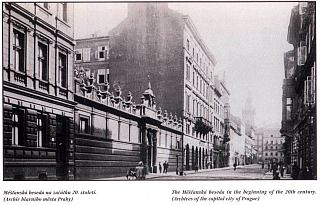
Beseda
is mentioned by Švejk when he tells Oberleutnant Lukáš how unfortunate he has been with women.
Background
Beseda
surely refers to Měšťanská beseda in Prague II. The institution existed from 1845 until 1952 and the associated restaurant was, in 1891, listed as belonging to Gustav Stejskal. Since 2008, the building has been a four-star hotel.
Quote(s) from the novel
[III.4] To se ví, že se všichni smáli a její matinka, která ji tam hlídala, že ji vodvedla na chodbu v ,Besedě’ a že tu svou blbou nánu zkopala.
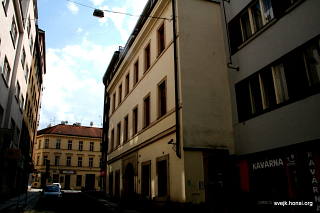
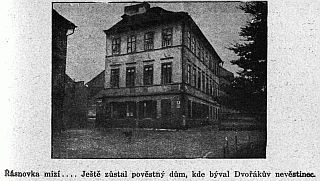
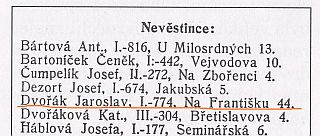
U Dvořáků
was one of the brothels tinsmith Pimpra often ended up at when he went out to buy sheet metal. This is an anecdote Švejk fittingly tells Leutnant Dub after the latter's escapades in a similar establishment in Sanok.
Background
U Dvořáků
almost certainly refers to a brothel in Staré město owned by Jaroslav Dvořák. The address book from 1912 [a] lists another brothel with Kateřina Dvořáková as proprietor, but it was located in Malá Strana, and the story about tinsmith Pimpra is clearly set in Staré Město.
Quote(s) from the novel
[III.4] Ale to byl asi nějakej vomyl. Klempíře Pimpra z Kozího plácku taky vždycky hledali, když šel kupovat plech do města, a našli ho také vždycky v podobnej místnosti, buď u ,Šuhů’, nebo u ,Dvořáků’, jako já vás našel.
Karmelitáni
probably refers to kostel Panny Marie Vítězné (Church of Our Lady of Victories) in Malá Strana, Prague. It was owned by the Carmelite order until 1784 and has been again since 1993.
Quote(s) from the novel
[III.4] Naproti karmelitánům v Praze měl, pane obrlajtnant, před lety krám s králíky a jiným ptactvem pan Jenom. Ten si udělal známost s dcerou knihaře Bílka.
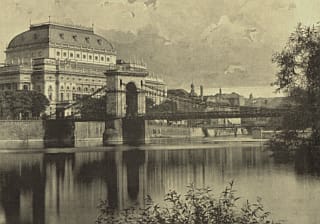
Národní divadlo
is mentioned in the anecdote about nadstrážník Hubička. The couple who were arrested in Resslova ulice had walked from the theatre to get some fresh air.
Background
Národní divadloNational Theatre
is the Czech National Theatre. The building was erected in the neo-Renaissance style between 1868 and 1883 and has become a national symbol.
Quote(s) from the novel
[III.4] Ekvipáž že je dovezla až za Národní divadlo a nyní že se chtí provětrat a bydlí nedaleko, na Moráni, on že je vrchní místodržitelskej rada s chotí.
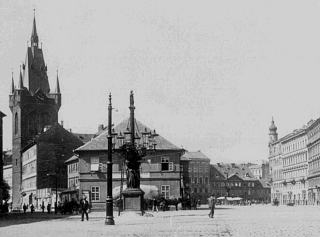
The police station was located in the building in the middle (1905)
Svatý Jindřich
is mentioned in the anecdote about nadstrážník nadstrážník Hubička, who had arrested an editor dressed as a policeman. The fake policeman said he was stationed here.
Background
Svatý JindřichSt. Henry
presumably refers to the police station by kostel Svatého Jindřicha (Church of St. Henry) in Prague. There is no police station there today, but in Švejk's time it was located at Havlíčkovo náměstí, in close proximity to the mentioned church. The building has since been demolished and the space is now empty, apart from some public toilets (2025).
Quote(s) from the novel
[III.4] Ta paní už ani plakat nemohla a pan vrchní místodržitelský rada rozčilil se tak, že začal mluvit něco vo sprosťáctví, načež byl zatčen a předveden k nejbližší patrole v rayonu komisařství v Salmově ulici, které řekl převlečený redaktor, aby ten párek odvedli na komisařství, on že je od svatého Jindřicha a byl za služební cestou na Vinohradech, oba dopadl při rušení nočního klidu, při noční rvačce, a zároveň že ještě spáchali přestupek urážky stráže.