


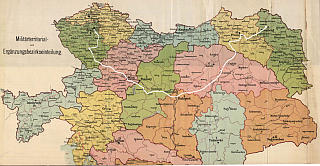
Švejk's journey on a of Austria-Hungary from 1914, showing the military districts of k.u.k. Heer. The entire plot of The Good Soldier Švejk is set on the territory of the former Dual Monarchy.
The Fateful Adventures of the Good Soldier Švejk (mostly known as The Good Soldier Švejk) by Jaroslav Hašek is a novel that contains a wealth of geographical references - either directly through the plot, in dialogues or in the author's narrative. Hašek was himself unusually well travelled and had a photographic memory of geographical (and other) details. It is evident that he put a lot of emphasis on geography: Eight of the 27 chapter headlines in the novel contain geographical names.
This web site will in due course contain a full overview of all the geographical references in the novel; from Prague in the introduction to Klimontów in the unfinished Part Four. Continents, states (also defunct), cities, market squares, city gates, regions, districts, towns, villages, mountains, mountain passes, oceans, lakes, rivers, caves, channels, islands, streets, parks and bridges are included.
The list is sorted according to the order in which the names appear in the novel. The chapter headlines are from Zenny Sadlon's recent translation (1999-2008) and will in most cases differ from Cecil Parrott's translation from 1973.
The quotes in Czech are copied from the on-line version of The Good Soldier Švejk: provided by Jaroslav Šerák and contain links to the relevant chapter. The toolbar has links for direct access to Wikipedia, Google maps, Google search, svejkmuseum.cz and the novel on-line.
The names are coloured according to their role in the novel, illustrated by these examples: Sanok a location where the plot takes place, Dubno mentioned in the narrative, Zagreb part of a dialogue, and Pakoměřice mentioned in an anecdote.
 Places index of countries, cities, villages, mountains, rivers, bridges ... (591)
Show all
Places index of countries, cities, villages, mountains, rivers, bridges ... (591)
Show all I. In the rear
14. Švejk as military servant to senior lieutenant Lukáš (60)
II. At the front
2. Švejk's budějovická anabasis (64)
3. Švejk's happenings in Királyhida (43)
III. The famous thrashing
1. Across Magyaria (38)
2. In Budapest (38)
3. From Hatvan to the borders of Galicia (50)
4. Forward March! (42)
I. In the rear
14. Švejk as military servant to senior lieutenant Lukáš (60)
II. At the front
2. Švejk's budějovická anabasis (64)
3. Švejk's happenings in Királyhida (43)
III. The famous thrashing
1. Across Magyaria (38)
2. In Budapest (38)
3. From Hatvan to the borders of Galicia (50)
4. Forward March! (42)


|
I. In the rear |
 | |
15. Catastrophe | |||
 | Zillergut |  | |||
| |||||
Zillergut appears in connection with the author's description of Oberst Kraus. His predecessors had appropriated the noble title Zillergut, after some village in Herzogtum Salzburg that they had fleeced in the 18th century.
Background
Zillergut is an unknown geographical entity, most probably an invention by the author. There is no village Zillergut in Salzburg or anywhere else, and a search in historical newspapers show no results apart from the common name "Zillergut" (unknown etymology). The author may have had Zillertal in mind, but this is a valley in Tyrol, not a village in Herzogtum Salzburg.
Quote(s) from the novel
[I.15] Plukovník Bedřich Kraus, mající též přídomek von Zillergut, po nějaké vesničce v Solnohradech, kterou jeho předkové prožrali již ve století osmnáctém, byl úctyhodným pitomcem.
|
| Herzogtum Salzburg | | |||
| |||||
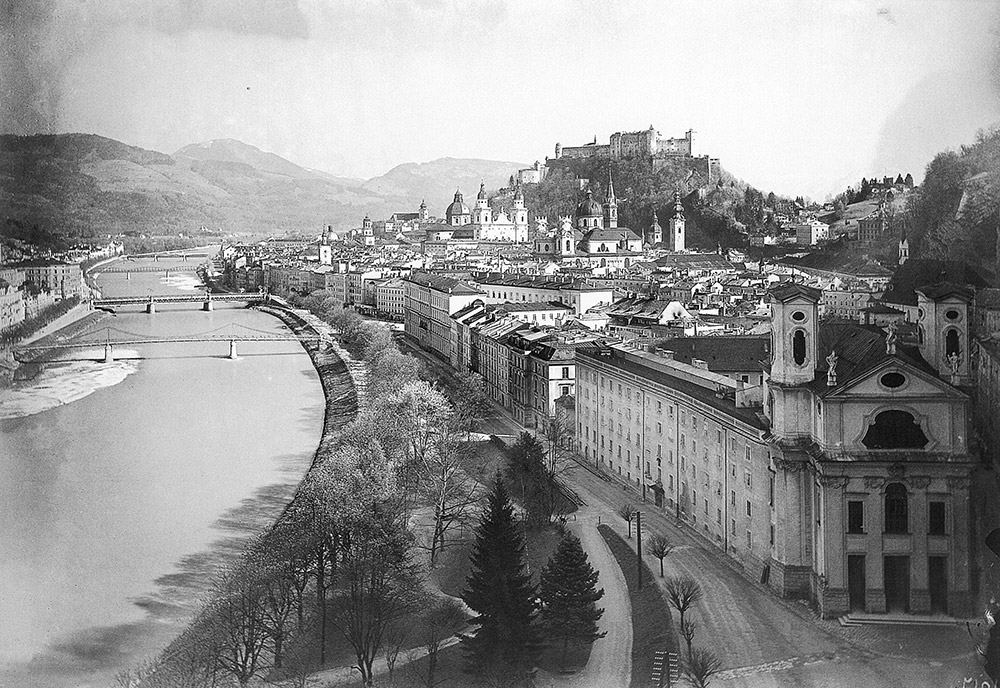
Blikk von der Humboldt-Terrasse, nach 1910
© Stadtarchiv Salzburg
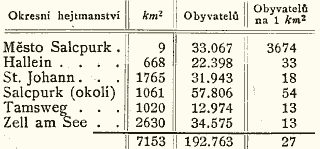
Ottúv slovník naučný, , 1904

Salzburg third in the literacy league.
, 10.12.1913
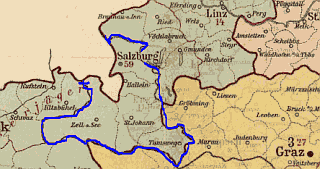
Ergänzungsbezirk Nr. 59
Herzogtum Salzburg appears in connection with the author's description of Oberst Kraus. His predecessors had appropriated the noble title Zillergut, after some village in the area that they had fleeced in the 18th century. The theme here is therefore the duchy of Salzburg, not the city itself.
Background
Herzogtum Salzburg (Duchy of Salzburg) was one of 15 crown lands of Cisleithanien. It was included in Austria in 1816 as a result of the Napoleonic wars, and thus became part of Austria-Hungary in 1867. From 1 January 1850 onwards the duchy enjoyed the status as a crown land, with it's own government, headed by the Landeshauptmann.
The area of the duchy was the same as the current Land Salzburg, one of the nine states in current Austria. It bordered Bavaria, Tyrol, Carinthia, Styria og Österreich ob der Enns (no Oberösterreich). At the start of the 20th century the population number was slightly below 200,000, distributed across six districts (Salzburg Stadt, Salzburg Umgebung, Hallein, Zell am See, St. Johann and Tamsweg).
Czech terminology
The author uses the plural term Solnohrady (The Salt Castles), as opposed to the singular Solnohrad that refers to the city of Salzburg. Solnohrady and Salcpursko were during the author's lifetime used interchangeably, but both refers to the duchy of Salzburg. In Czech the city was previously also called Salcpurk, but in our times (2011) Salcburg is more common.
Military
Militarily the city of Salzburg and the crown land belonged to Korpskommando Nr. 14 that was located in Innsbruck. The city was also the seat of recruitment district No. 59 with the "house regiment" Infanterieregiment Nr. 59. I 1914 only one battalion from the house regiment were garrisoned here. Salzburg was also the seat of Feldkanonenregiment Nr. 41, a military court and also Platzkommando.
Czech soldiers
It could be added that staff and three battalions of Infanterieregiment Nr. 75 were garrisoned in Salzburg from 1912 to 1914 so at the outbreak of war the city hosted a sizeable contingent of Czech soldiers.
Quote(s) from the novel
[I.15] Plukovník Bedřich Kraus, mající též přídomek von Zillergut, po nějaké vesničce v Solnohradech, kterou jeho předkové prožrali již ve století osmnáctém, byl úctyhodným pitomcem.
Also written:Duchy of Salzburg en Solnohrady Hašek Salcburské vévodství cz Hertugdømet Salzburg no
Literature
- Salcpursko1904
|
| Na Příkopě | | ||||
| ||||||
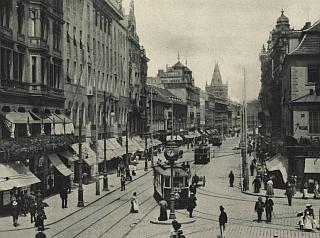
Na Příkopě / Am Graben, 1908
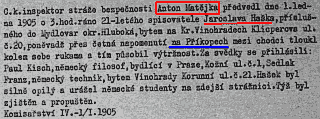
Police report. Hašek arrested after causing trouble on Příkopy 1 January 1905. Translated by Břetislav Hůla.
© LA-PNP
Na Příkopě is mentioned as Oberleutnant Lukáš was on the way to the corner of this street and Panská ulice to meet a lady when the fatal encounter with Oberst Kraus took place.
Background
Na Příkopě is a well-known street in Prague, often simply called Příkopy, one of the more up-market shopping streets. During Austria this area was dominated by Germans and was one of the most exclusive streets in the city.
In German the street was known as Am Graben, a parallel to the similarly exclusive and like-named street in Vienna. The name is literally translated On the Moat.
Drunk and disorderly
"German" Příkopy would not have been the street Hašek most frequently visited, but one incident is recorded. At 3 in the morning 1 January 1905 Hašek caused disorder on this street. Totally drunk he waved his arms around and also insulted German students. One of the witnesses to the incident was the "German philosopher" Paul Kisch, brother of the eventually famous Egon Erwin Kisch. The perpetrator admitted to being very drunk and said he couldn't remember much of it. A record of the incident is stored in the police archives, translated into Czech by Břetislav Hůla.
Quote(s) from the novel
[I.15] Vyšli na ulici a nadporučík Lukáš zaměřil se psem na Příkopy. Měl se setkat s jednou dámou na rohu Panské ulice. Byl zabrán v úřední myšlénky. O čem má zítra přednášet jednoročním dobrovolníkům ve škole?
Also written:Příkopy Hašek Am Graben de
Literature
|
| Panská ulice | | ||||
| ||||||
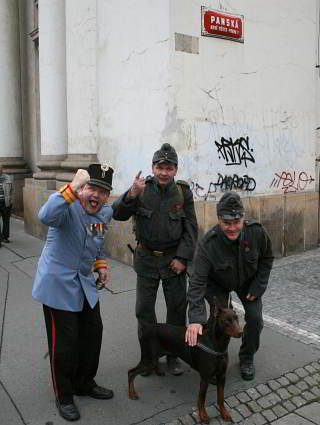
Corner of Příkopy and Panská, October 2010.
© Jomar Hønsi
Panská ulice is mentioned as Oberleutnant Lukáš was on the way to the corner of Na Příkopě and this street to meet a lady when the fatal encounter with Oberst Kraus took place.
Background
Panská ulice is a relatively short side street to Na Příkopě, extending south towards the main railway station. It reaches towards Jindřišská. Panská ul. (Herrengasse) was the home of, amongst others, Prager Tagblatt and the Piarists (see U Piaristů).
The good soldier Švejk in captivity
In Dobrý voják Švejk v zajetí the street is also mentioned but the context is that the editorial offices of Prager Tagblatt were located here.[1]
Velmi zamyšleně se tvářil pán v prostředních letech, velmi slušně oděný, který se včera dostal do chumlu před Prager Tagblattem v Panské ulici.
Quote(s) from the novel
[I.15] Vyšli na ulici a nadporučík Lukáš zaměřil se psem na Příkopy. Měl se setkat s jednou dámou na rohu Panské ulice. Byl zabrán v úřední myšlénky. O čem má zítra přednášet jednoročním dobrovolníkům ve škole?
[I.15] Z těchto myšlének byl vyrušen přísným „halt“, právě když se přiblížil k Panské ulici.
Literature
| 1 | Dobrý voják Švejk v zajetí | 1917 |
|
| Náchod | | |||
| |||||
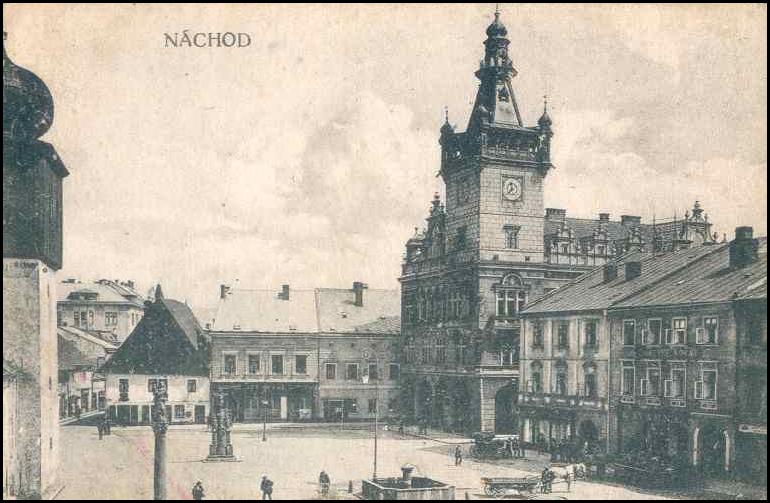
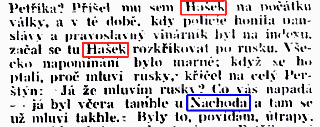
,14.10.1936
Náchod is mentioned as Švejk had heard from a soldier in the barracks that artillery fire from the front could be heard all the way here and that the Russian tsar would soon be in Kraków.
Background
Náchod is a town in eastern Bohemia, only a few kilometres from the border with Poland. The distance to the front at in the autumn of 1914 was about 300 km (Raba), so the claim about the sound of artillery was dubious and probably a popular saying.
Hašek in Náchod
Jaroslav Hašek visited the Náchod district in August 1914, a stay that finds its way into the novel via Josefov and Jasenná.
In 1936 Eduard Bass wrote about an episode that also could be linked to this stay and not the least to this fragment of the novel. At the start of the war the author visited the wine bar U Petříku where he caused consternation by talking loudly in Russian, and when requested to quieten down he replied: "Why should I? Yesterday I was by Náchod and already now they talk like that over there"[a].
Demography
According to the 1910 census Náchod had 11,804 inhabitants of which 11,632 (98 per cent) reported that they used Czech in their daily speech. The judicial district was okres Náchod, administratively it reported to hejtmanství Náchod.The district had 59,330 inhabitants of which a mere 320 reported German as their mother tongue.
Source:Seznam míst v království Českém(1913)
Military
In accordance with the recruitment districts infantrymen from Náchod were usually assigned to Infanterieregiment Nr. 18 (Königgrätz) or k.k. Landwehrinfanterieregiment Nr. 11 (Jičin).
Quote(s) from the novel
[I.15] Když oba potom ještě dále tlumočili názor českého člověka na válku, voják z kasáren opakoval, co dnes slyšel v Praze, že u Náchoda je slyšet děla a ruský car že bude co nejdřív v Krakově.
Sources: Radko Pytlík
| a | Vinárník Petřík umřel | Eduard Bass | 14.10.1936 |
|
| Prašná brána | | |||
| |||||

From 1856, as it might have appeared as Crenneville marched through
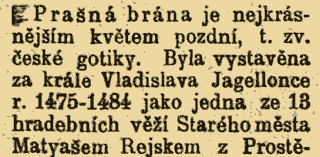
, 1900
Prašná brána is mentioned in a song Švejk sings after the calamitous return of Oberleutnant Lukáš after he had been caught by Oberst Kraus with the stolen Fox. It is not stated in the plot, but the famous meeting between Lukáš and the colonel took place only a few steps from the gate.
In [III.4] the power is mentioned again in the long story about the unfortunate Oberst Fliedler and his visit to the dentist.
Background
Prašná brána is a gothic tower and former city gate in Staré město, erected at the end of the 15th century. Between 1878 and 1886 the tower was rebuilt in pseudo-gothic style, which makes it's current appearance different from that on the picture. The architect leading the reconstruction was the renowned Josef Mocker (1835-1899). The tower is located by Náměstí Republiky and is 65 metres tall.
The mentioned song has several variations, and without featuring Prašná brána. See Graf Crenneville for more information.
Quote(s) from the novel
[I.15]Mašíruje Grenevil Prašnou bránou na špacír, šavle se mu blejskají, hezký holky plakají
[III.4] Ale ten obrst Fliedler, to vám byl taková potvora mizerná, dej mu pámbu nebe, že chodil druhej den po Praze a hledal někoho, kdo se vodvážil z našeho regimentu vylézt z kasáren, a někde u Prašný brány potkal taky šťastně Železnýho a hned na něho spustil: ,Já ti tám, já ti náučím, já ti dfakrát oslatím!’
Also written:Powder Tower en Pulverturm de Kruttårnet no
Literature
- Prašná věž v Praze1879
- Povídka o pořádnem člověkuJaroslav Hašek1.1.1914
|
| Ohře | | |||
| |||||
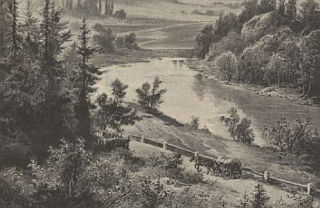
, 1896
Ohře is mentioned by Oberst Kraus who mistakingly thinks the river flows into Vltava by Budějovice.
Background
Ohře is a river in north western Bohemia. The source is in the Fichtelbebirge in Bavaria. The river does actually flow into Vltava, but by Litoměřice and not by Budějovice as the colonel thinks. It's total length is 316 km and the catchment area is 5,588 sq. km.
Quote(s) from the novel
[I.15] Víte, kde jsou Budějovice? Na Vltavě, ano, na Vltavě a vtéká tam Ohře nebo něco podobného.
Also written:Eger de
|
| Nekázanka | | ||||
| ||||||
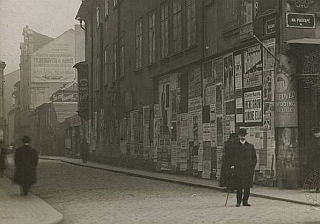
,1907

,1929
Nekázanka is mentioned because Oberleutnant Lukáš was to hold his farewell party somewhere in this street. This was the last time in The Good Soldier Švejk that that the plot was set in Prague.
The street is mentioned later in connection with Nechleba and the pub V čubčím háji.
Background
Nekázanka is a short street in Praha II., connecting Na Příkopě and Jindřišská. It has existed since the 14th century, under various names. The most important building was the Country Bank and the street had several restaurants.
Why Oberleutnant Lukáš would hold a farewell party in this particular street is not easy to explain. Perhaps he lived in the area? That he walked the stolen dog Max at Na Příkopě points in this direction. Perhaps there was some officer's club in the street? He may also have celebrated in one of the restaurants or other establishments.
Quote(s) from the novel
[I.15] Tím byl příjemný hovor ukončen a nadporučíkovi se velice ulehčilo, když vyšel z kanceláře a šel do školy jednoročních dobrovolníků, kde oznámil, že v nejbližších dnech jede na frontu, a uspořádá proto večírek na rozloučenou v Nekázance.
[II.1] Já mám takovou smůlu jako nějakej Nechleba z Nekázanky, který tam chodil do hospody ,V čubčím háji’.
|
|
I. In the rear |
| |
15. Catastrophe | |||
| © 2008 - 2024 Jomar Hønsi | Last updated: 16.4.2024 |