 Norsk
Norsk English
This site is devoted to The Fates of the Good Soldier Švejk in the World War*, written in 1921–22 by Jaroslav Hašek (1883–1923). The Good Soldier Švejk (an abbreviation often used for the title) is widely regarded as a satirical masterpiece and a pioneering work of anti-war literature. Bertolt Brecht reportedly called it one of the three most important novels of the century, and later wrote a play based on the book. Max Brod compared it with Don Quijote by Cervantes. Joseph Heller and his Catch 22 are often mentioned alongside Švejk, as are Rabelais, Dickens and Twain. The Good Soldier Švejk has been translated into 54 languages (59 if variations such as American English are counted) and is arguably the best-known novel ever written in Czech. *) A literal translation of the title.
Stupidity uncovered
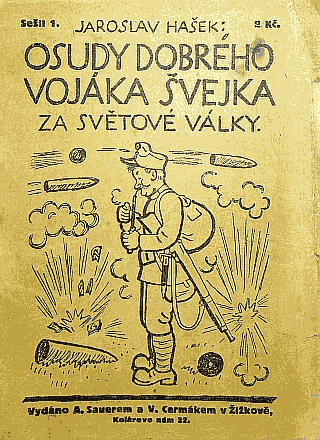
The cover of the first instalment (March 1921), drawn by Josef Lada. This is the only drawing of Švejk that Hašek ever saw. The better-known, more rotund version first appeared on 11 November 1923 in České Slovo, ten months after Hašek's death. Picture courtesy of Richard Hašek, the author's grandson.
Jaroslav Hašek's satire in The Good Soldier Švejk is biting—at times coarse but never vulgar. It is a sharp attack on institutions and authority and, above all, on the human stupidity embodied by those institutions. It is therefore no coincidence that The Good Soldier Švejk has been banned on several occasions. The authorities who resorted to censorship felt their toes had been trodden on—and for good reason.
Many readers associate the novel primarily with humour, but its message is serious and timeless. Its sting is directed at human-made systems—and at those who exploit their positions within them for personal gain, or who conform out of limited horizons, selfishness, fear, greed, cowardice, stupidity and, most tragically, a lack of alternatives.
Corruption and abuse of power are not limited to the era and region Hašek described; they are deeply rooted in human nature. The Good Soldier Švejk will therefore remain relevant as long as human beings exist on Earth. The novel has strong geographical, historical and cultural ties to Central Europe, but this does not make it any less universal.
Setting
The Good Soldier Švejk is set at the start of the First World War. It begins with the news of the assassination of Archduke Franz Ferdinand, the Austro-Hungarian heir to the throne, in Sarajevo on 28 June 1914, and ends on the Eastern Front in present-day Ukraine in the summer of 1915. Owing to the author's early death, the novel was never completed, although Karel Vaněk finished the fourth volume and added two further volumes. Most experts and readers consider these inferior, and hardly any translations exist.
Švejk
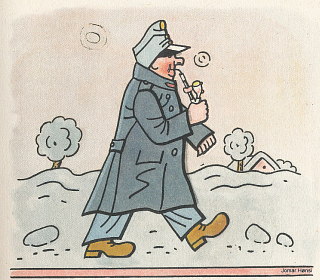
Švejk in a coloured edition from 1953. Drawn by Josef Lada.
The novel's main character, Josef Švejk, is a dog trader from Prague, then part of the Austro-Hungarian Empire. He makes a living by selling dogs with falsified pedigrees. He also likes to claim that he was discharged from the army on grounds of mental incapacity—an explanation he tends to reserve for encounters with the authorities. Otherwise, he has a gentle, charming and disarming manner; his outlook appears limited, his moral character seems dubious, and he is known for telling endless anecdotes, some of them quite unsavoury. These stories are often his way of extricating himself from difficult situations. He speaks readily, always has an answer, and is rarely caught off guard. Although he does not seem clever, he undoubtedly has a good memory and reads a great deal.
Misunderstood idiocy
Since the novel was published, readers—from academics to ordinary readers—have debated whether Švejk is mentally limited or simply plays the fool. He can certainly seem stupid when it suits him. Yet anyone who has read the novel attentively should be in no doubt. In the epilogue to the first volume, Hašek states that if the reader had taken Švejk to be an idiot, he, as an author, had failed to convey his message.
The art of survival
Švejk appears eager to serve his Emperor and is sent to the front to fight the Russians. He and those around him become entangled in countless absurd situations along the way. The author uses this as a backdrop to ridicule the Austro-Hungarian army, the Catholic Church, the police, the judiciary and, not least, the Habsburgs and their empire. Above all, however, he highlights the futility of war. The book has many facets beyond anti-authoritarian and anti-war satire. A former anarchist, Hašek is openly political and sharply critical of society. He portrays this era of European history, provides geographical and historical context, and gives the reader a sense of the region's cultural diversity. The novel is essential reading for anyone interested in Czech or Central European culture. Alongside its serious message, situation comedy and slapstick are vital parts of Hašek's method. He excels at describing ordinary people caught in systems designed to oppress or destroy them. Švejk survives and exposes stupidity through cunning and wit; he is a master of survival.
Inspired by real life
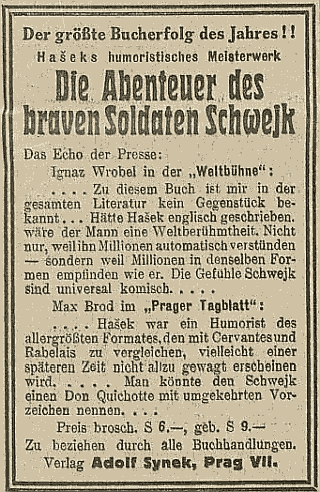
Advert for the German translation of Švejk.
,18.7.1926
Despite the literary influences mentioned at the start of this page, The Good Soldier Švejk draws much more on Hašek's own life and varied experiences than on Cervantes or Rabelais. German writer Kurt Tucholsky (a.k.a. Ignaz Wrobel) enthused: In the whole world of literature, I know of no novel comparable to this one. Švejk's route to the front line is described in detail and largely corresponds to Hašek's own journey to the battlefield in Galicia in early July 1915. Several characters and situations are borrowed directly from his surroundings and experiences. Although the characters in The Good Soldier Švejk are often caricatures that never fully match their real-life counterparts, they remain recognisable, down to biographical details.
Although the novel is fiction, it can, to some extent, be read as a historical document. Hašek's diverse background and extensive knowledge are evident throughout the novel. He provides detailed descriptions of drinking binges, the Catechism, meal preparation, historical events, stays in asylums, religious rituals and dog breeding—much of it based on his own experiences, but also interspersed with material from written sources including calendars, periodicals and encyclopaedias.
What was not written
Had Hašek not died before he could finish the fourth of the planned six volumes, we may assume that Švejk, like his creator, would have let himself be captured by the Russians, served in the Legions, worked for the Bolsheviks, and eventually ended up in Siberia. We will never know Hašek's detailed plan for his good soldier, but it seems likely that he intended to cover the years in Russia, including the Russian Civil War. We can only guess how directly the satire would have targeted the Legions and the Bolsheviks; however, judging from what Hašek wrote in Russia and after his return to Bohemia, they would not have been spared. That said, the criticism would probably not have been as severe as that directed against the Austro-Hungarian Empire in the first four parts of the novel. The Bugulma stories that appeared in early 1921 suggest a more conciliatory tone. Certain aspects of the Russian Revolution are ridiculed, but the author does not show the venom found elsewhere in The Good Soldier Švejk. Hašek did not like being asked what he had done in Russia, and when the subject came up, he retorted that anyone who wanted to know would have to wait for the novel. Unfortunately, he never reached that part...
The return that never happened
Undoubtedly, Hašek would have let Švejk return to Prague unhurt. He would have let him drink his Velké Popovice beer at U kalicha at six o'clock in the evening, this time with Sappeur Vodička. Bretschneider—the instrument of oppression—would be gone, along with the lingering odour that poisoned the air. We may well speculate about what Švejk might have experienced from mid-July 1915 until his return to Prague in 1920. Still, Hašek would surely have continued to align his hero's itinerary roughly with his own journey across the Eurasian continent. Hašek might also have let Švejk face the same rejection and hostility that he, branded a "Bolshevik" and a "traitor", endured when he returned to independent Czechoslovakia in December 1920.
My motivation for creating this website in 2009 was simple: despite the novel's and the author's global fame, there were few online resources on Švejk and Hašek in any of the Nordic languages. I started in Norwegian, but soon added an English translation to reach a wider readership. As well as introducing the author and the novel, the site aims to present existing information in a fresh way and to add some previously unknown material. The Good Soldier Švejk is replete with references to places, people and institutions—probably around 2,000. The range is so comprehensive that dedicated readers may welcome an overview of the often little-known individuals, places and institutions (now largely defunct) that Hašek mentions. I have therefore created lists in all categories, a task still in progress (as of 2026). Where possible, the descriptions include links to online resources and, in some cases, to archive and library material collected by the webmaster.