
|
search |
The Good Soldier Švejk |

|
  |
|||||
| museum | article | Švejk on-line | Literární Archiv | Bibliografie | Švejk Central | Blog | Travel Diary | home | |
People
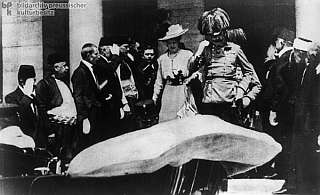
Franz Ferdinand and his wife Sophie leaving Sarajevo Town Hall on 28 June 1914, five minutes before the assassination.
The Good Soldier Švejk is a novel with an exceptionally rich cast of characters. Alongside those who play a direct part in the plot, a great many fictional and real people (and animals) are mentioned throughout the narrative, in Švejk's anecdotes and in the book's idioms and turns of phrase.
This page offers brief entries on the people referred to in the novel, from Napoléon in the introduction to Hauptmann Ságner in the final lines of the unfinished Part Four. The list is sorted in the order in which names first appear. Chapter headings follow Zenny Sadlon's recent translation (1999–2026) and, in most cases, differ from Cecil Parrott's 1973 version.
The Czech quotations are taken from the online version of The Good Soldier Švejk provided by Jaroslav Šerák and link to the relevant chapter. The toolbar provides direct links to Wikipedia, Google Maps, Google Search, svejkmuseum.cz and the novel online.
The names are colour-coded according to their role in the novel, as illustrated by the following examples:
- Dr. Grünstein, a fictional character directly involved in the plot.
- Fähnrich Dauerling, a fictional character who is not part of the plot.
- Heinrich Heine, a historical person.
Note that many seemingly fictional characters are inspired by real people. Examples include Oberleutnant Lukáš, Major Wenzl and many others. These are still listed as fictional, since they are literary creations only partly inspired by their similarly named 'models'.
Military ranks and other titles related to Austrian officialdom are given in German, in accordance with the terms used at the time (explanations in English are provided as tooltips). This means that Captain Ságner is still referred to as Hauptmann, even though the term is now obsolete and has been replaced by Kapitän. Civilian titles denoting profession, etc., are translated into English. This also applies to ranks in the nobility where a direct translation exists.
 People index of people, mythical figures, animals ... (589)
Show all
People index of people, mythical figures, animals ... (589)
Show all I. In the rear
1. The good soldier Švejk acts to intervene in the world war (30)
14. Švejk as military servant to senior lieutenant Lukáš (35)
II. At the front
1. Švejk's mishaps on the train (22)
2. Švejk's budějovická anabasis (55)
3. Švejk's happenings in Királyhida (46)
4. New afflictions (21)
5. From Bruck on the Leitha toward Sokal (45)
III. The Illustrious Thrashing
1. Across Magyaria (52)
2. In Budapest (32)
3. From Hatvan to the Borders of Galicia (31)
4. Forward March! (32)
IV. The Illustrious Thrashing Continued
1. Švejk in the Transport of Russian Prisoners of War (35)
3. Švejk again with his March Company (20)
I. In the rear
1. The good soldier Švejk acts to intervene in the world war (30)
14. Švejk as military servant to senior lieutenant Lukáš (35)
II. At the front
1. Švejk's mishaps on the train (22)
2. Švejk's budějovická anabasis (55)
3. Švejk's happenings in Királyhida (46)
4. New afflictions (21)
5. From Bruck on the Leitha toward Sokal (45)
III. The Illustrious Thrashing
1. Across Magyaria (52)
2. In Budapest (32)
3. From Hatvan to the Borders of Galicia (31)
4. Forward March! (32)
IV. The Illustrious Thrashing Continued
1. Švejk in the Transport of Russian Prisoners of War (35)
3. Švejk again with his March Company (20)| © 2008 - 2026 Jomar Hønsi | Last updated: 28 September 2026 |