


On 1 September 1911, the popular fortnightly magazine Svět zvířat (Animal World) printed a brief unsigned news item entitled Pravěká blecha (A prehistoric flea)[f], in its traditional column From Around the World. The entry translates approximately as follows:
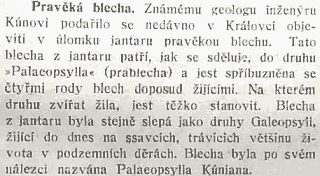
,1.9.1911
A prehistoric flea. Not long ago, the well-known geologist engineer Kún discovered a prehistoric flea preserved in a piece of amber in Königsberg. This flea reportedly belonged to the species Palaeopsylla (prehistoric flea), which is related to four genera of fleas still living today. It is difficult to ascertain what animal it lived on. Preserved in amber, it was as blind as the four species of Galaeopsylla that now live on mammals which spend most of their lives in underground burrows. It was named Palaeopsylla Kúniana after its discoverer.
Unnoticed
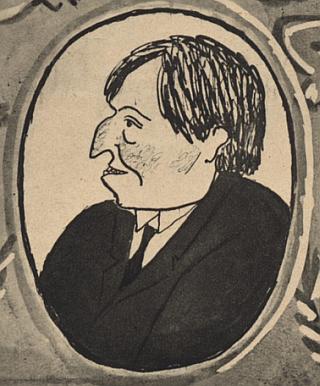
Engineer Kún as envisaged during the interwar years.
,17.11.1928
That this obscure news item naturally passed unnoticed at first is hardly surprising. More surprising is that the discovery eventually caused a minor stir in a couple of newspapers, but nearly two years later! In August 1913, it emerged that the flea's "discovery" was a prank by none other than Jaroslav Hašek, a former editor of Svět zvířat, a notorious hoaxer and, above all, the author of The Good Soldier Švejk. Hašek's world-famous novel ultimately ensured that the miniscule creature became known well beyond the confines of specialist literature.
Hašek the prankster
Hašek's small jokes and selected curiosities had also appeared in Svět zvířat during his time as editor of the journal (1909-1910). The pranks may have contributed to his losing the job, although not in the manner that his literary alter ego Einjährigfreiwilliger Marek describes in The Good Soldier Švejk. On one occasion, he turned the painter Josef Lada into a translator of Hungarian, and on another into a poet. He also printed various accounts of dubious veracity, in which genuine curiosities are hard to distinguish from outright hoaxes. In 1911, it was Vilém Kún's turn to lend his name to an obscure item in the animal journal. Kún had absolutely nothing to do with geology, amber or fleas. He was, however, a man of other talents and a member of Hašek's mock party Strana mírného pokroku v mezích zákona.
Surprising timing
There was nothing unusual about Hašek indulging in such pranks, but the timing of the flea story is surprising. It appeared many months after Hašek had left Svět zvířat, and researchers have rightly assumed that he did not contribute to the magazine at all during 1911. Jaroslav Šerák suggests a plausible explanation: Ladislav Hájek, then editor of Svět zvířat, may have helped his friend Hašek to "plant" the hoax in the animal journal. Alternatively, Hašek may have passed the item to the editor anonymously. Before press agencies became common, this approach was widespread. A famous example is the Grubenhund hoax by Karl Kraus, which tricked Neue Freie Presse in 1908 and again in 1911. Hašek may even have conspired with someone at the book printer Edvard Leschinger who printed Svět zvířat during Hašek's tenure as editor and also in 1911.
The flea, resurrected by Lidové noviny...
,12.8.1913
,17.8.1913
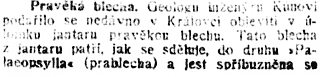
In 1913, the flea story reappeared, somewhat curiously, in the Brno newspaper Lidové noviny[b]. The only difference from the 1911 item in Svět zvířat is that engineer Kún is demoted from a renowned geologist to merely a geologist. Even the typo Galaeopsylla (instead of Palaeopsylla) is faithfully reproduced. Why the flea resurfaced two years later in a newspaper as far away as Brno remains unclear. Again, the clue may lie in Strana mírného pokroku v mezích zákona, as one of the editors was Jiří Mahen (1882-1939), another member of Hašek's "party". Still, there is no proof that Ladislav Hájek and Mahen colluded with Hašek to plant the items in Svět zvířat and Lidové noviny, respectively, though the suspicion remains...
...picked up by Čech...
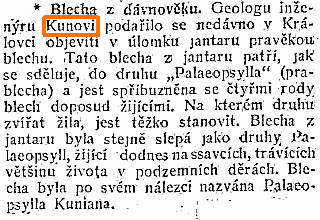
Four days after Lidové noviny's revelation, the clerical daily Čech reproduced the piece under a changed headline. The editors also appear to have checked it, as they corrected the aforementioned typo[c].
...and exposed by Právo lidu...
The note in Čech set the story's unravelling in motion: two days later (on 19 August 1913), Právo lidu exposed the hoax in an article sarcastically titled Hašek's engineer Kún's flea and Catholic Science, referring back to the Čech piece. It reported that the news about the flea had been published by the humourist Jaroslav Hašek in Svět zvířat at Lenten time four years earlier. Právo lidu drily observed a new development in Catholic science – Čech, which had previously drawn wisdom from the Holy Scriptures, now turned to Animal World for insight.
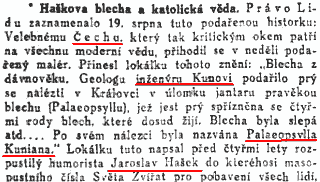
,21.8.1913
Franta Sauer claims that Hašek himself wrote the piece ridiculing Čech. Although Sauer is not regarded as the most reliable of witnesses, he may have a point, since Hašek was contributing frequently to Právo lidu when the flea story was exposed. Augustin Knesl supports this hypothesis.
...leading to bickering between Čech and Čas
The article in Právo lidu was picked up by several newspapers, including Čas[d]. This seems to have alerted Čech, which promptly issued an irate response[e]. The account of Hašek's flea, as quoted in Právo lidu, appeared in several newspapers and even reached the USA, where a number of Czech-language periodicals reproduced it. One of these was Minnesotské noviny.
In The Good Soldier Švejk
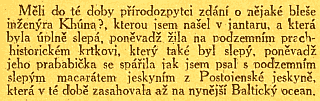
Osudy dobrého vojáka Švejka.,1921
The tale of the flea and the ensuing polemic between Čech and Čas will be familiar to readers of The Good Soldier Švejk. The incident featured in Einjährigfreiwilliger Marek's long monologue about his time as editor of Svět zvířat. Marek claimed that he had found the flea in amber, that it was blind, and that it was named after Khún. There the similarities end: Marek omitted some details and replaced others with more imaginative inventions. Those additions are absent from the original Svět zvířat article.
In The Good Soldier Švejk, the debate between Čech and Čas contributes to Einjährigfreiwilliger Marek's downfall as editor of Svět zvířat. In reality, it took place three years after Hašek's dismissal and therefore cannot have contributed to his losing the job. Nor is it true that Čech wrote that "what God does, he does well". According to Právo lidu, the phrase appeared "at masopust four years ago"[d]. Had that been true, it would have been published in February 1909, but it first appeared in the columns of Svět zvířat much later, on 1 September 1911.
Metamorphosis: From Klebs to Kún
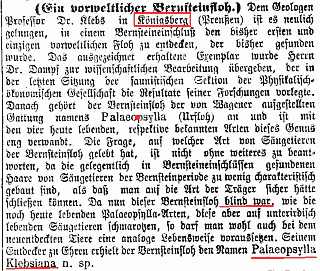
,1.8.1911
The ensuing exchange in the columns of Čech and Čas is well known because of The Good Soldier Švejk. The background to the flea's "discovery", however, has remained obscure and is still not fully understood.
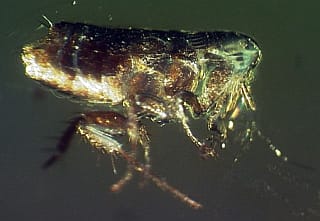
Palaeopsylla klebsiana
,2012
Sometime in 1910, a prehistoric flea was discovered in Königsberg, preserved in a piece of amber. The specimen was handed over to dr. Alfons Dampf for further analysis. In December 1910, Dampf published his findings in a scientific journal, giving a full account and even including drawings of the flea[a].
In January 1911, news of the discovery appeared in Westfälisches Tageblatt and Neues Wiener Journal[l], and the description of the creature bore a striking resemblance to the report in Svět zvířat. Its discoverer was dr. Richard Klebs (1850-1961), a well-known German geologist and an expert on amber. The specimen was officially named Palaeopsylla Klebsiana[a].
In August 1911, Neues Wiener Journal referred to the discovery again (with a typo, "Krebs"). Almost simultaneously, identical texts appeared in some German newspapers (e.g. Rhein- und Ruhrzeitung, Essener Volks-Zeitung), with Klebs's name correctly spelt. They all quote Natur, the bi-weekly publication of Deutsche Naturwissenschaftliche Gesellschaft, which was the text's source[h].
The account in Natur is even closer to that in Svět zvířat[f] than the January report. Apart from a few sentences being left out in the translated version, he only major difference is the discoverer's name: the well-known geologist dr. Klebs, not engineer Kún. To judge by the wording, Hašek's source was probably Neues Wiener Journal, from which he also seems to have translated on earlier occasions.
The flea is preserved to this day and is exhibited in Göttingen[g]. In the end, the creature itself is real enough; the prankster Jaroslav Hašek merely translated a short German news item and altered a few letters.
Flea folklore
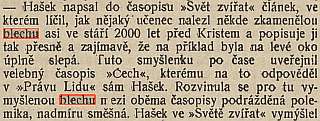
SAU claimed that Hašek himself exposed the flea hoax in Právo lidu. This seems probable considering that Hašek wrote frequently for this newspaper in 1913.
Franta Habán ze Žižkova II..,1923
engineer Kún's flea is one of Jaroslav Hašek's best-known pranks, and many books about the author of The Good Soldier Švejk refer to it. Particularly vivid are the claims made by Hašek's friends, some of which have found their way into scholarly biographies, while the legend lives on both in print and on the internet.
From 1913 onwards, the prehistoric flea retreated into hibernation, where it remained until Jaroslav Hašek resurrected it in 1921 through Einjährigfreiwilliger Marek's tale. Then, following Hašek's death, a number of his friends published their reminiscences of the author. Some of them referred to the flea: Sauer, Zdeněk Matěj Kuděj, Emil Artur Longen, and eventually Josef Lada.
Tak napsal dlouhý článek o šťastném objevení prahorní blechy a vylíčil to tak pravděpodobně, že redaktor kteréhosi zahraničního listu, ve spěchu nebo z nedbalosti, článek přeložil a otiskl, aniž uvažoval, je-li to možné. Článek přetiskly i jiné listy s pochybovačnými a posměšnými poznámkami i bez nich a brzy se o prahorní bleše objevily ve světových přírodopisných časopisech sáhodlouhé polemiky a jejich redakce zahrnuly "Svět zvířat" hrubými výčitkami a radily, aby se šel i s redakčním personálem rovnou utopit. Hašek byl vyhozen bez oné námezdní podmínky: aby dříve za sebe přivedl náhradníka. Josef Lada, 1947. "Kronika mého života"

Josef Lada's version of the flea story: invented from A to Z.
,1954
What these accounts share is the assumption that the flea was Hašek's invention, and his friends and biographers do not seem to have realised that it was a simple name-swapping trick. Of particular interest is Sauer's note that Hašek himself revealed the hoax in Právo lidu. This seems plausible, given that the article's style is typical of Hašek and that he was a regular contributor to that newspaper. It is also striking that Ladislav Hájek (1925) makes no mention of the flea, although, as editor of Svět zvířat, he was on the "inside" when the item appeared.
Kuděj (1924) gave the flea more space than any other biographer, letting Hašek himself tell the story to an audience in a pub in Kammený Přivoz by the river Sázava. The account is colourful, but it is a twisted fabrication, probably mainly by Hašek but also Kuděj. He gives many details but it is hard to believe that Kuděj reproduces them correctly after 10 years. He even claims to quote Hašek's article from Svět zvířat, but the "reproduced" section only marginally corresponds to the original. The story is part of a longer sequence where Hašek entertains the pub hosts with stories about his tenure at Svět zvířat. The event described took place in 1914 during the second of Kuděj's and Hašek's two excursions in Bohemia.
Emil Artur Longen (1928) referred to the minuscule creature only in passing, while Václav Menger ignored it altogether (both were more preoccupied with Hašek's werewolves). Josef Lada provided the most detailed version, claiming that the tale caused a heated debate among foreign scientists. It is not too far-fetched to assume that Hašek himself planted the seeds of these claims.
Flea scholarship
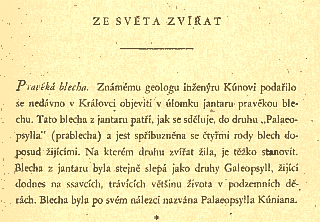
Malá zoologická zahrada,1950.
Serious scholars have also devoted attention to Hašek's flea, but only Břetislav Hůla seems to have read the original entry in Svět zvířat. The proof lies in the typo "Galaeopsyll", printed in Malá zoologická zahrada, the first of only two books dedicated to Hašek's animal stories[i]. Unfortunately, the book has no list of references, so future researchers were left wondering when it appeared. In 1953, Zdena Ančík published the first scholarly biography of Hašek. It does not refer to the flea; instead, the author merely declares that Hašek "thought up strange animals".
The most thorough study of "Hašek and Svět zvířat" was conducted over many years by Radko Pytlík, Zdena Ančík, and Milan Jankovič, and finally published in 1973. It contains an insightful afterword by Pytlík[j] explaining their findings. The flea receives only a brief mention, and the researchers behind the book do not appear to have seen the original item. Instead, they assumed that it was inspired by another piece in Svět zvířat, published during Hašek's time as editor, about a large breed of flea that lived on moles[k]. In the afterword, Pytlík inadvertently reveals why they overlooked it: Břetislav Hůla allegedly included material that "could not have been written by Hašek because it was printed at times when he did not work for the journal".
Knesl's research
The researcher who came closest to revealing the full truth about the flea was Augustin Knesl. He found the original article in Svět zvířat and also described how the polemic between Čech and Čas evolved in 1913. He did not identify the original German version of the account and therefore concluded that the flea was Hašek's invention. Nor did he locate the item in Lidové noviny that Čech presumably copied. Given the research tools available in 1988, those omissions are hardly surprising. Knesl likewise supports the assumption that Hašek himself uncovered the hoax in Právo lidu.
Radko Pytlík referred to the flea in his early works, but, although he was one of the few experts who had actually studied Svět zvířat, he did not make much of it in, for example, Toulavé house. More surprising is that the generally sceptical and thorough scholar Cecil Parrott was careless enough to pass on a summary of Josef Lada's version without quoting him directly.
His article on 'the newly discovered fossil of an antediluvian flea' was so convincing that it was translated and published abroad. Cecil Parrott, 1978. "The Bad Bohemian"
Wiki-myths and other fables
Parrott's blunder is relatively minor compared with what others have conjured up. At the time of writing, German Wikipedia offers perhaps the clearest example of flea folklore, stating that "the spectacular discovery of a prehistoric flea, for example, caused a great stir in the scientific community - Hašek corresponded with zoologists from all over the world".
Die spektakuläre Entdeckung eines Flohs aus der Urzeit beispielsweise sorgte für großes Aufsehen in der Fachwelt - Hašek korrespondierte mit Zoologen aus aller Welt.wikipedia.de, Zugriff 1. Juni 2025. “Jaroslav Hašek -> Leben"
The following is one example of how the legend found its way into academic journals.
His hoaxes were sometimes astonishingly successful. So, for example, in 1910, when Hašek was 27 years old, we find him as editor of a Czech periodical entitled Svět zvířat, a popular publication read by keepers of pets and breeders of domestic animals. It was on the pages of this magazine that the sensational discovery of a prehistoric flea was announced to the world. The creature was depicted so vividly, with an abundance of convincing arguments and striking details, that newspapers in all countries treated the report as first-rate news. International interest in the prehistoric flea and its extraordinary discovery was reaching its zenith when, one day, an infuriated scholar, an expert in the field, branded it a gross leg pull. The author of the hoax was none other than Jaroslav Hašek, who had presented his tale to the public so skilfully and gravely that even critical readers were deceived. Astrid Baecklund‐Ehler, 1964. “The Missing Years in the Life of Jaroslav Hašek.” Scando-Slavica 10 [1]: 94–101
Bæcklund‐Ehler (1908-1976) was more correct than she knew: Jaroslav Hašek's hoaxes were indeed successful, and even critical readers were deceived. This does not mean that the respected Swedish scholar invented the account; she surely drew it from a Czech source, probably Josef Lada. Her paper appeared in 1964, before critical studies of Hašek's writings in Svět zvířat existed.
The flea also found its way into the afterword to the latest German translation of The Good Soldier Švejk (2014), in a biographical section on Hašek written by the translator.
...der die Entdeckung eines urzeitlichen Flohs (»Palleopsyla Kuniana«) durch einen Ingenieur Kún, und führte dabei sogar eine eigene pseudowissenschaftliche Terminologie ein. Antonín Brousek, 2014. “Die Abenteuer des guten Soldaten Švejk im Weltkrieg.” S: 960
This may appear amusing, but one should not be overly condescending towards critical readers such as Parrott, Bæcklund‐Ehler and numerous others. That scholars and laypeople alike have taken Hašek's bait does not imply that they are particularly gullible. Rather, it testifies to Jaroslav Hašek's skill as a hoaxer "ne plus ultra"...
Literature
- Palaeopsylla klebsiana, Dr. Alfons Dampf,15.12.1910 [a]
- Ein vorweltlicher Bernsteinfloh, ,6.1.1911 [l]
- Ein vorweltlicher Bernsteinfloh, ,6.1.1911
- Ein Floh der Vorwelt, ,1.8.1911 [h]
- k. (Ein Floh der Vorwelt), ,9.8.1911
- kf. Ein Floh der Vorwelt, ,19.8.1911
- Ein Floh der Vorwelt, ,19.8.1911
- Pravěká blecha, ,1.9.1911 [f]
- Ein fossiler Floh, ,11.2.1912
- Největší blechy, ,1.3.1913 [k]
- Pravěká blecha, ,12.8.1913 [b]
- Blecha z dávnověku, ,17.8.1913 [c]
- Haškova blecha a katolická věda, ,19.8.1913
- Haškova blecha a katolická věda, ,21.8.1913 [d]
- Novověká kukačka lapajicá pravěké blechy, ,22.8.1913 [e]
- Pravěká blecha - a klerikální Čech, ,23.8.1913
- Haškova blecha a katolická věda, ,11.9.1913
- Nehody tisku, ,20.10.1913
- Jak jsem redigoval národně sociální Karikatury, Jos. Lada,16.5.1937
- Osudy dobrého vojáka Švejka, ,1921
- Franta Habán ze Žižkova II., ,1923
- Jaroslav Hašek, ,1928
- Malá zoologická zahrada, ,1950 [i]
- Kronika mého života, ,1954
- Zábavný a poučný koutek Jaroslava Haška, ,1973 [j]
- Haškův svět zvířat, Augustin Knesl,1988
- Richard Klebs,
- Fossiler Floh, ,2012 [g]
- The Edible Ox, ,7.5.2016
| a | Palaeopsylla klebsiana | Dr. Alfons Dampf | 15.12.1910 |
| b | Pravěká blecha | 12.8.1913 | |
| c | Blecha z dávnověku | 17.8.1913 | |
| d | Haškova blecha a katolická věda | 21.8.1913 | |
| e | Novověká kukačka lapajicá pravěké blechy | 22.8.1913 | |
| f | Pravěká blecha | 1.9.1911 | |
| g | Fossiler Floh | 2012 | |
| h | Ein Floh der Vorwelt | 1.8.1911 | |
| i | Malá zoologická zahrada | 1950 | |
| j | Zábavný a poučný koutek Jaroslava Haška | 1973 | |
| k | Největší blechy | 1.3.1913 | |
| l | Ein vorweltlicher Bernsteinfloh | 6.1.1911 |