


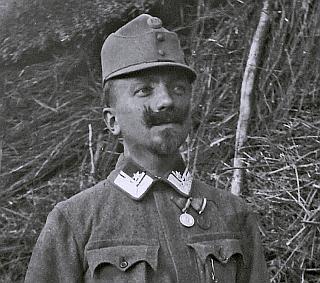
 | Adamička, Josef | |
| *24.6.1876 Dębica - †3.11.1917 Beograd | ||
| SearchŠvejkův slovník | ||
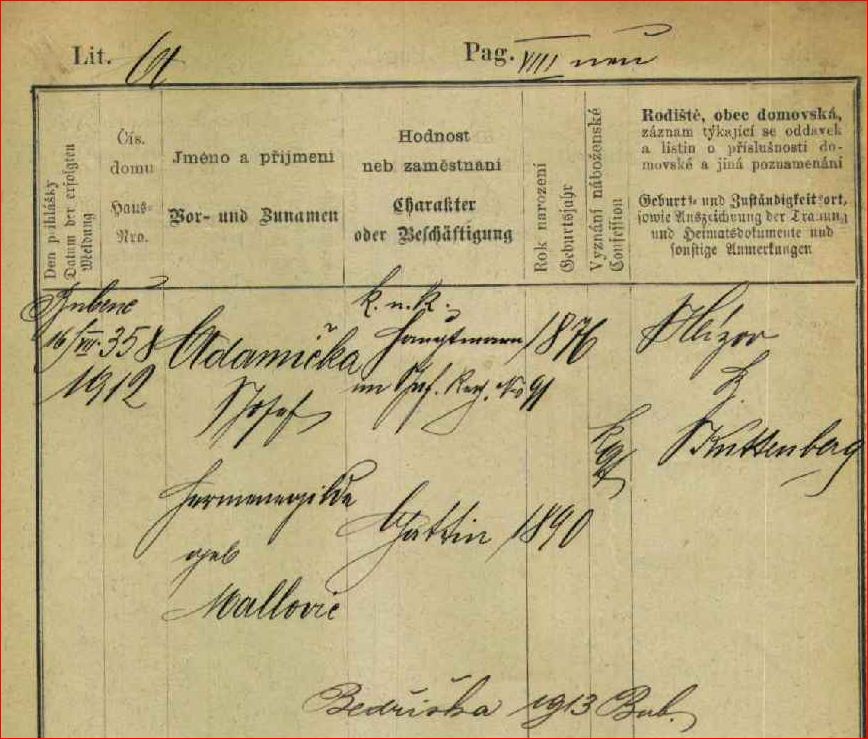
Police registration 1912
Josef Adamička was undoubtedly the prototype for Hašek's Adamička. Born in 1876 in Dębica (Galicia, now in Poland), his right of domicile was in Hlízov, near Kutná Hora. He graduated from a cadet school in Kraków with excellent marks.
Starting with his enrolment in the army in 1896, he served with Infanterieregiment Nr. 24 and Pionierbataillion Nr. 11 at various garrisons in Galicia (Lwów, Przemyśl etc.), until he was transferred to Prague and enlisted in Infanterieregiment Nr. 91 on 1 November 1904. From 22 March 1906 he served with the regiment in Budva, Cattaro (now Kotor), and some other locations in southern Dalmatia where the regiment's detached 1st battalion was stationed. At the time his rank was Oberleutnant.
On 14 March 1910 Josef Adamička married Hermenegilde Mallovič, and they had one child. The wedding took place in the parish of Mulla, Bezirk Cattaro, now Muo in present-day Montenegro. From 1 May 1912 he was back in Prague, and from 1913 until 30 April 1914 he was commander of 11. Feldkompanie. This unit was part of III. Feldbataillon that was garrisoned in Karlín. His private address was Bubeneč čp. 913, and by 1915 he had moved to Janovská čp. 979, Holešovice. Otherwise, his Evidenzblatt reveals that he was bilingual in Czech and German, and mastered Polish adequately. On 1 November 1911 he was promoted to Hauptmann.
First World War

Qualifikationsbeschreibung
© VÚA
When Austria-Hungary partially mobilised on 26 July 1914, the 2nd and 3rd battalions of Infanterieregiment Nr. 91 were transferred from Prague to Budějovice. As early as 1 August the regiment (apart from the detached 1st battalion) departed for the front against Serbia. They arrived in the area on 4 August, and on that date Josef Adamička was again given command of 11. Feldkompanie, the very unit in which Jaroslav Hašek was to serve a year later. His stay did not last long: on 8 September he was wounded on the Drina during the disastrous second attempt to invade Serbia, and he spent the period until 4 December 1914 in various hospitals. After a short leave he reported to Ersatzbataillon IR. 91 in Budějovice on 4 January 1915.
That same month he was appointed head of the reserve officers' school in Budějovice, and here he came into direct contact with Jaroslav Hašek. According to Franta Hofer, he liked the author and was very indulgent towards his eccentricities and even protected him. Josef Adamička also invited him to the officers' dining room to entertain the gentlemen with his anecdotes; the favourite themes were jokes about priests and Jews. On 18 March 1915 Adamička left for the front as commander of the 8th March Btn., and by this time Jaroslav Hašek was already hospitalised. On arrival (26 March) he became commander of the II. Field Btn., which at the time was fighting in the Carpathians.
Einjährigfreiwilliger Marek's assertion that Adamička departed for the front early is therefore accurate: Hašek's XII. Marschbataillon, commanded by Franz Wenzel, only left at the end of June.
Again his stay at the front was brief: a shot in the arm on 20 May 1915 near Kiernica was the last action he saw in the war. After some months in hospital and a period of Urlaub, he was assigned to k.u.k. Heeresbahn Süd in Belgrade. In 1917 Adamička contracted typhus and died on 3 November 1917 at the age of 41, at k.u.k. Reservespital "Brčko" in Belgrade.
Gott strafe England

Death certificate
© VÚA
Adamička is the main character in the short story Gott strafe England by Jaroslav Hašek, first published in Československý voják in Kiev on 15 October 1917. Here he is mercilessly pilloried as a lunatic who promotes the slogan Gott strafe England at every opportunity[a]. In this story Adamička initially appears as the head of the School for one-year volunteers (Einjährig-Freiwilligerschule) in Budějovice, and his Qualifikationsbeschreibung confirms that this was indeed his position at the time when Jaroslav Hašek joined IR. 91.
The story also reveals that he had a brother in the Prague police force. This is also a fact: his brother Ladislav, born in 1871, was employed by the police. Hašek’s story cannot, of course, fully qualify as a reliable source of information, but at least parts of it appear authentic. Other sequences are, however, pure invention: he lets Adamička go mad and join Infanterieregiment Nr. 75, and then lets him get captured during the battle of Zborów. Clearly none of this could have been the case because he served in Belgrade at the time of the battle (2 July 1917).
Credit: VÚA, Franta Hofer, Jaroslav Šerák
Literature
- Dienstbeschreibungen und Qualifikationslisten der Offiziere, ,1761-1918
- Gott strafe England, Jaroslav Hašek,15.10.1917 [a]
- Jak se Jaroslav Hašek učil oficírem,
- Nachrichten über Verwundete und Kranke, ,14.11.1914
- Feldpostbrief, ,20.6.1915
| a | Gott strafe England | Jaroslav Hašek | 15.10.1917 |