


For most readers of The Good Soldier Švejk, Hašek's use of anabasis as a chapter heading in [II.2] seems unremarkable. After all, it is just one of the novel's many references to ancient Greek and Roman history. Some literary scholars, however, regard it as significant because they believe Hašek used the term to mock the post-war enthusiasm surrounding the Legions and their so-called Siberian anabasis. This article traces the origins of that hypothesis and argues that Hašek's choice of the word anabasis has a much simpler explanation.
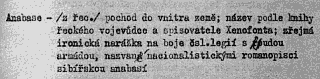
Břetislav Hůla was probably the first to suggest in writing that Hašek used anabasis as a subtle dig at the Czechoslovak Legions (1951). His conclusion was published in 1953 in a collection of explanations that formed part of a new edition of Švejk.
© LA-PNP
In his notes to the 1953 edition of The Good Soldier Švejk, Zdena Ančík treated the connection as self-evident, and others have repeated this view over the years. Literary scholars Antonín Měšťan (1983)[a], Antoni Kroh (Polish translator of The Good Soldier Švejk, 2002), and Abigail Weil (2019)[b] are among those who maintain that Hašek's use of "anabasis" was a dig at the Legions, and that he had their so-called Siberian anabasis from Kiev to Vladivostok in mind when writing Švejk's Budějovice Anabasis in 1921. Until 2020, a summary of Kroh's interpretation even appeared in the endnotes to Zenny Sadlon's translation of The Good Soldier Švejk.
The hypothesis cannot be ruled out entirely, since we have no record of Hašek's intentions as he wrote. Even so, one would expect it to be supported by quotations from the author or from people close to him at the time (from 1921 onwards). However, no such source has been identified, and there is scant evidence that contemporary readers saw Švejk's anabasis as a dig at the Legions. The discussion below examines how the claim arose and developed, focusing on the only serious attempt to substantiate it, by Antoni Kroh.
Fiala
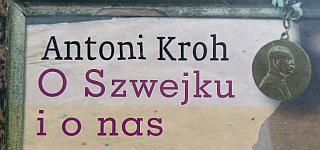
This otherwise excellent book contains far-fetched claims about Hašek and his use of the term anabasis.
In 2004, Professor Jiří Fiala (Olomouc) published a thorough analysis of "anabasis" and other motifs from The Good Soldier Švejk [e]. He notes that Zdena Ančík, in the explanatory notes to the 1953 edition of the book, concludes that anabasis "obviously is an ironic reference to the Legions and their fight against the Red Army, by nationalistic novel writers who coined the term Siberian anabasis"[1]. Fiala compares this with later explanations from Radko Pytlík [2] and Milan Hodík [3] and observes that these scholars do not draw such conclusions. Fiala ultimately leaves the question open. He then reproduces an excerpt from the book O Szwejku i o nas by Kroh[4], from a chapter entitled "Two Generals".
Kroh
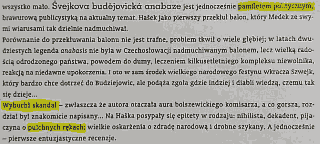
, s.45
© Antoni Kroh
As translated by Fiala, Kroh's text provides the starting point for the analysis that follows. Kroh places Rudolf Medek and Jaroslav Hašek side by side in the context of the anabasis, but even the title Two Generals raises doubts. Medek eventually attained the rank of general (1931), but linking Hašek with that rank is absurd.
Kroh's conclusion is more questionable still. It gives the impression that the hostility Hašek encountered in Czechoslovakia after returning from Russia in 1920 was caused by the publication of The Good Soldier Švejk's "anabasis" chapter, which supposedly unleashed a wave of criticism, insults and harassment.
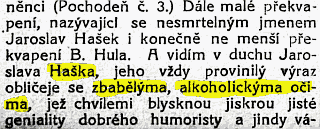
Rudolf Medek lashing out at Hašek, two years before the anabasis chapter appeared in Švejk.
,6.4.1918
There is no denying that Hašek was subjected to vicious attacks and insults, but the worst came while he was still in Russia, more than a year before he wrote Švejk's anabasis. In an article published shortly after Jaroslav Hašek left the Legions, Medek launched a cruel character assassination[c], and worse followed. In early 1919, Jaroslav Colman-Cassius wrote an obituary titled Zrádce (Traitor)[d], apparently believing Hašek to be dead. Cassius was no less unforgiving than Medek: he described Hašek as having "small chubby hands" and called him a clown and a drunkard, a man without a spine or any character.
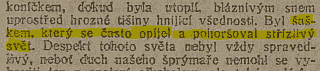
Extracts from Cassius' nasty obituary. Hašek read it in Irkutsk in 1920 and was deeply hurt.
,19.1.1919
In trying to connect Czech society's hostility towards Hašek with the anabasis chapter, Kroh cites the phrase drunkard with chubby hands as an example. The expression was indeed used, but it predates The Good Soldier Švejk by a year. Hašek coined it in 1920 in Irkutsk, in response to the obituary mentioned above, which he obtained while still in Russia [5]. His reply was the story Dušička Jaroslava Haška vypravuje (The Little Soul of Jaroslav Hašek Tells), where the insult is quoted. The story was printed soon after Hašek returned to Prague[f], thus many months before he wrote the "anabasis" chapter (autumn 1921).
Kroh's references to Rudolf Medek and his five "Anabase" novels are equally irrelevant chronologically: apart from the first, they appeared after Hašek's death [6]. As we have seen, Medek attacked Hašek fiercely in 1918, so those attacks cannot be connected with the publication of the "anabasis" chapter three years later. According to Zdeněk Matěj Kuděj, the two met in Prague in 1921 and were reconciled after a heated encounter. Kroh's attempt to link the spiteful attacks on Jaroslav Hašek with the publication of Švejk's 'budějovická anabasis' therefore falls apart when set against the timeline.
Weil
Výbor ze spisů Xenofontových, Anabase, Kyrupaideie, Apomnemoneumat, Hellenik a Symposia,1910
A welcome addition to haškology appeared in 2019: a generally insightful doctoral thesis by Abigail Weil[b], published by Harvard University. It devotes considerable space to the motif of anabasis and Hašek's alleged dig at the Legions.
Whereas Kroh at least tries to explain, albeit unconvincingly, the connection with the Legions' anabasis, Weil simply assumes it. She mentions neither Antonín Měšťan nor Kroh's book nor Fiala's discussion of it, so we must assume that she was unaware of these works when she wrote her thesis.
Her belief in the hypothesis may have been inspired or reinforced by Zdena Ančík (in reality Břetislav Hůla) and his comment in the 1953 edition of The Good Soldier Švejk. Weil explicitly refers to this as "the standard edition".
Ančík
What, then, of Břetislav Hůla's explanation from 1951, published by Zdena Ančík in 1953 (17th edition, Státní nakladatelství)? It was written at a time when anything that might cast the pre-war "bourgeois" republic and the Legions in a bad light was frowned upon. It is also striking that by 1955 (22nd edition, Práce), the same Ančík had removed the reference to the Legions and their anabasis. Nor does a completely different set of notes by Milan Jakovič (26th edition, Odeon, 1968) allude to "anabasis and the Legions".
Xenophon on the curriculum
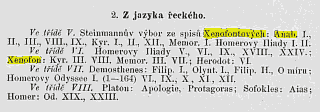
Xenophon was on the Greek language curriculum when Hašek was a student at the gymnasium in Žitná ulice.
The term "anabasis" was by no means unfamiliar in Czech literature, even before the wave of legionnaire writing reached Czechoslovakia in the 1920s. One of the teachers at the gymnasium in Žitná ulice, where Hašek studied from 1893 to 1898, was the celebrated author Alois Jirásek. He taught geography and history there, and in 1886 wrote a book on the subject of "anabasis". Xenophon's magnum opus had been translated into Czech some time before.
Classical Greek was taught at the gymnasium, and Xenophon was on the syllabus. However, the subject was introduced in the fifth form, which Hašek never reached, as he was forced to leave in the fourth. Jirásek did not teach the young Jaroslav's classes (Ia, IIa, IIIa, and IVa), despite Václav Menger and others claiming otherwise [7]. Even so, Xenophon's place on the syllabus suggests that he was well known among educated Czechs. Greek was also taught in the third form, so Xenophon's name may have been introduced already at that stage. Anabasis was widely used around the world as a textbook for classical Greek.
Hašek and Xenophon
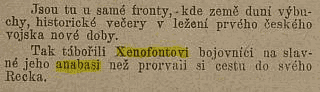
Xenophon and his Anabasis were well known to Hašek five years before he wrote Švejk.
,25.9.1916
Although Hašek may not have studied Xenophon as a subject at school, there is no doubt that he possessed a sound general knowledge of, and interest in, the history of ancient Greece. This is already apparent in the introduction to The Good Soldier Švejk and evident through his entire literary output, not only in his famous novel.
More importantly, we have direct evidence that Jaroslav Hašek's awareness of Xenophon was unrelated to the Legions' anabasis. In Dopis z fronty (Letter from the Front)[h], published in 1916, both Xenophon and his Anabasis are mentioned. Hašek could hardly have been mocking a Siberian anabasis that was still two years in the future.
This leaves the suspicion that the mentioned scholars didn't notice that Hašek's use of the term anabasis and his knowledge of Xenophon predated The Good Soldier Švejk. Even before the war, he mentioned Xenophon (but not the Anabasis) in one of his stories [g]. Moreover, the Greek author is referred to at least three times in Svět zvířat while Hašek was its editor (1909-1910).
Conclusion
Hašek's pre-war story in Svět, the entries in Svět zvířat and the Letter from the Front mentioned above do not, of course, prove that he didn't intend to make fun of the Legions. They do show, however, that he easily could have written about Xenophon and his Anabasis without any ironic intent, just like he did in 1916.
We searched digitised newspapers from 1921 and 1922 for signs that writers or critics connected Švejk's anabasis with the Legions. Extending the search to 1950 and including the substantial inter-war legionnaire literature proved fruitless as well. As noted earlier, the 1953 endnotes to The Good Soldier Švejk claimed that Hašek wrote the anabasis chapter as a slur on the Legions. That explanation disappeared from the 1955 edition. The likely reason is that the publishers had ceased to accept the hypothesis. Perhaps by then they had discovered Letter from the Front from 1916? Had the theory possessed any substance, the communist publishers would surely have exploited Švejk's 'budějovicke anabasis' to the full.
Sergey Soloukh's notes
1. At the time, "anabasis" was a standard term for any long and arduous journey by armed men. It was widely used, for example, in Russian literature about the Great War and the Civil War (by generals Denikin and Krasnov and by the writer and literary critic Shklovsky), without any connection to the Cz.Legion. The word was therefore common in war-torn Russia and did not refer specifically to any particular Legion undertaking. Indeed, the Cz.Legion used it as a conventional term for "the journey of armed men", rather than as a term originating in, and uniquely associated with, its own movement.
2. Had the chapter been understood at the time as an insult to the Cz.Legion or an attempted joke at its expense, this would certainly have been noted and discussed in the Czech press. We know that it was not. This supports my first point: "anabasis" was not then regarded as a term specific to the depiction of the Cz.Legion's adventure. It was a commonly used expression for any "journey of armed men". Only 30 years later was it recast as a unique term for the Legion adventure, for the purposes of communist propaganda.
Dva generálové (extr.). Antoni Kroh, transl. Jiří Fiala
Slovo „anabáze" mělo tehdy v češtině jediný, a to samozřejmý význam: znamenalo prodírání se česko- slovenských legií z Ukrajiny přes Sibiř do Vladivostoku. Kapesní slovník cizích slov (vydaný v Praze roku 1971) již objasňuje toto slovo subtilním a diskrétním způsobem: „Anabáze — probíjení se velkých vojenských oddílů do vlasti." Legenda „anabáze", zvláště živá ve dvacátých letech, byla živena a pěstována po celé období meziválečného Československa. Rudolf Medek je současně jeden z jejích tvůrců i její i hrdina. A nyní si připomeňme kapitolu Švejkova budějovická anabáze (II, 2). Švejk jel spolu s nadporučíkem Lukášem vlakem z Prahy do Budějovic. Po incidentu se záchrannou brzdou byl vysazen v Táboře a uvězněn. Když se ukázalo, že nemá peníze ani dokumenty, podporučík sloužící na nádraží mu přikázal, aby šel do Budějovic pěšky. „A čert ví, jak se to stalo, že dobrý voják Švejk místo na jih k Budějovicím šel pořád" rovně na západ. Není známo, jak se to stalo, ale je známo, že se to stalo nevědomky, poněvadž Švejk byl přece na západ." Není známo, jak se to stalo, ale je známo, že se to stalo nevědomky, poněvadž Švejk byl přece dobrý voják, žádný dezertér; on vskutku chtěl dorazit do Budějovic! Proč tam tedy nešel přímo, jen pořád kroužil a kroužil dokola? Protože byl idiot? Mnoho polských milovníků Švejka, jichž jsem se dotazoval, to právě tak vysvětluje. Ale kapitole Švejkova budějovická anabáze je možné porozumět teprve tehdy, když si uvědomíme, kdy a za jakých okolností byla napsána. Je to jedna z nejskvostnějších pasáží románu. Jako každé velké umělecké dílo se vymyká jednoznačným výkladům. Můžeme ji označit za panorama českého venkova, zvěčněním lidových typů a tehdejších nálad. Je to rovněž radostný hymnus ke cti životu, nespoutaný smích jakoby z Rabelaise. Rovněž groteska. Lze tam najít reminiscence na autorova dobrodružství. Ale to vše je málo. Švejkova budějovická anabáze je současně politický pamflet, bravurní publicistika na aktuální téma. Hašek jako první propíchl balon, který Medek se svými věrnými tak zdatně nafukoval. Přirovnání k balonu není trefné, problém vězel mnohem hlouběji; ve dvacátých letech nebyla legenda „anabáze" nafukovaným balonem, ale velikou radostí znovuzrozeného státu, důvodem hrdosti, léčbou několikasetletého komplexu zotročence, reakcí na nedávná pokořování. A tu do samého středu národní slavnosti vchází Švejk, který velice touží dorazit do Budějovic, ale dostává se kamsi úpině jinam a čert ví, proč se tak děje... Vybuchl skandál — zvlášť když autora obklopovala aura bolševického komisaře, a co horšího, kapitola byla znamenitě napsána... Na Haška se sesypaly přívlastky jako nihilista, dekadent, pijan s opuchlýma rukama; velké obžaloby ze zrady národa i drobné šikany. A současně — první entuziastické recenze.
| 1. | Although Zdena Ančík is credited with the explanations, they were almost entirely Břetislav Hůla's work. He passed his typewritten notes to Ančík in 1951, and Ančík made only minor edits before publishing them in 1953 and, in a slightly amended form, again in 1955. The 1955 edition omits the claim that Hašek intended the "anabasis" chapter as a dig at the Legions. |
| 2. | Radko Pytlík, Kniha o Švejkovi, 1982. |
| 3. | Milan Hodík, Encyklopedie pro milovníky Švejka, 1998. |
| 4. | Antoni Kroh, O Szwejku i o nas, 2002. |
| 5. | The story was first printed in Večerní Právo lidu on 31 December 1920, but was dated 25 August, so it must have been written in Irkutsk. Hašek must therefore already have read his own obituary. It was the first story he published after returning to Prague. |
| 6. | Rudolf Medek, Anabase, 1927. |
| 7. | Jaroslav Hašek had to repeat the fourth year and finally left the gymnasium in February 1898. Jirásek taught class IVa during that school year, so Václav Menger may still be correct. |
Literature
- O dobrodružných výpravách, Jaroslav Hašek,23.6.1913 [g]
- Dopis z fronty, Jaroslav Hašek,25.9.1916 [h]
- Průkopníci, Rudolf Medek,6.4.1918 [c]
- Zrádce, ,19.1.1919 [d]
- Realien und Pseudorealien in Hašeks "Švejk", ,1983 [a]
- Několik editologických poznámek k románu Jaroslava Haška Osudy dobrého vojáka Švejka za světové války, ,2004 [e]
- Man Is Indestructible: Legend and Legitimacy in the Worlds of Jaroslav Hašek, ,2019 [b]
- Dušička Jaroslava Haška vypravuje, Jaroslav Hašek,31.12.1920 [f]
- Výbor ze spisů Xenofontových, Anabase, Kyrupaideie, Apomnemoneumat, Hellenik a Symposia, Ferdinand Hoffmeister,1910
| a | Realien und Pseudorealien in Hašeks "Švejk" | 1983 | |
| b | Man Is Indestructible: Legend and Legitimacy in the Worlds of Jaroslav Hašek | 2019 | |
| c | Průkopníci | Rudolf Medek | 6.4.1918 |
| d | Zrádce | 19.1.1919 | |
| e | Několik editologických poznámek k románu Jaroslava Haška Osudy dobrého vojáka Švejka za světové války | 2004 | |
| f | Dušička Jaroslava Haška vypravuje | Jaroslav Hašek | 31.12.1920 |
| g | O dobrodružných výpravách | Jaroslav Hašek | 23.6.1913 |
| h | Dopis z fronty | Jaroslav Hašek | 25.9.1916 |