


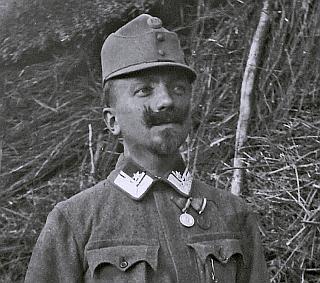
 | Hašek, Jaroslav Matěj František | |
| *30.4.1883 Praha - †3.1.1923 Lipnice nad Sázavou | ||
 czdeennnruuk
Search czdeennnruuk
Search | ||
Jaroslav Hašek embedded innumerable autobiographical elements and episodes from his unusual life in The Good Soldier Švejk. He was undoubtedly a direct inspiration for Einjährigfreiwilliger Marek and even more so for the book's main character. The period most relevant to The Good Soldier Švejk is, of course, the author's time in the k.u.k. Heer in 1915, although passages drawn from other stages of Hašek's life appear throughout the novel.
This page is limited to periods and episodes in Hašek's life that had an obvious and direct impact on his famous novel, The Good Soldier Švejk. In view of the novel's content, it concentrates chiefly on the author's time in k.u.k. Heer.
Jaroslav Hašek mirrored in Josef Švejk
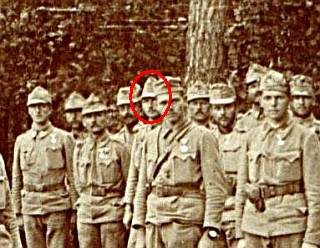
Żdżary, 18 August 1915. Hašek decorated.
© ÖStA
The author attributes unmistakable personal characteristics to his literary hero. In the first few lines of The Good Soldier Švejk, he exposed his rheumatism to world literature ‘by proxy’, and we can safely assume that Švejk’s verbal skills, quick wit, charm, composure, and the all-important ability to extricate himself from difficult situations were gifts inherited from his creator. Švejk and Hašek shared this survival strategy. Both were outgoing and sociable, fond of telling stories and entertaining others.
The similarities between Hašek’s and Švejk’s military careers are even more striking. Both lived in Prague but served in Infanterieregiment Nr. 91 (IR. 91), owing to their South Bohemian ancestry. They encountered the same places and historical circumstances while serving in the k.u.k. Heer. Many of Švejk’s superiors and peers are drawn from Hašek’s milieu in IR. 91, though their qualities and identities have been modified, caricatured and partly disguised. Švejk was the company messenger in his 11. Marschkompanie, corresponding to Hašek's role in 11. Kompanie. Both were also tasked with finding accommodation for their military units.
Their occupation provides an obvious pre-war connection between Švejk and Hašek. From November 1910, Hašek ran a short-lived dog-trading enterprise but was accused of selling dogs with false pedigrees, which his assistant had stolen. Both had trained as apprentice chemists. Švejk's stay at the blázinec (lunatic asylum) clearly reflects autobiography, as do his stays at c.k. policejní ředitelství (Police HQ), c.k. zemský co trestní soud (Country criminal court), and policejní komisařství Salmova ulice (Salmovská ulice). Hašek and his hero shared a fondness for pub life, and many establishments mentioned in the novel were among the author's favourites (U Fleků, Bendlovka, Montmartre, U Brejšky - to name a few). Another common trait is their indifference to, or lack of success with, women. They were keen singers of army songs, although by all accounts both were poor singers.
One-year volunteer Marek
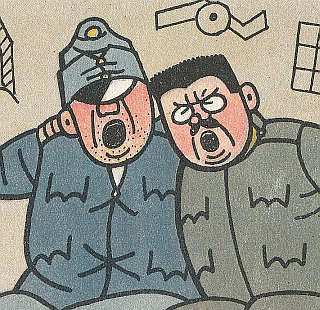
Švejk and Marek, Hašek's two alter egos enjoying themselves in Regimentsarrest in Budějovice
Einjährigfreiwilliger Marek appears even more closely modelled on the satirist, portraying an intellectual side of his personality not attributed to Švejk. Marek borrows several biographical details from Hašek.
His work as editor of Svět zvířat reflects Hašek's position at the magazine in 1909-1910 and 1912-1913, although many of the details supplied by Einjährigfreiwilliger Marek has no counterpart in the magazine itself. There is, for instance, no evidence that Hašek invented animals during his two tenures as editor. It is however true that Hašek succeeded Ladislav Hájek as editor, that the owner was Fuchs-Red and that Hašek eventually was fired.
Einjährigfreiwilliger Marek’s experiences in Budějovice likewise contain traces of Hašek's autobiography: his status as a one-year volunteer, turning up at the exercise ground in civilian clothes, dismissal from Budweiser Einjährigfreiwilligenschule, arrest by artillery patrols and hospitalisation. A real incident may have inspired the episode with the Krankenbuch. Like his literary alter ego, Hašek was allegedly transported from Budějovice to Királyhida in the prisoners' carriage. Marek generally serves as the mouthpiece for Hašek's political views; in this respect, he contrasts with Švejk, who conceals his opinions when it suits him.
Although Einjährigfreiwilliger Marek and Švejk are the figures that most obviously bear traces of the author, it is tempting to suggest that Hašek contributed a few of his less admirable qualities to at least two more of his literary creations: Offiziersdiener Baloun (gluttony), and Feldkurat Katz (alcoholism, lying and shirking financial obligations, e.g. not paying the moneylender in [I.13]).
Anecdotes
Many monologues bear traces of Hašek’s experiences. One example is the introduction of his grandfather, Jareš, at several points in the novel, beginning in the first chapter. Others include the two anecdotes about Rittmeister Rotter and the story about "nějakej" (some) Mestek. Einjährigfreiwilliger Marek's monologue about his time as editor of Svět zvířat belongs here too.
Before the draft
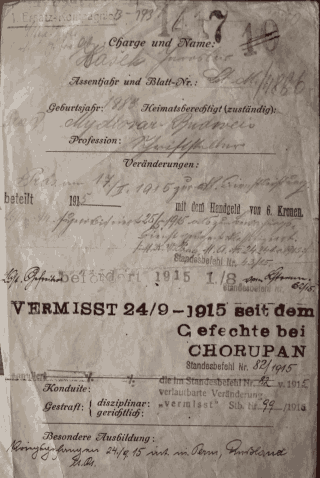
Jaroslav Hašek's Vormerkblatt Nr. 4886
© VÚA
Jaroslav Hašek was 31 years old in 1914 and had so far avoided military service. The reasons for this are unknown; no records of his early encounters with the armed forces have been found, so he must either have been declared unfit for armed service (Waffenunfähig) or dismissed after starting it (Superarbitriert).
According to Emil Artur Longen, Hašek was disappointed at not being admitted to the army and proud when, after the outbreak of war, he was finally deemed Tauglich. This is plausible: his military medical records state that he was Assentiert (drafted) in 1914. He was consequently assigned to Landsturm (Home Guard or militia), a reserve force called up only in times of danger. In the autumn of 1914, the authorities decided to reassess this large reserve of manpower to offset losses at the front. From 13 to 15 December 1914, the Landsturm medical examination for Hašek's age group and geographical affinity took place at Střelecký ostrov. Those who passed were to report for duty on 15 February 1915.
The parallel with Švejk's army career is obvious, although the chronology differs, as it does throughout the novel. It is striking that the author says Doctor Bautze had been acting as head doctor at the medical board for 10 weeks, while Landsturm medical examinations began at Střelecký ostrov on 1 October 1914. The timing corresponds closely to mid-December. Bautze declared 10,999 of 11,000 recruits fit for service. At the first draft, only about 60 per cent of the early recruits were deemed Tauglich; by the end of the year, when Hašek's age group was called up, the acceptance rate had fallen to around 30 per cent.
In Budějovice
Jaroslav Hašek's period in IR. 91 deserves particular attention: the novel comes closest to autobiography here, and more than half its plot is set in k.u.k. Heer. Army records show that Hašek was Präsentiert (reported at) 1. Ersatzkompanie in Ersatzbataillon IR. 91 on 17 February 1915. In Budějovice, he enrolled at the school for reserve officers, where he met people he would later caricature in his writing: Hauptmann Josef Adamička (head of the school), Oberleutnant Čeněk Sagner, and Hans Bigler. He may have met Major Franz Wenzel and Staff Sergeant Jan Vaněk there as well, although this cannot be verified. Senior Lieutenant Rudolf Lukas was at the front in the Východní Beskydy until 13 March and then on sick leave, so he and Hašek would have met only later, presumably in early June, in Királyhida. In Budějovice Hašek also encountered fellow soldiers who, forty or more years later, supplied researchers with vital information, although the intervening years often blurred their memories: Jaroslav Kejla, Bohumil Vlček, Franta Hofer, Bohumil Šindelár, and František Skřivánek, among others.
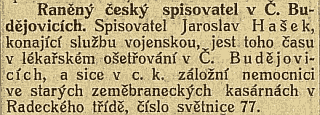
,13.3.1915
His stay at the school ended unsuccessfully. Poor physical condition made the exercises and drill taxing, and, according to his own account (confirmed by Kejla and Hofer), he was expelled. The precise reason remains unclear, although he offers colourful versions through Einjährigfreiwilliger Marek (in Švejk) and in the short stories Gott Strafe England and In strategic difficulties. Kejla and Hofer give a more mundane explanation: Hašek was dismissed for behaviour incompatible with that expected of a k.u.k. officer. Drunkenness and breaches of public order are the likeliest causes; he had been repeatedly arrested for such offences in Prague. Even so, the eloquent and rebellious author may have irritated his superiors enough to be disciplined, but hardly enough to be expelled. Hašek does not appear in the lists of graduates from Reserveoffizier-Schule Budweis, confirming that he left the school.
He seems to have played little part in military life, partly because of illness and partly because he was periodically locked up (by his own account, for as long as 30 days). Suffering from rheumatism and heart trouble, he was first hospitalised on 6 March near the railway station in the k.u.k. Reserve-Spital in Radeckého třída. Jihočeské listy reported his hospitalisation on 13 March 1915. He was then sent to a recuperation unit in Linecké předměstí, from which he appears to have made several excursions. The longest lasted four days and took him as far as Protivín and Netolice; some accounts even place him in Radomyšl. He is also reported to have visited Zliv and České Vrbné. While in Budějovice, he wrote several short stories, and the collection "My Business with Dogs" was published there.
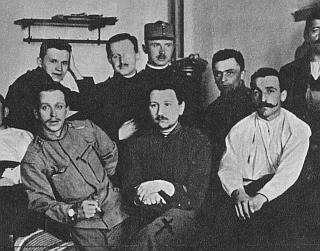
Hašek in k.u.k. Reservespital, Budweis
Jaroslav Hašek ve fotografii, ,1959
In the 1950s, several witnesses recorded memories of Hašek's period in Budějovice, although the intervening years affected their accuracy. One was František Skřivánek, who published his account in Stráž míru, 8 September 1954; a similar story had appeared in Jihočeské listy as early as 1923. The author visited an impressive range of pubs in the city (no surprise there), but only a few appear in the novel. Another witness was the young Bohumil Mičan, whose family owned the restaurant U Mičanů, a regular haunt of Hašek. He stayed with them and became well acquainted with the family.
Another witness was fellow one-year volunteer Franta Hofer, who gives an amusing account of Hašek's first weeks at the reserve officer school. He says that many officers, notably Josef Adamička, liked the author and invited him to the canteen to entertain them. This may have inspired the novel's scenes in the local hotel and the officers' dining rooms. Hofer's and Mičan's accounts were never published, but they are available in LA PNP, fond Zdena Ančík; links are provided below. František Langer offers another source, writing that the poet Peter Křička stopped in Budějovice on his way home from the front and met Hašek. At the time, Hašek was working in the kitchen, peeling potatoes: a detail that accords with Einjährigfreiwilliger Marek in the novel and with the story In strategical difficulties.
Rheumatism, heart-trouble and superarbitration
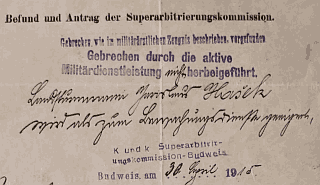
The verdict of the superarbitration-commission.
© VÚA
In May 2015, Hašek's military record was investigated at VÚA, and the picture of his illness and superarbitration became clearer. Already on 6 March 1915, he was admitted to the hospital and seems to have stayed there at least until 8 April. He was suffering from rheumatism in the joints, as well as a heart condition, and an application for his dismissal from the army for health reasons was lodged that day.
On 30 April, the superarbitration commission gave its verdict. The soldier was not entirely relieved from army duties; he was deemed capable of salvage, guard, and other lighter tasks. It was also concluded that his military service caused none of his health problems. The decision was rubber-stamped by k.u.k. Militärkommando Prag on 25 May.
The 91st regiment transferred
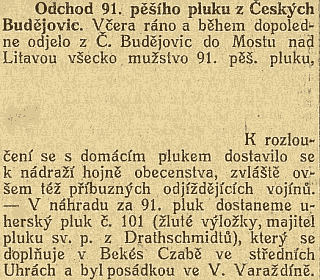
,2.6.1915
,11.6.1915
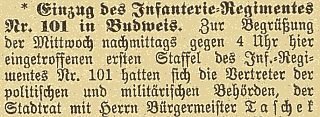
As reflected in The Good Soldier Švejk, Ersatzbataillon IR. 91 was transferred to Királyhida, a town on the border between the two constituent parts of the Dual Monarchy. The reason for the transfer was political; regiments from the various parts of the empire were moved to “foreign” parts because the authorities assumed (not without reason) that close contact between the k.u.k. “Kanonen-futter” and the civilian population could harm their will to die for the emperor. They could also be infected by anti-war sentiments that were taking root in the population as it became clear that the war would not be over soon. Czech reserve battalions were often swapped with Hungarians (or others), and in Budějovice, the Hungarian Infanterieregiment Nr. 101 replaced them.
Hašek was certainly part of this transfer and describes it in his novel. According to Jan Vaněk, he arrived in Királyhida under arrest, just as Švejk did. The literature on Hašek gives conflicting dates for the move. Radko Pytlík proposes several dates in early May, while Jaroslav Kejla places it on the 20th. František Skřivánek recalled that Hašek sent him a few lines of farewell dated 5 May. The transfer actually took place much later, on 1 June 1915, as confirmed by Jihočeské listy, Budweiser Zeitung, and Deutsche Böhmerwaldzeitung. The newspapers describe scenes at the station that match Hašek's account, including the sizeable crowd. The censors removed many lines from the first two reports, perhaps because they contained the Czech nationalist sentiments mentioned by the author.
The departure took place before noon in two stages. Their replacement, Infanterieregiment Nr. 101 from Hungary, arrived during the evening of the 9th and occupied the now-vacant Mariánská kasárna.
Bruck/Királyhida
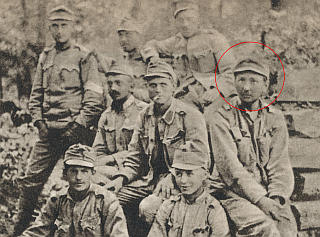
Hašek in IR. 91, probably by Żdżary in August. To the left of him is František Strašlipka (with the cigarette).
Jaroslav Hašek ve fotografii, ,1959
As we already know, Jaroslav Hašek had on 25 May been partly superarbitrated on health grounds and assigned lighter duties (capable of Rettungsdienst, i.e. rescue duties). After arriving in Királyhida, he served with Jan Vaněk, a staff sergeant responsible for accounting and logistics. Vaněk was subsequently to find his way into world literature through this encounter. He was arguably the most obvious of all the “prototypes” found in The Good Soldier Švejk. Hašek helped him with the office duties and got to know the cook Perníček, perhaps an inspiration for cook Jurajda. Vaněk was to provide valuable testimonies about Hašek's time in the k.u.k. Heer, as retold by Jan Morávek in 1924 in Večerní České slovo. The series from 1924 is by far the most detailed we have on Hašek's period in the Austro-Hungarian army and should be considered the very first contribution to “Švejkology”. Morávek also personally met Hašek in Királyhida.
XII./91 Marschbataillon
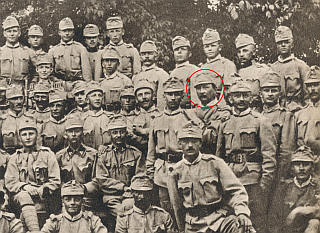
Hašek in IR. 91. According to Morávek, this photo was taken at the beginning of September 1915 with Hašek already promoted to Gefreiter.
Jaroslav Hašek ve fotografii, ,1959
XII. Marschbataillon of IR. 91 was formed around 1 June 1915, and the soldiers continued training and preparation for front duty. The commander of the battalion was Franz Wenzel, a major who served as inspiration for the literary figure Major Wenzl.
Each battalion consisted of four companies, and Hašek was assigned to the 4th (deduced from the Qualifikationsbeschreibung of Hans Bigler). Kejla, however, assigns him to the 3rd company and Vlček to the 2nd! In any case, it can be ruled out that Švejk’s 11. Marschkompanie ever existed. This fictional unit is rather a projection of 11. Kompanie in which Jaroslav Hašek was soon to serve.
On 1 June 1915 Rudolf Lukas was appointed commander of the 4th March Company. With this Oberleutnant, Hašek developed a good relationship, a bond that found its way into world literature some six years later. Lukas kept his hand over the author and even urged him to stop drinking. In the march company, he also met Hans Bigler again, the prototype of Kadett Biegler, and František Strašlipka, the servant of Lukas. Apart from his position as an officer's servant, Strašlipka is also believed to have inspired Švejk’s incessant storytelling and was one of Hašek's closest friends in the regiment.
Departure for the front loomed, and on 24 June, the men were barred from leaving the camp as they were to depart three days later. Hašek disappeared and was only found after three days, according to one report, drunk in a haystack; according to another, he was discovered in the same state in a café by the railway station, and according to Jan Morávek (interview printed in Průboj on 3 March 1968) he was found in U zlatého růže (Zur Goldene Rose). Jan Vaněk's diary reveals that the march battalion departed from Bruck station at 8:15 p.m. on 30 July.
Across the Carpathians
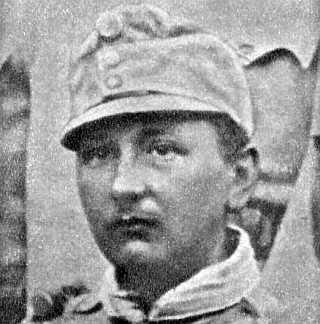
Hašek in IR. 91 (extracted from the picture above)
Jaroslav Hašek ve fotografii, ,1959
No known official material documents the journey from Bruck to Sambor, but Jan Vaněk's diary provides a rough outline. It records the departure, several places along the route, and three dates. Hašek adds detail in The Good Soldier Švejk and, more significantly, in his poem “Cestou na bojišti” (On the road to the battlefield). Written more or less on the spot, the poem is likely to be more accurate than his later writings. Vaněk gives a route identical to Švejk’s: from Bruck (30 June 1915) through Győr, Budapest, Miskolc and Humenné (2 July). After that, no places are mentioned until Sambor.
Jan Vaněk confirms that the train journey ended at Sambor, which they approached on 4 July 1915. In Dobrý voják Švejk v zajetí, Hašek has the soldiers continue beyond Sambor to a station he calls Kamenec (not identified). The Good Soldier Švejk presents a very different picture, with the march battalion leaving the train much earlier, at Sanok. Hašek mentions the Łupków Pass in The Good Soldier Švejk in captivity, so the route in The Good Soldier Švejk can safely be considered accurate as far as Zagórz near Sanok. The train would have passed further places familiar to readers of the novel on the way to Sambor: Krościenko, Chyrów and Felsztyn.
The only stretch where Hašek's and Švejk's routes diverge is between Sanok and Krościenko. Given the timing and geographical constraints, it could not have taken place as described in the chapter "Marschieren Marsch!" and the battalion would not have been marching with any brigade. The map shows XII. Marschbataillon's route to the front (updated with information from the diary of Jan Vaněk, 1 June 2014).
Einkantonierung and marching to the front
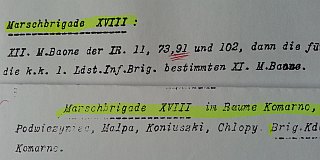
The orders directing IR. 91 to their Einkantonierungsgebiet east of Sambor.
© ÖStA
Official 2nd Army orders were the following: the “Einkantonierungsgebiet” was Komarno (ukr. Комарно), east of Sambor, and the daily legs are outlined in detail. Note that this was the planned route, not necessarily the one carried out.
- 5 July: Komarno - Szczerzec (ukr. Щирець)
- 6 July: Szczerzec - Zagorsze (ukr. Заґiря)
- 7 July: Zagorsze - Stare Sioło (ukr. Старе Село)
In the “Einkantonierungsgebiet” the 12th march battalions from Infanterieregiment Nr. 11, Infanterieregiment Nr. 73, IR. 91 and Infanterieregiment Nr. 102 were to gather and form the 18th March Brigade and continue to the front. Interestingly IR. 91 disappears from the records, whereas the march battalions from the other three regiments are reported to have arrived at their destination on 9 July. Jan Vaněk's diary gives us the most reliable information: on 4 July, they are still in transport but approaching Sambor. Then, on 5 July, they left Sambor for Rudki, and on 6 July, they marched to Szczerzec. This indicates a delay of one day compared to the 2nd Army orders.
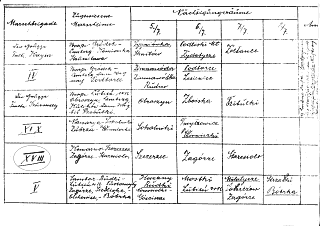
The planned route towards the front.
© ÖStA
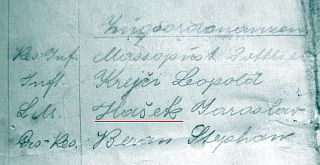
Hašek as Kriegsordonnanz in IR. 91/11th field company
© VÚA
Another of Jaroslav Hašek's poems lists towns and villages on a line between Sambor and Łonie (the village by Gołogóry where the XII. Marschbataillon joined the field battalions of IR. 91). This description in the poem corresponds almost perfectly to official orders stored in Kriegsarchiv in Vienna (2nd army files). Jan Vaněk adds several confirmatory items in his entry from 10 July. The places he mentions are Wańkowce, Lahodów, and Jaktorów. In the last place, he notes that on 10 July, they were waiting to join the regiment in the afternoon. The only slight contradiction between the various sources is the actual date the march battalion joined the regiment. According to Jan Eybl and Vaněk it was on 10 July, Inft. Reg. 91 Galizien... claims 11 July.
Joining the 11th Field Company
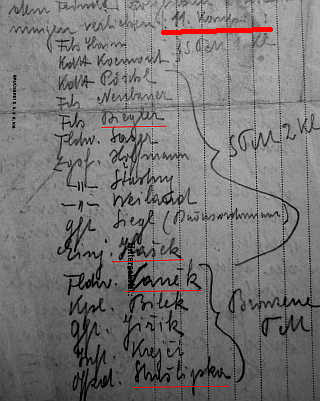
Fähnrich Biegler and Einjährig-Freiwilliger Hašek from the 11th company were awarded silver medals for courageous conduct at Sokal. Feldwebel Vaněk and Offiziers-Diener Strašlipka were given bronze medals.
© VÚA
Hašek’s journey to the front is patchily documented, but his stay at the front from around 10 July to 24 September 1915 is well covered. Jan Morávek’s above-mentioned series focuses mainly on this period. Additionally, Inft. Reg. 91 Galizien... covers the regiment's route in great detail, at times down to the hour, and with accurate geographical information. The diaries of Jan Vaněk and Jan Eybl describe the events even more precisely.
When the march battalion (approximately 800 men) joined the IR. 91 operative body, Rudolf Lukas took command of the renewed 11. Kompanie, with Hašek as his messenger. Hans Bigler was also assigned to this company as a squad leader (Zugsführer), and Jan Vaněk and František Strašlipka served in this unit. Companies 9 to 12 made up III. Feldbataillon, commanded by Čeněk Sagner, who had left for the front around mid-June. Franz Wenzel assumed command of the 2nd battalion (Companies 5-8).
From now it should be clear that the 11. Kompanie (field company) and part of its command structure have been projected directly onto the march units described in the novel. Hašek was named messenger in the 11th field company soon after 11 July 1915. This is a role Švejk gets much earlier in the 11. Marschkompanie (although Hašek may have been a messenger also in his March company).
After Żółtańce
Although the novel geographically ends at Żółtańce (IR. 91 made a 2-hour 15-minute break here on 16 July), the period after is still interesting even seen from the view of the pure “švejkologist”. Fragments from IR. 91's continuous march still appear in the novel and the most notable of those is Sokal which is dedicated a chapter header as early as Királyhida, in the final chapter of Part Two. The vicious battle that was fought here during the last week of July was no doubt intended to play a prominent part in the unfinished Part Four.
Some real events have been shifted forward in time. The order to build a bridge across the Bug was given on 17 July, i.e. not in Királyhida as the novel states. Brought forward in the same way is the order to march to Sokal. It was only issued on 20 July, after the regiment had started building that bridge by Kamionka Strumiłowa. During the march to Sokal, the regiment met German troops in Mosty Wielkie and Sokal (IR. 91 replaced German units there). Both these encounters may have inspired the various meetings with German military units and Švejk observing the well-fed Germans at Żółtańce town square (a place IR. 91 never set foot at).
Belohnungsantrag
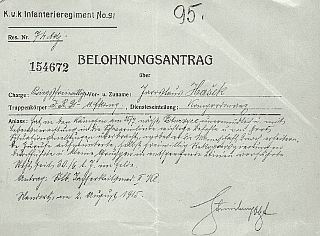
Application for reward, 2 August 1915.
© ÖStA
Hat in den Kämpfen am 25./7. nächst Poturzyce unermüdlich u. mit Lebensverachtung in die Schwarmlinie [= Schützen- oder Gefechtslinie] wichtige Befehle und von dort Situationsmeldungen überbracht, wobei er die Mannschaft durch Erheitern u. Zurufe aufmunterte, selbst freiwillig Rekognoszierungen [Erkundungen] durchführte und kleine Gruppen in entsprechende Linien vorführte.
Steht seit 30./6. l. J. [laufenden Jahres] im Felde
Antrag: Silb. Tapferkeitsmed. II Kl.
Standort, am 2. August 1915
Transkription dank Doris & Gert Kerschbaumer
Jaroslav Hašek was indeed decorated with the Silver Medal for bravery (II. Class) in the aftermath of the battle by Sokal. The application for his decoration was written on 2 August 1915 and signed by Steinsberg (for the regiment). Oddly enough, his rank is noted as "Kriegsfreiwilliger" (war volunteer). If this is correct, it means that he joined the army voluntarily.
The justification for the award was the bravery he exercised on 25 July 1915, the first day of an Austro-Hungarian attack whose aim was to capture the strategically important Góra Sokal, 254 metres. Without regard for his own life, he carried important messages to and from the trenches, encouraged his comrades with shouts, voluntarily undertook reconnaissance, and led smaller groups into position.
On 4 August 1915 the application was approved by Mossig for the brigade and Schenk for the division. The medals were handed out on 18 August. Soldiers from Hašek's 3rd battalion were decorated by Rudolf Kießwetter. That day, Hans Bigler, Jan Vaněk, and František Strašlipka also received their awards.
The official rubber stamp was given by the central authorities as late as 20 November, at a time when the author was already in Russian captivity.
More loyal than made out to be?
Much has been made of Jaroslav Hašek's alleged disloyalty to the k.u.k. Heer, an impression he, for obvious reasons, was eager to promote from 1916 onwards. Before the war, he also talked about his intention to defect. For years, it was, therefore, claimed that he actively crossed over to the Russians at Khorupan on 24 September 1915, that he tried to desert on several occasions before that, and that he was even given a three-year sentence for attempted desertion.
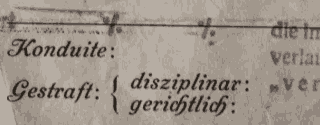
Jaroslav Hašek had no disciplinary record in k.u.k. Heer
© VÚA
None of these claims have been verified, and his military record shows no sign of punishment. On the other hand, it is documented that he was awarded a silver medal for bravery, taking risks that he did not have to take, and he may even have signed up as Kriegsfreiwilliger, i.e. volunteered for his emperor. Nor was he forced to enlist at the reserve officer's school in Budějovice. His superior in k.u.k. Heer, Rudolf Lukas, told Jan Morávek that Hašek was a good soldier, that his main problem was drinking, and did not mention any political stance. Bohumil Vlček quoted Hašek from Sokal: "This war we must win at all costs". On the other hand, he volunteered for reconnaissance patrols at Sokal, and it is known that Czech soldiers used this method to get over to the other side. That he intended this would, however, be pure speculation.
There is no doubt that he, like Einjährigfreiwilliger Marek, was locked up in the garrison prison occasionally, but again, it was likely to be public order offences rather than politics. The only known instance where he was disciplined for political reasons was in České legie in 1917 (after his infamous article The Czech Pickwick Club). It is also tempting to ask why it took him eight months to land on the "other side" if he was so convinced in his anti-Austrian views. He probably could have done what the main target of his scorn in the "Czech Pickwick Klub", Bohdan Pavlů, did in late 1914: join the Czech volunteers on the spot of capture or shortly thereafter. Ernst Kollmann, who was in the same prisoner transport as Hašek, noted that Družina were already recruiting in the transit camp at Darnytsa, so he surely would have had a chance to join there.
Hašek's time in Russia reflected in Švejk
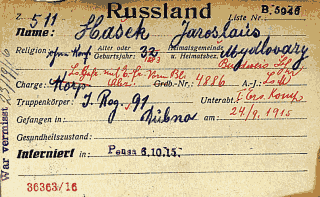
Kriegsgefangenenkartei
© ÖStA
Jaroslav Hašek and his time in Russia (1915-1920) is comprehensively covered under the headline České legie, and little from this period is directly reflected in The Good Soldier Švejk. One exception is the author's general description of officer's servants, where he mentions the Legions directly and describes a "pucflek's" journey into captivity carrying his master's luggage. The route described is at least partly identical to Hašek's (see Dubno, Darnytsa).
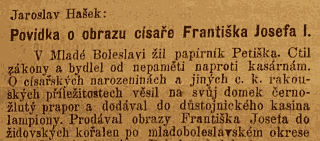
,17.7.1917
,1917
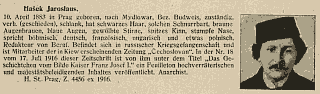
A more coincidental connection is the story of a tomcat soiling a picture of the emperor, a clear parallel to the scene from U kalicha where the flies were equally impertinent to his majesty. The story Povídka o obrazu císaře Františka Josefa I. was published in the Kiev weekly Čechoslovan on 17 July 1916 and described the owner of a paper shop, Mr. Petiška from Mladá Boleslav, who traded pictures of the emperor in Jewish liquor shops and also eagerly hoisted the flag on official state holidays. Unfortunately, a tomcat emptied his bladder on the pictures, making them unsaleable. The story was picked up by the Austrian intelligence services and led to an investigation in absentia of the author for high treason (Hochverrat) and defamation of His Imperial Majesty (Majestätsbeleidigung). The case was jointly investigated by c.k. policejní ředitelství and the k.u.k. Divisionsgericht in Vienna.
Thanks to this story, Jaroslav Hašek earned a place in the book ‘The Treacherous Activities of Austrian Czechs Abroad’, published by c.k. policejní ředitelství in 1917[a]. It named around 1,000 people, and the author of the tomcat story was in good company: Professor Masaryk, future Czechoslovak president Eduard Beneš, Hašek's friend Vlasta Amort, and, more surprisingly, James Joyce. How the latter became involved with ‘Austrian Czechs’ is baffling. According to the police records, his nationality was unknown, he lived in Zürich and was classified as politically suspect!
Credit: Radko Pytlík, Jaroslav Šerák, Břetislav Hůla, Jan Morávek, Jan Vaněk, Bohumil Vlček, Jaroslav Kejla, František Skřivánek, Franta Hofer, VÚA, ÖStA
Literature
- Májové výkřiky, ,1903
- Dobrý voják Švejk a jiné podivné historky, ,1911 (banned), 1912 (re-issued)
- Trampoty pana Tenkráta, ,1912
- Průvodčí cizinců a jiné satiry z cest i domova, ,1913
- Můj obchod se psy a jiné humoresky, ,1915
- Dobrý voják Švejk v zajetí, ,1917 [1]
- Dva tucty povídek, ,1920
- Pepíček Nový a jiné povídky, ,1921
- Tři muži se žralokem a jiné poučné historky, ,1921
- Dobrý voják Švejk před válkou a jiné podivné historky, ,1922
- Mírová konference a jiné humoresky, ,1922
- Osudy dobrého vojáka Švejka za světové války, ,1921
- Osudy dobrého vojáka Švejka za světové války. Díl II. Na frontě., ,1921-1922
- Osudy dobrého vojáka Švejka za světové války. Díl III. Slavný výprask., ,1922
- I. díl, 1. sešit (1. - 32. strana), tisk součástí razítko knihkupce Karla Marela z Hulína,
- I. díl, 2. sešit (33. - 64. strana), tisk.,
- I. díl, 3. sešit (65. - 96. strana), tisk.,
- I. díl, 4. sešit (97. - 128. strana), tisk.,
- I. díl, 5.-6. sešit (129. - 176. strana), tisk.,
- I. díl, 7.-8. sešit (177. - 256. strana), tisk součástí rukopisné poznámky,
- II. díl, 1.-2. sešit (1. - 64. strana), tisk součástí rukopisné poznámky,
- II. díl, 3.-4. sešit (65. - 128. strana), tisk součástí rukopisné poznámky,
- II. díl, 5.-6. sešit (129. - 192. strana), tisk,
- II. díl, 7.-8. sešit (193. - 255. strana), tisk,
- III. díl, 1.-2. sešit (1. - 64. strana), tisk součástí rukopisné poznámky,
- III. díl, 3.-4. sešit (65. - 128. strana), tisk,
- III. díl, 5.-6. sešit (129. - 192. strana), tisk součástí rukopisné poznámky,
- III. díl, 7.-8. sešit (193. - 256. strana), tisk součástí rukopisné poznámky,
- IV. díl, 1.-2. sešit (1. - 64. strana), tisk součástí rukopisné poznámky,
- IV. díl, 3.-4. sešit (65. - 128. strana), tisk součástí rukopisné poznámky,
- Pevnost,
- Agadir,
- Z Karlína do Bratislavy parníkem Lanna 8 za 365 dní, ,29.12.1921
- Malá zoologická zahrada, ,1950
- Črty, povídky a humoresky z cest, ,1955
- Loupežný vrah před soudem, ,1958
- Dědictví po panu Šafránkovi, ,1961
- Zrádce národa v Chotěboři, ,1962
- Fialový hrom, ,1962
- Utrpení pana Tenkráta, ,1962
- O dětech a zvířátkách, ,1960
- Galerie karikatur, ,1964
- Politické a sociální dějiny strany mírného pokroku v mezích zákona., ,1963
- Dobrý voják Švejk před válkou a jine podivné historky., ,1957
- Májové výkřiky. Básně a prózy., ,1972
- Zábavný a poučný koutek Jaroslava Haška, ,1973
- Dobrý voják Švejk v zajetí. Stati a humoresky z dob války, ,1973
- Velitelem města Bugulmy, ,1966
- Moje zpověď, ,1968
- Franta Habán ze Žižkova I., ,1923
- Franta Habán ze Žižkova II., ,1923
- Ve dvou se to lépe táhne. Sv. 1, ,1923
- Ve dvou se to lépe táhne. Sv. 2, ,1923
- In memoriam Jaroslava Haška, ,1924
- Z mých vzpomínek na Jaroslava Haška, ,1925
- Ve dvou se to lépe táhne, ve třech hůře. Sv. 1, ,1927
- Ve dvou se to lépe táhne, ve třech hůře. Sv. 2, ,1927
- Jaroslav Hašek, ,1928
- Když táhne silná čtyrka. Část 1, ,1930
- Když táhne silná čtyrka. Část 2, ,1930
- Jaroslav Hašek, zajatec číslo 294217, ,1934
- Jaroslav Hašek doma, ,1935
- Kdo je Jaroslav Hašek, ,1946
- Lidský profil Jaroslava Haška, ,1946
- Jaroslav Hašek v zajetí, ,1948
- Čtvrt století s Jaroslavem Haškem, ,1948
- O životě Jaroslav Haška, ,1953
- Hašek na Lipnici, ,1953
- Jaroslav Hašek v revolučním Rusku, ,1957
- Byli a bylo, ,1963
- Hašeks "Schweijk" in Deutschland, ,1963
- Přátelé Haškovi a lidé kolem nich, ,1965
- Jaroslav Hašek. Der Vater des braven Soldaten Schwejk, ,1966
- Toulavé house, ,1971
- Znal jsem Haška, ,1977
- The Bad Bohemian, ,1978
- Lidský profil Jaroslava Haška, ,1979
- Kniha o Švejkovi, ,1983
- Die Abenteuer des gar nicht so braven Humoristen Jaroslav Hašek, ,1989
- Osudy a cesty Josefa Švejka, ,2003
- Jaroslav Hašek a jeho Dobrý voják Švejk, ,2011
- Jaroslav Hašek: Data, fakty, dokumenty, ,2013
- Jaroslav Hašek na Vysočině, ,2014
- Křížem krážem Evropou / Jak vznikl Švejk, ,2019
- Nikdo za nic nedostane, ,2023
- Matrika narozeniných (ŠT N33), ,1883-1899
- Hašek Jaroslav, digitalizace,
- Stenographische Protokolle - Abgeordnetenhaus, ,29.11.1911
- Římskokatolická farnost u kostela sv. Mikuláše a sv. Václava Praha - Vršovice, 1911-1914, ,20.4.1912 Birth of son Richard
- Pobytové přihlášky pražského policejního ředitelství, ,1851 - 1914 1896-1908, Král. Vinohrady, Kateřina Hašková
- Pobytové přihlášky pražského policejního ředitelství, ,1851 - 1914 1909-1910, Smíchov, "Svět zvírat", Jarmila Haškova
- Pobytové přihlášky pražského policejního ředitelství, ,1851 - 1914 1911, Vršovice, Jarmila Haškova
- Pobytové přihlášky pražského policejního ředitelství, ,1851 - 1914 1912, Král. Vinohrady, Josef Adamíra
- Pobytové přihlášky pražského policejního ředitelství, ,1851 - 1914 1914, Praha II., Josef Lada
- Soupis pražského obyvatelstva 1830-1910, ,1920
- Bibliografie Jaroslava Haška, ,1960
- Belohnungsantrag Jaroslaus Hašek, ,1915
- Jak se Jaroslav Hašek učil oficírem, Franta Hofer
- Voják Jaroslav Hašek v Českých Budějovicích, Bohumil Milčan
- Hašek Jaroslav,
- Podivný Hašek, Jindřích Chalupecký,1991
- Jaroslav Hašek - dobrý voják Švejk, Jan Morávek,1924
- Poetika hry v dílech Jaroslava Haška, Sergej Vasiljevič Nikolskij,1986
- Hašek as a Journalist and Short Story Writer, Cecil Parrott,1982
- Jaroslav Hašek, rp,1993
- Švejk in the First World War and beyond, Susan Halstead,26.6.2014
- Josef Švejk, syn Jaroslava Haška, ,16.8.2016
- The Laughter and Glory of Jaroslav Hašek, ,1.12.2021
- Jaroslav Hašek slovem i obrazem, ,2023
- Debunking a Myth: Jaroslav Hašek's Death, Paul Saman,6.2.2022
- Jaroslav Hašek – tvůrce symbolu českého národa, ,19.1.2023
- Z Haškova života v pohledu ze Sibiře, Sylvie Richterová,4.4.2024
- Lad. Hajek Domažlický a Jaroslav Hašek ..., ,10.5.1903
- Aus dem praktischen Leben, Jaroslav Hašek,7.7.1903
- Letošní Sylvestrovský večer, ,2.1.1906
- První máj anarchistů, ,2.5.1907
- Žalár, transcedentální medicina a román., ,2.7.1907
- „Žurnalista“ Hašek, ,2.7.1907
- Zajímavosti z porotní síně, ,23.10.1909
- Zasnoubení, ,23.11.1909
- Zabrávěná sebevrazda, ,10.2.1911
- Zapomenutá kandidatura, ,15.6.1911
- Originelní kandidatura, ,23.6.1911
- Dobrý voják Švejk a jiné podivné historky, ,13.10.1911
- Smutná vzpominka, ,3.11.1911
- Kundmachungen, ,23.11.1911
- Úraz novináře, ,19.1.1912
- Nový pražský starosta, ,20.2.1912
- Jaroslav Hašek, ,16.3.1912
- Der hinausgeworfene Heldensänger, ,31.10.1912
- Ženský odbor Sokola v Turnově, ,10.11.1912
- Zprávy z Turnova, ,24.11.1912
- Čeští kabaretní umělci v Plzni, ,6.9.1913
- Sylvestr v lidovém paláci, ,31.12.1913
- Nezaměstnanost českých literátů, ,19.1.1914
- Musil sekati led, ,5.2.1914
- Falešný uprchlík z Ruska, ,13.12.1914
- Humoristovy rozmary, ,18.12.1914
- Jak Jaroslav Hašek dělal uprchlíka, ,18.12.1914
- Čestný večer Xeny a Artura Longenových, ,10.2.1915
- Nová kniha humoresek Jaroslava Haška, ,25.2.1915
- Raněný český spisovatel v Č. Budějvocích, ,13.3.1915
- Spisovatel Jaroslav Hašek, ,20.3.1915
- Spisovatel Jaroslav Hašek, ,14.11.1915
- Spisovatel Jaroslav Hašek zajat, ,16.11.1915
- V zajetí, ,15.3.1916
- Jaroslav Hašek v ruském zajetí, ,14.6.1916
- Jaroslav Hašek v ruském zajatí, ,17.6.1916
- Český spisovatel píše ze zajetí, ,19.9.1916
- České vojsko, ,9.2.1917
- Klub českých Pickwiků, J. Hašek,23.4.1917
- Když humorista vystavuje vysvědčení zacholavosti, ,15.6.1917
- Černé a bílé, V. Skokan,10.7.1917
- Verlustliste Nr. 566, ,4.5.1917
- Hochverräterische Umtriebe von österr. Čechen im Auslande, ,1917 [a]
- Podkopná práce, ,5.4.1918
- Průkopníci, Rudolf Medek,6.4.1918
- Zatykač, ,27.7.1918
- Ze starých dokumentů, ,31.7.1918
- Anekdota o Jaroslavu Haškovi, ,5.12.1918
- Jaroslav Hašek zastřelen?, ,14.1.1919
- Na koho vydán zatykač československou armádou v Rusku?, ,11.1.1919
- Jaroslav Hašek, ,16.1.1919
- Zrádce, ,19.1.1919
- Nekolik historek o Jaroslavu Haškovi, ,20.2.1919
- Jaroslav Hašek živ?, ,16.3.1919
- Jaroslav Hašek, Flor. Zapletal,28.3.1919
- Strana mírného pokroku v mezích zákona, ,10.4.1919
- "Bývalý oportunista - nyní skoro komunista", ,14.6.1920
- Jaroslav Hašek žije?, ,26.2.1920
- Humorista Hašek se vratil, ,20.12.1920
- Jaroslav Hašek zase v Praze, ,20.12.1920
- Jaroslav Hašek se vratil do Prahy, ,21.12.1920
- Čtyřikrát mrtvev a přece živ, ,21.12.1920
- Červená sedma, ,1.1.1921
- Jaroslav Hašek a komunisté, ,6.1.1921
- Divadélko Adria, ,1.11.1921
- Prager Lokalstücke, B.,5.11.1921
- Osudy dobrého vojáka Švejka za světové války, Ivan Olbracht,15.11.1921
- Švejk, DRAF,18.11.1921
- Jaroslav Hašek, E. A. Longen,31.1.1922
- Jaroslav Hašek se zlobí, ,23.11.1922
- Jaroslav Hašek mrtev?, Mi. Ma.,4.1.1923
- Spisovatel Jaroslav Hašek mrtev?, ,4.1.1923
- Jaroslav Hašek zemřel, ,4.1.1923
- Jaroslav Hašek zemřel, B.,4.1.1923
- Jaroslav Hašek uemřel, R.K.,4.1.1923
- Jaroslav Hašek, k.,5.1.1923
- U mrtvého geniálního humoristy, Michal Mareš,5.1.1923
- Jaroslav Hašek zemřel, A.V,5.1.1923
- Švejk greift in den Weltkrieg ein, ,5.1.1923
- Pohřeb spisovatele Jaroslava Haška, ,8.1.1923
- Profil mrtvého druha, Jarmila Hašková,10.1.1923
- K úmrti humoristy J. Haška, ,10.1.1923
- Jaroslav Hašek, ,11.1.1923
- Jaroslav Hašek zemřel, ,12.1.1923
- Auf den Tod eines Tschechischen Humoristen, e.e.k.,20.1.1923
- Za Jaroslavem Haškem, František Skřivánek,3.2.1923
- In memoriam Jaroslava Haška, ,30.3.1923
- Za mrtvým humoristou, Karel Vaněk,6.1.1924
- Nikoliv anekdota o Haškovi, ,8.1.1924
- Náš film, ,1.2.1924
- Z uzpomínek na Jaroslav Haška, Vincenc Jažlovický,14.8.1924
- Ke characteristice Jaroslava Haška, Ivan Suk,17.9.1924
- Dobrý voják Švejk vyloučen z čs. armády!, ,20.2.1925
- Die Börse der Nachrichten, Egon Erwin Kisch,6.12.1925
- Humor v čsl. odboji, ,25.3.1926
- Die Abenteuer des braven Soldaten Schwejk, ,16.11.1926
- O Jaroslavu Haškovi, Eduard Bass,27.3.1927
- O Jaroslavu Haškovi, Eduard Bass,3.4.1927
- Švejk u literárního raportu, Bohuslav Koutník,7.7.1927
- Jaroslav Hašek u A. V. Friče, Bedřich Golombek,3.9.1927
- Hádání o Švejka, Josef Kopta,22.9.1927
- Hádání o Švejka, Karel Vaněk,29.9.1927
- Ze dnů bohémy. V., E.A. Longen,15.12.1927
- Jaroslaus Hašek, Einj. Freiw. I. R. Nr. 91., ,15.12.1927
- Jaroslav Hašek na Lipnici, Kliment Štěpánek,20.12.1927
- Mé vzpominky na Jaroslava Haška, Kliment Štěpánek,4.1.1928
- Haškova návštěva, Ji-še,9.1.1928
- Hašek, der Dichter und Säufer, Michal Mareš,17.1.1928
- O posledních dnech Jaroslava Haška, Kliment Štěpánek,21.2.1928
- Švejk v Německu I., Jan Münzer,1.3.1928
- Hrdina Švejk, Viktor Dyk,15.4.1928
- "Hrdina Švejk" Viktora Dyka, ,19.4.1928
- "Švejk“ a senátor Dyk, ,24.4.1928
- Dykův Švejk, ,24.4.1928
- Několik vzpomínek na Jaroslava Haška, ,27.12.1928
- Der Dichter des "Švejk" in Irrenhaus, ,10.9.1929
- Vzpomínky Starodružinníka na Jar. Haška, Adam Kříž,9.3.1930
- Kamarádi dobrého vojáka Svejka umirají, ,22.8.1930
- Hašek v Kijevě, Vlasta Radechovský,15.8.1930
- Hašek v Kijevě. (Pokračování.), Vlasta Radechovský,22.8.1930
- Hašek v Kijevě. (Dokončení.), Vlasta Radechovský,29.8.1930
- Vzpominky z Ruska na Jaroslava Haška, A. Cechmajstr,5.7.1931
- Jarmila Haškova zemřela, Z,21.9.1931
- Meine Erinnerungen an Jaroslav Hašek, Kliment Štěpánek,29.11.1931
- Hašek naruby, Petr Fingal,22.1.1932
- Rybí jikry, které se dávají vysedět kvočnám, ,20.7.1932
- Hrdinové z dobrého vojáka Švejka se sešli, ,30.10.1932
- Ein Verein der "Freunde des guten Soldat Schweijk", ,9.11.1932
- Schwejk als Reporter, ,23.4.1933
- Jar. Hašek padesátník, Josef Čermák,23.4.1933
- Hašek a Mussolini, ,9.10.1935
- Jaroslav Hašek privat, ,29.8.1935
- Před dvaceti lety ... (I), M. Šešín,24.5.1936
- Před dvaceti lety ... (II), M. Šešín,31.5.1936
- Bolševik Hašek a legionář Brikcius, Vl. Brikcius,30.8.1936
- Vzpominka na T. G. Masaryka, Vincenc Svoboda,1937
- Jak jsem redigoval národně sociální Karikatury, Jos. Lada,16.5.1937
- Jaroslav Hašek v legiích a proti nim, A. Cechmajstr,1.8.1937
- Jar. Hašek a legie: od zborovské bitvy až do odchodu, A. Cechmajstr,8.8.1937
- Dobré srdce Jaroslav Haška, ,1.1.1938
- Setkání s Jaroslavem Haškem, ,22.3.1938
- Jaroslav Hašek - feulletonista Rudé armády, PS.,27.4.1938
- Jaroslav Hašek v Rudé armádě, ,22.5.1938
- Jaroslav Haseks Falschmeldungen, Egon Erwin Kisch,5.4.1948
- Šťastný domov aneb Helenka spálila Haškovy spisy, Ladislav Vilímek,28.8.1948
- Haškův dárek mamince, Ladislav Vilímek,21.9.1948
- Ženy kolem Jaroslava Haška, Ladislav Vilímek,28.11.1948
- Ze vzpomínek na Jaroslav Haška, V. Choděra,19.8.1949
- Ze vzpomínek na Jaroslav Haška, V. Choděra,19.8.1949
- Ein großer tschechischer Satiriker, ,24.4.1953
- Jaroslav Hašek - bojovník za socialismus, Zdena Ančík,29.4.1953
- Jaroslav Hašek a film, Anotnín Černý,2.7.1953
- O sebraných spisech Jaroslava Haška, Zdena Ančík,10.9.1955
- Hašek v Samaře, Josef Pospíšil,2.7.1956
- O činnostech J. Haška v SSSR, Zdeněk Šťastný,2.7.1957
- J. Hašek v Krasnojarsku, Zdeněk Šťastný,14.7.1957
- J. Hašek v Irkutsku, Zdeněk Šťastný,21.7.1957
- Alexandra Gavrilovna vzpomíná, Zdeněk Šťastný,28.7.1957
- Der Vater des "Braven Soldaten Schwejk", ,26.10.1957
- Pamětníci o Haškově životě, Zdeněk Šťastný,15.12.1957
- Stále živý Hašek, Jaroslav Bláha,3.1.1958
- Jaroslav Hašek - významný mezinárodní pracovník v řadách bojujicí 5. Rudé armády, Zdeněk Šťastný,14.2.1958
- Hašek a "Svět zvířat", Zdeněk Šťastný,22.4.1959
- Svědectví mezinárodního časopisu »Sovet«, Zdeněk Šťastný,13.11.1959
- Cesta za neznámým fejetonem Jaroslava Haška, Zdeněk Šťastný,25.12.1959
- Kde pracoval Hašek, J.N. Ščerbakov,24.1.1963
- Český komisař Jaroslav Hašek, Zdeněk Šťastný,30.4.1963
- Co jsme nevěděli o městě na Angaře, Zdeněk Šťastný,21.5.1963
- Jaroslav Hašek. Vzpominky Šury Lvové-Haškové, Jiří Částka,14.1 - 12.2 1965
- Haškův svět podivných zvířat, Miloslav Bohatec,27.12.1965
- S Jaroslavemm Haškem u plukovním komitétu, Josef Pospíšil,1.9.1967
- O lidech z Haškova Švejka II., Zdeněk Šťastný,28.1.1968
- O lidech z Haškova Švejka III., Zdeněk Šťastný,3.3.1968
- Ze Světa zvířat do Českého slova a naopak, Radko Pytlík,17.12.1969
- Na povel Aurory, ,7.11.1970
- Volební schůze na Lipnici, ,4.4.1973
- Jaroslav Hašek a mongolští revolucionáři, Josef Pospíšil,14.7.1976
- Když Jaroslav Hašek byl novinářem, ,24.12.1982
- Poslušně hlásím..., Ivan Černý,28.11.1989
- Díl I., ,1.9.1924
- Díl II., ,2.9.1924
- Díl III., ,3.9.1924
- Díl IV., ,4.9.1924
- Díl V., ,6.9.1924
- Díl VI., ,10.9.1924
- Díl VII., ,12.9.1924
- Díl VIII., ,13.9.1924
- Díl IX., ,15.9.1924
- Díl X., ,18.9.1924
- Díl XI., ,20.9.1924
- Díl XII., ,22.9.1924
- Díl XIII., ,25.9.1924
- Díl XIV., ,27.9.1924
- Díl XV., ,1.10.1924
- Díl XVI., ,4.10.1924
- Díl. I., ,7.1.1928
- Díl. II., ,14.1.1928
- Díl. III., ,28.1.1928
- Díl. IV., ,4.2.1928
- Díl. V., ,11.2.1928
- Díl VI., ,25.2.1928
- Díl VIII., ,10.3.1928
- Díl IX., ,17.3.1928
- Díl X., ,24.3.1928
- Díl XI., ,21.4.1928
- Díl XII., ,28.4.1928
- Díl XIII., ,5.5.1928
- Díl XIV., ,12.5.1928
- Díl XV., ,19.5.1928
- Díl XVI., ,26.5.1928
- Díl XVII., ,2.6.1928
- Dětství Jaroslava Matěje Františka Haška, ,23.4.1933
- Jaroslav Hašek před vojnou a po vojně, ,27.4.1933
- Jaroslav Hašek - komisař bolševiků, ,7.5.1933
- Hašek jde na vojnu, ,27.5.1933
- Dobrý voják Hašek, ,11.6.1933
- Hašek vstupuje do praktického života, ,18.6.1933
- Hašek inteligentním praktikantem, ,2.7.1933
- Hašek si loučí s drogerií, ,9.7.1933
- Hašek policajtem, ,18.7.1933
- Hašek sebevrahem, ,23.7.1933
- Hašek volebním agitátorem, ,3.8.1933
- Hašek přichází do Vídně, ,15.8.1933
- Hašek cestovatel, ,5.9.1933
- Hašek u hraběte Andrassyho, ,17.9.1933
- Jaroslav Hašek v Uhrách, ,22.9.1933
- Hašek cestovatelem, ,1.10.1933
- Hašek s bratří s maďary, ,15.10.1933
- Hašek mezi krajany, ,26.10.1933
- Hašek začíná psát, ,2.11.1933
- Jaroslav Hašek vstupuje do literatury, ,28.11.1933
- Hašek spisovatelem, ,10.12.1933
- Hašek loupežníkem, ,17.12.1933
- Na pěti sloupečcích: Hašek na toulkách, ,27.12.1933
- Krevní mstitel, ,29.12.1933
- Hašek na návštěvě, ,14.1.1934
- Kapitoly ze života Jaroslav Haška, ,5.10.1959
- 7. pokračování, ,12.10.1959
- 8. pokračování, ,19.10.1959
- 9. pokračování, ,26.10.1959
- 10. pokračování, ,2.11.1959
- 11. pokračování, ,9.11.1959
- 12. pokračování, ,16.11.1959
- Dokončení, ,23.11.1959
| 1 | Dobrý voják Švejk v zajetí | 1917 | |
| a | Hochverräterische Umtriebe von österr. Čechen im Auslande | 1917 |