


In 1973, The Entertaining and Educational Corner of Jaroslav Hašek[b] was published. It contains a selection of stories and unsigned items thought to have been written by Hašek. The volume was the product of twenty years of research and includes a valuable afterword by Radko Pytlík, one of its three editors. This afterword implicitly dispels most of the myths surrounding Hašek and his work at Svět zvířat (Animal World), chiefly the claims that he deceived readers by describing imaginary animals and that this led to his dismissal.
Hašek's zoological garden
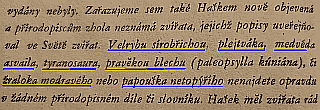
Haškologists Ančík and Hůla barking up the wrong tree by claiming that Hašek discovered new species.
Before 1950, no one had seriously investigated Hašek's activities at Svět zvířat. Information on the subject was limited to Hašek's own writing and brief passages in memoirs by his friends (Franta Sauer, Ladislav Hájek, Emil Artur Longen, Václav Menger).
Břetislav Hůla undertook the first scholarly investigation of this subject in the years following World War II. The result was The Small Zoological Garden [a], published in 1950 with Zdena Ančík, rather than Hůla, listed as editor. Unfortunately, it provides no bibliographic information about the stories and includes many items that the editors mistakenly attributed to Hašek. In the introduction, Ančík claimed that Hašek had invented no fewer than seven new species, thereby reinforcing the myths about his animal hoaxes; he even asserted that Hašek was responsible for the discovery of the blue whale and the tyrannosaurus.
The volume also contains several stories published in Svět zvířat years before Hašek became editor. That alone does not prove that he did not write them, but closer examination reveals that they were simply translated from German.
Hašek, entertainer and educator
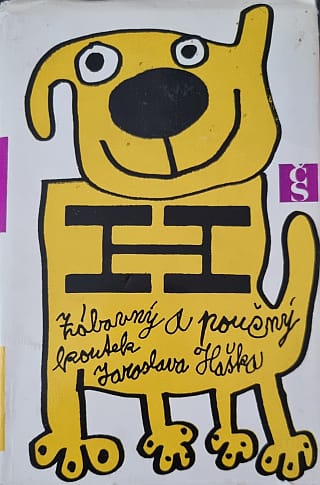
The second investigation of Hašek's work at Svět zvířat goes a long way towards correcting the shortcomings of its 1950 predecessor. It contains a detailed bibliography of the stories and articles, endnotes and a substantial afterword. Published in 1973, it formed part of the series The Writings of Jaroslav Hašek[c] and was entitled Zábavný a poučný koutek Jaroslava Haška (hereafter Koutek).
It was the twelfth of sixteen volumes of stories, plays, articles and other pieces by Jaroslav Hašek. The series, entitled Spisy Jaroslava Haška (The Writings of Jaroslav Hašek), was published between 1955 and 1973. With very few exceptions, Spisy contains everything Hašek is known to have written. This volume was edited by Zdena Ančík, Milan Jankovič and Radko Pytlík, who were then generally regarded as the foremost experts on Hašek's work.
Volume twelve of "Spisy" is devoted to Hašek's journalism rather than his satirical and humorous stories. It contains selected material from Svět zvířat (Animal World) and, to a lesser extent, from České Slovo (The Czech Word) and Svět (The World).
Fun and Education covers the years 1909 to 1913, during which Hašek worked for Svět zvířat in two separate spells. He moved into the editorial offices in November 1908 and may have begun contributing to the magazine as early as December. He was editor from February 1909 to October 1910, then took on a similar role from December 1912 until May 1913. In effect, he spent longer working for Svět zvířat than for any other employer, including the Red Army and the Legions.
Particularly revealing is Radko Pytlík's afterword, based on the researchers' reading and investigation of every issue of Svět zvířat published during Hašek's tenure, as well as České Slovo and Svět. It is essential reading for anyone interested in Hašek's journalistic work and the myths surrounding it.
Undermining the myths
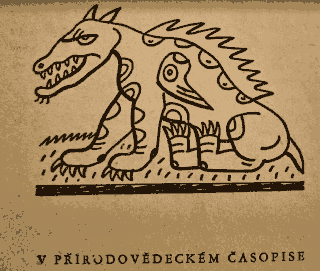
Hltoun strašlivý (the terrible guzzler) never appeared in the columns of Svět zvířat.
Over the years, much has been written about Jaroslav Hašek and Svět zvířat. Biographies, memoirs and articles, both in print and online, often claim that Hašek invented animals much as Einjährigfreiwilliger Marek did in The Good Soldier Švejk, that he was sacked because of his "discoveries" and other pranks, that he advertised werewolves for sale, that he wrote about an animal called the terrible guzzler, and that he dreamed up all manner of animal stories.
In the afterword, Radko Pytlík challenges these myths, not by refuting them directly, but by describing what the researchers de facto discovered while reading and investigating Svět zvířat.
After twenty years of research, he and his colleagues (Zdena Ančík and Milan Jankovič) concluded that Hašek's later accounts of his time at Svět zvířat, whether in short stories, Strana mírného pokroku v mezích zákona or through Einjährigfreiwilliger Marek in The Good Soldier Švejk, were largely exaggerated and distorted.
The researchers did, however, find many references in the three magazines that resurfaced in Hašek's later writing, including The Good Soldier Švejk. Examples include Flanderka, Xenophon, Bretschneider, Gyula Kakonyi, the sulphur-bellied whale, the jay and the Merry Corner. The robber from the Bakony forest also appears, as do the motif of Herostrates, who set fire to the temple in Ephesus, the cat eating a canary in [I.41,1], the wrecked marble table in [I.4], and more.
O Haškových pověstných mystifikacích jsme doposud věděli jen z jeho pozdějšího humorného vyprávění, zejména z příslušných kapitol Dějin strany mírného pokroku, z črty V přírodovědeckém časopise a z vyprávění jednoročního dobrovolníka Marka ve Švejkovi. Podle shod, jež se nám nyní po podrobném průzkumu časopisu podařilo objevit, zjišťujeme, že jsou v pozdějším vyprávění vesměs přehnány a přetvořeny. Radko Pytlík, Zábavný a poučný koutek Jaroslava Haška, 1973
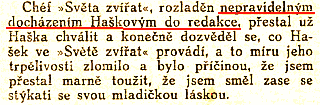
Hájek describing how Fuchs lost patience with Hašek, initially due to his irregular appearances in the office.
,1925
Nor could the literary experts identify any particular item in the journal that might have given its owner, Václav Fuchs, sufficient grounds to dismiss his editor. Referring to Ladislav Hájek, they suggest that Hašek left because of his careless management of the magazine.
Hájek did note that Hašek appeared at the office increasingly rarely and indicated that he had returned to an irresponsible way of life [e].
Interestingly, Hájek too claims that Hašek invented animals, including a fly with sixteen wings. Yet this creature also fails to appear in Svět zvířat, suggesting that Ladislav Hájek relied on hearsay rather than on anything he had actually read in the magazine.
Hned v úvodní stati je zmínka o starověkém Efialtovi, jenž prý zapálil chrám bohyně v Efesu, aby se dostal do dějin. Totéž řecké jméno se vyskytuje za několik týdnů poté v Haškově humoresce Baluškova zrada, tentokráte ve správném významu: Efialtes byl starořecký zrádce, jenž zavedl perské vojsko do zad svých krajanů u Thermopyl. Snad někdo Haška na omyl upozornil, snad přišel na svou chybu sám. V poválečném Švejkovi se objevuje motiv hérostratovský, jenž patří k základním složkám výstavby tohoto díla a slouží k odhalení protikladných zájmů malého člověka a ctižádostivých vojevůdců; vyskytuje se již se správným označením historickým. Radko Pytlík, Zábavný a poučný koutek Jaroslava Haška, 1973
Not only Svět zvířat
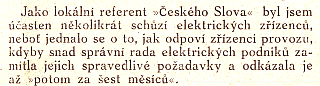
Hašek describes how he was forced to leave the National Social Party, thus ending his brief career as a local reporter for České slovo.
,14.3.1912
Although most of Koutek comes from Svět zvířat, it also covers Hašek's brief career as a local reporter for České Slovo. This lasted from December 1911 until February 1912 and, according to his own account, ended when he was expelled from Česká strana národně sociální [f].
In addition, Koutek includes some pieces from Svět, a weekly closely tied to Svět zvířat. It began as an Svět zvířat supplement but became an independent magazine in 1913. Both journals belonged to Ladislav Hájek, who had inherited Svět zvířat from his father-in-law, the late Václav Fuchs. The Svět pieces all date from the first half of 1913.
The afterword also analyses similarities between Hašek's journalism and his humorous stories. Both, it observes, often have an encyclopaedic character, combining a range of facts. Radko Pytlík concluded that there are countless factual and situational allusions and similarities in Hašek's journalism and humorous work.
Shortcomings
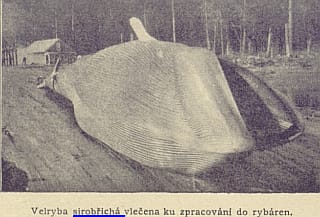
The sulphur-bellied whale was not Hašek's invention, but he probably translated an article about it.
,1.6.1909
The analysis does, however, have some flaws. The researchers devoted little attention to issues of Svět zvířat published before, between and after Hašek's spells as editor. Radko Pytlík indirectly acknowledges this by stating that Břetislav Hůla (meaning The Small Zoological Garden) included material that "could not have been written by Hašek because it was printed before he was appointed editor". This is correct, but a broader review would have prevented several erroneous conclusions.
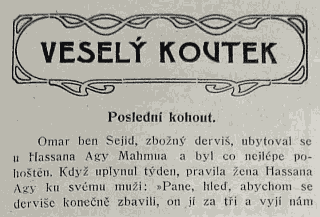
The Merry Corner predated Hašek's time at Svět zvířat with at least five years.
,15.1.1904
The editors of Fun and Education claim that Hašek introduced the column Veselý koutek. Had they browsed the older volumes, they would have seen that it already existed and dates back at least to 1 January 1904. This narrow focus also led them to omit Hašek's flea, an unsigned notice printed in 1911. They therefore overlooked one of Hašek's few confirmed animal hoaxes, and arguably his most successful.
The researchers also wrongly attributed to Hašek some stories and unsigned articles that he did not write, though he may have translated them. One example is "Modern Whalehunting" by Franz Winter, translated from Über Land und Meer (1909) and published in Svět zvířat on 1 June 1909 with photographs from the German original. They consequently concluded that Frant. Winter was one of Hašek's pseudonyms. Another supposed "pseudonym" was in fact a real person: Svobodný pán z Kapherrů (Egon von Kapherr).
Findings going unnoticed, legends living on
The researchers' conclusions appeared as a postscript in one of the volumes of Spisy, which may explain why they received little attention. Very few scholars seem to have taken note of them. As a result, myths about Hašek and Svět zvířat have persisted to this day (2025), even among scholars and other experts.
Radko Pytlík himself must bear some responsibility for this. After 1973, he published many books about Jaroslav Hašek but never again referred to the findings presented in the afterword to Zábavný a poučný koutek Jaroslava Haška, 1973.
Bibliography
The bibliography in Koutek is incomplete, so this webpage supplements it wherever possible. The articles are listed chronologically, from the earliest known item of 1 February 1909 to the last known article from 1913. They are divided into two sections: Main stories (Stati a fejetony) and Unsigned articles. Entries mistakenly attributed to Hašek are struck through.
Literature
- Cena slávy, Dr. Vladimír Vyhnal,8.1.1913
- Jak člověk bydlil a bydlí, Dr. Vladimír Vyhnal,22.1.1913
- Jak na koupání a čistotu těla se pohlíželo před 150 léty, ,22.1.1913
- O rafinovanosti zločinců, Dr. Vladimír Vyhnal,9.2.1913
- Jak dříve "ošetřovali" duševně choré, T. Witry,9.2.1913 Dr. Theodore Witry, Luxembourg? To be investigated
- Revoluce v Mexiku, Dr. Vladimír Vyhnal,23.2.1913
- O vyzvědačích, Dr. Vladimír Vyhnal,23.4.1913
- Válka ve vzduchu, Dr. Vladimír Vyhnal,8.5.1913
- O dobrodružných výpravách, Dr. Vladimír Vyhnal,23.6.1913
- Rozumné zvíře a pošetilý člověk, ,1.2.1909
- Moderní lov velryb, Frant. Winter,1.6.1909 Über Land und Meer, no. 32, 1909
- Vítězný boj o severní točnu, ,1.10.1909 Debatable authorship
- Vlastizasvěcená, E. Th. A. H.,1.12.1909 Ernst Theodor Amadeus Hoffmann: Haimatochare
- Objevení severní točny, Jaroslav Hašek,15.9.1909
- Jak havran krkavec stal se učitelem, Svobodný pán z Kapherrů,15.2.1910 Egon von Kapherr, Sport im Bild Nr. 3, 1910
- Vliv hudby na zvířata, Milka Langrová,1.5.1910
- Vánoční noc v lese, Jaroslav Hašek,15.12.1912
- Amazonský papoušek, ,1.1.1909
- Antilopy, ,1.1.1909
- Barvář pes, ,1.1.1909
- Bažant, ,1.1.1909
- Bizon, ,1.1.1909
- Bobr, ,1.1.1909
- Brhlík, ,1.1.1909
- Buvol, ,1.1.1909
- Býk, ,1.1.1909
- Cibetka, ,1.1.1909
- Čáp, ,1.1.1909
- Čejka, ,1.1.1909
- Červená zvěř, ,1.1.1909
- Červenka, ,1.1.1909
- Drozd, ,1.1.1909
- Fenky psů, ,1.1.1909
- Gorila, ,1.1.1909
- Hadi, ,1.1.1909
- Hejl, ,15.1.1909
- Hmyz, ,15.1.1909
- Hranostaj, ,15.1.1909
- Hroch, ,15.1.1909
- Hroznýš, ,1.2.1909
- Hřebec, ,1.2.1909
- Huňák, ,1.2.1909
- Husa divoká, ,1.2.1909
- Hyeny, ,15.2.1909
- Chrt, ,15.2.1909
- Chřestýš, ,15.2.1909
- Jaguár, ,15.2.1909
- Jehně, ,1.3.1909
- Jelen, ,1.3.1909
- Jeřáb, ,1.3.1909
- Jestřáb, ,1.3.1909
- Ještěrka, ,1.3.1909
- Kos, ,15.3.1909
- Kozorožec, ,15.3.1909
- Kráva, ,15.3.1909
- Kůň, ,15.3.1909
- Kolibřík, ,15.3.1909
- Krocan, ,1.4.1909
- Krokodýl, ,1.4.1909
- Krtek, ,1.4.1909
- Křeček, ,1.4.1909
- Křepelka, ,1.4.1909
- Kukačka, ,1.4.1909
- Krysy, ,15.4.1909
- Labuť, ,15.4.1909
- Lama, ,15.4.1909
- Lední medvěd, ,15.4.1909
- Leopard, ,15.4.1909
- Lev, ,15.4.1909
- Liška, ,1.5.1909
- Los, ,1.5.1909
- Lovecký ohař, ,1.5.1909
- Majka, ,1.5.1909
- Mandril, ,15.5.1909
- Medvědi, ,15.5.1909
- Mezek, ,15.5.1909
- Moli, ,15.5.1909
- Motýli, ,15.5.1909
- Myš, ,15.5.1909
- Tetřívek, ,1.6.1909
- Tchoř, ,1.6.1909
- Včely, ,1.6.1909
- Velryby, ,1.6.1909
- Velbloud, ,15.6.1909
- Veverka, ,15.6.1909
- Vlk, ,1.7.1909
- Vrabci, ,1.7.1909
- Vrány, ,1.7.1909
- Vydra, ,1.7.1909
- Tapír, ,15.7.1909
- Tchoř, ,15.7.1909
- Trochylus, ,15.7.1909
- Vretky, ,15.7.1909
- Tuleň, ,15.8.1909
- Tygr, ,15.8.1909
- Vydra, ,15.8.1909
- Zajíc, ,15.8.1909
- Zebra, ,15.8.1909
- Monografie hus, ,1.12.1909
- Psí proletariát, ,1.3.1909
- Vepři tažnými zvířaty v Bakoni v Uhrách, ,1.4.1909
- Automobil postrachem lidí a zvířat v Koreji, ,1.4.1909
- Gorila pijící z helmy, ,15.4.1909
- Uctívání hadů, ,15.4.1909
- Zápasy s kohouty, ,1.6.1909 Org.: Zápasy kohoutů
- Boj proti nakažlivým epidemiím a nemocem v Číně, ,15.6.1909
- Hlouposti velkých mužů, ,1.7.1909
- Hromadné hubení australské zvěře, ,15.7.1909
- Žraloci u Messiny, ,15.7.1909 Prager Tagblatt, 6.7.1909
- Žaludníci, ,15.7.1909 Eichelhäher - Sojka - Jay
- Úřední horlivost, ,1.8.1909
- Štvanice na jeleny v severním Skotsku u Tornhellu, ,1.10.1909
- Čarodějnice a kočky, ,1.10.1909
- Používání včel ve válečnictví, ,1.10.1909
- Vyděračství pomocí poštovních holubů, ,1.10.1909
- Polární medvěd uvažuje, ,1.10.1909
- Zajímavý lov na tygřici, ,1.10.1909
- Král lovců krys, ,15.10.1909
- Stěhování evropských osadníků, ,1.11.1909
- Lidoop "Diana", ,1.11.1909
- Čínské zpěvné myši, ,1.11.1909
- Tučňáci a gramofon, ,15.11.1909 "The Heart of the Antarctic" by Shackleton, 1909
- Stříbřití pávi, ,1.12.1909
- Historické nápisy na náhrobcích psů, ,15.12.1909
- Posvátní krokodilové, ,15.12.1909
- Ze života lvů, ,15.1.1910
- Kocour mistra Arbesa, ,15.1.1910
- Největší dravec světa, ,15.2.1910 Arbeiter-Zeitung, 5.2.1910
- Štvanice na vlky, ,15.3.1910
- Jak si domorodci na Jávě vysvětlují zemětřesení, ,15.3.1910
- Mravenci v Ugandě, ,15.4.1910
- Účinek střelby na nervy psů, ,15.4.1910
- Historická kočičina, ,15.7.1910
- Klokan umělcem v boxu, ,1.8.1910
- Jak se z pořádného člověka málem stane pytlák, ,1.8.1910
- Jak se provádí zubní operace na slonu, ,1.8.1910
- Pštrosí žaludek, ,15.9.1910
- Létací žába, ,15.9.1910
- Anglie děkuje za své bohatství kočkám, ,15.9.1910
- První pravěká stopa domácí kočky, ,1.10.1910 Salzburger Volksblatt, 1.10.1910
- Wapiti ve sněhu, ,1.12.1912
- Štvanice na zubry za dávných dob, ,15.12.1912
- Štvanice na kapského lva, ,15.12.1912
- Z vykopávek v Pompejích, ,15.12.1912
- Jak oceňuje slavný cestovatel, ,15.12.1912
- Reje vysoké zvěře, ,15.12.1912
- Lov v pravěku, ,1.1.1913
- Na perském statku, ,1.1.1913
- Vlci v Haliči, ,15.1.1913
- V ležení Tunguzů, ,15.1.1913
- Nové druhy zvířat, ,15.1.1913 *sjh12,akn* Arbeiterwille, 9.1.1913
- Ortel proti vepři, ,1.2.1913
- Hyeny bojiště, ,1.2.1913
- Historická vzpomínka, ,1.2.1913
- Jak jsou uctiví obyvatelé severní Číny ku zvířatům, ,1.2.1913
- Něco z dějin koně, ,1.3.1913
- Něco zajímavého o ježkovi, ,1.3.1913
- Největší blechy, ,1.3.1913
- Chov vepřů v Číně, ,15.3.1913
- K dějinám psa, ,15.3.1913
- Umělé líhně starých Egypťanů, ,15.3.1913
- Ranní cvičení s tigrem, ,1.4.1913
- Pečení celého vola, ,1.4.1913
- Nakažený kapr, ,1.4.1913
- Historické péro, ,1.4.1913
- Čemu všemu se nosorožec nenaučí, ,1.4.1913
- Slon na divadle, ,1.4.1913
- Životu nebezpečné návštěvy, ,15.4.1913
- Nový neznámý druh kytovců, ,1.5.1913
- Lví a levhartí spřežení, ,1.5.1913
- Starý bleší cirkus, ,1.5.1913
- Proměňování lidí ve zvířata, ,15.5.1913
- Lev v kinematografu, ,1.6.1913
- Ježkové a staří Římani, ,1.6.1913
- Velmi mylný názor o velrybách, ,1.6.1913
- Staří Řekové chovali zvláštní úctu ke hmyzu, ,1.8.1913
- Pražští Turci, ,?
- Čínské vývěsní štíty, ,?
- Malá zoologická zahrada, ,1950 [a]
- Zábavný a poučný koutek Jaroslava Haška, ,1973 [b]
- Jaroslav Haška zoologická zahrada, Břetislav Hůla,1950 [c]
- Bibliografie Jaroslava Haška, ,2025 [d]
- Z mých vzpomínek na Jaroslava Haška, ,1925 [e]
- Toulavé house, ,1971
- Některé záhady pravěku, Jaroslav Hašek,15.8.1910
- Jak jsem vystoupil ze strany Nár. sociální, Jaroslav Hašek,14.3.1912 [f]
- Ze Světa zvířat do Českého slova a naopak, Radko Pytlík,17.12.1969
| a | Malá zoologická zahrada | 1950 | |
| b | Zábavný a poučný koutek Jaroslava Haška | 1973 | |
| c | Jaroslav Haška zoologická zahrada | Břetislav Hůla | 1950 |
| d | Bibliografie Jaroslava Haška | 2025 | |
| e | Z mých vzpomínek na Jaroslava Haška | 1925 | |
| f | Jak jsem vystoupil ze strany Nár. sociální | Jaroslav Hašek | 14.3.1912 |