


Many admirers of The Good Soldier Švejk may be unaware that the good soldier first appeared on the literary stage several years before the First World War. Švejk made his debut in 1911, in five short stories published in the magazines Karikatury and Dobrá kopa. The first appeared in Josef Lada's magazine Karikatury on 22 May 1911; this date is often treated as Švejk's official birthday. The five pieces were later collected in Dobrý voják Švejk a jiné podivné historky (The Good Soldier Švejk and other strange stories), part of Hejda & Tuček's series Nová knihovna humoru a satiry. The book was published in the autumn of 1911, soon confiscated, and finally reissued in 1912.
An early predecessor
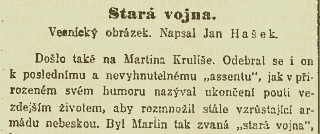
,28.2.1902
Even before The Good Soldier Švejk entered the world, Jaroslav Hašek had written stories with an army setting. The first appeared as early as 28 February 1902 in Národní listy, under the name Jan Hašek. The budding author was then only nineteen and still a student at the Czechoslavonic Commercial Academy (see Obchodní akademie) in Prague. A few more pieces on the same theme followed over the next five years.
Then, on 30 January 1907, the anarchist paper Nová Omladina published a tale that would have struck a chord with future readers of The Good Soldier Švejk. It was called Povídka o hodném švědském vojákovi (The story of a kind Swedish soldier). In this grotesque episode, a Swedish soldier on guard duty at 25 degrees below zero mutilates himself to avoid falling asleep and freezing to death. Yet death holds no fear for him: after all, he will perish honourably for the sake of King Oscar and the dear fatherland. He values army property more highly than his own miserable life and remains loyally devoted to his officer. Although this nameless soldier says nothing before he dies, he is clearly recognisable to readers of Švejk: he meets death with a joyful heart for his king. There is one important distinction, however: the Swedish soldier dies forlorn and miserable, whereas Švejk survives by his wits…
Five short stories
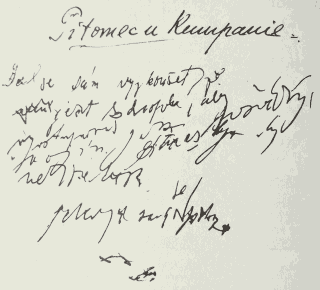
Hašek's concept for the company idiot.
According to Jarmila Haškova, her husband conceived the idea of a literary figure described as Pitomec v kumpanii (The Idiot in the Company) sometime in the spring of 1911. Hašek had scribbled a few lines on a scrap of paper when he arrived home in a sorry state; the text was barely legible. Jarmila threw it in the bin, but Hašek searched for it frantically and managed to retrieve it.
On 22 May 1911, the first of the five stories appeared in Karikatury, so the idea for the character—jotted down on that piece of paper—probably took shape shortly beforehand. The name Švejk also appeared in a couple of plays that Hašek co-wrote later that year. In one of them, Švejk plays the servant of the Holy Roman Emperor (and Czech King) Charles I.
In this 1911 incarnation, Švejk is a simple, good-natured figure, just as eager to serve his sovereign as his Swedish counterpart had been four years earlier. Although he shares certain traits with the famous character from the novel, he lacks the latter's sting and subtlety (any intended sting would presumably have been snuffed out by the censors). The style differs too: there are, for instance, no anecdotes. All five tales are set in Trento (Trient), in South Tyrol, where the Dual Monarchy built a huge fortress complex to forestall a potential Italian attack up the Adige valley. As in the novel, Švejk creates havoc by following orders to the letter. Hašek may already have intended him to be subversive, but this is much less explicit than in the later novel.
The five 1911 stories can be summarised briefly:
I. The Good Soldier Švejk
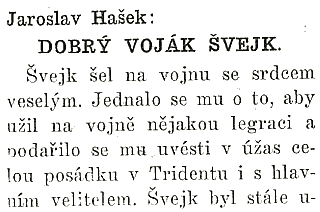
The first story about Švejk, reprinted in Chicago!
,8.7.1911
In the first story[a], Švejk crosses the border into Italy, where he captures a donkey and a machine-gun. Before this, he is imprisoned several times. His standard phrase ‘Poslušně hlásím’ (I dutifully report) is already in place, as is the use of colloquial Czech in dialogue. The story was reprinted in a couple of Czech-American newspapers that summer.
II. The Good Soldier Švejk provides wine for the mass
The second story[b] opens with the author's musings on military chaplains. Then, as in the novel, a field chaplain—in this case Augustinus Kleinschrodt—‘recruits’ Švejk. He receives his marching orders from his feldkurát and sets out from the camp in Castel-Nuovo to buy wine from ‘Vöslava’ (present-day Bad Vöslau) in Austria. Švejk obeys to the letter, travelling by train up the Adige valley and through numerous tunnels to fulfil his duty. What follows is an epic rail journey all the way to Bad Vöslau and back via Graz, Zagreb, Trieste and Trento. On the way, he is arrested and taken to the garrison in Korneuburg.
III. The Good Soldier Švejk and the superarbitration procedure
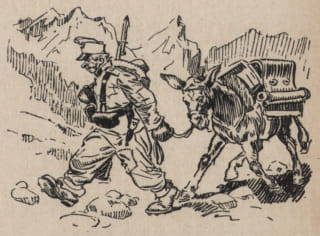
Švejk capturing an Italian donkey.
In the third story[c], Švejk doggedly resists attempts to superarbitrate him, a theme carried over into the opening passages of the novel.
IV. The Good Soldier Švejk learns how to handle gun cotton
In the fourth story[d], Švejk blows up a powder magazine while smoking his familiar pipe. He is the sole survivor.
V. The Good Soldier Švejk operates in aeroplanes
Finally, in the fifth story[e], Švejk joins the fledgling k.u.k Air Force and accidentally flies off to Libya, with his officer on board. Before reaching this point, he has crashed his plane into the Danube. According to the tale, the entire Austrian air force consists of 18 airships (which are impossible to operate) and five aeroplanes.
The name
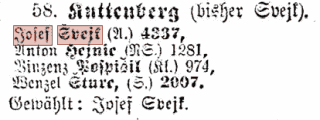
Deputy Josef Švejk re-elected from district 58, Kutná Hora
,14.6.1911
Why Jaroslav Hašek chose the name Švejk remains unknown, but the most likely inspiration was the agrarian deputy Josef Švejk. According to Radko Pytlík, the claim goes back to Václav Menger. Elections to the Reichsrat took place in June 1911, and his name featured frequently in the newspapers.
Another frequently suggested inspiration is Josef SVEJK, who actually lived next to U kalicha. This was not until June 1912, however, so it is highly unlikely that Hašek knew him in 1911. It is also worth noting that the five stories never mention the first name Josef, nor associate the character with U kalicha.
Hašek and the army, pre-war
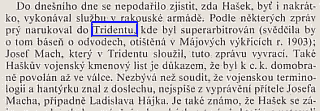
Kniha o Švejkovi, s. 133
, 1982
Hašek never served in the army before World War I, and this is reflected in the five stories. His details rarely fit reality, in stark contrast to the wealth of military fact in Dobrý voják Švejk v zajetí (1917) and The Good Soldier Švejk (1921). Few, if any, of the officers' names appear in the Schematismus; geographically, he sets every story in Trento, a city he probably visited, though hardly as a soldier. In one of the tales, he even mentions Infanterieregiment Nr. 104, a unit that did not yet exist.
Radko Pytlík concludes that the stories were most likely inspired by the experiences of Hašek's friends, notably Josef Mach, who served in Trento as a one-year volunteer. Trento also regularly hosted military units recruited from Bohemia, so many people may have passed their experiences on to the future author of The Good Soldier Švejk. Units from Infanterieregiment Nr. 91, the regiment Hašek eventually joined, were never garrisoned in Trento.
Given his age group, Hašek should have been called up on 1 October 1904, but by the 9th he had already published a story about visiting Ladislav Hájek in Domažlice on his way back from Switzerland and Bavaria. He had most probably been deemed unfit for service in April, when the military examining boards convened. The likely cause was a heart condition. Hašek was not finally passed fit for service until after the outbreak of war in 1914.
Hašek's seal of confession in Reichsrat
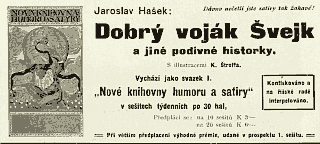
,13.10.1911
On 29 November 1911, one of Jaroslav Hašek's stories from Dobrý voják Švejk a jiné podivné historky became the subject of an interpellation in the Chamber of Deputies of the Reichsrat. On 18 November 1911, K.k. Landesgericht als Preßgericht in Prague had ordered the book to be confiscated.
The issue was not the five stories about Švejk, but Zpovědní tajemství (The Seal of Confession), which had been deemed blasphemous. A group of deputies led by Fresl protested to the Minister of Justice, pointing out that it had already appeared in České Slovo in 1908 without being censored.
The eighteen signatories were: eleven from Česká strana národně sociální (Fresl, Vojna, Formánek, Klofáč, Choc, Stříbrný, Lisy, Konečný, Slavíček, Baxa, Šviha); three Czech independent progressives (Masaryk, Kalina, Prunar); two Czech agrarians (Masata, Bradač); and two Ukrainians (Breiter, Трильовський (Trylowskyj)). The agrarian deputy Josef Švejk, notably, did not sign it …
The complaint appears to have been heeded: the book was reprinted in 1912. The censored passages were marked with a note about the petition, but nothing seems to have been removed. The interpellation did not explicitly mention Hašek or the book's title.
Literature
- Dobrý voják Švejk, Jaroslav Hašek,22.5.1911 [a]
- Dobrý voják Švejk opatřuje mešní víno, Jaroslav Hašek,19.6.1911 [b]
- Superarbitrační řízení s dobrým vojákem Švejkem, Jaroslav Hašek,17.7.1911 [c]
- Dobrý voják Švejk učí se zacházet se střelnou bavlnou, Jaroslav Hašek,21.7.1911 [d]
- Dobrý voják Švejk působí u aeroplánů, Jaroslav Hašek,28.7.1911 [e]
- The Good Soldier Švejk: the first sketches, Jaroslav Hašek
- Stará vojna, Jan Hašek,28.2.1902
- Povídka o hodném švědském vojákovi, Jarmila Mayerová,30.1.1907
- Dobrý voják Švejk, ,8.7.1911
- Dobrý voják Švejk, ,12.9.1911
- Dobrý voják Švejk a jiné podivné historky, ,1911 (banned), 1912 (re-issued)
- Kundmachungen, ,23.11.1911
- Stenographische Protokolle - Abgeordnetenhaus, ,29.11.1911
- 58. Kuttenberg, ,14.6.1911
| a | Dobrý voják Švejk | Jaroslav Hašek | 22.5.1911 |
| b | Dobrý voják Švejk opatřuje mešní víno | Jaroslav Hašek | 19.6.1911 |
| c | Superarbitrační řízení s dobrým vojákem Švejkem | Jaroslav Hašek | 17.7.1911 |
| d | Dobrý voják Švejk učí se zacházet se střelnou bavlnou | Jaroslav Hašek | 21.7.1911 |
| e | Dobrý voják Švejk působí u aeroplánů | Jaroslav Hašek | 28.7.1911 |