


This article traces a little-known episode from Hašek's tumultuous life, set in a region that the author of The Good Soldier Švejk seldom visited. In Turnov, on 27 October 1912, Hašek caused a scandal by ridiculing the Serbs, who were fighting the First Balkan War at the time. This took place before an audience with strong sympathies for Serbia, loyalties that Hašek himself no doubt shared. It remains a mystery, then, why he chose to foul his own nest so thoroughly. Was it a clumsy attempt at humour? A simple urge to provoke? Was he drunk? Or was it sheer mischief and recklessness? Any combination of these factors is possible, but together they sum up Jaroslav Hašek. Nothing was sacred to him, not even his convictions. Like a child, he rarely considered the consequences of his actions, and repeatedly ended up undermining himself.
Hůla's research
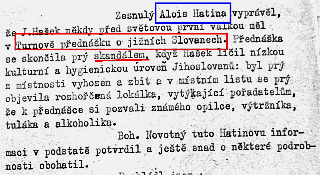
Břetislav Hůla reporting to Zdena Ančík.
,24.4.1951
This incident first caught my eye in 2015, when I was studying the correspondence between Břetislav Hůla and Zdena Ančík. In it, the former recorded (and handed over) the results of his impressive research, conducted between 1948 and 1951, an effort for which he has received scant credit. Alois Hatina (1886-1940), a former politician and friend of Jaroslav Hašek, told Hůla about a scandal that erupted when Hašek spoke at the Turnov branch of Sokol, describing the low cultural level and poor hygiene of the South Slavs. One Bohuslav Novotný corroborated the story, which allegedly prompted an indignant report in a local newspaper. According to Hatina, Hašek was hounded from the premises and even beaten[e].
The diligent Břetislav Hůla traced the story's origins by searching local newspapers. Hašek was invited to speak at an "evening of Czech humour" arranged by the women's section of Sokol on Sunday, 27 October 1912. Unfortunately, Hůla never found the alleged indignant report on the event.
In biographies
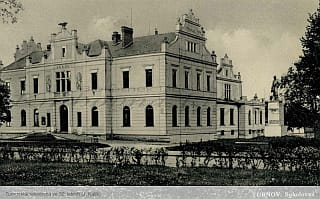
The Sokol building in Turnov, scene of Jaroslav Hašek's 'performance' on 27 October 1912.
In the standard biography of Hašek, Toulavé house (The Wandering Gosling), Radko Pytlík mentions this curious episode. The local chapter of Sokol invited Hašek to speak on behalf of Strana mírného pokroku v mezích zákona, but he failed to live up to expectations and left the audience unimpressed. Worse still, he provoked them by mocking the Serbs, who were then fighting the First Balkan War, and allegedly made derogatory comments about social and hygienic conditions in the Balkans. In the end, local Sokol members chased him across the garden restaurant.
Later, Pytlík provided slightly contradictory information about the incident[d], relocating it to Náchod, while other biographers seem to have overlooked it altogether (Cecil Parrott does not mention it). Radko Pytlík's account draws on Břetislav Hůla's research, but also appears to use other sources.
31. října 1912, v době balkánské války, účinkoval například na akademii ženského odboru Sokola v Turnově jako řečník Strany mírného pokroku. Nesplnil však očekávání, publikum nepobavil. Zesměšňoval však dočasné vítězství Srbů a mluvil o ubohých sociálních a hygienických poměrech na Balkáně. Místními Sokoly byl hnán přes celou zahradní restaurací, dokonce prý inzultován.
Radko Pytlík, 1971, "Toulavé house"
As historical newspapers have become more widely available through digitisation, it is now possible to recount the episode in greater detail and correct inaccuracies in Pytlík's books and Hatina's account. Let us therefore reconstruct the events from newspaper reports published around the time.
An evening of Czech humour
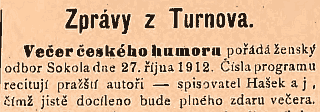
Advert for the evening of Czech humour.
,20.10.1912
On 20 October 1912 Listy pojizerské, a local newspaper in Turnov, announced that the women's section of the Sokol would arrange an "evening of Czech humour" the following week. A group of literati were invited, with Hašek billed as the main attraction (a). He was given two timeslots under the heading Causerie dobrodružstvi ze života autorova. Among the other participants were Josef Mach and Karel Pelant, both associated with Hašek's Strana mírného pokroku v mezích zákona. The session was due to start at 7:30 PM [b].
Young Czech indignation
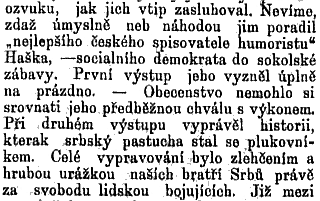
,10.11.1912
Listy pojizerské does not seem to have covered the event. The rival newspaper Krakonoš, a regional mouthpiece of Mladočeši in Jičín, did so, but only two weeks later[c].
At Sokolovna, Hašek grabbed the headlines for all the wrong reasons. According to Krakonoš, his first stage act fell completely flat; the audience did not appreciate his craving for recognition. Worse was to follow. In the second part, he told a story about a Serbian shepherd who became a colonel, mocking the South Slavs who were then fighting the First Balkan War.
This went down badly with an audience strongly sympathetic to Serbia. The story provoked an uproar, and many people left the hall in disgust. When he began another story, he was asked to stop, but responded by swearing at the audience. The disturbance continued until Hašek left the stage and the building. Only the mayor's intervention calmed the deeply offended crowd.
Lebt in Prag ein tschechischer Schriftsteller...
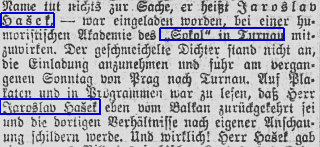
,31.10.1912
Krakonoš was not the first to respond. On 31 October 1912, four days after the infamous event, Bohemia published its version of the story [f]. It was even more colourful and ironic than Krakonoš's report. The piece was unsigned, but its style bears the traces of Egon Erwin Kisch, the soon-to-be-famous "raging reporter" who worked for the newspaper at the time.
It is unknown where Bohemia obtained its information, but the content suggests that Hašek himself may have had a hand in it. Allegedly, the unfortunate speaker was pelted with food from the buffet and driven from the stage; matters might have ended badly had the organiser dr. Práčník not protected him and called the k.k. Landwehr guards. Hašek and Kisch were friends, and the story may have passed from one to the other over a beer or two... The anonymous writer in Bohemia also added an ironic anti-Czech twist, wording unlikely to have come from Hašek.
More indignation
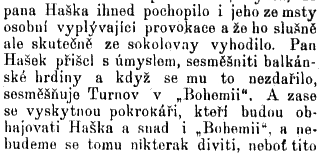
,24.11.1912
Bohemia's ironic article did not go unnoticed: a Salzburg newspaper even picked it up and reproduced it word for word[g]. More significantly, Krakonoš returned to the incident, evidently prompted by the news in Bohemia. It printed a complete translation before debunking parts of the account.
Hašek had not been chased by an angry crowd. He had been asked, firmly but tactfully, to leave both the stage and the building, without any of the drama described by Bohemia. He was also berated for ridiculing the Serbs who were fighting a war at the time. Moreover, Krakonoš criticized him for making fun of Turnov. The paper thus clearly assumed that Hašek was Bohemia's source of information [h].
Other variations
In 1923 České Slovo published a note that probably refers to the same event, but gives a very different account. The organisers waited in vain for Hašek to arrive, then announced that his talk had been cancelled. A voice was then heard from the back: "but I am after all here, I have been sitting here drinking since the morning!" [i]
Literature
- Vešer českého humoru, ,20.10.1912 [a]
- Ženský odbor Sokola v Turnově, ,20.10.1912 [b]
- Der hinausgeworfene Heldensänger, ,31.10.1912 [f]
- Der hinausgeworfene Heldensänger, ,3.11.1912 [g]
- Ženský odbor Sokola v Turnově, ,10.11.1912 [c]
- Jaroslav Hašek, ,24.11.1912 [h]
- In memoriam Jaroslava Haška, ,30.3.1923 [i]
- Zesnulý Alois Hatina..., Břetislav Hůla,24.4.1951 [e]
- Toulavé house, ,1971
- Jaroslav Hašek: Data, fakty, dokumenty, ,2013 [d]
- Historie turnovského Sokola,
| a | Vešer českého humoru | 20.10.1912 | |
| b | Ženský odbor Sokola v Turnově | 20.10.1912 | |
| c | Ženský odbor Sokola v Turnově | 10.11.1912 | |
| d | Jaroslav Hašek: Data, fakty, dokumenty | 2013 | |
| e | Zesnulý Alois Hatina... | Břetislav Hůla | 24.4.1951 |
| f | Der hinausgeworfene Heldensänger | 31.10.1912 | |
| g | Der hinausgeworfene Heldensänger | 3.11.1912 | |
| h | Jaroslav Hašek | 24.11.1912 | |
| i | In memoriam Jaroslava Haška | 30.3.1923 |