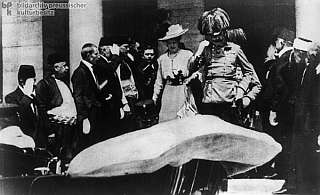
Franz Ferdinand and his wife Sophie leaving Sarajevo Town Hall on 28 June 1914, five minutes before the assassination.
The Good Soldier Švejk is a novel with an exceptionally rich cast of characters. Alongside those who play a direct part in the plot, a great many fictional and real people (and animals) are mentioned throughout the narrative, in Švejk's anecdotes and in the book's idioms and turns of phrase.
This page offers brief entries on the people referred to in the novel, from Napoléon in the introduction to Hauptmann Ságner in the final lines of the unfinished Part Four. The list is sorted in the order in which names first appear. Chapter headings follow Zenny Sadlon's recent translation (1999–2026) and, in most cases, differ from Cecil Parrott's 1973 version.
The Czech quotations are taken from the online version of The Good Soldier Švejk provided by Jaroslav Šerák and link to the relevant chapter. The toolbar provides direct links to Wikipedia, Google Maps, Google Search, svejkmuseum.cz and the novel online.
The names are colour-coded according to their role in the novel, as illustrated by the following examples:
Dr. Grünstein, a fictional character directly involved in the plot.
Fähnrich Dauerling, a fictional character who is not part of the plot.
Heinrich Heine, a historical person.
Note that many seemingly fictional characters are inspired by real people. Examples include Oberleutnant Lukáš, Major Wenzl and many others. These are still listed as fictional, since they are literary creations only partly inspired by their similarly named 'models'.
Military ranks and other titles related to Austrian officialdom are given in German, in accordance with the terms used at the time (explanations in English are provided as tooltips). This means that Captain Ságner is still referred to as Hauptmann, even though the term is now obsolete and has been replaced by Kapitän. Civilian titles denoting profession, etc., are translated into English. This also applies to ranks in the nobility where a direct translation exists.
Kraus
was a colonel at some barracks in Prague (presumably Karlín), originally from the Salzburg area. He was the owner of the stolen dog Fox (who was named Max for the short period he belonged to Oberleutnant Lukáš).
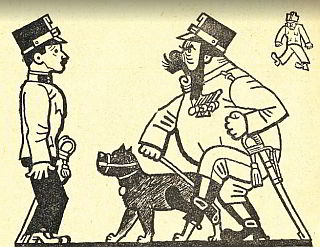
Kraus was a prize idiot and also had plenty of other despicable qualities. He was probably the most stupid of the many officers described in the novel. He had a habit of explaining the most obvious things, which drove his colleagues to insanity. Despite all this, he had advanced in the military hierarchy thanks to good connections, a fact the author uses to emphasise the rottenness of the Habsburg Monarchy.
After running into Oberleutnant Lukáš, who was promenading with Fox/Max, Kraus made sure that Lukáš and Švejk were sent to the front. This was an important turning point in the novel, which from then on mostly uses military life as a backdrop to the plot.
Background
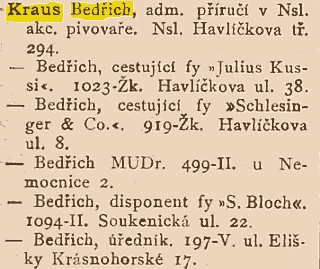
Adresář královského hlavního města Prahy a obcí sousedních,1910
Colonel Kraus does not have any obvious model from real life, and the author gives little biographical information that could help to identify him. With his grotesque stupidity, one must assume that the colonel is a caricature, but some of his character traits may well have been borrowed from officers or other people that Hašek knew. Not even the geographical name Zillergut gives any clue, as no such place can be identified, be it on modern maps or in historical newspapers.
However, it is likely that Hašek knew people with this name, for in Prague in 1910 there were several individuals whose first and last names match those of the colonel[a]. We have many examples of the author assigning the names of real people to literary characters, and in many cases there is little else that connects the living person to the fictional one.
A fellow student
One Kraus who Hašek may have known was Bedřich (Friedrich), a fellow student at the gymnasium in Žitná ulice from 1893 to 1896. This Kraus hailed from Karlín and studied five years above Hašek, so he would probably have been no more than a peripheral acquaintance.
The theories of Augustin Knesl
Augustin Knesl
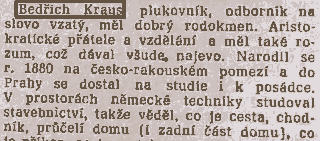
Večerní Praha, 1983
Seemingly Augustin Knesl is the only researcher who has made a serious attempt at identifying a model for the idiotic colonel. Allegedly, he is inspired by a certain Friedrich Kraus who studied civil engineering at the German technical high school in Prague. This Kraus was born in 1880, and Knesl claims that he was a colonel and served at the Prague garrison. Knesl also maintains that Kraus had a mania for explaining the most obvious things.
Unfortunately, Knesl's conclusions are unconvincing. He rather naively accepts information from The Good Soldier Švejk as historical facts, and thus concludes that Kraus was a colonel in Prague. However, no trace of such a colonel exists, be it in Schematismus (1914) or in the Prague address books. The closest are some reservists, but none of them served in Prague in 1914. Not even in k.k. Landwehr can any such officer be traced.
Friedrich Kraus was quite a common name, so Hašek may well have known a few of them, and there is good reason to believe that Knesl's engineering student actually lived. Apart from this, there is little tangible information, and the parallel to Knesl's write-up on Feldkurat Katz is striking: the researcher dug out a person with some similarities to the literary figure, but then assumed that additional information can be deduced from The Good Soldier Švejk.
Rector Řežábek
In the Hašek biography The Bad Bohemian, Cecil Parrott notes that the rector of Obchodní akademie, Řežábek, was detested by the author, who targeted him in a scathing satire printed in Karikatury in 1908. Parrott observed that Řežábek, like colonel Kraus, demanded that "subordinates" greet him already at a distance, and woe betide anyone who didn't!
Cecil Parrott: The Bad Bohemian
Režábek's insistence that the students should greet him from a long way off recalls Colonel Kraus von Zillergut in "The Good Soldier Švejk". Woe betide anyone who failed to notice him! The culprit was given a dressing down before the whole class and his crime was recorded in the class book. In addition his marks for good behaviour were slashed and he was led off to the Rector's office, where he got a second dressing down and his parents were told of his unheard of behaviour.
Quote(s) from the novel
[I.15]Plukovník Bedřich Kraus, mající též přídomek von Zillergut, po nějaké vesničce v Solnohradech, kterou jeho předkové prožrali již ve století osmnáctém, byl úctyhodným pitomcem.
[I.15] Scházela mu polovička levého ucha, kterou mu usekl jeho protivník za mládí v souboji kvůli prostému konstatování pravdy, že Bedřich Kraus von Zillergut je prachpitomý chlap.
[I.15] Před nadporučíkem stál plukovník Kraus von Zillergut. Nadporučík Lukáš zasalutoval a stál před plukovníkem, omlouvaje se, že neviděl.
[I.15] "Pane nadporučíku," hrozným hlasem řekl plukovník Kraus, "nižší šarže musí vždy vzdát čest vyšším. To není zrušeno.
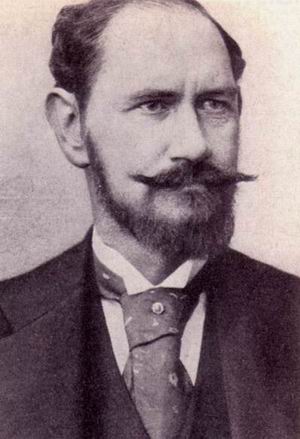
Mannlicher
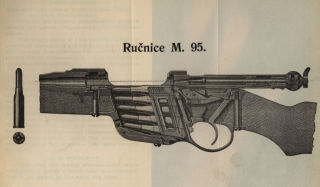
is indirectly referred to by the Mannlicher rifle, called manlicherovka in the novel. The theme here is Oberst Kraus who was obsessed with this rifle and therefore got the nickname "Mannlicher idiot" (Manlichertrottel).
Background
Mannlicher
was an Austrian inventor and small armaments designer, best known for M1895, a series of self-loading rifles that became the standard issue rifle in k.u.k. Wehrmacht. The term manclicherovka refers to this gun. The most common version was Infanterie Repetier-Gewehr M1895. The rifles were produced in Steyr and later also in Budapest.
Mannlicher, who hailed from a family in Brüx (now Most) in Bohemia, moved with them to Vienna in 1857. Here he studied machine engineering and made a career as a railway engineer. In 1876 he travelled to Philadelphia for a railway equipment exhibition, and on the side he had a chance to study the patents of various small-arms designs. This was probably the impetus for his career as a small arms designer.
In 1879 his first design for an 11 mm repeater rifle was ready. It underwent several improvements over the next few years, until it in 1886 was introduced in k.u.k. Heer. Two years later the M88, with calibre 8 mm, was introduced, and several models followed until the flagship M1895 was introduced in 1895. Mannlicher also designed pistols and hunting guns. Mannlicher firearms were also widely exported. He is generally regarded as one of the greatest small arms designers in history.
Personal details
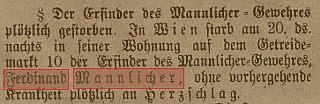
Mannlicher remained employed by the railways until 1887 when he finally took up a full position at the Steyr armaments factory, Österreichische Waffen-fabriksaktiengesellschaft. He was by now famous, repeatedly decorated, and in 1892 he was ennobled, choosing the name Ritter von Mannlicher. In 1899 he was awarded life long membership of Herrenhaus, the upper chamber of Reichsrat (the parliament of Cisleithania). Mannlicher was married and had two daughters. In 1904 he died of a heart attack, still only 55.
Hašek and "manlicherovka"
Mannlicher's famous rifle is mentioned by Hašek already in the story "Smrt Horala" (The death of Horal). It was published first in Národní listy on 8 April 1902 and also appeared across the Atlantic in Národní noviny, Baltimore, on 3 May. This was surely the first time ever that Hašek had a story published outside Bohemia.
Quote(s) from the novel
[I.15] Při přehlídkách pluku dával se do hovoru s vojáky a ptal se jich vždy jedno a totéž: „Proč se ručnici, zavedené ve vojsku, říká manlicherovka?“
U pluku měl přezdívku „manlichertrottel“. Byl neobyčejně mstivý, ničil podřízené důstojníky, když se mu nelíbili, a když se chtěli ženit, tu posílal nahoru velmi špatná doporučení jejich žádostí.
Schiller
is mentioned because Oberst Kraus passed idiotic remarks when his officer colleagues talked about Schiller at a banquet.
Background
Schiller
was a world-famous German playwright, poet, historian and philosopher. He belonged to the Romantic era and was strongly associated with Goethe and Weimar. His full name was Johann ChristophFriedrichvon Schiller.
Quote(s) from the novel
[I.15] Týž spád řeči, táž zásoba největší naivnosti. Na jednom banketu v důstojnickém kasině plukovník Bedřich Kraus von Zillergut z čista jasna pronesl, když byla řeč o Schillerovi: „Tak jsem vám, pánové, včera viděl parní pluh hnaný lokomotivou. Považte si, pánové, lokomotivou, ale ne jednou, dvěma lokomotivami. Vidím kouř, jdu blíž, a ona to lokomotiva a na druhé straně druhá. Řekněte mně, pánové, není-liž to směšné? Dvě lokomotivy, jako by nestačila jedna.“
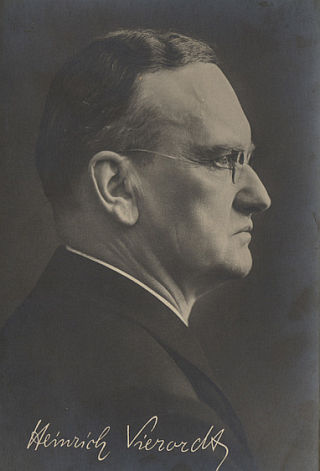
Vierordt
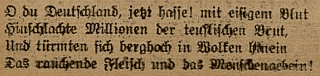
is mentioned when the author of The Good Soldier Švejk describes Oberst Kraus. The stupid colonel has ideas that align with those of Vierordt as expressed in a poem where he urges "Germany to hate and to slaughter millions of French devils with an iron soul". He is thus spiritually in line with the attitudes of the colonel who wanted to kill all prisoners, burn all Serbs and kill their children with bayonets. Hašek flawlessly translated two lines from the poem, whereas his introduction to it is less accurate.
Background
Vierordt
was a poet from Karlsruhe who soon after the outbreak of World War I wrote an infamously bloodthirsty poem in ten verses: Deutschland, Hasse! (Germany, Hate!). From this poem, verse seven is no doubt the one that Hašek refers to in The Good Soldier Švejk. Vierordt otherwise wrote patriotic poetry and ballads, praising the virtues of his home area and his nation. After the Nazi take-over, he associated himself with the party and even wrote poems glorifying Hitler[1]. Vierordt was married and had one daughter. On his 50th birthday, he was awarded the title Hofrat.
A grotesque poem
The poem first appeared in Badische Landeszeitung[2] on 29 August 1914[d]. In October it was published as a single sheet title Deutschland hasse! Kriegsruf by VerlagMüller& Gräff in Karlsruhe and sold for the benefit of the Red Cross for 10 pfenning[b]. Best known are the last four verses that made the poem infamous and caught the attention both at home and abroad. These verses have later frequently been mentioned in articles and books that deal with the theme of war propaganda. The mentioned sheet probably contained only these verses.
Also in Austria the poem was printed and discussed, for instance by the newspaper Arbeiterwille in 1914 and 1915. The text published on the front page of this paper 25 November 1914 is an extract and differs slightly from the original. The same paper mentioned the poem again on 22 April 1915 and now clearly distanced itself from the content[a]. They might have done so already in November 1914, but as most of the surrounding text was removed by censorship, it is difficult to judge the context.
Objections
The poem was controversial from the beginning, even in Germany. It was eventually banned by German General Staff. The Red Cross in Baden refused to use it in its promotional material. Already in November 1914 it provoked a counter-poem named Deutschland, Hasse nicht![c].
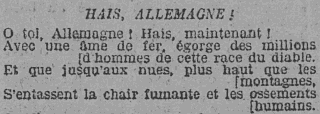
Inevitably Vierordt's abnormal literary outburst was noticed abroad, notably in France where future Prime Minister Georges Clemenceau translated two verses and commented on them in his newspaper L'Homme enchaîné[e]. He dryly observed that Vierordt as late as the previous year had visited France and praised the country in glowing terms! Among others who reacted were the writers Karl Kraus and Erich Mühsam and the German pacifist/feminist Helene Stöcker.[f].
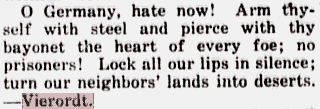
After the USA entered the war extracts of the poem were translated and appeared in some newspapers as an example of "Hun" bestiality and anti-culture. Already in 1915 it was partly translated and observed in the Dutch newspaper De Preangerbode[g].
Aftermath
The poem has also in recent times appeared in books that deal with war propaganda and is often emphasized as one of the most grotesque ones. The author himself had a street Vierordtstrasse named after himself in 1974, but in 2017 discussions were held about a possible renaming due to the author's war poetry. It was decided to keep the surname but rather associate it with his grandfather (1797-1867) of the same name, a local banker and benefactor.
Quote(s) from the novel
[I.15] Nebyl o nic horší než německý básník Vierordt, který zveřejnil za války verše, aby Německo nenávidělo a zabíjelo s železnou duší miliony francouzských ďáblů:
  Ať až k oblakům nad hory
  hromadí se lidské kosti a kouřící se maso.
Credit: Hans-Peter Laqueur, Georges Clemenceau, Johannes Werner
Some studies claim that the poem was published in Welt om Sonntag on 20 November 1914. In view of the above mentioned information this is obviously not true and moreover this date fell on a Friday (Hans-Peter Laqueur)! Nor have I have succeeded in identifying any newspaper named Welt om Sonntag from 1914. Ref. Werner, "Ein schreckliches Gedicht".
Kuneš
was a bagmaker in Spálená ulice, described by Švejk when he tries to explain the dog theft to the furious Oberleutnant Lukáš. Kuneš had the habit of losing his dogs wherever he ventured.
Background
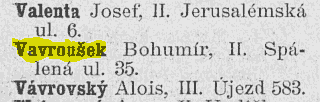
Address books from 1907 and 1910 do not show up any bag-maker Kuneš in the Prague. There was a one person listed with this occupation in Spálená ulice No 35, but his name was Bohumír Vavroušek. In 1896 two bag makers were registered in the street but none of them were named Kuneš.
Quote(s) from the novel
[I.15] Ve Spálený ulici je nějakej brašnář Kuneš a ten nemoh jít se psem na procházku, aby ho neztratil. Vobyčejně ho nechal někde v hospodě nebo mu ho někdo ukrad nebo si ho vypůjčil a nevrátil
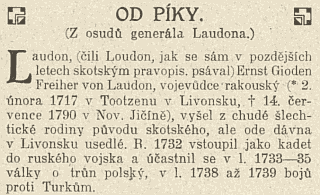
Laudon
is mentioned indirectly through the powerful expression Himllaudon that Oberleutnant Lukáš used when he verbally berated Švejk after discovering that Max had been stolen.
The same expression is used by Fähnrich Dauerling when he pesters the Czech recruits in 11. Kompanie. Feldoberkurat Lacina uses the expression Krucilaudon when he wakes up on the train to Bruck and does not know where he is.
His name reappears in the final chapter when the author describes Oberst Gerbich.
Background
Laudon
was an Austrian field marshal of German Baltic origin, and one of the most successful Austrian commanders of the 18th century. He fought in the Seven Years' War, the War of the Bavarian Succession and wars against Turkey. His troops captured Belgrade in 1789.
Born into a noble family in present-day Latvia, Laudon first served in the Russian army before offering his services to Prussia, where he was rejected. He had more luck in Austria but, in the beginning, he was assigned to the irregular troops of the infamous Baron von Trenck, the so-called Panduren. When these were dissolved, he joined the regular army.
During the Seven Years' War (1756-1763), his exploits in the campaign against Prussia made him famous. Many of the battles took place on Czech territory and this is undoubtedly the main reason for his legendary status in the Czech lands. Here, the well-known folk song GenerálLaudonjede skrz vesnici bears his name and his fame lingers on in the expletive himmellaudon!, the very one that Oberleutnant Lukáš used in the novel.
Quote(s) from the novel
[I.15] „Švejku, dobytku, himmellaudon, držte hubu! Buď jste takový rafinovaný ničema, nebo jste takový velbloud a blboun nejapný. Jste samý příklad, ale povídám vám, se mnou si nehrajte. Odkud jste přived toho psa? Jak jste k němu přišel? Víte, že patří našemu panu plukovníkovi, který si ho odvedl, když jsme se náhodou potkali? Víte, že je to světová ohromná ostuda? Tak řekněte pravdu, ukrad jste ho, nebo neukrad?“
[II.2] Náš nejvyšší vojenský pán je taky Němec. Posloucháte? Himmellaudon, nieder!’
[II.3] Vrchní polní kurát prděl a krkal na lavici a hřmotné zíval na celé kolo. Konečné se posadil a udivené se tázal: "Krucilaudon, kde to jsem?"
Božetěch
was a man from Košíře who specialised in stealing dogs and then claimed a reward based on newspaper advertisements from the owners of the missing animals. Švejk found it appropriate to mention this to Oberleutnant Lukáš in the midst of the severe reprimand he was subjected to after the senior lieutenant learned that Max had been stolen. Not to be confused with bookbinder Božetěch.
Background
Božetěch[1] is a very rare surname and is found primarily in Moravia. In 1910, not a single person with this family name was listed in the Prague address directory.
1. Božetěch is more common as a first name than as a surname.
Quote(s) from the novel
[I.15] Nějakej Božetěch z Košíř, ten se jen tak živil. Ukrad vždycky psa, pak hledal v inserátech, kdo se zaběh, a hned tam šel.
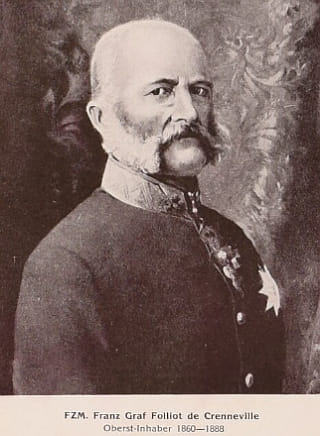
Crenneville
is mentioned in a song that Švejk sings about Grenevil, who marched through Prašná brána.
Background
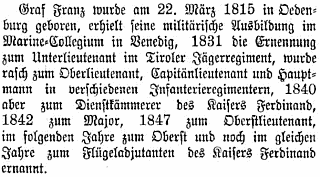
Crenneville
was an Austrian count, Feldzeugmeister, Geheimer Rat, imperial Generaladjutant and Oberstkämmerer. He came from a renowned military family of French descent and joined the army as a boy. He became a lieutenant at the age of 16 and a captain at 22. He distinguished himself in the wars against Italy and was repeatedly decorated. During the battle of Solferino on 24 June 1859, he was severely wounded. Between his military duties, he also held a post at the court of Emperor Ferdinand I.In 1860, he was named Inhaber[1] of Infanterieregiment Nr. 75.
After retiring from active military service following Solferino, he was employed at the Imperial Court and was in charge of the imperial art collection. He remained a supporter of the arts throughout, even after his retirement in 1884. From this year until his death, he lived in Gmunden. Crenneville was married and had three sons.
1. Regiments-Inhaber (regiment proprietor) was, by 1880, a purely honorary title and the person had no function in the military command chain. His name would then appear attached to the standard name of an infantry regiment in the official Schematismus. Usually, the "owner" was a senior military commander, a nobleman or a foreign monarch. The title was lifelong.
The song
The song about Crenneville had already been introduced by Hašek in the stories Dobrý voják Švejk působí u aeroplánu (1911), Číslo patnáct (1912) and Povídka o pořádnem člověku (1914). Here, the name is, however, spelt "Grenewil", "Grenewill" and "Greenewill" respectively, but there is no doubt that he refers to the same song.
Hašek thus managed to spell the name "Grenevil" in four different ways in four publications, and it does not stop there. In 1968, Václav Pletka published the album Písničky Josefa Švejka (with a booklet of remarks attached). Here, another variation is introduced. The name is "Grenevír" (which rhymes with špacír) and the rest of the verse is also altered (there is no reference to Prašná brána).
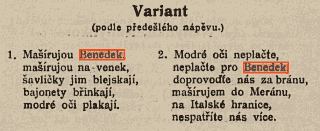
The source of Pletka's lyrics is unknown. Searches in the Czech National Library do not show a single hit on any of these variations, but there are similar songs in the book Vojenský zpěvník (Army Songbook), published in 1914 by some captain Beran from Vysoké Mýto. In one of the songs, General Benedek seems to take the place of "Grenevil", a fact that is also mentioned by Pletka.
Quote(s) from the novel
[I.15] Nadporučík se odvrátil, vzdychl a uznal za vhodné místo se Švejkem obírat se raději bílou kávou. Švejk šukal již v kuchyni a nadporučík Lukáš slyšel zpěv Švejkův:
Mašíruje Grenevil
Prašnou bránou na špacír,
šavle se mu blejskají,
hezký holky plakají.