Franz Ferdinand and his wife Sophie leaving Sarajevo Town Hall on 28 June 1914, five minutes before the assassination.
The Good Soldier Švejk is a novel with an exceptionally rich cast of characters. Alongside those who play a direct part in the plot, a great many fictional and real people (and animals) are mentioned throughout the narrative, in Švejk's anecdotes and in the book's idioms and turns of phrase.
This page offers brief entries on the people referred to in the novel, from Napoléon in the introduction to Hauptmann Ságner in the final lines of the unfinished Part Four. The list is sorted in the order in which names first appear. Chapter headings follow Zenny Sadlon's recent translation (1999–2026) and, in most cases, differ from Cecil Parrott's 1973 version.
The Czech quotations are taken from the online version of The Good Soldier Švejk provided by Jaroslav Šerák and link to the relevant chapter. The toolbar provides direct links to Wikipedia, Google Maps, Google Search, svejkmuseum.cz and the novel online.
The names are colour-coded according to their role in the novel, as illustrated by the following examples:
Dr. Grünstein, a fictional character directly involved in the plot.
Fähnrich Dauerling, a fictional character who is not part of the plot.
Heinrich Heine, a historical person.
Note that many seemingly fictional characters are inspired by real people. Examples include Oberleutnant Lukáš, Major Wenzl and many others. These are still listed as fictional, since they are literary creations only partly inspired by their similarly named 'models'.
Military ranks and other titles related to Austrian officialdom are given in German, in accordance with the terms used at the time (explanations in English are provided as tooltips). This means that Captain Ságner is still referred to as Hauptmann, even though the term is now obsolete and has been replaced by Kapitän. Civilian titles denoting profession, etc., are translated into English. This also applies to ranks in the nobility where a direct translation exists.
Virgin Mary is mentioned 33 times in The Good Soldier Švejk.
Virgin Mary
was someone the inmates of the lunatic asylum could pretend to be. She is also mentioned indirectly through the common Czech exclamation Ježíšmarjá. Švejk utters it in the first dialogue of the novel on hearing the news about the assassination in Sarajevo, and it is repeated 15 times. Her name is directly invoked several times, as both Marie and Maria.
Background
Virgin Mary
was the mother of Christ and the principal saint of the Catholic Church. In the New Testament she appears in the Gospels and in the Acts of the Apostles. At the Ecumenical Council of Ephesus in 431, the Council Fathers bestowed upon her the title Theotokos, 'Mother of God'. The Quran portrays her as chosen by God above all women in the world; she is mentioned in seven chapters of the Quran, one of them bearing her name as the title. She features in numerous works of art, where she is usually called 'Madonna' — 'Our Lady'.
Quote(s) from the novel
[I.4] Člověk se tam může vydávat za pánaboha nebo za panenku Marii, nebo za papeže, nebo za anglickýho krále, nebo za císaře pána, nebo za sv. Václava, ačkoliv ten poslední byl pořád svázanej a nahej a ležel v isolaci.
[I.9]
Ze všech znejmilejší
svou milou já mám,
nechodím tam za ní sám,
chodí za ní jiných více,
milenců má na tisíce,
a ta moje znejmilejší
je panenka Maria...
[II.4] Tak například na otázku, proč se nepřizná, odpověděl dle protokolu: "Já jsem zrovna v takový situaci, jako se voctnul jednou kvůli néjakejm obrazům Panny Marie sluha akademického malíře Panušky.
The Pope
was one of the people the inmates of blázinec could pretend to be.
Background
The Pope
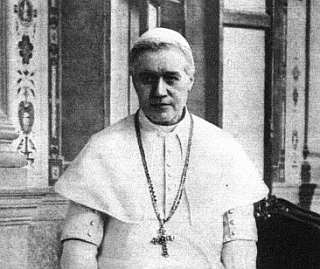
is the Bishop of Rome, head of the Roman Catholic Church, and head of state in the Vatican.
The Pope from 1903 to 20 August 1914 was Pius X (born Giuseppe Melchiorre Sarto). He was succeeded by Benedict XV (Giacomo della Chiesa) on 3 September.
Pius therefore still occupied the papal seat at the time Švejk was at blázinec (July 1914).
Quote(s) from the novel
[I.4] Člověk se tam může vydávat za pánaboha nebo za panenku Marii, nebo za papeže, nebo za anglickýho krále, nebo za císaře pána, nebo za sv. Václava, ačkoliv ten poslední byl pořád svázanej a nahej a ležel v isolaci.
[I.8] Já jsem původně také chtěl dělat blázna, náboženského šílence, a kázat o neomylnosti papežově, ale nakonec jsem si opatřil rakovinu žaludku od jednoho holiče na Malé Straně za patnáct korun.“
King of England
was one of the persons the patients at the lunatic asylum could pretend to be, and that without repercussions.
Background
In context of The Good Soldier Švejk the term "king" probably refers to the title rather than the person George V who was King of Great Britain, Ireland and the Commonwealth from 1910 to 1936.
The title king of England hadn't formally existed since 1707, but then as now it was common to interchange the terms England, Great Britain and United Kingdom.
King George belonged to the House of Saxe-Coburg, a noble family originating from Germany. He was the cousin of both Emperor Wilhelm II and Tsar Nicholas II. In addition, he bore considerable physical resemblance to the Russian tsar. In 1917 the Royal House was renamed House of Windsor, one of several examples of politically motivated name changes during World War I.
Quote(s) from the novel
[I.4] Člověk se tam může vydávat za pánaboha nebo za panenku Marii, nebo za papeže, nebo za anglickýho krále, nebo za císaře pána, nebo za sv. Václava, ačkoliv ten poslední byl pořád svázanej a nahej a ležel v isolaci.
Svatý Václav
is mentioned during Švejk's stay at Blazinec (the madhouse) when the author lists various persons or objects the inmates pretended to be.
He reappears in the anecdote about the chamberpot in Poděbrady which was claimed to be the helmet of Saint Wenceslaus.
Background
Svatý VáclavSaint Wenceslaus/Wenceslas
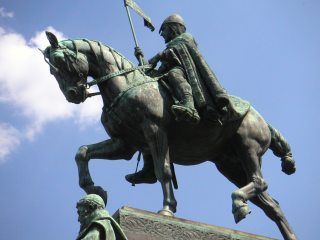
was prince of Bohemia from 921 until his death. He was murdered by his brother Boleslav, was canonised after his death and was eventually to become the Czech patron saint. Wenceslaus is still the patron saint of the Czech people and Czechia. His feast day is 28 September and is also a Czech national holiday.
Václavské náměstí is named after him and in 1912 a big equestrian statue of him was unveiled at the southern end of the street, in front of Museum. Václav is still today one of the most common Czech male names.
Quote(s) from the novel
[I.4] A von mu ten jeho kamarád napsal takovej fejton vo takovým jednom sběrateli, jak našel v písku na břehu Labe starej nočník plechovej a myslel, že to přilbice svatýho Václava, a udělal s tím takovej rozruch, že se tam na to přijel podívat biskup Brynych z Hradce s procesím a s korouhvema.
[III.3] A von mu ten jeho kamarád napsal takovej fejton vo takovým jednom sběrateli, jak našel v písku na břehu Labe starej nočník plechovej a myslel, že to přilbice svatýho Václava, a udělal s tím takovej rozruch, že se tam na to přijel podívat biskup Brynych z Hradce s procesím a s korouhvema.
Literature
Václav svatý, Ottův slovník naučnýDíl 26. U – Vusín,1907
Archbishop
is referred to when one of the patients at blázinec claims that he is archbishop.
In [I.9] he is mentioned again because he received Feldkurat Katz and seemingly supported the latter in his attempt to join the Seminář.
Background
The archbishop here may arguably refer to the Roman-catholic archbishop of Prague although the text doesn't indicate any particular person, and is rather used as a generic term. In [I.9] there is however no doubt that the author has the archbishop of Prague in mind.
In office at the time was Lev Skrbenský z Hříště (1863-1938) who held the seat from 1899 to 1916. He was a Czech cleric and nobleman who before becoming archbishop had served for 10 years as field chaplain in k.u.k. Heer.
Quote(s) from the novel
[I.4] Byl tam taky jeden, kterej křičel, že je arcibiskupem, ale ten nic jiného nedělal, než jen žral a ještě něco dělal, s odpuštěním, víte, jak se to může rýmovat, ale tam se žádnej za to nestydí. Jeden se tam dokonce vydával za svatýho Cyrila a Metoděje, aby dostával dvě porce.
[I.9] Rozsadím vás po ajnclících, to vám udělám, lumpové. Ztrácím s vámi čas a vidím, že je to všechno dočista marné. Že kdyby zde byl sám polní maršálek nebo arcibiskup, že se nenapravíte, neobrátíte k bohu. A přece si jednou na mne vzpomenete, že jsem to s vámi myslel dobře.
[I.10.2] Já byl u arcibiskupa,“ hulákal, drže se vrat v průjezdu. „Vatikán se o mne zajímá, rozumíte?“
Saint Cyril
was mentioned when Švejk told about his stay in blázinec. One of the inmates claimed to be Saints Cyril and Methodius in order to get two portions.
Background
Saint Cyril
was a Greek missionary, later to become a saint, who together with his brother Methodius started the Christianisation of the Slavic peoples. The Cyrillic alphabet is named after him.
Quote(s) from the novel
[I.4] Jeden se tam dokonce vydával za svatýho Cyrila a Metoděje, aby dostával dvě porce.
Saint Methodius
was mentioned when Švejk told about his stay at blázinec. One of the inmates claimed to be Saints Cyril and Methodius in order to get two portions.
Background
Saint Methodius
was a Greek missionary, later to become a saint, who together with his younger brother Cyril started the Christianisation of the Slavic peoples. During his lifetime he was known as Michael. The two brothers are often referred to as the "Apostles to the Slavs". They translated the Bible to what is now called Old Church Slavonic.
Quote(s) from the novel
[I.4] Jeden se tam dokonce vydával za svatýho Cyrila a Metoděje, aby dostával dvě porce.
Otto
was indirectly mentioned in connection with the mental patient who claimed to be the 16th part of Otto's Encyclopedia.
Background
Otto
was a Czech publisher best known for publishing Ottův slovník naučný. He also published literature, text books and magazines. Amongst the latter were Zlatá Praha and Světozor which Jaroslav Hašek contributed to. The head office of the publishing house J. Otto was located at Karlovo náměstí No. 34 and they also had a branch office in Vienna.
Otto's son studied at Obchodní akademie at the same time as Jaroslav Hašek (1899-1902). Otto also ran a foundation that enabled poor students to attend the academy.
Quote(s) from the novel
[I.4] Nejzuřivější byl jeden pán, kerej se vydával za 16. díl Ottova slovníku naučného a každého prosil, aby ho otevřel a našel heslo ,Kartonážní šička’, jinak že je ztracenej.
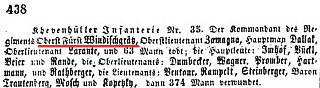
Oberst Fürst Windischgrätz, commander of IR. 35 reported dead, 24 June 1859
Oesterreichischer Soldatenfreund,2.7.1859
Windischgrätz
is first only referred to as a song which Švejk mentions when one of the court doctors asks him which songs he knows.
In [I.7] he sings parts of the song in bed, stricken by rheumatism and fortified by patriotic fervour, just before he is carted off to war in a wheelchair by Mrs. Müllerová.
Background
Windischgrätz
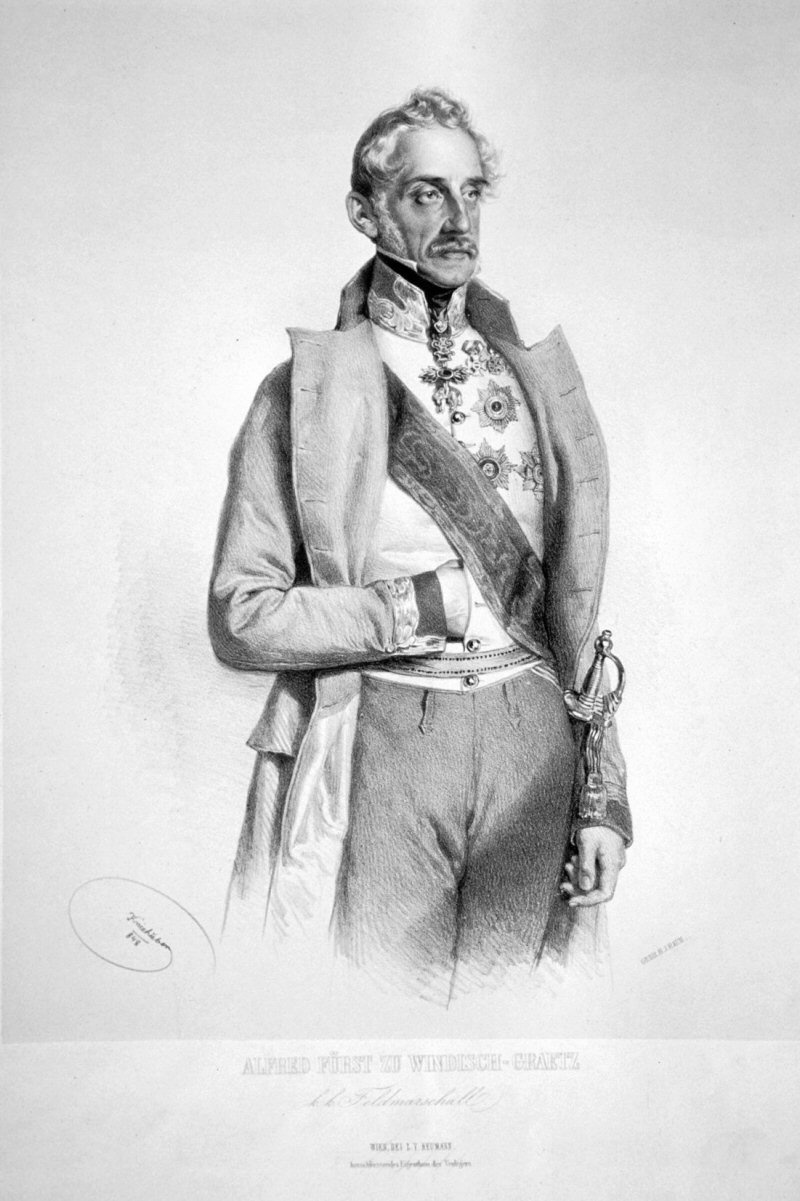
may refer to general Alfred I. Fürst zu Windisch-Graetz (ref. Břetislav Hůla, 1951). He was a famous Austrian commander who brutally suppressed the revolutions of 1848, both in Prague and Vienna.
The song in question however refers to events during the Second Italian War of Independence in 1859, and on this occasion the old field marshal was not involved. On the other hand, his nephew and son-in-law was on duty: Karl Vinzenz (1821-1859), colonel and commander of Infanterieregiment Nr. 35. He was killed during the battle by Solferino on 25 June 1859. On 18 July his body was brought back to Prague, and the event received extensive press coverage.
Conflicting notes
The latest German translation of The Good Soldier Švejk (Antonín Brousek, Reclam Verlag, 2014) provides extensive Anmerkungen (annotations). Both persons are mentioned, but at the first occurrence of the name it claims that Alfred I. is the person in question. On the next mention it is Karl Vinzenz, despite the indisputable fact that Švejk refers to the same song on both occasions. Only a thorough investigation of the etymology behind the song may shed proper light on these contradictions.
The Good Soldier Švejk in Captivity
The song in question is also partly quoted in Dobrý voják Švejk v zajetí and in a context that is very similar.[1]
"Bylá bitvá bylá, tám u Solferiná, teklo tam krvé moc, krvé pod koléna a na fůry mása, vždyť se tam sekála osmnáctá chása, hop, hop, hop. Osmnáctá cháso, neboj ty se nouze, vždyť za tébou vézou peníze na voze. Peníze na voze a mináž v kočáře …"
Quote(s) from the novel
[I.4] A také to dál neumím,“ vzdychl Švejk. „Znám ještě první sloku z ,Kde domov můj’ a potom ,Jenerál Windischgrätz a vojenští páni od východu slunce vojnu započali’ a ještě pár takových národních písniček jako ,Zachovej nám, Hospodine’ a ,Když jsme táhli k Jaroměři’ a ,Tisíckrát pozdravujeme Tebe’...“
[I.7]Jenerál Windischgrätz a vojenští páni
od východu slunce vojnu započali,
hop, hop, hop!
Vojnu započali, takto jsou zvolali:
„Pomoz nám Kristus pán s panenkou Marií,
hop, hop, hop!“
 English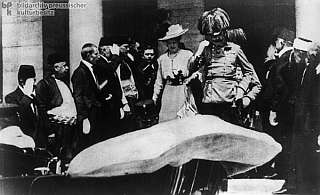


 czdeennnno
Search
czdeennnno
Search