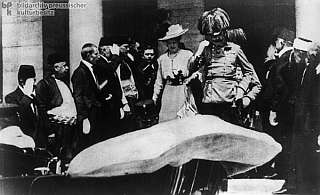
Franz Ferdinand and his wife Sophie leaving Sarajevo Town Hall on 28 June 1914, five minutes before the assassination.
The Good Soldier Švejk is a novel with an exceptionally rich cast of characters. Alongside those who play a direct part in the plot, a great many fictional and real people (and animals) are mentioned throughout the narrative, in Švejk's anecdotes and in the book's idioms and turns of phrase.
This page offers brief entries on the people referred to in the novel, from Napoléon in the introduction to Hauptmann Ságner in the final lines of the unfinished Part Four. The list is sorted in the order in which names first appear. Chapter headings follow Zenny Sadlon's recent translation (1999–2026) and, in most cases, differ from Cecil Parrott's 1973 version.
The Czech quotations are taken from the online version of The Good Soldier Švejk provided by Jaroslav Šerák and link to the relevant chapter. The toolbar provides direct links to Wikipedia, Google Maps, Google Search, svejkmuseum.cz and the novel online.
The names are colour-coded according to their role in the novel, as illustrated by the following examples:
Dr. Grünstein, a fictional character directly involved in the plot.
Fähnrich Dauerling, a fictional character who is not part of the plot.
Heinrich Heine, a historical person.
Note that many seemingly fictional characters are inspired by real people. Examples include Oberleutnant Lukáš, Major Wenzl and many others. These are still listed as fictional, since they are literary creations only partly inspired by their similarly named 'models'.
Military ranks and other titles related to Austrian officialdom are given in German, in accordance with the terms used at the time (explanations in English are provided as tooltips). This means that Captain Ságner is still referred to as Hauptmann, even though the term is now obsolete and has been replaced by Kapitän. Civilian titles denoting profession, etc., are translated into English. This also applies to ranks in the nobility where a direct translation exists.
Giordano Bruno
is mentioned by a prisoner at Vojenská nemocnice Hradčany who attempts to feign insanity by yelling day and night: "Giordano Bruno's fire is still smouldering, renew the process against Galilei!"
Background
Giordano Bruno
was an Italian astronomer and philosopher who was burned as a heretic in 1600. Finally, in the year 2000 the Papal Cultural Council and a theological commission declared his execution as illegal.
Quote(s) from the novel
[I.8] Nejlepší,“ mínil jeden ze simulantů, „dá se simulovat šílenství. Z našeho učitelského sboru jsou vedle v cimře dva, jeden neustále křičí dnem i nocí: ,Hranice Giordana Bruna ještě dýmá, obnovte proces Galileův!’ a ten druhý štěká, napřed třikrát pomalu: haf - haf - haf, potom pětkrát rychle za sebou: hafhafhafhafhaf, a zas pomalu, a tak to jde neustále.
Galilée devant le Saint-Office au Vatican. Joseph-Nicolas Robert-Fleury, 1847
Galilei
is mentioned because a recruit at Vojenská nemocnice Hradčany was simulating madness by shouting day after day: "Giordano Giordano Bruno's fire is still smouldering, renew the process against Galileo!"
In Putim in [II.2] he is mentioned again when Švejk explains his anabasis to Wachtmeister Flanderka. Here the author quotes an expression that is attributed to Galieo.
Background
Galilei
was an Italian scientist, best known for his work in the fields of astronomy and physics. He is regarded as the founder of experimental natural sciences.
The trial that is mentioned in The Good Soldier Švejk was conducted in 1633 as a result of Galilei's book Dialogo sopra i due massimi sistemi del mondo (Dialogue concerning the two chief World Systems). The systems being discussed in the book was the heliocentric (Copernicus) and the geocentric (Ptolemy).
The book caused anger in clerical circles and Galilei was put before a papal court. Here he withdrew his theories and thus avoided being sentenced to death by burning. He was found guilty of heresy and ordered to abjure (recant), sentenced to life imprisonment, albeit soon converted to house arrest. During interrogation when he was forced to retract his heliocentric world view, he allegedly said about the earth: "and yet it moves" (Eppur si muove)[a]. It is this statement that Hašek refers to in connection with Švejk being arrested by Wachtmeister Flanderka in Putim.
Only in 1835 did the Catholic Church withdraw the ban of the book, but the final rehabilitation of Galili only followed in 1992.
Quote(s) from the novel
[I.8] Nejlepší,“ mínil jeden ze simulantů, „dá se simulovat šílenství. Z našeho učitelského sboru jsou vedle v cimře dva, jeden neustále křičí dnem i nocí: ,Hranice Giordana Bruna ještě dýmá, obnovte proces Galileův!’ a ten druhý štěká, napřed třikrát pomalu: haf - haf - haf, potom pětkrát rychle za sebou: hafhafhafhafhaf, a zas pomalu, a tak to jde neustále.
[II.2] Strážmistr podíval se laskavě na Švejka, který klidně a důstojně řekl: „A přece jdu do Budějovic.“ Bylo to víc než Galileovo: „A přece se točí!“ Poněvadž ten to musel říct patrně asi hodně vztekle.
Franta Henčlů
(František Henčl) was a soldier from Hluboká who was given two years in prison after having informed members of Reichsrat about maltreatment of soldiers. This is revealed in an anecdote Švejk tells his fellow malingerers at Vojenská nemocnice Hradčany. The episode happened during Švejk's pre-war military service and 11. Kompanie is mentioned for the first time. This company disobeyed their colonel, a tyrant.
Background
This story surely has some connection to real events but attempts to pinpoint it have so far been fruitless. Before the war there were several reports in the press about mistreatment of soldiers, and at least one of these incidents involved Infanterieregiment Nr. 91.
Quote(s) from the novel
[I.8] Nějakej ministr poslal k nám komisi, aby to vyšetřila, a nějakej Franta Henčlů ze Hluboký dostal potom dva roky, poněvadž to byl ten, co se vobrátil do Vídně k poslancům kvůli tý facce, kerou dostal na cvičišti od pana obršta.
Grünstein is mentioned 18 times in The Good Soldier Švejk.
Grünstein
was head doctor at Vojenská nemocnice Hradčany where the malingerers were undergoing treatment. Doctor Grünstein made sure they got the demon of sabotage exorcised by medical means like quinine, aspirin, enema, stomach pumping and a strict diet.
Background
Grünstein doesn't have an obvious model from real life. Although Jaroslav Hašek was admitted to a military hospital in 1915, this was in Budějovice so any person that may have served as inspiration for Grünstein may rather be looked for there and not in Prague.
Dr. Halbhuber
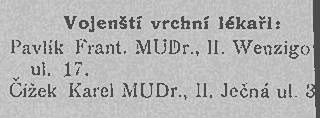
That said, Hašek could have been inspired by people he had heard of or read about. We know that the head medic at Hradčany in 1916 was Dr. Josef Krejčí, and that his superior at the main military hospital at Karlovo náměstí was the infamous and hated Dr. Franz Halbhuber. The latter was well known and Hašek was probably aware of him. As such, Halbhuber may well have lent his dubious qualities to Grünstein and even Doctor Bautze.
Quote(s) from the novel
[I.8] Přiblížila se doba odpolední visity. Vojenský lékař Grünstein chodil od postele k posteli a za ním sanitní poddůstojník se zápisní knihou. „Macuna?“ „Zde!“ „Klystýr a aspirin! - Pokorný?!“ „Zde!“ „Vypláchnout žaludek a chinin! - Kovařík?!“
[I.8] Přiblížila se doba odpolední visity. Vojenský lékař Grünstein chodil od postele k posteli a za ním sanitní poddůstojník se zápisní knihou.
„Macuna?“
„Zde!“
„Klystýr a aspirin! - Pokorný?!“
„Zde!“
„Vypláchnout žaludek a chinin! - Kovařík?!“
[I.8] Přiblížila se doba odpolední visity. Vojenský lékař Grünstein chodil od postele k posteli a za ním sanitní poddůstojník se zápisní knihou.
„Macuna?“
„Zde!“
„Klystýr a aspirin! - Pokorný?!“
„Zde!“
„Vypláchnout žaludek a chinin! - Kovařík?!“
Kovařík
was one of the malingerers who was called up for treatment by Doctor Grünstein. He was given enema and aspirin. But soon after, from his bed by the window, he suddenly reported fit for duty, and Grünstein awarded him with an enema for the road. See Vojenská nemocnice Hradčany.
Quote(s) from the novel
[I.8] „Vypláchnout žaludek a chinin! - Kovařík?!“ „Zde!“ „Klystýr a aspirin!
[I.8] "Poslušně hlásím, pane obrarct," ozvalo se tiše od postele u okna, "já už jsem zdravej, já už v noci pozoroval, že mne záducha přešla." "Jmenujete se?" "Kovařík, poslušně hlásím, mám dostat klystýr:" "Dobře, klystýr dostanete ještě na cestu," rozhodl dr. Grünstein, "abyste si nestěžoval, že jsme vás tady neléčili".
There is no evidence to suggest that the inspiration for this character is anything more than a borrowed surname. See Fähnrich Koťátko for further information.
Quote(s) from the novel
[I.8] „Vypláchnout žaludek a chinin! - Kovařík?!“
„Zde!“
„Klystýr a aspirin! - Koťátko?!“
„Zde!“
„Vypláchnout žaludek a chinin!“
A tak to šlo, jeden za druhým, bez milosti, mechanicky, řízně.
Socrates
is mentioned because not even he emptied the poison chalice with such calm as Švejk drank quinine.
Background
Socrates
was a Greek philosopher, one of the all time greats, and regarded as one of the founders of Western philosophy. The outspoken philosopher was late in his life accused and convicted of impiety and having corrupted the youth. He was sentenced to either exile from Athens or to take his own life by a method of his own choice. He chose the latter by emptying a chalice of poison.
Quote(s) from the novel
[I.8] Ani Sokrates nepil svou číši bolehlavu s takovým klidem jako chinin Švejk, na kterém vyzkoušel dr Grünstein všechny stupně trápení.
Von Botzenheim
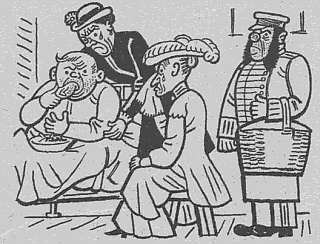
was the widow of an infantry general. She had read about Švejk's exploits in Bohemia. The editors had urged readers to collect money for the brave cripple, who brimming with patriotism was pushed to mustering in a wheelchair. The baroness brought splendid gifts for Švejk, amongst them a bottle of war liquor with the inscription Gott Strafe England! The author mocks the poor Czech of the German-speaking baroness and her visit ranks amongst the most famous episodes of the novel.
Background
Botzenheim is a surname that is impossible to find in name databases and is surely an invention. Needless to say no such noble family existed[a] and there is no trace of any Botzenheim (general or other) in Schematismus or other military records. Nor does the surname reflect any known geographical entity.
Quote(s) from the novel
[I.8] V té době měla vdova po generálovi pěchoty baronka von Botzenheim velice mnoho starostí, aby vypátrala toho vojáka, o kterém uveřejnila nedávno Bohemie zprávu, jak se dal vozit, on, mrzák, na vozíku pro nemocné a křičel: „Na Bělehrad!“, kterýž vlastenecký projev dal původ redakci „Bohemie“ k vyzvání čtenářů, aby konali sbírky ve prospěch loyálního hrdiny-mrzáka.
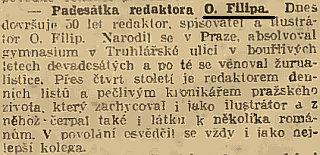
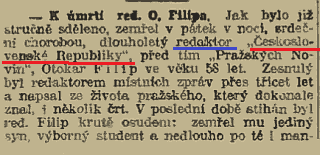
Filip
was probably the person the narrator had in mind as, quote: author of Stories from the life of our monarch and editor in chief of Československá Republika.
Background
Otakar Filip was a Czech journalist. author, and illustrator, and long time editor of local news in official newspapers that were published in Prague both under Austria-Hungary and Czechoslovakia. The book that is referred to he actually wrote, albeit with a title that differs somewhat from the one given in the novel. It was published in 1910 and contained 242 pages. That he was editor in chief of Československá Republika isn't entirely true, he was one of the board of editors. Filip specialised in reports and literature about Prague and published several books. See also Pražské úřední noviny.
The full title of the book Jaroslav Hašek refers to was: Osmdesátiletý mocnář: Význačné události a zajímavé obrazy ze života jeho veličenstva cisáře a krále Františka Josefa I. Translated: The eighty year old monarch: significant events and interesting pictures from the life of His Majesty Emperor and King Franz Josef I.
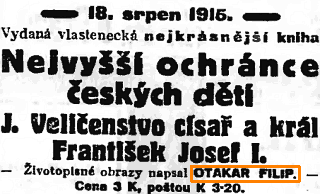
On 18 August 1915, ironically on the very day that Jaroslav Hašek was awarded the small silver medal for bravery, an advert for a patriotic book appeared in his home town. It was titled The supreme protector of Czech children, His Highness Emperor and King Franz Josef I. and written by none other than our editor Filip!
Quote(s) from the novel
[I.8] Vše elegantně rozložila na prázdnou postel vedle Švejka, kam přibyla ještě pěkně vázaná kniha „Příběhy ze života našeho mocnáře“, kterou napsal nynější zasloužilý šéfredaktor naší úřední „Československé republiky“, který se ve starém Frantíkovi viděl.
Shrapnel
is mentioned indirectly through the term shrapnel as Baronesse von Botzenheim and her entourage enter the sick-ward of the malingerers at Hradčany. As the novel progresses his name, or rather his invention, crops up several times in various stories from the fighting.
Background
Shrapnel
was a British officer and inventor who is famous for having invented the shrapnel shell, a shell filled with metal fragments. It turned out to be an effective anti-personnel weapon. The method was in use from the Napoleonic Wars until the end of World War I.
Quote(s) from the novel
[I.7] Zejména ne vrchní vojenský lékař Bautze. Byl to muž neúprosný, který ve všem viděl podvodný pokus uniknout vojně, frontě, kulce a šrapnelům.
[I.8] Ani arcikněžna nemohla tak vážně vejít, jako to udělala baronka von Botzenheim. Za ní valil se celý průvod, ve kterém nescházel ani účetní šikovatel při nemocnici, který v tom všem viděl tajemnou ruku revise, která ho od tučného žlabu v týlu hodí napospas šrapnelům někam pod drátěné překážky posic.
[I.8] Na krabici byl obrázek, jak praská šrapnel a nějaký člověk v šišáku se žene s bodákem kupředu.
[I.9] Střílet do nepřítele a zabíjet na druhé straně šrapnely a granáty stejné takové nešťastné suplenty, matematiky, považoval za blbost.
[I.13] Na obzoru hoří vesnice a praskají šrapnely a v popředí leží umírající voják s utrženou nohou, nad kterým se sklání anděl a přináší mu věnec s nápisem na stuze: "Ještě dnes budeš se mnou v ráji." A umírající se blaženě usmívá, jako by mu nesli zmrzlinu.
[I.13] Starý rezervista podíval se na zelenáčka a řekl: "Pěkný doufání, že ti šrapnel utrhne hlavu.
[I.14.2] V tom okamžiku zapomínal, že sviští mu nad hlavou granáty a šrapnely, a probíral se neúnavně se zavazadly ke štábu, kde stálo vozatajstvo.
[II.1] Von si tu hůl přendal do druhý ruky, zařval, že jim to nevodpustí, a bůhví jak by to s ním dopadlo, kdyby ho byl šrapnel za chvilku definitivně nezamordoval.
[II.3] Tady se jedná vo mizerný dvě zlatky, a já bych vás rád viděl, kdybyste měl vobětovat život za svýho vojenskýho představenýho, kdyby von ležel raněnej někde na nepřátelskej linii a vy jste ho měl zachránit a vodnest na svejch rukách a voni by stříleli po vás šrapnely a vším možným." "Vy byste se podělal," bránil se desátník, "vy jedna fajfko."
[II.3] Já ho chytnu za krk a shodím ho z prvního poschodí dolů po schodech, že poletí jako šrapnel.
[I.8] Ja čist všekno f nófiny, já vám přinest pápat, kousat, kuřit, cucat, cešky fójak, toprá fójak. Johann, kommen Sie her!„
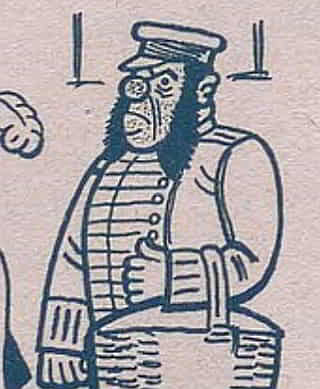
Komorník, připomínající svými ježatými licousy Babinského, přitáhl objemný koš k posteli, zatímco společnice staré baronky, vysoká dáma s uplakanou tváří, sedla si na Švejkovu postel a urovnávala mu slaměný polštář pod záda, s fixní myšlenkou, že se to patří dělat nemocným hrdinům.
Babinský
was a Czech criminal, sentenced for a series of murders and a number of other crimes. He is one of the best known Czech criminals ever and Egon Erwin Kisch devotes a whole chapter to him in his Die Abenteuer in Prag. A lot of space was devoted to him in the police museum.
Quote(s) from the novel
[I.8] Komorník, připomínající svými ježatými licousy Babinského, přitáhl objemný koš k posteli, zatímco společnice staré baronky, vysoká dáma s uplakanou tváří, sedla si na Švejkovu postel a urovnávala mu slaměný polštář pod záda, s fixní myšlenkou, že se to patří dělat nemocným hrdinům.
Wilhelm II
is mentioned for the first time when Baronesse von Botzenheim visits Vojenská nemocnice Hradčany. She gave Švejk a bottle of Kriegslikör on which the label depicted Emperor Franz Joseph I holding hands with Wilhelm. On the other side of the bottle were written the words Gott strafe England.
The second mention of the German emperor is equally fleeting. Švejk browses a newspaper and notes that the Sultan has decorated Wilhelm with a war medal whereas he himself so far had not even been awarded a small silver medal.
Wilhelm is mentioned twice more thereafter. He was reportedly called an 'animal' by the drunk gendarme Wachtmeister Flanderka in Putin, and, together with Emperor Franz Joseph I, he appears in a picture that decorates the wall at k.u.k. Gottes Hauptquartier in Kadett Biegler's pungent dream on the way to Budapest.
Background
Wilhelm II
was Emperor of Germany and King of Prussia from 1888 until 1918, a member of the house of Hohenzollern. Forced to abdicate in 1918 after the defeat in World War I, he lived the rest of his life in the Netherlands. The Tsar Nicholas II of Russia and the King of England were both his cousins. He was also related to the royal houses of Spain, Norway, Romania, and Greece.
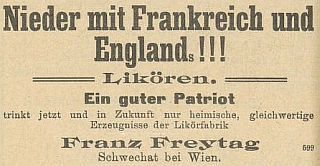
Kriegslikör
Der neue Bezirksbote,23.5.1915
It has not been possible to verify that bottles of Kriegslikör with labels on which Emperor Franz Joseph I and Wilhelm hold hands existed, but in any case similar propaganda material abounded. A colour postcard with this theme was indeed produced and bore the title In Treue fest[1]. The postcard was in circulation in 1916 and perhaps as early as 1914.
Gott strafe England ('God punish England') was likewise a common slogan from the end of 1914 onwards, so even if the bottle that Švejk was given cannot be precisely identified, similar items that may have inspired the author were plentiful.
The war medal
Neue Freie Presse,10.3.1915
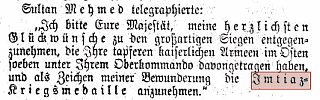
The context of this sequence of the novel strongly indicates that the decoration of Wilhelm to which Švejk refers took place in March 1915. Already on the ninth, the official Ottoman news agency Agence Milli reported that the Sultan had telegraphed Wilhelm and congratulated him on the great victories in the east. In the same telegram, it is revealed that the Emperor was offered the Imtiaz war medal as an expression of the Sultan's admiration.
On 25 March 1915, Milli reported that Goltz Paşa had travelled to Berlin in order to personally decorate the Emperor. The war medal had even been specially made for Wilhelm.
The Good Soldier Švejk in Captivity
In Dobrý voják Švejk v zajetí the German emperor is simply classified as brain-damaged.[1]
Nebo vezměme si případ císaře Viléma. Každé malé dítě dnes ví, že císař Vilém trpí úbytkem mozku. Ve dvorních kruzích jeho žvásty a plány považují však za geniálnost.
Quote(s) from the novel
[I.8] Baronka zatím vytahovala dárky z koše. Tucet pečených kuřat, zabalených do růžového hedvábného papíru a ovázaných černožlutou hedvábnou stužkou, dvě láhve nějakého válečného likéru s etiketou „Gott strafe England!“ Na druhé straně byl na etiketě František Josef s Vilémem, jak se drží za ruce, jakoby si chtěli hrát hru „Králíček v své jamce seděl sám, ubožátko, co je ti, že nemůžeš skákati“.
[I.14.3] „Tak vida,“ řekl pro sebe Švejk, sleduje se zájmem přehled denních událostí, „sultán vyznamenal císaře Viléma válečnou medalií, a já nemám dosud ani malou stříbrnou.“
[II.2] ...že je císař pán nemocný dědek a že co nejdřív natáhne brka, že je císař Vilém zvíře, že mu budete do vězení posílat peníze na přilepšenou a ještě víc takových řečí...
[III.1] Uprostřed pokoje, ve kterém po stěnách visely podobizny Františka Josefa a Viléma, následníka trůnu Karla Františka Josefa, generála Viktora Dankla, arcivévody Bedřicha a šéfa generálního štábu Konráda z Hötzendorfu, stál pán bůh.
Eugen
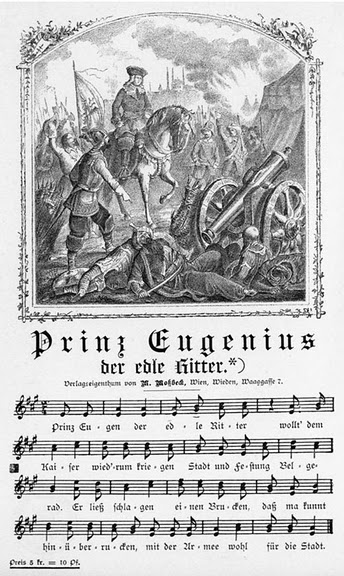
is mentioned by a young doctor who attempts a rousing speech to the malingerers and points to prince Eugen and Marschall Radetzky as glorious military role models.
Also, the song is partly quoted in [III.1] when soldiers from the march battalion of the Deutschmeister regiment sing it on their way through Győr. See Zemun.
Background
EugenEugene of Savoy
was an Austrian prince and field commander. He gets most of the credit for the successful military operations against the Ottomans from the siege of Vienna in 1683 to the peace treaty of Sremski Karlovci in 1699.
The song however refers to an event that took place much later: the siege of Belgrade in 1717. The full name of the French born prince was Eugène-François de Savoie.
Quote(s) from the novel
[I.8] Mluvil dlouho o tom, že každý z těch, kteří opouští nemocnici, aby odešli ke svým plukům do pole, musí být vítězem i rytířem. On že jest přesvědčen, že budou zruční ve zbrani, na bojišti i čestní ve všech záležitostech válečných i soukromých. Že budou nepřemožitelnými válečníky, pamětlivými na slávu Radeckého i prince Eugena Savojského.
[I.8] Z těch lumpů by ani Radecký, ani ten váš princ Eugen Savojský nevychovali vojáky.
[I.12] V zápalu a v řečnickém rozmachu vydával polní kurát i prince Evžena Savojského za světce, který je bude chránit, až budou dělat mosty přes řeky.
[II.2] Večer z arestu ozývalo se vždy „Zachovej nám, Hospodine“ a „Prinz Eugen, der edle Ritter“.




 czdeenitno
Search
czdeenitno
Search