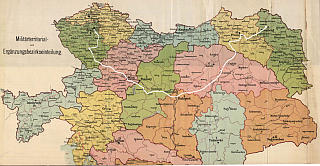
Švejk's journey is mapped on an Austria-Hungary map from 1914, showing the military districts of the
k.u.k. Heer. The entire plot of The Good Soldier Švejk is set within the territory of the former Dual Monarchy.
The Fateful Adventures of the Good Soldier Švejk (commonly known as The Good Soldier Švejk) by Jaroslav Hašek is rich in geographical
references, whether through the plot itself, in dialogues, or in the author's narrative voice. Hašek was unusually
well-travelled and had a photographic memory for geographical (and other) details. Geography mattered to him: eight
of the 27 chapter headings in the novel contain geographical names.
This website will, in due course, provide a complete overview of the novel's geographical references, from Prague in
the introduction to Klimontów in the unfinished Part Four. It includes continents, states (including defunct ones),
cities, market squares, city gates, regions, districts, towns, villages, mountains, mountain passes, oceans, lakes,
rivers, caves, channels, islands, streets, parks, and bridges.
The list is sorted according to the order in which the names appear in the novel. The chapter headings are taken from
Zenny Sadlon's recent translation (1999–2026); in most cases, these differ from Cecil Parrott's translation from 1973.
The Czech quotations are taken from the online version of The Good Soldier Švejk provided by Jaroslav Šerák and link to the relevant chapter. The
toolbar provides direct links to Wikipedia, Google Maps, Google Search, svejkmuseum.cz, and the novel online.
The names are colour-coded according to their role in the novel, as illustrated by the following examples:
New Guinea
is mentioned by the author in connection with the religious rituals of cannibals, compared to current rituals related to the war. This is his introduction to Feldkurat Katz's and Švejk's field mass.
Background
New Guinea
was, in 1914, split between the Netherlands, the British Empire, and Germany, but Australian forces occupied the German part already in 1914.
New Guinea is the second largest island in the world and is located just north of Australia. Today, the island is divided between Papua New Guinea and Indonesia.
Quote(s) from the novel
[I.11.1] Lidožrouti ostrovů Guinejských a Polynesie, než sežerou slavnostně své zajatce či lidi nepotřebné, jako misionáře, cestovatele a jednatele různých obchodních firem či prosté zvědavce, obětují předtím svým bohům, vykonávajíce nejrozmanitější náboženské výkony. Poněvadž k nim nepronikla ještě kultura ornátů, vyzdobují své hyždě věnci z pestrého péří lesního ptactva.
Polynesia
is mentioned when the author expands his opinion on religious rituals in connection with executions.
Background
Polynesia
is a subregion of Oceania, made up of over 1,000 islands scattered over the central and southern Pacific Ocean. The term "Polynesia" was originally applied to all the islands of the Pacific. The only major political and geographical entity is New Zealand. The American state of Hawaii is also in Polynesia. The islands are partly independent, partly belonging to other states (USA, Chile, France and Australia). Until 1914, Germany was also present (Samoa).
Quote(s) from the novel
[I.11.1] Lidožrouti ostrovů Guinejských a Polynesie, než sežerou slavnostně své zajatce či lidi nepotřebné, jako misionáře, cestovatele a jednatele různých obchodních firem či prosté zvědavce, obětují předtím svým bohům, vykonávajíce nejrozmanitější náboženské výkony.
Spain
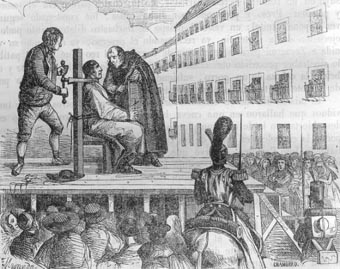
is mentioned by the author when he describes methods for executing people, and accompanying rituals where clerics take part. In this case, there is talk "of a chair where the victim is strangled", certainly the garrote (el garrote). This execution device has been in use until recent times, and not only in Spain.
The country was mentioned indirectly already in [I.2] through the term "the Spanish boot", an instrument of torture. Some geographical points in Spain also appear in the novel: Madrid, Toledo and Seville. Amongst historical figures, Ignatius of Loyola is the only one referred to. Literary figures, on the other hand, are better represented: Don Quijote, Sancho Panza, and the still unidentified Duke of Almavira and his servant Fernando.
Background
Spain
was a kingdom in 1914 and preserved its neutrality throughout the world war. Conflicts with Germany occurred because some Spanish ships were sunk, but there was never any armed action taken by the Spanish side.
Quote(s) from the novel
[I.11.1] V Prusku vodil pastor ubožáka pod sekyru, v Rakousku katolický kněz k šibenici, ve Francii pod gilotinu, v Americe kněz na elektrickou stolici, ve Španělsku na židli, kde byl důmyslným způsobem uškrcen, a v Rusku bradatý pop revolucionáře atd.
Bremen
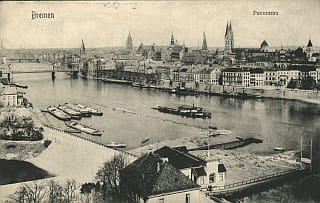
is mentioned by Švejk when he tells Feldkurat Katz that he learned to make grog in Bremen. He was there on his wanderings a few years back. Bremen is one of the few places outside Bohemia that Švejk explicitly says he has visited.
Background
Bremen
is a city and port in northwest Germany, 60 km south of the mouth of the river Weser. During the time of Švejk, it had the status of a Freie Hansestadt (Free Hanseatic city).
Although Švejk says he has been to Bremen, there is no evidence that the author himself ever went there, so it is not clear what might have inspired this story. A possible source is Zdeněk Matěj Kuděj, who travelled to New York from Cuxhaven on 17 March 1906 and may well have visited nearby Bremen on the way.
What Jaroslav Hašek was no doubt well informed about was the Bremer Räterepublik from early 1919, one of the two best-known Soviet Republics on German territory. The revolutionary republic lasted for only one month.
Quote(s) from the novel
[I.11.2] „Když jsem před léty vandroval,“ odpověděl Švejk, „v Brémách od jednoho zpustlýho námořníka, který říkal, že grog musí být tak silný, aby, když někdo spadne do moře, přeplaval celej kanál La Manche. Po slabým grogu se utopí jako štěně.“
English Channel
is mentioned when Švejk tells Feldkurat Katz that grog must be so strong that one can swim across the Channel with one of these inside.
Background
English Channel
is a strip of sea that separates England and France. It is part of the Atlantic Ocean, and connects this to the North Sea. The channel is at its narrowest between Dover and Calais, where it is 34 km wide.
Quote(s) from the novel
[I.11.2] „Když jsem před léty vandroval,“ odpověděl Švejk, „v Brémách od jednoho zpustlýho námořníka, který říkal, že grog musí být tak silný, aby, když někdo spadne do moře, přeplaval celej kanál La Manche. Po slabým grogu se utopí jako štěně.“
Mödling
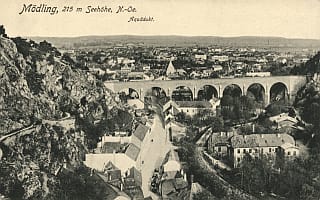
is mentioned by the author in connection with the race Vienna - Mödling, in which Oberleutnant Witinger won the cup that Feldkurat Katz used as a chalice at the field Mass. Witinger reportedly ran 40 km in 1 hour and 48 minutes.
Background
Mödling
is a town in Niederösterreich, with a population (in 2007) of around 21,000. The town is situated 16 kilometres south of Vienna and is often called Perle des Wienerwaldes.
Oberleutnant Witinger allegedly ran 40 km in 1 hour 48 minutes, which suggests that the author did not care much about numbers. The marathon (41,185 metres) world record as of 2016 was 2:02:57 and was set by Dennis Kimetto in Berlin in 2014. This is the first example in The Good Soldier Švejk of the author's disregard for chronological precision. Obviously, Jaroslav Hašek could also have got the distance wrong; the actual distance between the towns (16 km) could easily be run in 1 hour 48 minutes.
It is also possible that Hašek was simply mocking Oberleutnant Witinger’s bragging rather than misstating the numbers.
Demography
According to the 1910 census, Mödling had 18,067 inhabitants. The judicial district was GerichtsbezirkMödling, administratively it reported to BezirkshauptmannschaftMödling.
Per the recruitment districts, infantrymen from Mödling were usually assigned to Infanterieregiment Nr. 84 (Wien) or k.k. Landwehrinfanterieregiment Nr. 21 (Sankt Pölten).
Quote(s) from the novel
[I.11.2] Tak dostaneme sportovní pohár od nadporučíka Witingra od 75. pluku. On kdysi před lety běhal o závod a vyhrál jej za ,Sport-Favorit’. Byl to dobrý běžec. Dělal čtyřicet kilometrů Vídeň-Mödling za 1 hodinu 48 minut, jak se nám vždycky chlubí. Jsem hovado, že všechno odkládám na poslední chvíli. Proč jsem se, trouba, nepodíval do té pohovky.“
[I.11.2] Konečně se ozvalo „Zum Gebet!“, zavířilo to prachem a šedivý čtverec uniforem sklonil svá kolena před sportovním kalichem nadporučíka Witingra, který on vyhrál za Sport-Favorit v běhu Vídeň-Mödling.
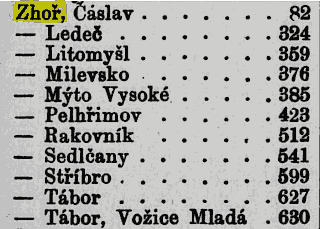
Zhoř
is mentioned in an anecdote Švejk tells the priest in Vršovice, where he implicitly threatens with the worst if the field altar, the property of the army, does not appear again.
A place with such a name is mentioned again in the story about Špatina in [III.2], but it may not be the same place.
Background
Zhoř
is the name of several places in Bohemia and Moravia. The author has surely been aware of most of these, so it is anybody's guess which one he has in mind. It should still be assumed that it is from an area he knew well, for instance Vysočina or South Bohemia.
In the list of places in Bohemia from 1913, Zhoř appears no less than 11 times[a]. They were all small places, the largest being in okres Pacov, hejtmanstvíPelhřimov, with 622 inhabitants. In Moravia there are also several, one of them by Jihlava.
Quote(s) from the novel
[I.11.2] Jeden člověk ve Zhoři taky vyoral nějakej kalich na poli, kterej pocházel ze svatokrádeže a byl tam schovanej na lepší doby, až se na to zapomene, a považoval to taky za pokyn boží a šel, místo aby jej rozšmelcoval, k panu faráři s tím kalichem, že prý ho chce darovat kostelu.
[III.2] „Poslušně hlásím, pane obrlajtnant“ řekl s obvyklou ohebností Švejk, „věc, o kterou jde, je nesmírně důležitou. Prosil bych, pane obrlajtnant, abychom mohli tu celou záležitost vyřídit někde vedle, jako říkal jeden můj kamarád, Špatina ze Zhoře, když dělal svědka na svatbě a chtělo se mu najednou v kostele...“
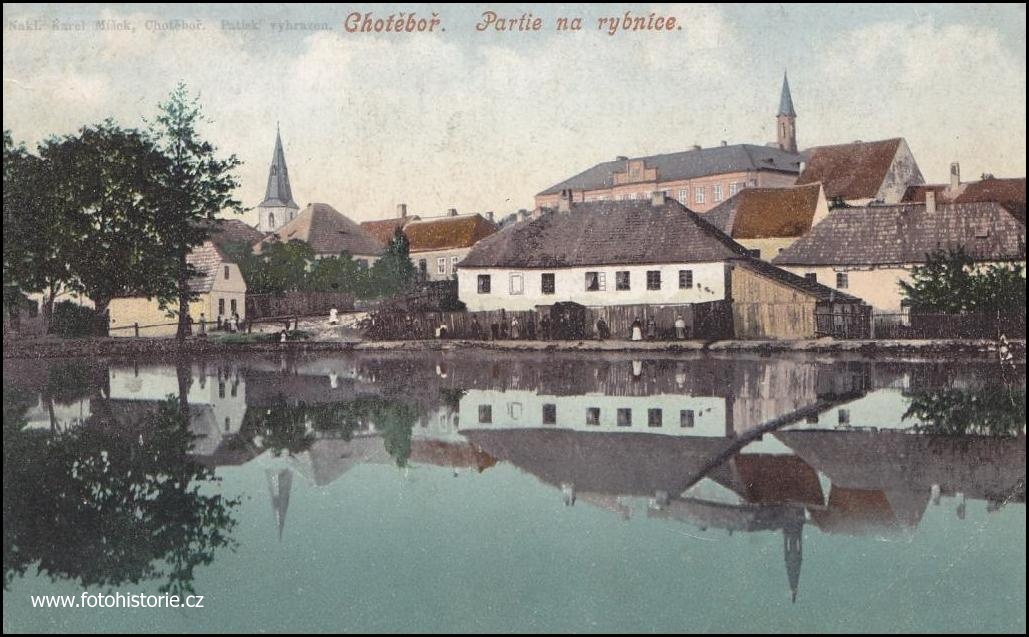
Chotěboř
is mentioned in Švejk's conversation with the priest in Vršovice, relating to a certain Pivoňka.
Background
Chotěboř
is a town in Vysočina with 9,633 inhabitants (2011). It is located 14 km northeast of Havlíčkův Brod and belongs to the district of the same name.
Hašek in Chotěboř
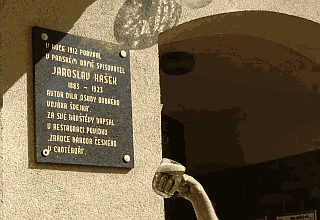
Jaroslav Hašek visited Chotěboř in the summer of 1912, and this stay no doubt inspired the story The traitor of the nation in Chotěboř[a]. The author resided at Panský dům for some weeks, and the building boasts a memorial plaque in his honour. His hosts allegedly had great problems getting rid of him.
Demography
According to the 1910 census, Chotěboř had 4,481 inhabitants, of whom 4,472 (99 per cent) reported using Czech as their everyday language. The judicial district was okresChotěboř, administratively it reported to hejtmanstvíChotěboř.
Per the recruitment districts, infantrymen from Chotěboř were usually assigned to Infanterieregiment Nr. 21 (Časlau) or k.k. Landwehrinfanterieregiment Nr. 30 (Hohenmauth).
Quote(s) from the novel
[I.11.2] Nějakej Pivoňka z Chotěboře považoval jednou také za boží řízení, když se mu do rukou připletla ohlávka s cizí krávou.
Credit: František Drašner, Radko Pytlík, László Polgár
Zambezi
is mentioned in the author's description of the field altar, which could just as well have been used by pagans from that area.
Background
Zambezi
is Africa's fourth longest river and flows from west to east in the southern part of Africa.
Quote(s) from the novel
[I.11.2] Nebylo také možno zjistit bez fantasie, co vlastně představují obrazy namalované na těch třech dílech. Jisto je, že to byl oltář, kterého by mohli stejně používat nějací pohani na Zambezi či šamáni Burjatů i Mongolů.
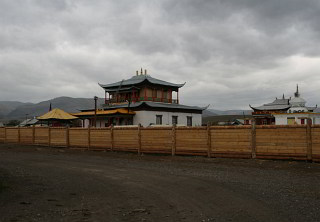
Buryatia
is mentioned in the author's description of the field altar, which according to him could just as well have been used by Buryat and Mongol shamans.
Background
Buryatia
is an autonomous republic in Siberia between Baikal and Mongolia. The Burjats are a people of Mongolian descent, now a minority in the republic. In 1923 Burjatia became an autonomous Soviet republic (ASSR). The capital is Ulan-Ude and the Trans-Siberian railway runs through the republic.
In 1920, Jaroslav Hašek conducted propaganda activities among the Buryats and even taught himself some of the language. It is known that he visited the region and at least reached Гусиное Озеро (Gusinoye Ozero) (Goose Lake), near the Mongolian border.
Quote(s) from the novel
[I.11.2] Nebylo také možno zjistit bez fantasie, co vlastně představují obrazy namalované na těch třech dílech. Jisto je, že to byl oltář, kterého by mohli stejně používat nějací pohani na Zambezi či šamáni Burjatů i Mongolů.
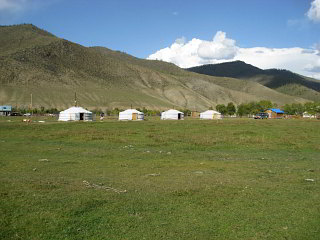
Mongolia
is mentioned by Jaroslav Hašek in his description of the field altar "which could just as well have been used by Buryat and Mongolian shamans".
Background
Mongolia
is a republic in Asia between Russia and China that broke away from China in 1911. During the Russian civil war, Mongolia changed hands several times, but from 1921 the communists led by Damdin Sükhbaatar gained the upper hand, which led to nearly 70 years of communist rule and strong links to the Soviet Union. A legacy from this period is the use of the Cyrillic alphabet.
Hašek and Mongolia
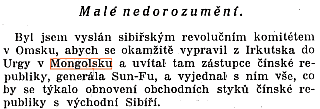
In 1920, Jaroslav Hašek was involved on the periphery of the political struggle for Mongolia and he did indeed know Sükhbaatar personally. In the story Malé nedorozumění (Small misunderstandings)[a], he writes that he travelled all the way to Urga (now Ulaanbaatar). This story has not been verified and is surely an example of "mystifikace". Such a journey during the short time he stayed in Irkutsk would, in 1920, have been practically impossible.
Quote(s) from the novel
[I.11.2] Nebylo také možno zjistit bez fantasie, co vlastně představují obrazy namalované na těch třech dílech. Jisto je, že to byl oltář, kterého by mohli stejně používat nějací pohani na Zambezi či šamáni Burjatů i Mongolů.
Wyandotte
is mentioned indirectly through the Wyandotte chicken, which cackle their way into the plot twice. First, when the author describes the altar that Feldkurat Katz uses for his field mass, here through the white Wyandotte hen.
The second instance occurs when Einjährigfreiwilliger Marek recounts his unfortunate experiences as editor of Svět zvířat. During the job interview, Fuchs, the owner of the magazine, offered him a pair of miniature Wyandottes that had won first prize at a poultry exhibition in Berlin.
Background
Wyandotte
is the name of several places in the US, but the name of this chicken breed is taken from the Huron tribe, who also call themselves Wyandotte. The tribal headquarters are located in Wyandotte, Oklahoma.
The breed of chicken was officially recognised in 1883 and borrowed its name from the aforementioned Native American tribe. In Europe, a bantam variety was bred later.
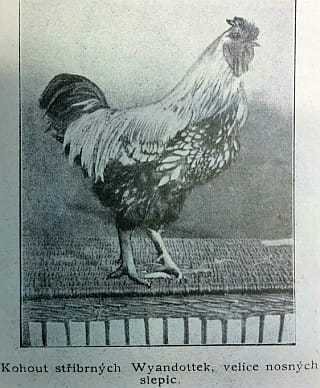
Jaroslav Hašek was clearly familiar with this animal breed (and many others) from his time as editor of Svět zvířat in 1909 and 1910. During his editorship, the magazine published several items about "wyandottky", and photos also appeared.
Quote(s) from the novel
[I.11] Namaloval nějakého ptáka, který mohl být stejně holubicí jako slepicí bílých wyandotek.
[II.3] Opět mne přerušil a řekl, že mu to úplně stačí, a jestli jen polovičku toho podaří se mně splnit, že mně daruje párek trpasličích wyandotek z poslední berlínské výstavy drůbeže, které obdržely první cenu a majitel zlatou medalii za výborné spáření.
View from Lipnice across the Sázava valley, 8.9.2009
Posázaví
is mentioned by the author when he describes the field altar, where he compares some of its motifs with the landscape by the Sázava.
Background
Posázaví
is a region in the Vysočina region, and is the name of the area by the river Sázava. The river flows from east to west; its source is the lake Velké Dářko, and it flows into the Vltava by Davle south of Prague.
This was an area Jaroslav Hašek knew very well from the time he lived in Lipnice, near the upper part of the river valley.
Quote(s) from the novel
[I.11.2] Vojáci se vždy hádali a luštili ten rebus. Někdo myslel dokonce, že je to krajinka z Posázaví.




 czdeenno
SearchMap
czdeenno
SearchMap