Švejk's journey is mapped on an Austria-Hungary map from 1914, showing the military districts of the
k.u.k. Heer. The entire plot of The Good Soldier Švejk is set within the territory of the former Dual Monarchy.
The Fateful Adventures of the Good Soldier Švejk (commonly known as The Good Soldier Švejk) by Jaroslav Hašek is rich in geographical
references, whether through the plot itself, in dialogues, or in the author's narrative voice. Hašek was unusually
well-travelled and had a photographic memory for geographical (and other) details. Geography mattered to him: eight
of the 27 chapter headings in the novel contain geographical names.
This website will, in due course, provide a complete overview of the novel's geographical references, from Prague in
the introduction to Klimontów in the unfinished Part Four. It includes continents, states (including defunct ones),
cities, market squares, city gates, regions, districts, towns, villages, mountains, mountain passes, oceans, lakes,
rivers, caves, channels, islands, streets, parks, and bridges.
The list is sorted according to the order in which the names appear in the novel. The chapter headings are taken from
Zenny Sadlon's recent translation (1999–2026); in most cases, these differ from Cecil Parrott's translation from 1973.
The Czech quotations are taken from the online version of The Good Soldier Švejk provided by Jaroslav Šerák and link to the relevant chapter. The
toolbar provides direct links to Wikipedia, Google Maps, Google Search, svejkmuseum.cz, and the novel online.
The names are colour-coded according to their role in the novel, as illustrated by the following examples:
Marathon
is mentioned indirectly by the author through the term marathon run. The arrested family father at the police station in Salmova ulice runs around as if he wants to win a marathon and screams: "Let me out!"
Background
Marathon
is the former name of Marathónas, a small town north of Athens that has become widely known through the marathon run. According to legend, a messenger ran to Athens with the news of victory at the battle of Marathon in 490 BC.
The marathon run was introduced during the first Olympic Games in 1896 in Athens. In the beginning, the distance varied slightly until it was fixed at the current 42,195 metres in 1921. In 1914, the distance was 40.2 kilometres. The first official run in Bohemia took place on 25 August 1908 between Smíchov and Dobříš. It was arranged by S.K. Slavia and the distance was 40 km.
Today, marathon is a major sport with hundreds of runs annually around the world. The largest take place in New York with more than 50,000 finishers (2013). Within old Austria-Hungary, there are annual runs in, among others, Prague, Vienna, Budapest and Bratislava. Every year there is also a classic marathon along the presumed original route.
Quote(s) from the novel
[I.5] Muž, který běhal mezi dveřmi a pryčnou, jako by chtěl vyhrát maratónskýběh, se zastavil a udýchán se posadil opět na své staré místo, složil hlavu do dlaní a náhle zařval: "Pusťe mne ven!" "Ne, oni mne nepustí," mluvil pro sebe, "nepustí a nepustí. Už jsem zde od rána od šesti hodin."
Kravín, where Hašek's party held pre-election meetings
Populuation statistics and administrative sub-division in 1913
Královské Vinohrady is mentioned 15 times in The Good Soldier Švejk.
Královské Vinohrady
is where Švejk's cell-mate from policejní komisařství Salmova ulice is said to have made an exhibition of himself in a respectable establishment. Vinohrady is mentioned again when Doctor Pávek arrives to treat Švejk's rheumatism in [I.7], and later, the name appears in several anecdotes. The plot never explicitly takes place here.
Background
Královské Vinohrady
is a former city and district of Prague, southeast of the centre. Administratively, it is split between Prague 2, 3 and 10. After 1968, the official name was Vinohrady, and this short form was common already during Austrian rule. This is also the name the author uses throughout. In 1922, Vinohrady became part of the capital.
Vinohrady achieved the status of "royal town" in 1879 and grew quickly to become the third largest city in the Kongeriket Bohemia.
Hašek og Vinohrady
Jaroslav Hašek lived in various locations in Vinohrady from 1896 to 1908 and for shorter periods later. On 23 May 1910 he married Jarmila Mayerova here, in kostel svaté Ludmily. His famous "party" Strana mírného pokroku v mezích zákona held many of their election meetings here, mainly before the elections of 1911, where he, according to legend, stood as a candidate.
In the second version of Švejk, Dobrý voják Švejk v zajetí, the main character lives in Vinohrady. Here, his occupation was a cobbler, not a dog trader, as he became known later.
The Good Soldier Švejk in Captivity
In Dobrý voják Švejk v zajetí, Švejk lives in Vinohrady; his occupation is a cobbler, not a dog trader. His servant is Bohuslav, who assumes part of Mrs. Müllerová's role in The Good Soldier Švejk by pushing Švejk to the draft board in a wheelchair. Otherwise, very little of the plot is set here.[1]
V duchu opustil hradčanský vojenský soud a mysl jeho zaletěla na Vinohrady do malého krámku, svezla se po obraze Františka Josefa a vyhledala pod starou postelí dvě morčata. Švejk k smrti rád pěstoval morčata. A jich osud byl také jedinou chmurou zde.
Demography
According to the 1910 census, Královské Vinohrady had 77,190 inhabitants, of whom 69,091 (89 per cent) reported using Czech as their everyday language. The judicial district was okresKrálovské Vinohrady, administratively it reported to hejtmanstvíKrálovské Vinohrady.
Per the recruitment districts, infantrymen from Královské Vinohrady were usually assigned to Infanterieregiment Nr. 28 (Prag) or k.k. Landwehrinfanterieregiment Nr. 8 (Prag).
Quote(s) from the novel
[I.5] Tak jsme ho šli opět všude hledat a nakonec jsme se ztratili jeden druhému, až nakonec jsem se ocitl v jedné z nočních kaváren na Vinohradech, velmi slušné místnosti, kde jsem pil nějaký likér přímo z láhve.
[II.2] "O velkej stříbrnej medalii za udatnost, kterou dostal jeden truhlář z Vávrovy ulice na Král. Vinohradech, nějakej Mlíčko, poněvadž byl první, kterému u jeho regimentu utrh na začátku války granát nohu.
[II.2] Jednou přišel do Apolla na Vinohradech a tam se dostal do sporu s řezníky z porážky, kteří mu nakonec utrhli umělou nohu a praštili ho s ní přes hlavu.
[II.3] Jednou před lety byl v Praze nějakej Mestek a ten vobjevil mořskou pannu a ukazoval ji na Havlíčkově třídě na Vinohradech za plentou.
Ražice
is first mentioned by Švejk in an anecdote about scouts he tells his fellow prisoner at the police station at Salmova ulice.
The place also appears in [I.14] and [II.2], and the good soldier must have been within a few kilometres on his anabasis in Part Two when he walked past Protivín to Putim after having stayed overnight at Švarcenberský ovčín.
Jaroslav Hašek knew the village very well and mentions it both in The Good Soldier Švejk and in some of his stories. See also ražická bašta.
Demography
According to the 1910 census, Ražice had 398 inhabitants, of whom 398 (100 per cent) reported using Czech as their everyday language. The judicial district was okresPísek, administratively it reported to hejtmanstvíPísek.
Per the recruitment districts, infantrymen from Ražice were usually assigned to Infanterieregiment Nr. 11 (Pisek) or k.k. Landwehrinfanterieregiment Nr. 28 (Pisek).
Quote(s) from the novel
[I.5] Potom na trápení u starosty, pod rákoskou, doznali, že není ani jedna louka v okolí, kterou by nebyli zváleli, když se vyhřívali na slunci, dále že ten lán žita nastojatě, právě před žněmi u Ražic, vyhořel čirou náhodou, když si v žitě pekli na rožni srnku, ku které se přikradli s noži v obecním lese.
[I.14.6] „Nejste vy Jarešův?“ otázala se dívka, začínajíc sympatisovat s neznámým vojáčkem. „Jsem.“ „A kterýho Jareše, toho z Krče u Protivína, nebo z Ražic?“ „Z Ražic.“
[II.2] Z Ražic za Protivínem syn Jarešův, dědeček starýho Jareše, baštýře, dostal za zběhnutí prach a volovo v Písku.
[II.2] Fakticky bylo tomu tak, že se s nimi nechtěl jednou v zimě tahat ve sněhu až do Písku, tak je u Ražic v polích pustil a vypálil ránu do vzduchu pro forma.
Okres Hluboká
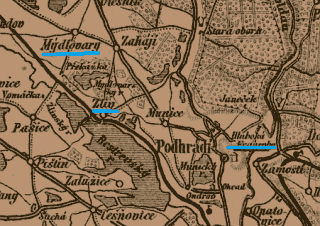
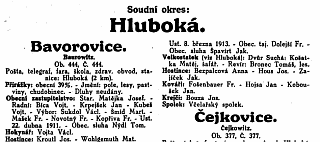
refers to the okres (judicial district) named after its seat Hluboká. The district belonged to hejtmanství Budějovice as Švejk clearly states. The district counted 26 municipalities that were almost exclusively inhabited by Czechs: Bavorovice, Břehov, Čejkovice, Češnovice, Dasný, Dobřejice, Dříteň, Hluboká, Hosín, Hrdějice, Chlumec, Chotýčany, Jaroslavice, Jeznice, Česká Lhota, Lišnice, Munice, Mydlovary, Nakří, Opatovice, Pištín, Plastovice, Purkarec, Velice, Nová Ves, Volešník, Vyhlavy, Zbudov, Zliv.
Mydlovary plays a particularly prominent role because this is where Jaroslav Hašek had right of domicile and was thus under the jurisdiction of the recruitment region of Infanterieregiment Nr. 91. See Ergänzungskommando.
Demography
According to the 1910 census, okres Hluboká had 15,594 inhabitants, of whom 15,512 (99 per cent) reported using Czech as their everyday language. Administratively it reported to hejtmanstvíBudějovice.
Per the recruitment districts, infantrymen from okres Hluboká were usually assigned to Infanterieregiment Nr. 91 (Budweis) or k.k. Landwehrinfanterieregiment Nr. 29 (Budweis).
Quote(s) from the novel
[I.5] "U skautů?" zvolal Švejk. "O těch skautech rád slyším. Jednou v Mydlovarech u Zlivi, okres Hluboká, okresní hejtmanství České Budějovice, právě když jsme tam měli jednadevadesátí cvičení, udělali si sedláci z okolí hon na skauty v obecním lese, kteří se jim tam rozplemenili.
Hejtmanství Budějovice
is mentioned in the story about the unfortunate scouts whom Švejk tells the unhappy family father about in the cell at policejní komisařství Salmova ulice.
Background
Hejtmanství Budějovice
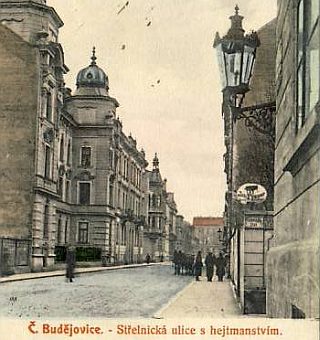
was the administrative district in the area around Budějovice. Apart from the district capital, there were no major population centres within its boundaries. These places in the district are mentioned in The Good Soldier Švejk: Zliv, Mydlovary and Hluboká.
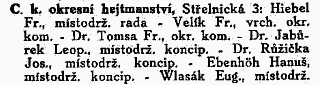
The district contained four okres: Budějovice, Hluboká, Lišov and Trhové Sviny. The administration was located in Střelnická ulice, now třída 28. října.
Bezirkhauptmannschaft
The term (Cz. okresní hejtmanství) needs clarification. Cecil Parrott's English translations of The Good Soldier Švejk (1973) interpret it as "police district", which it definitely is not. It is rather the third level of government administration in Cisleithania (i.e. the Austrian part of the Dual Monarchy). The next level up was the Statthalter (Cz. místodržitel), who in turn reported directly to the government in Vienna. In the Hungarian part of the empire, the equivalent to Bezirk was vármegye.
The Kongeriket Bohemia consisted of nearly 100 political districts politické okresy (politische Bezirke) that were created after a reform in 1868 that split the executive from the judicial administration. The districts generally contained three or four soudní okresy (Gerichtsbezirke), but the number could vary. Often used in Czech is the shortened version hejtmanstvi, for instance in Ottův slovník naučný. Likewise, soudní okres is mostly referred to as simply okres.
Demography
According to the 1910 census, hejtmanství Budějovice had 120,659 inhabitants, of whom 95,317 (79 per cent) reported using Czech as their everyday language.
Per the recruitment districts, infantrymen from hejtmanství Budějovice were usually assigned to Infanterieregiment Nr. 91 (Budweis) or k.k. Landwehrinfanterieregiment Nr. 29 (Budweis).
Quote(s) from the novel
[I.5] "U skautů?" zvolal Švejk. "O těch skautech rád slyším. Jednou v Mydlovarech u Zlivi, okres Hluboká, okresní hejtmanství České Budějovice, právě když jsme tam měli jednadevadesátí cvičení, udělali si sedláci z okolí hon na skauty v obecním lese, kteří se jim tam rozplemenili.
Ječná ulice
is one of the streets Švejk walks through with a police escort, on his way from Salmova ulice police station back to c.k. policejní ředitelství. The date must have been around 28 July 1914.
Background
Ječná ulice
is a busy street in Prague II, leading from Karlovo náměstí to IP Pavlova. The family of Jaroslav Hašek lived at no. 7 for a while in 1884, the year after he was born.
Quote(s) from the novel
[I.5] Ukloniv se uctivě, odcházel s policejním strážníkem dolů na strážnici a za čtvrt hodiny bylo již vidět na rohu Ječné ulice a Karlova náměstí Švejka v průvodu druhého policejního strážníka, který měl pod paždí objemnou knihu s německým nápisem „Arrestantenbuch“.
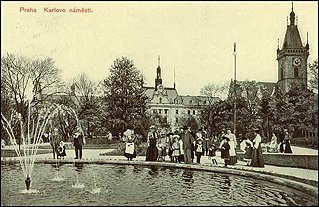
Karlovo náměstí
is another place Švejk passes with police escort, on his way from Salmova ulice police station back to c.k. policejní ředitelství. The date must have been around 28 July 1914, the day of the declaration of war against Serbia.
The place is mentioned several times in Part One, and appears already in the first chapter, through the colloquial expression "Karlák".
Karlovo náměstíCharles Square
is the centre of Nové město and is one of the largest city squares in Europe. Today, it appears more like a park than a square. It was founded by King Charles IV in 1348.
[I.1] Představte si park, řekněme na Karláku, a na každým stromě jeden voják bez disciplíny. Z toho jsem vždycky měl největší strach."
[I.3] "To prosím nemám, jen jednou málem byl by mne zachvátil nějakej automobil na Karlově náměstí, ale to už je řada let "
[I.5] Ukloniv se uctivě, odcházel s policejním strážníkem dolů na strážnici a za čtvrt hodiny bylo již vidět na rohu Ječné ulice a Karlova náměstí Švejka v průvodu druhého policejního strážníka, který měl pod paždí objemnou knihu s německým nápisem „Arrestantenbuch“.
[I.13] Potom přečetl polní kurát ještě jednou předpis, ve kterém se mu oznamuje, že zítra má jít na Karlovo náměstí do Vojenské nemocnice zaopatřovat těžce raněné. „Poslyšte, Švejku,“ zavolal polní kurát, „není to svinstvo? Jako kdyby v celé Praze byl jsem jen já jediným polním kurátem. Proč tam nepošlou toho nábožného kněze, který u nás posledně spal. Máme jít zaopatřovat na Karlák. Já už zapomněl, jak se to dělá.“
[II.5] „A potom,“ řekl Švejk tiše, „to s tím Zátkou po čase skončilo moc špatně. Dal se do Mariánský kongregace, chodil s nebeskýma kozama na kázání pátera Jemelky k svatýmu Ignáci na Karlovo náměstí a zapomenul jednou zhasnout, když byli misionáři na Karláku u svatýho Ignáce, plynový svítilny ve svým rayoně, takže tam hořel po ulicích plyn nepřetržitě po tři dny a noci.
[III.3] Počal se tedy dál a dál vzdalovat vod svýho domova, až se přivalil do Černýho pivovaru na Karlově náměstí, a vodtamtuď šel na Malou Stranu k Sv. Tomáši do pivovaru a odtamtud přes restaurací U Montágů a ještě vejš přes hospodu U krále brabantskýho, pak na Krásnou vyhlídku, odtud do Strahovskýho kláštera do pivovaru. Ale to už mu změna podnebí přestala svědčit.
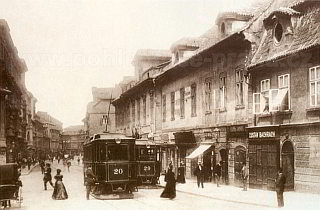
Spálená ulice
appears in the plot when Švejk and his police escort stop at the corner of Karlovo náměstí - Spálená ul. to read a poster announcing the declaration of war on Serbia. The date was probably 28 July 1914.
The street is mentioned again in Švejk's anecdote about the bag maker bagmaker Kuneš, who always lost his dogs.
Background
Spálená ulice
is a street in Prague II leading from Karlovo náměstí north towards Národní třída (then Ferdinandova třída). The name means "Burnt Street".
This street was also home to U Teissiga and U Brejšky, restaurants that are mentioned in The Good Soldier Švejk.
Quote(s) from the novel
[I.5] Na rohu Spálené ulice setkal se Švejk se svým průvodčím s tlupou lidí, kteří se tlačili kolem vyvěšeného plakátu. „To je manifest císaře pána o vypovězení války,“ řekl policejní strážník k Švejkovi.
[I.15] Ve Spálený ulici je nějakej brašnář Kuneš a ten nemoh jít se psem na procházku, aby ho neztratil. Vobyčejně ho nechal někde v hospodě nebo mu ho někdo ukrad nebo si ho vypůjčil a nevrátil...“
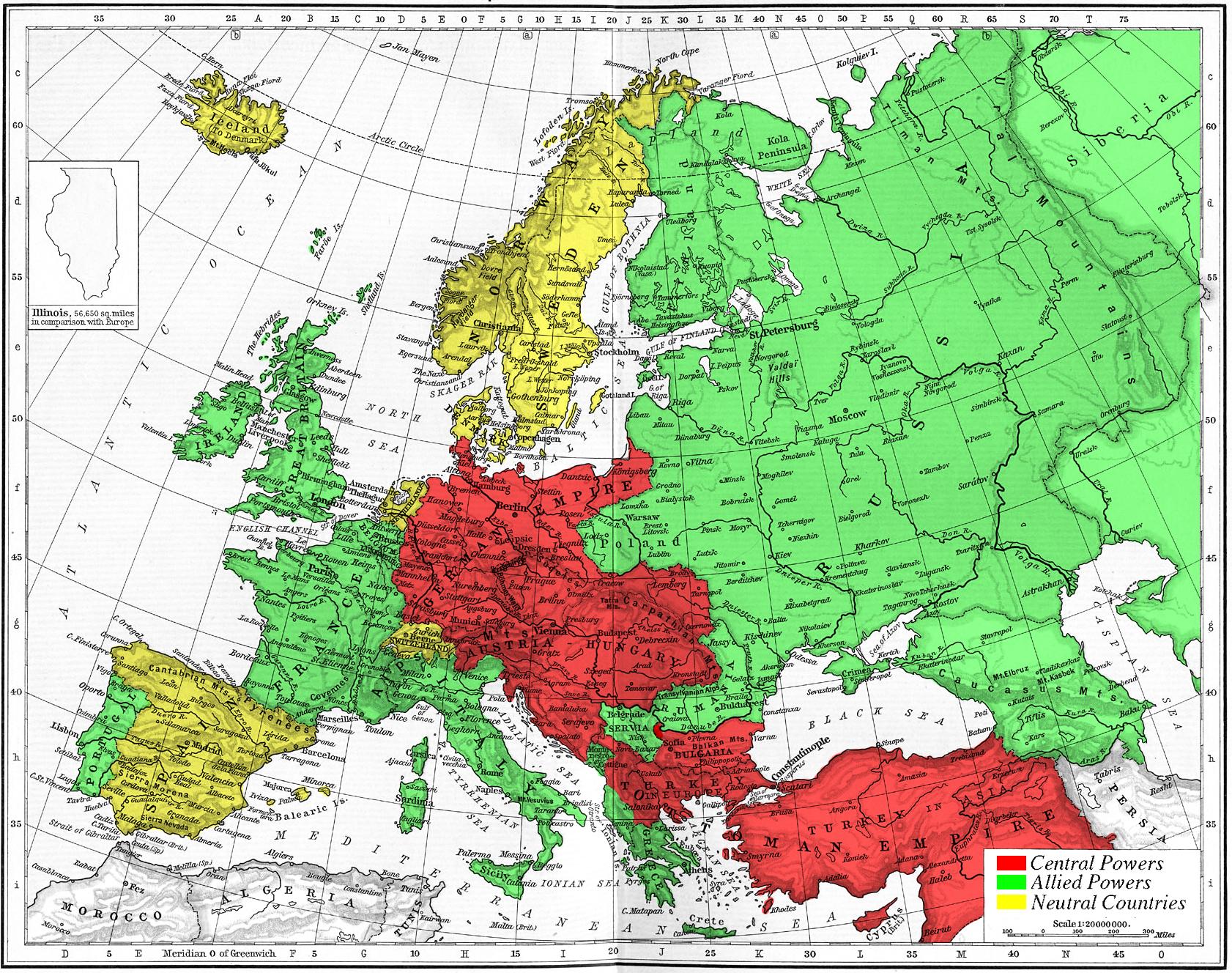
Europe
is mentioned by the author in conjunction with the news that Austria-Hungary had declared war on Serbia: "and somewhere from distant history it dawned on Europe that tomorrow would obliterate the plans of today."
The continent is also mentioned twice in [III.2], but only in passing.
Background
Europe
was, at the outbreak of World War I, far less fragmented than today, not least because of Austria-Hungary, which covered areas that now belong to 13 different states. Germany and Russia were also much larger than they are today.
The Great War turned Europe upside down. The empires of Germany, the Austria-Hungary, Turkey and Russia all collapsed and the human and material losses were enormous. The total death toll is estimated at around 15 million. Only Spain, Netherlands, Switzerland, Sweden, Denmark and Norway managed to preserve their neutrality.
Quote(s) from the novel
[I.5] A kdesi v dálných dálavách historie snášela se k Evropě pravda, že zítřek rozboří i plány přítomnosti.
[II.3] "Tato jediná rakouská kolonie může ledem zásobit celou Evropu a jest znamenitým národohospodářským činitelem.
[II.3] Váš duševní obzor se vám ještě víc zouží, a když složíte někde na bojišti své kulturně zakrnělé kosti, po vás v celé Evropě nikdo nezapláče."
I. In the rear
5. Švejk at the district police station in Salmova street
 English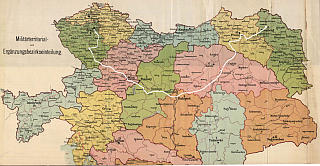


 czdeennn
SearchMap
czdeennn
SearchMap