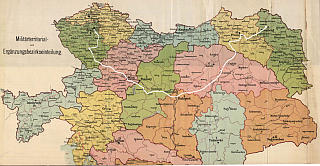
Švejk's journey is mapped on an Austria-Hungary map from 1914, showing the military districts of the
k.u.k. Heer. The entire plot of The Good Soldier Švejk is set within the territory of the former Dual Monarchy.
The Fateful Adventures of the Good Soldier Švejk (commonly known as The Good Soldier Švejk) by Jaroslav Hašek is rich in geographical
references, whether through the plot itself, in dialogues, or in the author's narrative voice. Hašek was unusually
well-travelled and had a photographic memory for geographical (and other) details. Geography mattered to him: eight
of the 27 chapter headings in the novel contain geographical names.
This website will, in due course, provide a complete overview of the novel's geographical references, from Prague in
the introduction to Klimontów in the unfinished Part Four. It includes continents, states (including defunct ones),
cities, market squares, city gates, regions, districts, towns, villages, mountains, mountain passes, oceans, lakes,
rivers, caves, channels, islands, streets, parks, and bridges.
The list is sorted according to the order in which the names appear in the novel. The chapter headings are taken from
Zenny Sadlon's recent translation (1999–2026); in most cases, these differ from Cecil Parrott's translation from 1973.
The Czech quotations are taken from the online version of The Good Soldier Švejk provided by Jaroslav Šerák and link to the relevant chapter. The
toolbar provides direct links to Wikipedia, Google Maps, Google Search, svejkmuseum.cz, and the novel online.
The names are colour-coded according to their role in the novel, as illustrated by the following examples:
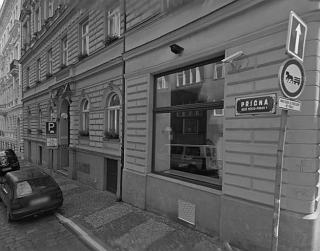
Příčná ulice
is a very short street in Nové město, slightly east of Karlovo náměstí. It connects Žitna ulice and Navrátilova ulice (then Hopfenstockova ulice).
According to the address book from 1910, there was no upholsterer in this street; the nearest were a few in Žitná ulice.
Quote(s) from the novel
[I.6] Za tu celou dobu dostal na lep jen čalouníka z Příčné ulice.
[I.6] Pak jsme všichni slyšeli, že pan Bretschneider řekl, vytahuje si zápisník: ,I hleďme, zase nová pěkná velezráda!’, a odešel s tím čalouníkem z Příčné ulice, který se již nevrátil.“
Račiněves
is a village by Roudnice nad Labem, 47 km north of Prague. As correctly pointed out in The Good Soldier Švejk, it had a post office.
Demography
According to the 1910 census, Račiněves had 840 inhabitants, of whom 840 (100 per cent) reported using Czech as their everyday language. The judicial district was okresRoudnice, administratively it reported to hejtmanstvíRoudnice.
Per the recruitment districts, infantrymen from Račiněves were usually assigned to Infanterieregiment Nr. 42 (Leitmeritz) or k.k. Landwehrinfanterieregiment Nr. 10 (Jungbunzlau).
Quote(s) from the novel
[I.6] Švejk sňal s věšáku nějaké noviny a prohlížeje si zadní stranu inserátů, ozval se:
„Tak vida, tenhle Čimpera v Straškově č. 5, p. Račiněves, prodá hospodářství s třinácti korci vlastních polí, škola a dráha na místě.“
Literature
Račiněves, Ottův slovník naučnýDíl 21. R (Ř) – Rozkoš,1904
Straškov
is a village by Roudnice nad Labem, 47 km north of Prague. The nearby mountain Říp is, according to legend, the first place in Bohemia where arriving Czechs settled.
It is correctly pointed out in The Good Soldier Švejk that the post office was in Račiněves and that Straškov itself had a railway station and a school.
Demography
According to the 1910 census, Straškov had 509 inhabitants, of whom 509 (100 per cent) reported using Czech as their everyday language. The judicial district was okresRoudnice, administratively it reported to hejtmanstvíRoudnice.
Per the recruitment districts, infantrymen from Straškov were usually assigned to Infanterieregiment Nr. 42 (Leitmeritz) or k.k. Landwehrinfanterieregiment Nr. 10 (Jungbunzlau).
Quote(s) from the novel
[I.6] Švejk sňal s věšáku nějaké noviny a prohlížeje si zadní stranu inserátů, ozval se:
„Tak vida, tenhle Čimpera v Straškově č. 5, p. Račiněves, prodá hospodářství s třinácti korci vlastních polí, škola a dráha na místě.“
Dejvice
is an urban area and cadastral district in western Prague between the centre and the airport. It is administratively part of Prague 6, and is regarded as one of the more exclusive parts of the capital. The district became part of Prague in 1922 and Vítězné náměstí is regarded as its focal point.
In 1913, Dejvice was still a separate administrative unit, although it was part of the Prague conurbation.
Demography
According to the 1910 census, Dejvice had 6,582 inhabitants, of whom 6,274 (95 per cent) reported using Czech as their everyday language. The judicial district was okresSmíchov, administratively it reported to hejtmanstvíSmíchov.
Per the recruitment districts, infantrymen from Dejvice were usually assigned to Infanterieregiment Nr. 28 (Prag) or k.k. Landwehrinfanterieregiment Nr. 8 (Prag).
Quote(s) from the novel
[I.6] „Já bych chtěl špice,“ s klidnou umírněností řekl Bretschneider, „špice, kterej by nekousal.“ „Přejete si tedy bezzubého špice?“ otázal se Švejk, „vím o jednom. Má ho jeden hostinský v Dejvicích.“
[II.3] "Von mně připomíná s těma drobnejma, který nemá", prohodil Švejk, "že je jako nějaký Mlíčko, zedník z Dejvic, ten taky neměl tak dlouho drobný, až se zasekal po krk a byl zavřenej pro podvod. Prožral velký a neměl drobný."
Great St Bernard Pass
is mentioned indirectly through the dog breed St Bernard (or Bernardiner) that takes its name from the well-known mountain pass in the Alps.
The dog breed first appears in [I.6] when Švejk avoids detective Bretschneider's attempts to trick him into compromising himself. He achieves this by giving completely off-topic responses, in this case a story about a Bernardiner puppy. In the same chapter Mrs. Müllerová reveals that she had a visit from the police while Švejk was under arrest and a Bernardiner bit a policeman before it ran away.
Later in the novel the dog breed appears several times, including in [I.14] during a conversation with Oberleutnant Lukáš and also during the preparation of the dog theft. Factory owner factory owner Vydra owned a Bernardiner that Blahník stole.
Background
Great St Bernard Pass
is a mountain pass in the western Alps that has given its name to the mentioned dog breed. The highest point is 2,469 metres above sea level and the pass connects Switzerland and Italy. It is named after Bernard of Aosta, better known as Saint Bernhard.
The dog breed
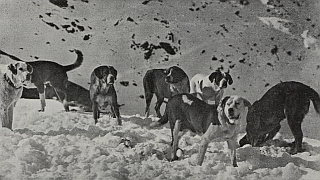
The St Bernard dogs are considered the largest of all dog breeds and may weigh up to one hundred kilos and reach a height of one metre. They were originally bred by the sanctuary at Great St Bernard Pass and used for rescue duties in the mountains. One hundred years ago the dogs were much smaller than today, but because of the increased weight they are no longer suitable as avalanche and rescue dogs.
Hašek and St Bernard dogs
Jaroslav Hašek doma, Václav Menger
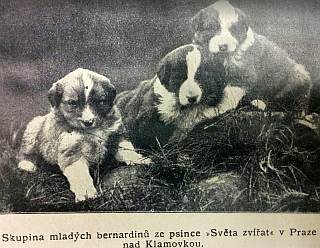
At the time when Jaroslav Hašek edited the magazine Svět zvířat, the St Bernard dog appeared repeatedly on its pages, in text and photos. Furthermore, Václav Menger writes that Hašek once wrote an invented story about such a dog in České Slovo, much to the annoyance of the dog's owner, the hotel proprietor Karel Černý from Černošice. The latter even appeared in the editorial offices in an agitated mood, with his enormous dog on a lead!
Quote(s) from the novel
[I.6] Švejk prohlásil, že neměl se státem co dělat, ale že jednou měl na ošetřování slabé štěně bernardýna, které krmil vojenskými suchary, a že také chcíplo.
[I.6] Pak šla stlát postel, neobyčejně pečlivě uváděla všechno do pořádku a vrátivši se ke Švejkovi do kuchyně se zaslzeným zrakem poznamenala: „Ty dvě štěňata, milostpane, co jsme měly na dvoře, chcíply. A ten bernardýn, ten nám utek, když tady dělali domovní prohlídku.“
[I.14.3] Kam se na něj hrabe takovej pitomej bernardýn. Je ještě chytřejší než foxteriér. Já jsem znal jednoho...
[I.14.6] „Pohostím ho hovězíma,“ rozhodl se Blahník, „na ty jsem už dostal bernardýna továrníka Vydry, náramně věrný zvíře. Zejtra ti psa přivedu v pořádku.“
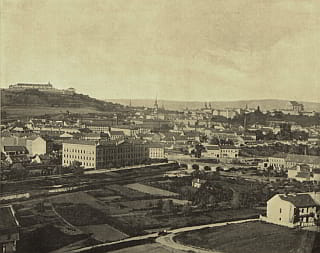
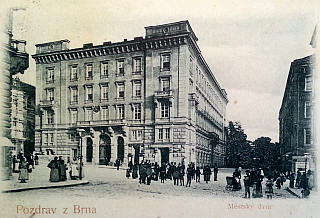
Brno
is mentioned by Mrs. Müllerová when she tells Švejk about the police interrogation after the latter had been arrested by detective Bretschneider. She was asked by the police if she had received money from abroad, and she replied: "Yes, from Brno".
The city is mentioned only once more, in connection with Feldkurat Matyáš who died there without having paid his debts.
Background
Brno
is the second largest city of Czechia with a population of around 380,000. The city has a strong industrial tradition and is also the seat of the country's most important legal institutions.
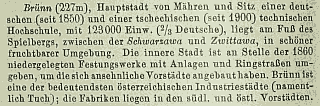
In 1914 Brno was the capital of Moravia, but the city was much smaller than today, also in area. At the time a majority of the 123,000 inhabitants were German (this number also includes the 15,000 Jews).
Hašek in Brno
Jaroslav Hašek visited Brno in 1902 on his way back from a trip to Slovakia. He wrote a postcard from here, addressed to his cousin Marie who at the time lived in Jaroměř. The card is also signed by Viktor Janota and Jan Čulen.
The Good Soldier Švejk in Captivity
In Dobrý voják Švejk v zajetí the city is briefly mentioned in connection with a German Lehrerinnenverein and also the street Františkova ulice.[1]
Německá učitelka z 'lehrerinnenvereinu' v Brně jednoho rána převlékla se do vojenské uniformy, sekala šavli do výkladních skříní po ulici Františkově a hulákala: "Gott strafe England!"
Demography
According to the 1910 census, Brno had 125,737 inhabitants.
Military
Per the recruitment districts, infantrymen from Brno were usually assigned to Infanterieregiment Nr. 8 (Brünn) or k.k. Landwehrinfanterieregiment Nr. 14 (Brünn).
Quote(s) from the novel
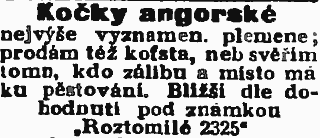
[I.6] Se mnou také dělali výslech, kdo k nám chodí, jestli nedostáváme nějaké peníze z ciziny, a potom dělali narážky, že jsem hloupá, když jsem jim řekla, že peníze z ciziny chodějí jen zřídka, posledně od toho pana řídícího z Brna ta záloha šedesát korun na angorskou kočku, kterou jste inseroval v Národní politice a místo toho jste mu poslal v bedničce od datlí to slepé štěňátko foxteriéra.
[I.13] „Vidíte: Polní kurát Matyáš v Brně, zemřel v isolační nemocnici před týdnem. Já bych si rval vlasy. Nezaplatil mně 1800 korun, a jde do cholerového baráku zaopatřovat nějakého člověka, po kterém mu nic nebylo.“
Angora
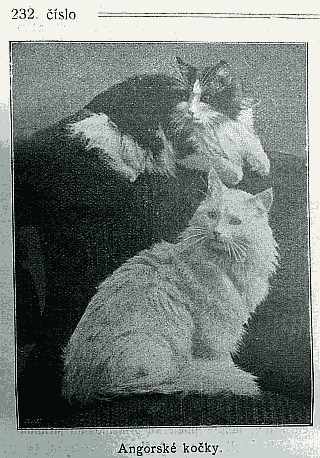
is here used as an adjective to denote a breed of cats, Angora. The cat breed is mentioned several times in the novel.
It first appears when Mrs. Müllerová tells Švejk that she told the police that he had received money for a cat that he had advertised in Národní politika. The money was from "abroad", from a businessman in Brno.
The second cat [I.14] belonged to senior Oberleutnant Lukáš and takes part in the plot directly. It devoured his canary bird after Švejk had the idea to let the cat and the bird be together "to get used to each other". The cat soon after ended its life by eating shoe polish [I.15].
Background
Angora
is the historical name of Ankara, the capital of Turkey. Ankara is the second largest city in the country and has been the capital since 1923. The Angora cat is a breed of domestic cats originating from central Asia Minor.
Pictures of Angora cats appeared on the pages of the animal magazine Svět zvířat during the time Jaroslav Hašek edited the periodical (1909-1910). At the same time he wrote a story about the Angora tomcat Bobeš, a cat that could talk. The story's title was O domýšlivém kocouru Bobešovi (About the conceited tomcat Bobeš) and was printed in Svět zvířat on 1 March 1910.
The Angora cat also appears in altogether six (or more) pre-war stories. One of them is Má drahá přitelkyně Julča (My dear friend Julie) that was printed in three issues of Zlatá Praha in April/May 1915. This story is also set during Hašek's time as an animal trader at Košíře and contains themes known from the novel (Brehm and Klamovka are mentioned). The story O nejošklivějším psu Balabánovi (Svět zvířat, 1913) also contains a reference to an Angora cat. Another talking cat Markus features in another story, and there is also a cat Lili in the story about Professor Axamit. See links below for a full list.
Quote(s) from the novel
[I.6] Se mnou také dělali výslech, kdo k nám chodí, jestli nedostáváme nějaké peníze z ciziny, a potom dělali narážky, že jsem hloupá, když jsem jim řekla, že peníze z ciziny chodějí jen zřídka, posledně od toho pana řídícího z Brna ta záloha šedesát korun na angorskou kočku, kterou jste inseroval v Národní politice a místo toho jste mu poslal v bedničce od datlí to slepé štěňátko foxteriéra.
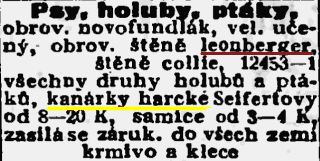
[I.14.3] Neobyčejně rád měl zvířata. Měl harckého kanárka, angorskou kočku a stájového pinče.
[I.14.3] A angorská kočka si opět vlezla pod pohovku.
[I.15] „Poslušně hlásím, pane obrlajtnant, že jste přišel o kočku. Sežrala krém na boty a dovolila si chcípnout. Hodil jsem ji do sklepa, ale do vedlejšího. Takovou hodnou a hezkou angorskou kočku už nenajdete.“
Leonberg
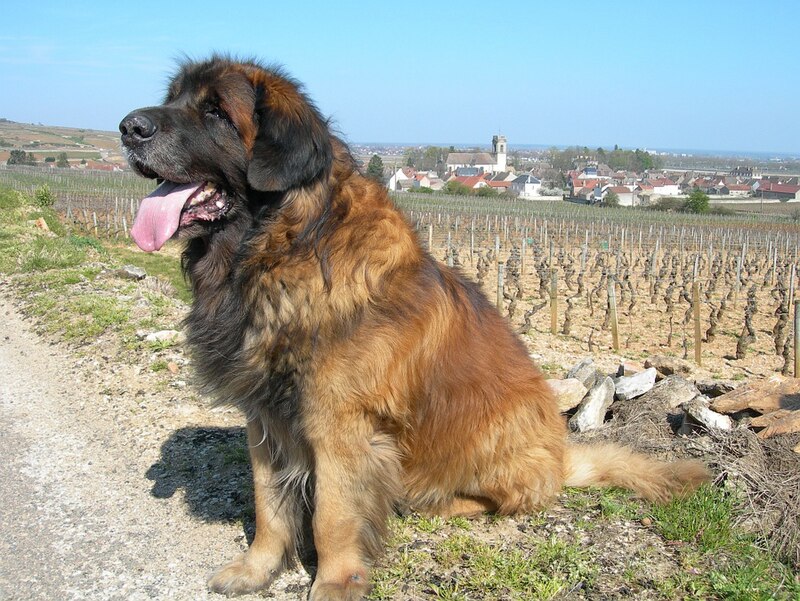
is mentioned indirectly through the dog breed Leonberger when Švejk tells detective Bretschneider that he once sold a Leonberger to an anarchist for 100 crowns.
Background
Leonberg
is a town in Swabia that gave its name to the mentioned dog breed. This is a very large and furry dog breed, that appeared through breeding in the 19th century. It can weigh up to 80 kilos.
Leonberger dogs are written about in Svět zvířat at the time when Jaroslav Hašek was editor of this magazine. The author had good knowledge of dog breeding, something that is reflected in the many references to dogs throughout the novel and elsewhere in his literary output.
Quote(s) from the novel
[I.6] Když měli každý pátou čtvrtku, prohlásil se Bretschneider za anarchistu a ptal se Švejka, do které organisace se má dát zapsat. Švejk řekl, že si jednou jeden anarchista koupil od něho leonbergera za sto korun a že mu zůstal poslední splátku dlužen.
Scotland
is mentioned indirectly through the dog breed Scottish sheepdog when the author describes Švejk's dog dealings with detective Kalous.
Background
Scotland
is a nation occupying the northern part of the island Great Britain that since 1707 has been in a union with England. As part of the United Kingdom, Scottish forces contributed during World War I.
The Scottish sheepdog (Border Collie) was bred in the late 19th century. It is now regarded as the world's most popular shepherd's dog.
Quote(s) from the novel
[I.6] Pak tam šel koupit psa detektiv Kalous a vrátil se s vyjevenou potvorou, připomínající hyenu skvrnitou, s hřívou skotského ovčáka, a v položkách tajného fondu přibyla nová: D...90 K.