The Good Soldier Švejk mentions numerous institutions and firms, both public and private. Until 15 September 2013, these were categorised as
'Places' on these pages. That categorisation only partly makes sense, because this type of entity cannot always be
tied to geographical coordinates in the way that cities, mountains, and rivers can. This page therefore covers
military and civilian institutions (including army units, regiments, etc.), organisations, hotels, public houses,
newspapers, and magazines.
The boundary between this page and 'Places' is not always clear-cut. Churches, for instance, rarely change location
yet are still included here. By contrast, Prague and Vienna remain in the 'Places' database because they have fixed
coordinates. Institutions, however, may move: Odvodní komise and Bendlovka are not unambiguous geographical terms,
so they are listed on this page.
The names are colour-coded according to their role in the novel, as illustrated by the following examples:
U kalicha, a location where the plot takes place.
k.u.k. Kriegsministerium, mentioned in the narrative.
Na Zavadilce
is mentioned in Švejk's comment to the conversation between Major Wolf and the captain where the former's conclusion is that Švejk is to be hanged after a summary trial. According to Švejk, it was a pub in Libeň.
Background
Na Zavadilce
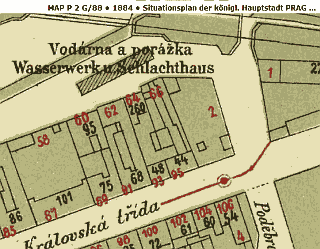
it has not been possible to identify with certainty. Any hospoda bearing this name does not seem to have existed in Libeň, but in Karlín there was a restaurant with this name. The location, Královská třída 91, is not that far from Libeň, so it might be this one Švejk had in mind.
Quote(s) from the novel
[IV.1] Švejk, kterého vedli napřed a slyšel celý zajímavý rozhovor, neřekl nic jiného svým průvodčím než: „Pěšky jako za vozem. To jsme se vám jednou v hospodě ,Na Zavadilce’ v Libni hádali mezi sebou, jestli máme nějakýho kloboučníka Vašáka, kerej vždycky dělal při zábavě neplechu, vyhodit, hned jak se vobjeví ve dveřích, nebo ho vyhodit, až si dá pivo, zaplatí a dopije, nebo mu vyndat boty, až přetančí první kolo.
Ratskeller
is mentioned in the anecdote Švejk uses against the spy who enters his cell in Przemyśl.
Background
RatskellerTown Hall Cellar
is a restaurant in Graz which is still trading (2010). The address is Hauptplatz 17. The English translation of Cecil Parrott for some reason locates it in Steyr.
Quote(s) from the novel
[IV.1] Všechny lidi, který potkával na ulici, viděl buď na nádraží v Miláně, nebo s nimi seděl ve Štýrským Hradci v radničním sklepě při víně.
Lustige Blätter
is mentioned by the author as the publisher of some silly booklets that General Fink likes to quote from.
Background
Lustige Blätter
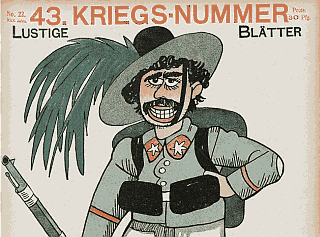
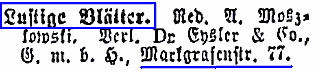
was an illustrated humorous weekly that was published from 1886 to 1944. It was founded in Hamburg in 1886 by Alexander Moszkowski and Otto Eysler. The former was editor-in-chief until 1928 and in 1915 the publisher of the magazine was Verlag der "Lustigen Blätter" (Dr. Eysler & Co.) G.m.b.h.. As early as 1887 the editorial offices moved to Berlin.
Tornister-Humor series
From early 1915 they published a collection of patriotic booklets called Tornister-Humor, each of 64 pages. The author's description of the circumstances around the booklets is very accurate. In 1915 both Schloemp and Artur Lokesch contributed and Jaroslav Hašek correctly lists the names of some of the booklets the two were involved in[a]. He also mentions some subtitles but gives the impression that these were also full titles.
Quote(s) from the novel
[IV.1] Po všech instrukcích, které mu dával velitel garnisonní posádky, dával vždycky generál Fink něco ostrého nalít a potom mu vypravoval nejnovější anekdoty z nejblbějších svazečků, které pro vojsko byly vydány v „Lustige Blätter“.
Měl celou knihovnu takových svazečků s pitomými názvy jako „Humor v tornistře pro oči i uši“, „Hindenburgovy anekdoty“, „Hindenburg v zrcadle humoru“, „Druhá tornistra plná humoru, naládovaná Felixem Schlemprem“, „Z našeho gulášového kanonu“, „Šťavnaté granátové třísky ze zákopů“, nebo tyto hovadiny: „Pod dvojitým orlem“, „Vídeňský řízek z c. k. polní kuchyně. Ohřál Artur Lokesch“. Někdy mu také předzpěvoval ze sbírky veselých vojenských písní „Wir müssen siegen!“, přičemž naléval neustále něco ostrého a nutil polního kuráta Martince, aby pil a hulákal s ním.