


Franz Ferdinand and his wife Sophie leave the Sarajevo Town Hall on 28 June 1914, five minutes before the assassination.
The Good Soldier Švejk is a novel with an unusually rich array of characters. In addition to the many who directly form part of the plot, a large number of fictional and real people (and animals) are mentioned; either through the narrative, Švejk's anecdotes, or indirectly through words and expressions.
This web page contains short write-ups on the people that the novel refers to; from Napoléon in the introduction to Hauptmann Ságner in the last few lines of the unfinished Part Four. The list is sorted in the order of which the names first appear. The chapter headlines are from Zenny Sadlon's recent translation (1999-2024) and will in most cases differ from Cecil Parrott's version from 1973.
The quotes in Czech are copied from the on-line version of The Good Soldier Švejk: provided by Jaroslav Šerák and contain links to the relevant chapter. The toolbar has links for direct access to Wikipedia, Google maps, Google search, svejkmuseum.cz and the novel on-line.
The names are coloured according to their role in the novel, illustrated by the following examples:
- Dr. Grünstein as a fictional character who is directly involved in the plot.
- Fähnrich Dauerling as a fictional character who is not part of the plot.
- Heinrich Heine as a historical person.
Note that a number of seemingly fictional characters are inspired by living persons. Examples are Oberleutnant Lukáš, Major Wenzl and many others. This are still listed as fictional because they are literary creations that are only partly inspired by their like-sounding "models".
Military ranks and some other titles related to Austrian officialdom are given in German, and in line with the terms used at the time (explanations in English are provided as tooltips). This means that Captain Ságner is still referred to as Hauptmann although the term is now obsolete, having been replaced by Kapitän. Civilian titles denoting profession etc. are translated into English. This also goes for ranks in the nobility, at least where a direct translation exists.
 People index of people, mythical figures, animals ... (588)
Show all
People index of people, mythical figures, animals ... (588)
Show all I. In the rear
1. The good soldier Švejk acts to intervene in the world war (30)
14. Švejk as military servant to senior lieutenant Lukáš (35)
II. At the front
1. Švejk's mishaps on the train (22)
2. Švejk's budějovická anabasis (55)
3. Švejk's happenings in Királyhida (46)
5. From Bruck on the Leitha toward Sokal (45)
III. The famous thrashing
1. Across Magyaria (52)
2. In Budapest (32)
3. From Hatvan to the borders of Galicia (31)
4. Forward March! (32)
IV. The famous thrashing continued
1. Švejk in the transport of russian prisoners of war (35)
3. Švejk again with his march company (20)
I. In the rear
1. The good soldier Švejk acts to intervene in the world war (30)
14. Švejk as military servant to senior lieutenant Lukáš (35)
II. At the front
1. Švejk's mishaps on the train (22)
2. Švejk's budějovická anabasis (55)
3. Švejk's happenings in Királyhida (46)
5. From Bruck on the Leitha toward Sokal (45)
III. The famous thrashing
1. Across Magyaria (52)
2. In Budapest (32)
3. From Hatvan to the borders of Galicia (31)
4. Forward March! (32)
IV. The famous thrashing continued
1. Švejk in the transport of russian prisoners of war (35)
3. Švejk again with his march company (20)


|
I. In the rear |
 | |
13. Švejk goes to provide the last rites | |||
 | Němcová, Božena |  | |||
| *4.2.1820 Wien - †21.1.1862 Praha | |||||
| |||||
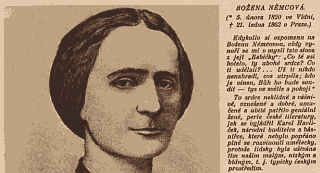
,19.1.1927
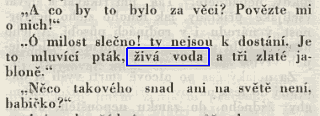
České národní báchorky a pověsti, Díl I
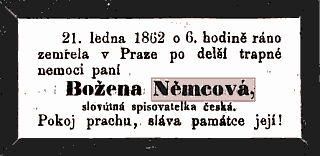
,24.1.1862
,26.1.1862
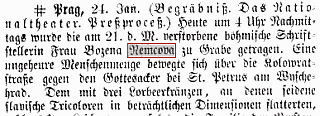
Božena Němcová is mentioned when Švejk tells Feldkurat Katz that finding oil consecrated by a bishop is worse than finding the water of life in tales by Božena Němcová.
Background
Božena Němcová was a prominent Czech writer who wrote short stories, poems and fairytales. Her best known work is however a novel: Babička (Grandmother), regarded as one of the classics of Czech literature. The well known film Three nuts for Cinderella (1973) is based on one her fairytales from 1845, called O Popelce (About Cinderella).
Water of life
One of the tales that Švejk refers to is surely About the talking bird, the water of life and the three golden apple trees. It was first printed in 1846 and has since been included in many compilations.[a]
Life
Božena Němcová was born Barbara Pankl in Vienna but the family moved to Bohemia when she was a year old. Her father was a German (Austrian) coach driver, her mother a Czech maid. Němcová grew up in Ratibořice by Náchod and married the 15 year older civil servant Josef Němec when she was 17. The marriage was a result of pressure from her parents. The couple had four children but the marriage was an unhappy one, and Němcová had a number of extra-marital affairs.
In 1842 the family moved to Prague where she came in contact with leading figures in the Czech national revival movement. She started to write and in 1844 her first tales were published. Around this time she changed her first name to the more typical Czech Božena.
The family moved frequently and Božena Němcová suffered from poverty and illness during the final years of her life. She was only 42 years old when she died on 21 January 1862. The funeral took place three days later, and was a stark contrast to the penury of her later years. It was attended by a big crowd; amongst them were a number of Czech notabilities from literary and political circles. She was buried at Vyšehrad and her tomb is still there.
Quote(s) from the novel
[I.13] Švejk vypravil se tedy na cestu za olejem posvěceným od biskupa. Taková věc je horší než hledání živé vody v pohádkách Boženy Němcové.
Literature
- O mluvícím ptáku, živé vodě a třech zlatých jabloních, [a]
- O Popelce,
- Babička,
- Božena Němcová †, ,28.1.1862
- Ve stopách Němcové "Babičky", ,1905
- Božena Němcová Bibliografie,
| a | O mluvícím ptáku, živé vodě a třech zlatých jabloních |
|
| Mr. Tauchen | | ||||
| ||||||
Tauchen was a shop clerk at firma Polák. It was from him that Švejk purchased Hamp seed oil Nr.3 that was to be used by Feldkurat Katz for the last rites at Vojenská nemocnice na Karlově náměstí. It was required that the oil was consecrated by a bishop.
Tauchen is a name that re-appears in [II.5] when Švejk tells Rechnungsfeldwebel Vaněk about his apprenticeship at drogerie Kokoška. This second Mr. Tauchen is also a chemists assistant.
Background
Tauchen (in the slightly changed form Tauben) had alreday in 1909 played a part in stories by Jaroslav Hašek; he was an assistant at Kološka (read Kokoška) in the eight stories "From the old chemists" in Veselá Praha. It is very likely that these three varieties of Tauchen are inspired by the author's time as a chemists apprentice in 1898-99.
Quote(s) from the novel
[I.13] Když Švejk přišel a přál si za deset korun olej posvěcený od biskupa, řekl šéf k příručímu: „Nalejou mu, pane Tauchen, deset deka konopného oleje čís. 3.“
Literature
|
| Saint John Chrysostom | | ||||
| *347 Antiokia - †14.9.407 Komana Pontika | ||||||
| ||||||

,1828
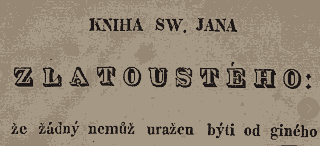
Saint John Chrysostom was quoted by Feldkurat Katz when addressing the persistent money lender: "He who honours the priest, honours Christ. He who persecutes the priest, persecutes Christ the Lord, whose representative happens to be that very priest".
Background
Saint John Chrysostom was a Greek Church Father who was proclaimed a saint with 13 September as his memorial day. He was famous for his rhetorical capabilities. The name of Chrysostom, which is Greek for 'golden mouth', refers to this ability.
Quote(s) from the novel
[I.13] „Vidíte, Švejku, jak to dopadá s takovým člověkem, který nectí kněze,“ usmál se polní kurát. „sv. Jan Zlatoústý řekl: ,Kdo ctí kněze, ctí Krista, kdo příkoří činí knězi, činí příkoří Kristu pánu, jehož zástupcem právě kněz jest.’
Also written:Sv. Jan Zlatoústýcz
|
| Boušek | | ||||
| ||||||
,1896
Boušek was a man from Libeň who was impossible to get rid of at U Exnerů. In one of his aptly chosen analogies Švejk compared him to the ever persisting money lender who pestered Feldkurat Katz.
Background
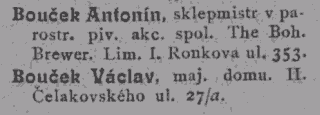
There is no person carrying this name in the address book of Libeň from 1896, but on the other hand a couple of Bouček are listed. Nor in the police registers is there any trace of Boušek.
Quote(s) from the novel
[I.13] „Poslušně hlásím, pane feldkurát,“ poznamenal Švejk, „že je to hotovej nezmar, jako nějakej Boušek z Libně. Vosumnáctkrát za večer ho vyhodili od ,Exnerů’, a vždycky se jim tam vrátil, že tam zapomněl fajfku.
|
| Oberleutnant Janata | | ||||
| ||||||
,23.12.1914
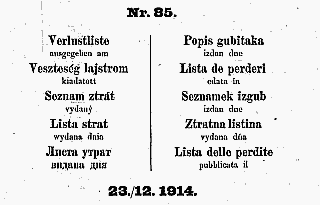
Janata was a senior lieutenant who fell by the Drina without having paid the 700 crowns he owed the moneylender who pestered Feldkurat Katz.
Background
The name Janata appears several times in the list of casualties throughout the war. The database of fallen soldiers from the current Czech and Slovak republic contains 21 names[a], but none of them appear to have died by the Drina or even had the rank of senior lieutenant. Schematismus reveals only one Janata and he served in the navy[b]. Otherwise this surname is quite common in Czechia with almost 1000 bearing the name[c].
Quote(s) from the novel
[I.13] Vytáhl zápisník z kapsy a pokračoval: „Mám to všechno zapsáno. Nadporučík Janata dluhoval mně 700 korun a odvážil se padnout na Drině.
Literature
- Databáze padlých v 1. sv. válce, [a]
- Schematismus für das kaiserliche und königliche Heer ..., ,1914 [b]
- Příjmení: 'Janata', počet výskytů v celé ČR, ,2017 [c]
- Verlustliste ausgegeben am ...,
| a | Databáze padlých v 1. sv. válce | ||
| b | Schematismus für das kaiserliche und königliche Heer ... | 1914 | |
| c | Příjmení: 'Janata', počet výskytů v celé ČR | 2017 |
|
| Leutnant Prášek | | ||||
| ||||||
Prášek was a lieutenant who was captured by the Russian without having paid his debts to the money lender.
Background
Many soldiers named Prášek were taken prisoner at the Russian front and some of them eventually joined the Legions. Still, there is not indication that any of them held the rank of lieutenant when they were captured[a]. This is no surprise as in the entire k.u.k. Heer served only one Prášek in 1914 and he was a Fähnrich in Bosnisch-hercegovinisches Infanterieregiment Nr. 3[b]. That Hašek knew this person is almost ruled out and the name is probably picked pretty much at random.
Quote(s) from the novel
[I.13] Poručík Prášek upadl na ruské frontě do zajetí, a je mně dlužen na 2000 korun.
Literature
- Příjmení: 'Prášek', počet výskytů v celé ČR, ,2017
- Verlustliste ausgegeben am ...,
- Schematismus für das kaiserliche und königliche Heer ..., ,1914 [b]
- Databáze legionářů, [a]
| a | Databáze legionářů | ||
| b | Schematismus für das kaiserliche und königliche Heer ... | 1914 |
|
| Hauptmann Wichterle | | ||||
| ||||||
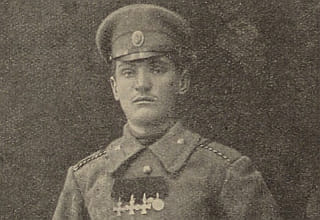
Josef Wuchterle: did Hašek borrow the name of the Czechoslovak national hero?
,1927
Wichterle was a captain who let himself get killed by his own soldiers at Rawa Ruska without having settled his debts to the money-lender who pestered Feldkurat Katz.
Background
No Wichterle is listed in the database of fallen from World War I (soldiers from the current Czech and Slovak republics). Nor is the name found in Verlustliste or in Schematismus from 1914. The only item that appears on searches for Wichterle at the time is a tools manufacturer in Prostějov. In Czechia live only 30 persons with this surname[a]. Even rarer is the similar Wuchterle.
Wuchterle
There lived a person of this name whom Hašek definitely had heard of and probably also knew in person. He was Josef Boris Wuchterle (1891-1923), a high ranking officer in the Legions and a national hero in Czechoslovakia. He was one of the very first who joined the Česká Družina in 1914. He commanded one of the companies of the 1st rifle regiment (where Hašek also served) and was severely wounded during the battle of Zborów in 1917. After the battale he was promoted to captain[b]. The small difference between Wichterle and Wuchterle is well within the margin of errors in The Good Soldier Švejk and it could even be that Hašek deliberately changed the letter to avoid controversies.
Quote(s) from the novel
[I.13] Hejtman Wichterle, dluhující mně stejný obnos, dal se zabít pod Ruskou Ravou vlastními vojáky.
Literature
- Příjmení: 'Wichterle', počet výskytů v celé ČR, ,2017 [a]
- Příjmení: 'Wuchterle', počet výskytů v celé ČR, ,2017
- Verlustliste ausgegeben am ...,
- Schematismus für das kaiserliche und königliche Heer ..., ,1914
- Databáze padlých v 1. sv. válce,
- Wuchterle Josef Boris, Alexej Petrašovský [b]
- Cestami odboje, ,1927
| a | Příjmení: 'Wichterle', počet výskytů v celé ČR | 2017 | |
| b | Wuchterle Josef Boris | Alexej Petrašovský |
|
| Oberleutnant Machek | | ||||
| ||||||
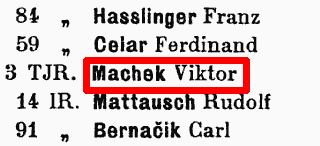
,1914
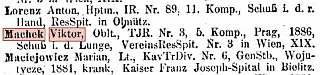
Nachrichten über Verwundete und Verletzte, 21.1.1915
,21.1.1915
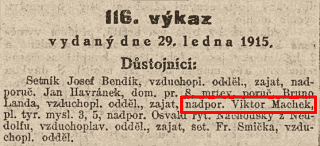
,10.2.1915
Machek was a senior lieutenant who was a prisoner of war in Serbia despite his unpaid debts of 1500 crowns.
Background
In Schematismus from 1914 one Oberleutnant Viktor Machek is actually listed. That year he served at 3. Tyroler Kaiserjägerregiment. On 1 July 1915 he was promoted to captain and was still enlisted with the same regiment.
From the list of wounded 21 January 1915 it is evident that Machek was hospitalised in Vienna after having been shot in the lungs. It is also mentioned that he was born in Prague in 1886. In Verlustliste Nr. 116 from 29 January he is correspondingly listed as "Verwundet". The Czech version is however confusing. In Čech and Národní listy it may be interpreted as if he was captured. Národní politika however makes it clear that when nothing else is noted, the soldier mentioned in the list is wounded.
The rank fits, Machek was born in Prague and from Czech newspapers it's not entirely clear whether he was wounded or captured. Moreover his family lived in Vinohrady, a place Jaroslav Hašek knew very well. This indicates that the author may perhaps have linked his literary figure with the real Viktor Machek.
Quote(s) from the novel
[I.13] Nadporučík Machek zajat v Srbsku, dluhuje mně 1500 korun. Je zde víc takových lidí.
Literature
|
| Feldkurat Matyáš | | ||||
| ||||||
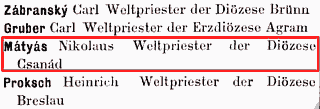
Schematismus für das kaiserliche und königliche Heer..., 1914
Matyáš was a field chaplain from Brno who died in isolation hospital, he never got round to paying his debts before he pegged out.
Background
A field chaplain Miklos Mátyás actually served in k.u.k. Heer in 1914 (as a reserve). The field chaplain was Hungarian and Hašek spells the name slightly differently (but phonetically correct). Whether he was from Brno or died there is not known. There is apparently no evidence in military documents about him being killed, captured or injured although several others with this name appear (but none of them were field chaplains).
Quote(s) from the novel
[I.13] Přistrčil polnímu kurátovi svůj zápisník pod nos. „Vidíte: Polní kurát Matyáš v Brně, zemřel v isolační nemocnici před týdnem. Já bych si rval vlasy. Nezaplatil mně 1800 korun, a jde do cholerového baráku zaopatřovat nějakého člověka, po kterém mu nic nebylo.“
Literature
|
| Professor Zenger, Karel Václav Bedřich | | |||
| *17.12.1830 Chomutov - †22.1.1908 Praha | |||||
| |||||

Karel V. Zenger
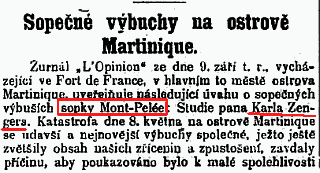
,2.10.1902
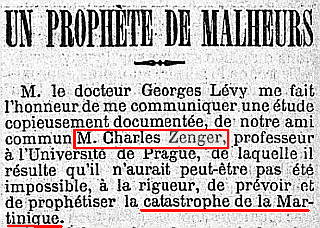
,6.7.1902
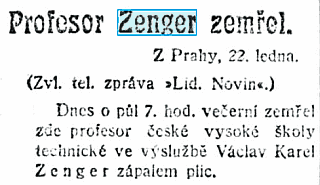
,23.1.1908
Zenger is mentioned indirectly as "one professor" when Švejk reveals his mishaps relating to sunspots. Our good soldier claimed that when "that time the volcano Mount Pelée destroyed the entire island of Martinique a professor had written in Národní politika that he well in advance had warned about a big sunspot".
Background
Zenger is by near certainty the professor that Švejk refers to in the conversation at Vojenská nemocnice na Karlově náměstí. It can however not be verified that Zenger wrote any article similar to the one Švejk mentions, but his studies of the connection between sunspots and seismic activity on earth makes him an obvious inspiration for the professor in the novel.
Zenger was a distinguished physician and meteroroloist and towards the end of his life he was even awarded the title "Hofrat". He published widely; in Czech, German and even French. He was particularly well known in French academic circles, but his name also appears in newspapers like Bergens Tidende (Norway).
He taught at the technical high school Česká technika (now ČVUT) in Prague and Jaroslav Hašek mixed a great deal with it's students and has surely been aware of professor Zenger and his theories.
Zenger observed an approximate ten year cycle on volcanic eruptions, and linked this to a corresponding cycle of high solar activity. The first eruption that was included in the statistics happened in 1732, and with only two exceptions there were repeated eruptions in years that ended in two. The two remaining happened in years that ended in three, amongst these were Krakatoa in 1883.
Národní politika
Some months after the disaster at Martinique an article was printed in the very Národní politika where Zenger's theories were linked to the mentioned eruption. The article quotes the newspaper L'Opinion from Martinique, but also other French newspapers wrote about Zenger and his theories.
Many years earlier Zenger had investigated the connection between solar activity and its effect on the earth. He coined the term "sun climate" and was an international capacity within this research. For instance he provided some statistic that indicate a link between low sun spot activity and seismic events on earth, and it may well be that Švejk had noticed this.
Quote(s) from the novel
[I.13] Když tenkrát ta sopka Mont-Pellé zničila celý ostrov Martinique, jeden profesor psal v ,Národní politice’, že už dávno upozorňoval čtenáře na velkou skvrnu na slunci.
Literature
- Stjerneskud som brandstifter, ,6.3.1888
- Slunce a jeho výkoné dynamické, ,10.10.1890
- Sopečné výbuchy na ostrově Martinique, ,2.10.1902
- Přednáska dvor. rady profesora Zengra, ,4.12.1902
- Český učenec K.V. Zenger, ,23.1.1908
- Zengerova teorie slunce a sopek, ,14.4.1908
- Karel Václav Bedřich Zenger,
|
|
I. In the rear |
| |
13. Švejk goes to provide the last rites | |||
| © 2008 - 2024 Jomar Hønsi | Last updated: 22.10.2024 |