The Who's who page on Jaroslav Hašek profiles people connected, to varying degrees, with The Good Soldier Švejk and its creator.
Several characters in the novel are known to be based on real individuals, mostly officers from Infanterieregiment Nr. 91. Clues
include a shared full name, a thin disguise, or contextual details that point to the model despite different
names.
Some models are easy to recognise, including Rudolf Lukas and Jan Vaněk; others, such as Zdeněk Matěj Kuděj and Emanuél Michálek, are
less obvious. Many characters may combine traits from multiple people, including Švejk.
For many other characters, the proposed identification rests largely on a name shared with the model. This is
clearest for Josef Švejk; Jan Eybl is another example.
Haškologists are also covered. As of 15 February 2026, this group comprises Radko Pytlík and Václav Menger, along with two
important but relatively little-known contributors to our understanding of Hašek and Švejk. Other experts, such
as Zdena Ančík, may be added later.
Jan Morávek
should rightly be considered the first ever "švejkologist" as he was a pioneer in pinpointing the parallels between The Good Soldier Švejk and the author's own experiences in k.u.k. Heer. He published his findings in a sixteen-part series in Večerní České slovo from 1 September to 4 October 1924. The series is based on post-war interviews with Rudolf Lukas and Jan Vaněk and also the latter's diaries. Morávek reveals that a number of Jaroslav Hašek's literary figures were inspired by people whom the author met during his seven months' service in the army[a].
The series appears quite trustworthy although the number of dialogues and leaning towards "beletrie" to a degree diminishes its value as a primary source. However, none of the interviewed parts ever openly contradicted Morávek's version, but at the end the author makes comments that suggest that the veracity of his series had already been questioned.
Ground for scepticism
Večerní České slovo,1.9.1924
His description of the circumstances around Jaroslav Hašek's decoration is particularly dubious. It contains several minor factual errors, but more importantly, it is flatly contradicted by the author's Belohnungsantrag and also that of Jan Vaněk.
These two documents do not mention the "300 Russian prisoners" that Hašek and Vaněk according to Morávek brought into captivity. It is also striking that none of the recently discovered (2014) diaries of Jan Eybl and Jan Vaněk mentions this "deed".
A similar story does however show up in Rudolf Lukas' obituary. Jaroslav Hašek was given the task to lead a group of Russian prisoners to divisional HQ but he let them keep their guns, assuming they were happy to have the war behind them anyway. This understandably caused panic when they arrived at HQ, which again reflected badly on Lukas. This was however NOT the reason why Hašek and Vaněk were decorated.
Another unlikely claim is that Hašek's superiors requested that he be pardoned a three year sentence for desertion because he "led the whole battalion across the river Ikva, having used his knowledge of Russian to ask the locals where the ford was". There is however no trace of any conviction in Jaroslav Hašek's service record from k.u.k. Heer. A three year sentence is no minor matter and would have had to be imposed by a military court. He was allegedly also proposed for promotion in connection with this deed. Jaroslav Kejla, who was present by the Ikva on 18 September 1915 when the river crossing took place, flatly dismisses the story as "pure invention"[b].
The Bad Soldier
From Špatný voják.
In 1930 Morávek published a novel that is based on his time with Infanterieregiment Nr. 91 on the Serbian front in 1914. The title is Špatný voják (The Bad Soldier). The novel is autobiographical although it is impossible to verify to which extent the author keeps to facts. The first part deals with his youth and life before the war, his relation to his family in the countryside, his career as an actor and his relationship with women. It also describes his pre-war three-year military service with IR. 91 in Karlín.
His wartime service started with the mobilisation at the end of July 1914. This part of the novel appears authentic, the geographical names and dates of the campaign in Serbia in 1914 are accurate and verifiable, and align very well with Böhmerwalds Söhne im Felde and Egon Erwin Kisch's diary Schreib das auf Kisch!.
Morávek took part in the catastrophic battle of Cer in August and was wounded, Thus he luckily avoided the calamity at the mouth of the Drina on 8 September 1914 were a huge number of k.u.k. soldiers drowned when retreating in panic after a failed attempt to establish a foothold on the eastern bank. The whole operation is vividly described by Kisch and some others.
On 12 September he became messenger (Ordonnanz) for major Franz Wenzel who had just been appointed commander of the 2nd battalion. Morávek's description of Wenzel is merciless: a megalomaniac, madman and coward who gave the most ridiculous orders. This picture is confirmed by Jaroslav Hašek, Bohumil Vlček and also documents from the war archives.
In October 1914 Morávek suffered another injury and with aid of understanding doctors he was transported behind the front line, then home via Osijek - Budapest - Vienna and finally "super-arbitrated" in Budějovice. He then returns to Prague where the book ends.
Morávek's army file (Hauptgrundbuchblatt) underpins the authenticity of Morávek's account. He did his military service by IR. 91 in Karlín from 1909 to 1912. He was promoted to Korporal during the service and it is revealed that he served in the 7th company (i.e. 2nd battalion). On 28 July 1914 he was called up, and on 1 March 1915, he was super-arbitrated. On 8 May he was called back into service and finally released again on 13 October 1917. The file confirms his pre-war occupation as an editor and actor. Although largely unknown as a writer today, he produced several novels and other prose in the inter-war years and his novel from the Serbian campaign is a vital supplement to other eye-witness accounts from that period.
Břetislav Hůla
was a columnist, translator and communist political activist who rightfully ought to be considered the first ever "scientific" haškologist and švejkologist, and in hindsight he ranks as one of the most important. He was the only post-World War II Hašek-expert who knew the author personally. Important with regard to The Good Soldier Švejk are his explanations to Švejk (vysvětlívky), a 170-page document never published under his name, but printed by Zdena Ančík in a 1953 edition of The Good Soldier Švejk. He didn't have the chance to publish the material himself but his effort in identifying Hašek's innumerable stories across dozens of newspapers and magazines was invaluable.
Hůla has arguably researched more and collected more material on Jaroslav Hašek than anyone apart from Radko Pytlík. He was very knowledgeable on his subject, methodical in his research and also document his findings impeccably. The material that Hůla collected has been drawn upon extensively by biographers. All later haškologists owe Hůla much but hardly any of a them gave him credit for his efforts (and most of them admittedly didn't even know about his contributions).
Early years
Church records on birth and christening, Polička 1894
Břetislav Hůla was born in 1894 in Polička, a small town in Vysočina. His parents were František Hůla, a k.k. Gendarmerie (Austrian state police) officer, his mother Marie Hůlová, born Borešová (from Soběslav). Břetislav was the youngest of four children. In 1896, after his father’s premature death, the widow and the children moved to Vinohrady, then to Prague II. Here they show up in police records in 1896, 1897, 1901 and 1903. Young Břetislav studied at the gymnasium in Žitná ulice, incidentally where Jaroslav Hašek had studied ten years earlier. By 1907 (and still in 1910) his mother seems to have been the proprietor of a Trafika in that very street (568/18), and they lived in Žitná ulice 565/12. On 10 July 1913 Hůla graduated from the gymnasium and embarked on law studies at Univerzita Karlova (Charles University) that same autumn. He had completed two terms by the outbreak of war, aided by a Franz-Joseph Stipendium worth 240 Crowns!
In the Austro-Hungarian army
Soldiers in IR28, Hůla's regiment
Soon he was off to fight for his emperor. Called up to serve with the Prague's own Infanterieregiment Nr. 28, he was sent first to the Serbian with the 2nd battalion. At some stage he was injured; he appears in Verlustliste Nr. 140 on 12 March 1915 as Verwundet, belonging to the 7th company. Here his rank is listed as one-year volunteer. On 3 April 1915 he was captured by Dukla, now with the 10th company (i.e. 3rd battalion). Subsequently interned in camps in Ardatov and Simbirsk, and in total he spent 17 months in Russian captivity.
Czech volunteer
On 3 August 1916 he joined the Czech anti-Austrian volunteers in Russia (Českoslovenká Střelecká Brigada, later known as the Legions. He was assigned to the same unit as Jaroslav Hašek; the 1st Czechoslovak Rifle Regiment. Like Hašek he worked for the Union of Czechoslovak Associations in Russia, and both became contributors to Čechoslovan. It is possible that the two met already in the autumn of 1916, but we don’t know exactly when Hůla started to write for the paper (Hašek had his first contribution published in July).
Revoluce,15.6.1916
In June 1917 Hůla wrote an article in Revoluce, a Czech weekly in Kiev who were centred around the ultra-nationalist group Černá Ruka (Black Hand). It was in this paper that Jaroslav Hašek on 23 April 1917 published his infamous The Czech Pickwick Club, a stinging story that pilloried virtually the whole leadership of the Czech organisations in Russia. The loud-thinking writer and satirist was "exiled" to the front already on 3 May, but from 15 November 1917 he was back in the offices of Čechoslovan. If he hadn't met Hůla previously he would surely have done so now (or very soon after).
From January 1918 Hašek and Hůla are both are listed as editors of Čechoslovan. Rhey celebrated New Year 1917/18 together in the editorial offices, and Jaroslav Hašek was reportedly in a very sentimental mood (Radko Pytlík). Around this time the two belonged to a group of radicals who toyed with idea of organising terrorist groups to operate in Austria-Hungary, an idea firmly rejected by Professor Masaryk (who was in Kiev at the time).
Bolshevik
Hůla and Hašek as editors of Čechoslovan. This is the weekly's final issue before Kiev was occupied by German troops in 1918 and both left for Moscow.
Čechoslovan,24.2.1918
Hašek-expert Cecil Parrott even notes that "the Communist Hůla” was instrumental in Hašek's shift towards the extreme left in early 1918. This view is shared by Radko Pytlík in his latest book (2013). It is however not clear when Hůla started to sympathise with the Bolsheviks. Biography of the Comintern claims “after the October Revolution” whereas Encyclopedia of Czech Literature states that “early in 1918 he joined the Czech communists in Kiev, organised around the weekly Svoboda”. In either case Parrott and Pytlík may have a good point.
In the meantime the Red Guards had occupied Kiev on 8 February 1918. This event made an impression on the two journalists who for the first time came in contact with representatives of the new regime. This is very clear in the two issues of Čechoslovan that were published during the Bolshevik occupation. Although HasJ’s writing had started to drift towards the left already in January, the shift was now dramatic. The paper as a whole more or less espoused Bolshevik ideas, and according to historian Jaroslav Křižek, Hůla played a prominent role in this break with the past. Amongst the Bolshevik occupiers of Kiev were also a few hundred Czechs, amongst them Václav Fridrich, who was head of the Red Guards in Kiev, appointed by commander Mikhail Muravyov.
Rudolf Medek lashing out at Hašek and Hůla.
Československý deník,6.4.1918
The Bolshevik occupation of Kiev was brief. Soon peace negotiations between Germany and Russia broke down, and on 18 February the German army attacked. Retreating from the invaders (they reached Kiev on 1 March 1918), Bolshevik and Czechoslovak troops were forced east, fighting a rearguard battle as de-facto allies. Which unit Hůla and Hašek were part of during the withdrawal is unclear, but it was very likely Fridrich’s Red Guards (Muravyov had by then been appointed commander of the Red Guards in Moldova, and later in Odessa).
Československý deník,8.4.1918
At some stage during this retreat Hašek and Hůla left the army and travelled together to Moscow (via Kharkov) where they joined the Petrograd section of the left wing of the Czech Social Democrats. In Moscow they contributed to the paper Průkopník where Hašek in a front page article on 27 March made his opposition to the transfer of the legions to France clear, and also rued the Czech Army's reluctance to fight the Germans during the invasion of Ukraine. Hůla published articles in the same newspaper. Václav Menger remembers meeting both in Moscow at this time and writes that Jaroslav Hašek and Hůla were inseparable, but were also on friendly terms with their former comrades from the Legions, and even went drinking with them. Amongst those "enemies" were the sculptor Vlasta Amort and the future Czechoslovak general Jan Šípek.
At the beginning of April Hašek was sent to Samara as an agitator/recruiter, and their paths split. In May 1918 Hůla was instrumental in organising the Czech section of the Bolshevik Party. Rudolf Medek also mentions him in a scathing attack on the left-wing social democrats. The article Průkopníci was published in Československý deník (6 April 1918). In his book Pout’ do Československa he tells how Jaroslav Hašek and Hůla in Restaurant Praha in Moscow tried to convince Ladislav Tuček to join the Bolsheviks. This allegedly happened after the battle of Bachmach (ended 13 March).
Back home
In November 1918 Hůla returned to Prague and took up his abandoned law studies, where he completed another two terms. There is however no evidence of him having graduated in the summer of 1919. He lived at two different addresses: Všehrdova ulice 17 (Malá Strana) and Ruská ulice 26 (Vršovice). He also edited the papers Naš venkov and Svoboda, and translated Russian Communist literature.
Czechs and Slovaks at the 2nd Comintern congress in Moscow in July/August 1920. Hůla was one of the delegates and is almost certainly present on this picture. At the front in the middle is Antonín Zápotocký. The other Czech delegates with voting rights were Miloš Vaněk and Ivan Olbracht (from Jaroslav Křížek - Jaroslav Hašek v revolučním Rusko).
In 1920 he was one of four Czech delegates at the 2nd congress of Comintern in Petrograd and Moscow (July and August), and even became a member of the Comintern executive committee (EKKI). He stayed in Moscow at least until 17 September 1920, a day he wrote an article about Soviet art[a]. It was at the request of Hůla that Jaroslav Hašek in October 1920 was asked to return to Czechoslovakia to aid the revolutionary movement in his homeland.
There is no evidence that the two met after Hašek's return although there is a period of 11 days where it hypothetically could have happened. The author/activist appeared in Prague on 19 December 1920, and Hůla was arrested in his flat in Dejvice on New Year's Eve.
Arrested
Hůla was at this stage editor of the weekly Svoboda in Kladno, together with later Czechoslovak president and hard-line Stalinist Antonín Zápotocký. During the previous week they were amongst the organisers of a general strike and attempted revolution that the left wing of the Czech Social Democrats (communists) instigated. After the failed coup the leaders were put on trial, incidentally at c.k. zemský co trestní soud, an institution well known to Švejk!. Hůla was sentenced to 13 months in prison. In press reports from the court proceedings in April 1921 he is listed as “editor from Dejvice”.
Interwar years
Hůla sentenced
Lidové noviny,13.4.1921
After his release on 3 January 1922 and until 1926 Hůla worked for several Communist newspapers, amongst them Rudé Právo. He was active in the Communist party organisation until 1926 when he left, accused of "rightism" and "opportunism". In 1927 he signed a petition against the treatment of Trotsky, printed in Rudé Právo. He seems never to have returned to active politics, instead making a living as a translator from Russian and German (he translated Lenin, Dostoevsky, Turgenev etc.) using pseudonyms. He also attended classes in philosophy at Charles University. From 1928 he was active in UměleckáBeseda (Artists Union) and after World War II briefly in the Czechoslovak Red Cross.
Nazi occupation
Little is known about his activities during the Nazi occupation, but in 1942 he appears to have been writing for a periodical named Přitomnost. Lidové Noviny reproduced one of his articles and it shows a pro-German tendency. During the protectorate he continued his work as a translator, working on Dostojevsky and Mikhail Sholokhov (And Quiet Flows the Don). He also translated a book by German art historian Wilhelm Waetzoldt. The book titled Nebojte se umění (Have no fear of the arts) was published in 1942. The original text was presumably Du und die Kunst (1938).
Professional haškologist for Synek
Václav Kaplický about Hůla's work an a new Hašek compilation.
Práce,13.3.1947
From 1 February 1947 he was commissioned by the publishers of The Good Soldier Švejk, Nakladatelství Karel Synek, to edit and publish a new version of Sebrané spisy (Collected works), to be issued in 12 or 13 volumes. An early version had been published by Synek from 1925 to 1929, edited by Dolenský, but was deemed incomplete. It contained 419 stories, was issued in 16 soft back instalments and was illustrated by Josef Lada. Hůla went about assembling and identifying new material very methodically; browsing newspapers and magazines and reporting on the progress once a month. The result was an impressive collection: he found 303 previously unknown stories. In addition Hůla identified many of the pseudonyms the author had used, more than 100 in total, paving the way for further discoveries. In a letter to Synek dated 27 December 1948 he summarises his work, and also estimates that a further 500 stories could exists. He also thanks Synek for honouring their contract. In 1947 he also met actor Václav Menger, another friend of Hašek’s who in the thirties had written two semi-factual biographies about the author. Menger handed over all the material he had collected and was very pleased that Synek and Hůla had taken on the task to publish an updated Sebrané Spisy (Collected works). The contract with Synek covered two entire years; 1947 and 1948.
Working for the Ministry of Information
From fond Břetislav Hůla, LA PNP
By early 1948 he had also started to collaborate with Zdena Ančík, a Communist journalist and columnist who at the time was secretary for minister of information, Václav Kopecký. Ančík later achieved recognition as a pioneer haškologist. He had been active in the Czech resistance during the war, and managed to escape to England. He was an admirer of Jaroslav Hašek, and in 1953 he published the first post-war biography on the famous father of The Good Soldier Švejk. The book O životě Jaroslava Haška contained a lot of new material, no doubt (in part) thanks to Hůla.
Correspondence dated 15 January 1948 reveals that Hůla was assisting the ministry of information in collecting material for an exhibition on Jaroslav Hašek (it eventually opened on 19 May 1953). In a letter to Ančík he reveals how a photo from 1917 that shows Jaroslav Hašek together with Václav Menger and Jan Šípek was to be modified for the upcoming exhibition, retaining Hašek alone. From October he started to report and hand over material at regular intervals. This included not only stories by Hašek that he was discovering but also material from archives, most importantly from the Ministry of Interior who had kept records on the author's encounters with the police. These have been drawn upon extensively by biographers like Radko Pytlík. He was also in close contact with former friends and colleagues of the author: Josef Lada, Alois Hatina, Ladislav Grund, Zdeněk Matěj Kuděj, Gustav Roger Opočenský and others. He also collected extensive material from other archives and sources, including newspapers and magazines.
In the autumn of 1948 Hůla landed in trouble as he was being investigated for his conduct during the Nazi occupation. Ančík informed him on the proceedings, that he had been given a one-year sentence, but was offered an amnesty. It is obvious that Hůla had become very dependent on Ančík who was well connected in the party hierarchy.
According to the official Slovník české literatury Hůla retired due to ill health in 1948 but his letters to Ančík reveal continued and impressive research until September 1951 when he in a desperate tone pleads to Ančík for protection against confiscation of his property. From now the correspondence seems to have ceased. By early April 1950 he had moved to Dobřichovice where he lived in house number 129. Otherwise his names appears in several StB documents dated from 1953 to 1958, some of them indicating that he may have been an informer (unconfirmed). He lived in Dobřichovice until his death in 1964.
Legacy
From Hůla's vysvětlívky, a few of them rather obvious
Hůla’s collection of is still available at LA PNP at Strahov. It contains seven cartons of documents, the bulk of it directly related to Jaroslav Hašek. Yet more is stored in the files of Zdena Ančík to whom he had passed on virtually all the results of his research. Hůla also edited a selection of stories by Hašek: Škola humoru (1949). Hůla's research was extensively used by Ančík and František Daneš when they finally set about publishing Spisy Jaroslav Haška (later Milan Jankovič and Radko Pytlík joined the editorial board).
Ančík in particular owes much of his reputation as a Hašek-expert to the endeavours of Hůla. In some editions of the novel that appeared in the 1950's he printed (with minor modifications) Hůla's extensive "vysvětlívky" (explanations) without saying a word about their origin (his only contribution to them was proof-reading). When Ančík and Daneš in 1955 published the first volume of the 16-part “Writings of Jaroslav Hašek”, Hůla is not mentioned although the series mainly consisted of stories that he had identified as written by Jaroslav Hašek. In 1960, In Bibliografie Jaroslava Haška Hůla's name finally appears, albeit as a minor note. Radko Pytlík reveals that Hůla's collection had been deposited at PNP by 1955, the year Pytlík became aware of it. How the material ended there 10 years before the owners death is not known.
Hůla's explanations to The Good Soldier Švejk is a 170-page type-written document, still in the custody of PNP. He seems to have been commissioned by Ančík to collect the explanations, and the latter also did some proof-reading. The work started on 25 May 1951 and was to be completed by 1 October. The explanations shows evidence of a very knowledgeable person, and the sheer extent of the information is impressive. Errors of course exist, but those are remarkably few and Hůla had not even finished the document when he seems to have abandoned work on it. His political views shine through, some of the entries are quite amusing in retrospect. U Fleků is described as a place where “the petite bourgeoisie get radicalised after a few beers”. All of this, including Hůla’s blunders, is faithfully reproduced by Ančík who only corrected some minor errors in the original manuscript. The odd explanation has also found the way into English translations of The Good Soldier Švejk (e.g Rava Ruska). If anything could be criticised it would be a Oberst Kraus like tendency to explain even the most obvious of terms.
The extent of Hůla's research has largely remained unknown. There was not a single word said about him at the conference in Bamberg in 1983, and of course not at the rival conference in Dobříš that same year. Nor has he (to my knowledge) been mentioned at subsequent Hašek-conferences at Lipnice in 2003, 2008, 2013 and 2018. The side-lining of Hůla has been so effective that even Hašek-experts with an explicit anti-communist agenda (e.g. Pavel Gan and Jan Berwid-Buquoy ) have overlooked him completely. So did Hašek's only other foreign-language biographers: Gustav Janouch and Cecil Parrott.
About Hůla in Sergey Soloukh's book
Only the recent research of Petr Kovařík has shed proper light on the importance of Hůla and his contribution to our knowledge on Jaroslav Hašek. It was published as an epilogue to his book Když bolševici zrušili Vánoce (2005). In Radko Pytklík’s latest collection of Hašek’s short stories, Turista Arataš a jiné humoresky (2012) Hůla’s role in collecting stories by Hašek is briefly mentioned. Recently, in an extensive fact file on "Švejk": Jaroslav Hašek’s Good Soldier Švejk, Notes on the Russian Translation (Sergey Soloukh, 2013), Hůla’s contribution is given due recognition.
Credit: SOA Zámrsk, NAČR, VÚA, LA-PNP, Radko Pytlík, Petr Kovařík, Archiv UK (Petr Šmíd)
Radko Pytlík
- „Velký člověk, nobles, hudebník. Napsal čtyři desítky knih. Zkrátka úžasné věci. To je náš guru. Guru haškologie, guru hrabalogie, člověk, který rozuměl světu a uměl ho i popsat.“
Richard Hašek to Radiožurnál, 1 February 2022.
Radko Pytlík was a prominent literary scholar and writer who is best known as a specialist in the writings and life of Jaroslav Hašek. He is widely regarded as the leading authority on the creator of The Good Soldier Švejk and on the novel itself.
Over the course of almost 70 years he conducted extensive literary and historical research and was also very productive as a writer. Apart from his works on Hašek, he wrote books about Bohumil Hrabal, Fyodor Dostoyevsky, Franz Kafka, Egon Erwin Kisch and others. Some of his books touched on humour in general and also the local history of Prague VII, his home district in the Czech capital.
All in all he published around 40 books and also contributed to a number of newspapers and magazines. Pytlík was married twice and had a daughter and a son. His son is the well-known actor and singer Vojtěch Dyk.
Pytlík graduated from Karlova Univerzita in Prague where he studied Czech language, philosophy and literature. His dissertation was on the early writing of Jaroslav Hašek (1952). After finishing his studies and completing his military service, he was employed from 1955 onwards by Ústav pro Československou literaturu (The Institute of Czechoslovak Literature), where he worked until he retired in 1991.
Toulavé house (1971), Dr. Pytlík's finest work.
He began publishing in 1951, and in 1960 he and Miroslav Laiske published the book Bibliografie Jaroslava Haška, which catalogued all of Jaroslav Hašek's known writings at the time. In 1961 he published his first book on, simply called Jaroslav Hašek. In 1971 the book that is arguably his finest work appeared, a full biography of Jaroslav Hašek titled Toulavé house (The Wandering Gosling). It has been translated into several languages, and parts of it were even reproduced in Cecil Parrott's The Bad Bohemian (1978), so far the only English-language biography of Hašek to exist.
In the early eighties Pytlík was particularly productive, mainly around the 100th anniversary of Hašek's death in 1983, a time when Czechoslovakia was flooded with material about Jaroslav Hašek. During this period his first work of "pure švejkology" appeared, called Kniha o Švejkovi (The book about Švejk) (1982). This was probably the first meta-text about The Good Soldier Švejk ever published in book form.
After his retirement Pytlík continued to write and research, but less actively and without the support of the authorities (the Communist regime "canonised" Hašek, so ample funds were made available for research). Revised versions of Toulavé house appeared in 1998 and 2012. Books about The Good Soldier Švejk were published in 2002 and as late as 2019.
His most important contribution to scholarship on Hašek since 1990 is by far Data, fakty, dokumenty (2013), a reflection of Pytlik's immense knowledge of his favourite subject. The book could have benefited from more thorough editing and a clean-up, but it still remains the most complete collection of information about Jaroslav Hašek available and is a good starting point for further research.
Pytlík was, apart from being an outstanding literary scholar, a man of multiple talents. He was an accomplished musician and singer, and spoke German and Russian fluently. He was witty and charming, had an appealing low-key sense of humour, and expressed his knowledge and views eloquently. Moreover, he was capable of captivating and entertaining his audience. It was always a pleasure to listen to him talk about his favourite subject, Jaroslav Hašek, over a beer or two in one of his favourite hospody in Holešovice.
Václav Menger
was an actor and writer who is arguably best known for his books about Jaroslav Hašek. He could also be considered the first serious "haškolog", because his books about Hašek differed from earlier memoir literature in that they also contained results from his archival research. He was one of the few researchers who knew Hašek personally (the others were Břetislav Hůla and, to some extent, Jan Morávek). His efforts resulted in an extensive 25-part series published in Lidové noviny in 1933–34, soon followed by a two-volume biography.
Early years
Menger was born in 1888 in Prague II, the second youngest of nine siblings, the son of Jan and Josefa, née Heřmannová[e]. During his childhood and youth, the family lived in Lipová ulice; in effect, he grew up in the same neighbourhood as Jaroslav Hašek. The two knew each other from childhood, so Menger is by far the best source that exists for information about Hašek's younger years. Menger noted that his parents lived in the same house as Jaroslav, and that he took part in some of the mischief that young Jaroslav got up to (Lidové noviny, 23 April 1933). After Hašek was expelled from the Gymnasium in Žitná ulice (1897), the two lost touch for many years. The only other pre-war meetings that Menger recorded happened at Montmartre in 1913.
Little is known about Menger's childhood and younger years, apart from the fact that he became an actor, performed at Adria on Václavské náměstí, and when this theatre went bankrupt, he toured the provinces with various theatre groups (Lidové noviny, 27 April 1933).
The First World War
Jan Šípek, Jaroslav Hašek, Václav Menger. Berezne, Ukraine, 29 September 1917 (12 October).
In 1909, Menger would have entered military service according to his age group, but the details are not known, nor has his pre-war service record been studied. After the outbreak of war, he served with k.k. Landwehrinfanterieregiment Nr. 28 as a Gefreiter, was taken prisoner on 7 August 1915 in Lubartów by Lublin (Russian Poland), and joined Československá brigáda on 15 August 1916, thus six weeks later than Hašek[f].
Here he soon became involved in the cultural activities of the Czech volunteers (later known as Legions), organising theatre groups, etc. Menger met Hašek again at Kiev University (the seat of the Czech replacement battalion) in 1916 and, over the next two years, the two were at times in touch. One piece of visual evidence is a photo from 29 September 1917 in which both appear alongside Jan Šípek (1886-1953), a future Czechoslovak general and associate of Prseident Masaryk.
Unlike Hašek, Menger continued to serve in the Legions until he was demobilised in 1920.
Actor, translator and writer
From The Legionnaire's Songbook.
Václav Menger,1929
In the inter-war years, Menger made a living from acting, for instance at Revoluční scéna, the theatre at Václavské náměstí where The Good Soldier Švejk was first performed on 1 November 1921. In addition, he played minor roles in films, was himself a film and stage director, and also a translator of Russian and German literature. Occasionally, he wrote articles for Lidové noviny, Národní osvobození and others. In 1929 he published the The Legionnaire's Songbook[l], a collection of songs and hymns, not always connected to the Legions.
Menger is, however, best known as the author of two books about Hašek, published in 1934 and 1935 (more on that later).
Later years
Menger's funeral
Národní osvobození,23.2.1947
After the Second World War he published revised editions of his two inter-war books about Jaroslav Hašek[c][d]. Before he died, he handed over his material to Břetislav Hůla, who in a sense carried on Menger's research but in a much more methodical manner.
Following Menger's death on 16 February 1947, several newspapers printed reports of his death. In one of the obituaries, it is even revealed that he was a Communist Party member. Menger's body was cremated at Strašnice cemetery on 23 February and one of the people who spoke at the ceremony was his good friend Egon Erwin Kisch, the famous "raging reporter". Former members of the Legions also gave speeches, as did local representatives of the Communist Party[k].
Writing about Hašek
Václav Menger,1934
Although Zdeněk Matěj Kuděj, Franta Sauer, Emil Artur Longen and Ladislav Hájek's memoirs about Hašek pre-dated Menger's, his was the first to cover the entire lifespan of the author of The Good Soldier Švejk, and Menger could thus be classed as his first proper biographer. Menger's books were based on the aforementioned series in Lidové noviny but were "embellished" with additional dialogues, lending them the air of fiction. Indeed, the first volume is explicitly labelled as a novel.
The books were titled Jaroslav Hašek, Prisoner Number 294217[a] (1934) and Jaroslav Hašek at Home[b] (1935). In 1946, the latter was republished as A Human Profile of Jaroslav Hašek[c], now in a somewhat abridged version. In 1948, the first book was also republished, titled Jaroslav Hašek in Captivity[d].
Menger put great effort into collecting information about Hašek, something that his extensive file at LA-PNP bears witness to. This, together with the fact that he knew Hašek personally, makes him stand out in the sense that he combined personal knowledge of Hašek with research. His books were even published as a series in a Chicago newspaper in 1936[h].
Menger also contributed to raising awareness of Strana mírného pokroku v mezích zákona. From Alois Hatina he borrowed Hašek's manuscript and allowed parts of it to be published in Rudé právo, but without Hatina's permission[g]. He used the manuscript extensively when writing his books, particularly with regards to Hašek's "apostolical journey" in 1905 to Moravia, Austria, western Hungary and Styria.
Research
From Menger's file at the Museum of Czech Literature. Grete Reiner asking for permission to translate Menger's article series from Lidové noviny about Hašek.
Menger collected a large amount of material about Hašek, and 5 cartons with his material are in the custody of LA-PNP. It contains letters, photos, notes, clippings, etc. The material includes correspondence with Egon Erwin Kisch, Grete Reiner, Franta Sauer, Jiří Červený, Michal Kacha, Václav Kapický, František Wildmann, Emil Špatný, Jarmila Hašková (Hašek's wife), and also the young Richard Hašek (Hašek's son).
A large part of the collection is made up of newspaper clips and also material about Strana mírného pokroku v mezích zákona. However, it seems that little of the material that Menger collected found its way into his books.
Scepticism
Although the two books about Hašek were well received at the time, scholars have later pointed out serious flaws in Menger's narrative. Cecil Parrott noted in his biography of Hašek that Menger was a valuable but unreliable source[g]. While Menger's Jaroslav Hašek at Home[b] includes unique information about Hašek's childhood and youth, it is vague regarding chronology and contains several errors. Jaroslav Hašek, Prisoner Number 294217[a] is even less trustworthy. Written as a novel, it should indeed be treated as such. A much better source for information is the series in Lidové noviny. It contained fewer dialogues and some of the wildest stories were left out, such as a supposed meeting with Mussolini (see paragraph below).
The following paragraphs discuss two of Menger's most propagated claims, "facts" that linger in the public consciousness even into the twenty-first century.
Animals
Muskrats in the Vltava. This April Fool's story appeared in at least two biographies of Hašek (Menger, Parrott), though in a slightly altered form. It was published in Svět zvířat on 1 April 1914 and is therefore unlikely to be the work of Hašek.
Some of the most widespread of Menger's claims concern Hašek's time as editor of Svět zvířat. Hašek allegedly published an article called Rational Breeding of Werewolves and offered his creations for sale. Menger also stated that Hašek had published an April Fools' joke with a photomontage showing the Vltava below Vyšehrad flooded with muskrats (ondatra) and that people had flocked to the river to watch the exotic animals. In addition, Hašek allegedly transformed the serious magazine Svět zvířat into an entertainment periodical, and that this happened within a few issues[b].
None of these claims stand up to further scrutiny. Still, some of them found their way into biographies about Hašek, for instance by Cecil Parrott and Jan Berwid-Buquoy .
The April Fool's joke is, however, not pulled from thin air. On 1 April 1914, Svět zvířat indeed printed a picture of the Vltava flooded with muskrats, but at the time Hašek did not contribute to the magazine. Nor is it likely that many flocked to the river to watch the animals!
Otherwise, such manipulated photos were quite common as jokes, irrespective of who edited a magazine[j].
For the record, the photomontage shows the muskrats by Národní divadlo, not by Vyšehrad as Menger claimed.
Mussolini
Menger suggests that this book, published in 1913, was inspired by Hašek. Allegedly they met in Trento in 1906. The source of this claim is Hašek himself.
Another myth that Menger propagated was a story about Mussolini and Hašek meeting in Trento in 1906 when Hašek allegedly did his military service there[b]. It is, however, notable that Menger removed this passage when the original book from 1935 was republished after World War II[c]. Whether this removal was because Menger did not want to soil Hašek's name with the by now untouchable dictator, or that he had discovered there was no substance to the story, remains unknown.
Hašek did not do any military service until 1915 and, in any case, Mussolini did not visit Trento in 1906. Significantly, Menger adds that this was a story that Hašek set in motion himself! Still, this has not stopped the "Mussolini legend" from resurfacing, for example in the film Toulavé house (Vít Olmer, 2013).
Jaroslav Hašek, ač již v obou předcházejících letech unikl onomu osudnému slovu "tauglich", při posledním odvodu v roce 1906 mu neunikl. Byl odveden a přidělen do důstojnické školy 28. pěšího pluku "Pražských dětí", který tou dobou byl rozložen v Tyrolích, v Tridentu a Levicu. Nezůstal tam však dlouho. Zde vlastně sebral své první zkušenosti pro "Dobrého vojáka Švejka před válkou", kterého však začal psát až v roce 1910. Když se vrátil z tohoto svého prvního vojenského tažení, vyprávěl - tak jako všichni ti, kteří na vojně strávili třeba jen jediný den - obsáhlé legendy. A ještě dlouhá léta dovedl vyprávěti o těch několika nedělích, které strávil v Tridentu, kdy byl po svém příchodu k pluku při dodatečné prohlídce uznán neschopným a jako takový poslán k superarbitrační komisi. Ta tento nález potvrdila a Hašek měl po své vojenské slávě.
V té době byl v Tridentu dávný přítel Haškův, básník Mach a současně s ním byli v Tridentu narukovaní syn Aloise Jiráska a nynější poslanec Hatina. Než byly vyřízeny obvyklé formality a než prošlo plukovním rozkazem Haškovo propuštění, uplynulo několik neděl, které trávil s jmenovanými druhy. Scházeli se, jak sám vypravoval, v jakési vinárně, kde je Mach seznámil s bývalým poslancem na říšském sněmu Caesarem Batisti, jenž byl za světové války rakouskou vládou odsouzen к smrti a popraven. Kolem Batistiho shromažďovala se také společnost italských emigrantů, z nichž jeden, jakýsi redaktor sociálně demokratických listů, se brzy spřátelil s Jaroslavem. Velmi ho zajímaly české dějiny a zejména doba husitská. Dokonce se odhodlal napsat o tom knížku a Hašek mu ochotně poskytl prameny i materiál. Zejména jej upozornil na knihu Friedricha von Bezolda: „Das Hussitentum”, která vyšla v Mnichově. Tato italsky psaná kniha o husitismu, inspirovaná Haškem, skutečně vyšla a jejím autorem není nikdo jiný než dnes „velký duce” — Mussolini, kterému se ovšem tenkráte, tak jako Haškovi, ještě ani nesnilo o velké slávě, neboť byl pouhým štvaným emigrantem.
Václav Menger, 1935. “Jaroslav Hašek doma” S: 133
Accumulating legends
Česká literatura,1.1958
In 1958, the literary historian Miloslav Nosek (1925-1962) remarked that Menger in his biographies put on paper whatever he had heard about Hašek and even guessed when he lacked information[m]. Detracting even more from Menger's trustworthiness is the suspicion that the notorious hoaxer Hašek himself was the originator of many of these stories. Here the Mussolini story is a good example, but in this case Menger at least informs readers about the provenance of the myth!
Menger's two books about Hašek are valuable sources of information, but they should be treated with caution. To conclude, Cecil Parrott summarises Menger's contribution to haškology adequately:
A valuable, if often unreliable, source is the actor and author Václav Menger, who claimed to have known Hašek from his childhood and was later with him in the Czech Legion. He was for a time the custodian of most of Hašek's and Jarmila's papers and published two biographical books about him, Jaroslav Hašek, Prisoner No. 294217[a] (1934) and Jaroslav Hašek at Home[b] (1935), which was issued in a revised version in 1946 under the title The Human Profile of Jaroslav Hašek[c] (1935). Both books were based on a series of articles he had published in the People's Newspaper in 1933. Menger planned to write a third book — Jaroslav Hašek, the Commissar, but failed to do so. His two books are indispensable sources of information for the earlier part of Hašek's life.
Cecil Parrott, 1978. “The Bad Bohemian", P: 16
Credit: LA-PNP, Jaroslav Šerák, Cecil Parrott, Jindřich Toman
Jaroslav Hašek
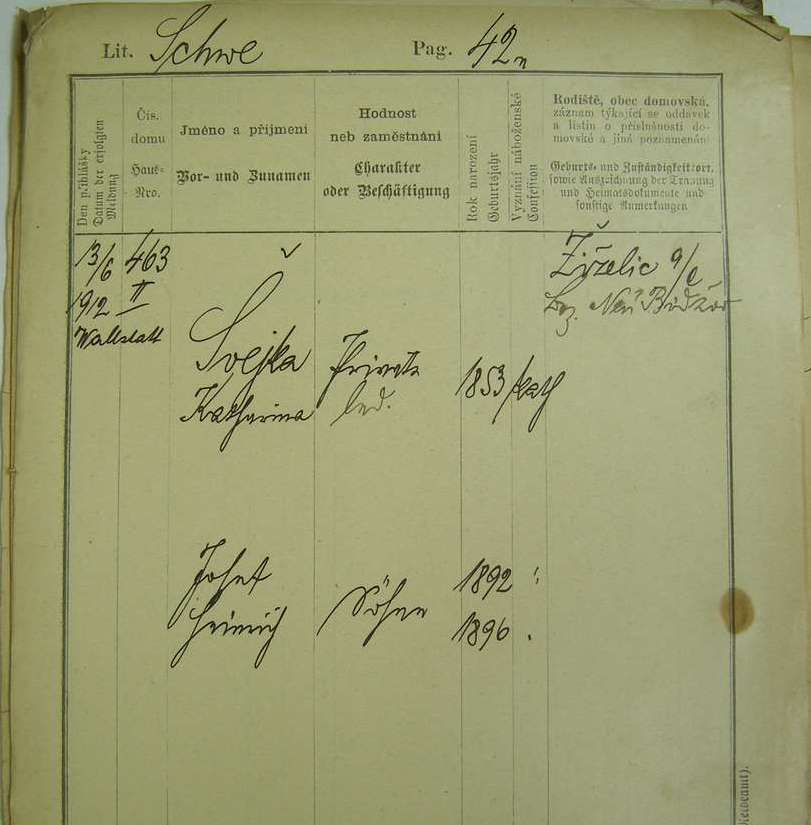
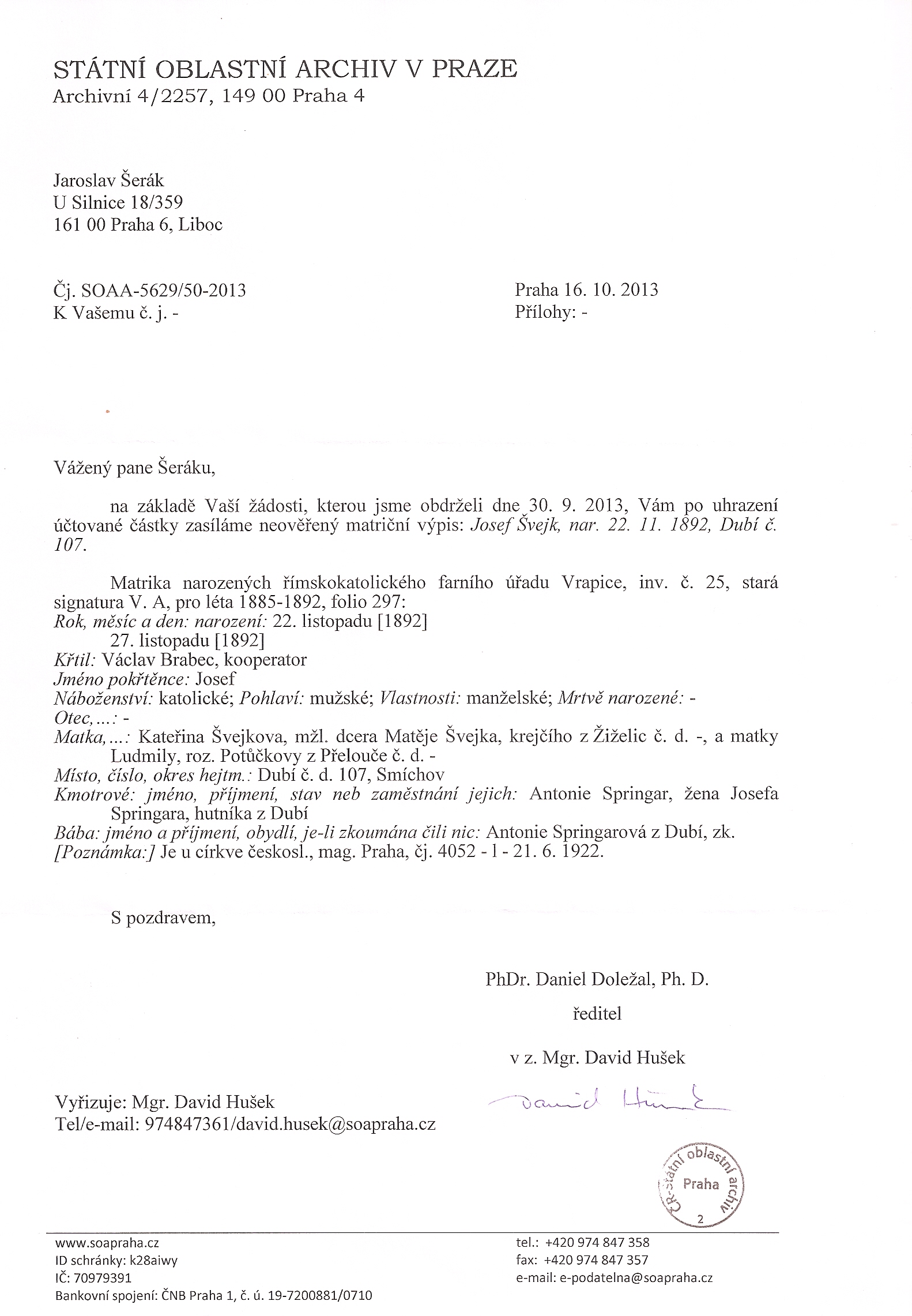
embedded innumerable autobiographical elements and episodes from his unusual life in The Good Soldier Švejk. He was undoubtedly a direct inspiration for Einjährigfreiwilliger Marek and even more so for the book's main character. The period most relevant to The Good Soldier Švejk is, of course, the author's time in the k.u.k. Heer in 1915, although passages drawn from other stages of Hašek's life appear throughout the novel.
This page is limited to periods and episodes in Hašek's life that had an obvious and direct impact on his famous novel, The Good Soldier Švejk. In view of the novel's content, it concentrates chiefly on the author's time in k.u.k. Heer.
The author attributes unmistakable personal characteristics to his literary hero. In the first few lines of The Good Soldier Švejk, he exposed his rheumatism to world literature ‘by proxy’, and we can safely assume that Švejk’s verbal skills, quick wit, charm, composure, and the all-important ability to extricate himself from difficult situations were gifts inherited from his creator. Švejk and Hašek shared this survival strategy. Both were outgoing and sociable, fond of telling stories and entertaining others.
The similarities between Hašek’s and Švejk’s military careers are even more striking. Both lived in Prague but served in Infanterieregiment Nr. 91 (IR. 91), owing to their South Bohemian ancestry. They encountered the same places and historical circumstances while serving in the k.u.k. Heer. Many of Švejk’s superiors and peers are drawn from Hašek’s milieu in IR. 91, though their qualities and identities have been modified, caricatured and partly disguised. Švejk was the company messenger in his 11. Marschkompanie, corresponding to Hašek's role in 11. Kompanie. Both were also tasked with finding accommodation for their military units.
Their occupation provides an obvious pre-war connection between Švejk and Hašek. From November 1910, Hašek ran a short-lived dog-trading enterprise but was accused of selling dogs with false pedigrees, which his assistant had stolen. Both had trained as apprentice chemists. Švejk's stay at the blázinec (lunatic asylum) clearly reflects autobiography, as do his stays at c.k. policejní ředitelství (Police HQ), c.k. zemský co trestní soud (Country criminal court), and policejní komisařství Salmova ulice (Salmovská ulice). Hašek and his hero shared a fondness for pub life, and many establishments mentioned in the novel were among the author's favourites (U Fleků, Bendlovka, Montmartre, U Brejšky - to name a few). Another common trait is their indifference to, or lack of success with, women. They were keen singers of army songs, although by all accounts both were poor singers.
One-year volunteer Marek
Švejk and Marek, Hašek's two alter egos enjoying themselves in Regimentsarrest in Budějovice
Einjährigfreiwilliger Marek appears even more closely modelled on the satirist, portraying an intellectual side of his personality not attributed to Švejk. Marek borrows several biographical details from Hašek.
His work as editor of Svět zvířat reflects Hašek's position at the magazine in 1909-1910 and 1912-1913, although many of the details supplied by Einjährigfreiwilliger Marek has no counterpart in the magazine itself. There is, for instance, no evidence that Hašek invented animals during his two tenures as editor. It is however true that Hašek succeeded Ladislav Hájek as editor, that the owner was Fuchs-Red and that Hašek eventually was fired.
Einjährigfreiwilliger Marek’s experiences in Budějovice likewise contain traces of Hašek's autobiography: his status as a one-year volunteer, turning up at the exercise ground in civilian clothes, dismissal from Budweiser Einjährigfreiwilligenschule, arrest by artillery patrols and hospitalisation. A real incident may have inspired the episode with the Krankenbuch. Like his literary alter ego, Hašek was allegedly transported from Budějovice to Királyhida in the prisoners' carriage. Marek generally serves as the mouthpiece for Hašek's political views; in this respect, he contrasts with Švejk, who conceals his opinions when it suits him.
Although Einjährigfreiwilliger Marek and Švejk are the figures that most obviously bear traces of the author, it is tempting to suggest that Hašek contributed a few of his less admirable qualities to at least two more of his literary creations: Offiziersdiener Baloun (gluttony), and Feldkurat Katz (alcoholism, lying and shirking financial obligations, e.g. not paying the moneylender in [I.13]).
Anecdotes
Many monologues bear traces of Hašek’s experiences. One example is the introduction of his grandfather, Jareš, at several points in the novel, beginning in the first chapter. Others include the two anecdotes about Rittmeister Rotter and the story about "nějakej" (some) Mestek. Einjährigfreiwilliger Marek's monologue about his time as editor of Svět zvířat belongs here too.
Jaroslav Hašek was 31 years old in 1914 and had so far avoided military service. The reasons for this are unknown; no records of his early encounters with the armed forces have been found, so he must either have been declared unfit for armed service (Waffenunfähig) or dismissed after starting it (Superarbitriert).
According to Emil Artur Longen, Hašek was disappointed at not being admitted to the army and proud when, after the outbreak of war, he was finally deemed Tauglich. This is plausible: his military medical records state that he was Assentiert (drafted) in 1914. He was consequently assigned to Landsturm (Home Guard or militia), a reserve force called up only in times of danger. In the autumn of 1914, the authorities decided to reassess this large reserve of manpower to offset losses at the front. From 13 to 15 December 1914, the Landsturm medical examination for Hašek's age group and geographical affinity took place at Střelecký ostrov. Those who passed were to report for duty on 15 February 1915.
The parallel with Švejk's army career is obvious, although the chronology differs, as it does throughout the novel. It is striking that the author says Doctor Bautze had been acting as head doctor at the medical board for 10 weeks, while Landsturm medical examinations began at Střelecký ostrov on 1 October 1914. The timing corresponds closely to mid-December. Bautze declared 10,999 of 11,000 recruits fit for service. At the first draft, only about 60 per cent of the early recruits were deemed Tauglich; by the end of the year, when Hašek's age group was called up, the acceptance rate had fallen to around 30 per cent.
In Budějovice
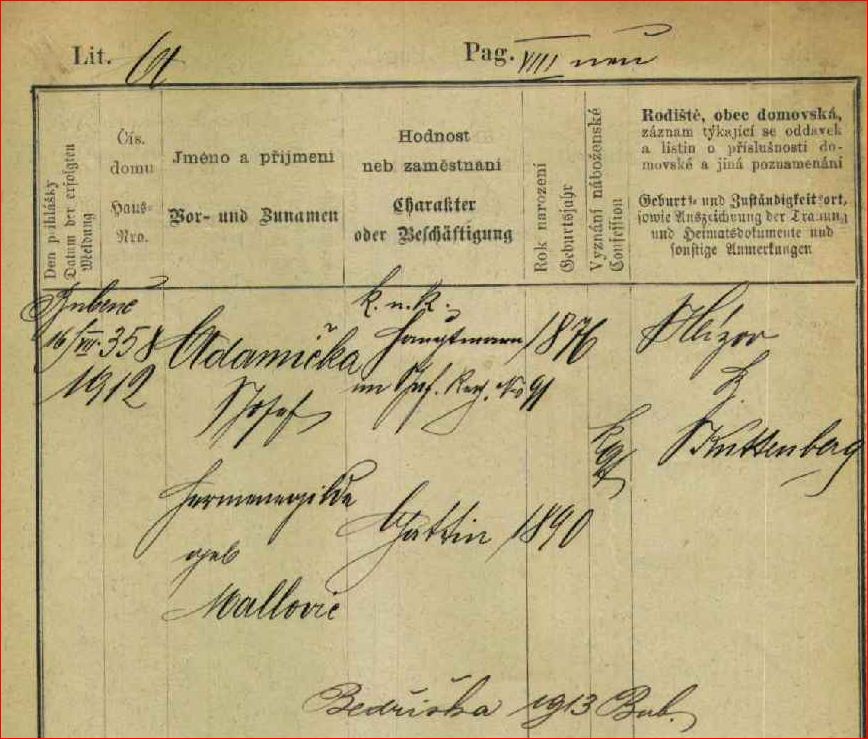
Jaroslav Hašek's period in IR. 91 deserves particular attention: the novel comes closest to autobiography here, and more than half its plot is set in k.u.k. Heer. Army records show that Hašek was Präsentiert (reported at) 1. Ersatzkompanie in Ersatzbataillon IR. 91 on 17 February 1915. In Budějovice, he enrolled at the school for reserve officers, where he met people he would later caricature in his writing: HauptmannJosef Adamička (head of the school), OberleutnantČeněk Sagner, and Hans Bigler. He may have met MajorFranz Wenzel and Staff Sergeant Jan Vaněk there as well, although this cannot be verified. Senior Lieutenant Rudolf Lukas was at the front in the Východní Beskydy until 13 March and then on sick leave, so he and Hašek would have met only later, presumably in early June, in Királyhida. In Budějovice Hašek also encountered fellow soldiers who, forty or more years later, supplied researchers with vital information, although the intervening years often blurred their memories: Jaroslav Kejla, Bohumil Vlček, FrantaHofer, Bohumil Šindelár, and František Skřivánek, among others.
Jihočeské listy,13.3.1915
His stay at the school ended unsuccessfully. Poor physical condition made the exercises and drill taxing, and, according to his own account (confirmed by Kejla and Hofer), he was expelled. The precise reason remains unclear, although he offers colourful versions through Einjährigfreiwilliger Marek (in Švejk) and in the short stories Gott Strafe England and In strategic difficulties. Kejla and Hofer give a more mundane explanation: Hašek was dismissed for behaviour incompatible with that expected of a k.u.k. officer. Drunkenness and breaches of public order are the likeliest causes; he had been repeatedly arrested for such offences in Prague. Even so, the eloquent and rebellious author may have irritated his superiors enough to be disciplined, but hardly enough to be expelled. Hašek does not appear in the lists of graduates from Reserveoffizier-Schule Budweis, confirming that he left the school.
He seems to have played little part in military life, partly because of illness and partly because he was periodically locked up (by his own account, for as long as 30 days). Suffering from rheumatism and heart trouble, he was first hospitalised on 6 March near the railway station in the k.u.k. Reserve-Spital in Radeckého třída. Jihočeské listy reported his hospitalisation on 13 March 1915. He was then sent to a recuperation unit in Linecké předměstí, from which he appears to have made several excursions. The longest lasted four days and took him as far as Protivín and Netolice; some accounts even place him in Radomyšl. He is also reported to have visited Zliv and České Vrbné. While in Budějovice, he wrote several short stories, and the collection "My Business with Dogs" was published there.
Hašek in k.u.k. Reservespital, Budweis
Jaroslav Hašek ve fotografii, Josef Kalaš,1959
In the 1950s, several witnesses recorded memories of Hašek's period in Budějovice, although the intervening years affected their accuracy. One was František Skřivánek, who published his account in Stráž míru, 8 September 1954; a similar story had appeared in Jihočeské listy as early as 1923. The author visited an impressive range of pubs in the city (no surprise there), but only a few appear in the novel. Another witness was the young Bohumil Mičan, whose family owned the restaurant U Mičanů, a regular haunt of Hašek. He stayed with them and became well acquainted with the family.
Another witness was fellow one-year volunteer FrantaHofer, who gives an amusing account of Hašek's first weeks at the reserve officer school. He says that many officers, notably Josef Adamička, liked the author and invited him to the canteen to entertain them. This may have inspired the novel's scenes in the local hotel and the officers' dining rooms. Hofer's and Mičan's accounts were never published, but they are available in LA PNP, fond Zdena Ančík; links are provided below. František Langer offers another source, writing that the poet Peter Křička stopped in Budějovice on his way home from the front and met Hašek. At the time, Hašek was working in the kitchen, peeling potatoes: a detail that accords with Einjährigfreiwilliger Marek in the novel and with the story In strategical difficulties.
In May 2015, Hašek's military record was investigated at VÚA, and the picture of his illness and superarbitration became clearer. Already on 6 March 1915, he was admitted to the hospital and seems to have stayed there at least until 8 April. He was suffering from rheumatism in the joints, as well as a heart condition, and an application for his dismissal from the army for health reasons was lodged that day.
On 30 April, the superarbitration commission gave its verdict. The soldier was not entirely relieved from army duties; he was deemed capable of salvage, guard, and other lighter tasks. It was also concluded that his military service caused none of his health problems. The decision was rubber-stamped by k.u.k. Militärkommando Prag on 25 May.
The 91st regiment transferred
Jihočeské listy,2.6.1915
Budweiser Zeitung,11.6.1915
As reflected in The Good Soldier Švejk, Ersatzbataillon IR. 91 was transferred to Királyhida, a town on the border between the two constituent parts of the Dual Monarchy. The reason for the transfer was political; regiments from the various parts of the empire were moved to “foreign” parts because the authorities assumed (not without reason) that close contact between the k.u.k. “Kanonen-futter” and the civilian population could harm their will to die for the emperor. They could also be infected by anti-war sentiments that were taking root in the population as it became clear that the war would not be over soon. Czech reserve battalions were often swapped with Hungarians (or others), and in Budějovice, the Hungarian Infanterieregiment Nr. 101 replaced them.
Hašek was certainly part of this transfer and describes it in his novel. According to Jan Vaněk, he arrived in Királyhida under arrest, just as Švejk did. The literature on Hašek gives conflicting dates for the move. Radko Pytlík proposes several dates in early May, while Jaroslav Kejla places it on the 20th. František Skřivánek recalled that Hašek sent him a few lines of farewell dated 5 May. The transfer actually took place much later, on 1 June 1915, as confirmed by Jihočeské listy, Budweiser Zeitung, and Deutsche Böhmerwaldzeitung. The newspapers describe scenes at the station that match Hašek's account, including the sizeable crowd. The censors removed many lines from the first two reports, perhaps because they contained the Czech nationalist sentiments mentioned by the author.
The departure took place before noon in two stages. Their replacement, Infanterieregiment Nr. 101 from Hungary, arrived during the evening of the 9th and occupied the now-vacant Mariánská kasárna.
Bruck/Királyhida
Hašek in IR. 91, probably by Żdżary in August. To the left of him is František Strašlipka (with the cigarette).
Jaroslav Hašek ve fotografii, Josef Kalaš,1959
As we already know, Jaroslav Hašek had on 25 May been partly superarbitrated on health grounds and assigned lighter duties (capable of Rettungsdienst, i.e. rescue duties). After arriving in Királyhida, he served with Jan Vaněk, a staff sergeant responsible for accounting and logistics. Vaněk was subsequently to find his way into world literature through this encounter. He was arguably the most obvious of all the “prototypes” found in The Good Soldier Švejk. Hašek helped him with the office duties and got to know the cook Perníček, perhaps an inspiration for cook Jurajda. Vaněk was to provide valuable testimonies about Hašek's time in the k.u.k. Heer, as retold by Jan Morávek in 1924 in Večerní České slovo. The series from 1924 is by far the most detailed we have on Hašek's period in the Austro-Hungarian army and should be considered the very first contribution to “Švejkology”. Morávek also personally met Hašek in Királyhida.
XII./91 Marschbataillon
Hašek in IR. 91. According to Morávek, this photo was taken at the beginning of September 1915 with Hašek already promoted to Gefreiter.
Jaroslav Hašek ve fotografii, Josef Kalaš,1959
XII. Marschbataillon of IR. 91 was formed around 1 June 1915, and the soldiers continued training and preparation for front duty. The commander of the battalion was Franz Wenzel, a major who served as inspiration for the literary figure Major Wenzl.
Each battalion consisted of four companies, and Hašek was assigned to the 4th (deduced from the Qualifikationsbeschreibung of Hans Bigler). Kejla, however, assigns him to the 3rd company and Vlček to the 2nd! In any case, it can be ruled out that Švejk’s 11. Marschkompanie ever existed. This fictional unit is rather a projection of 11. Kompanie in which Jaroslav Hašek was soon to serve.
On 1 June 1915Rudolf Lukas was appointed commander of the 4th March Company. With this Oberleutnant, Hašek developed a good relationship, a bond that found its way into world literature some six years later. Lukas kept his hand over the author and even urged him to stop drinking. In the march company, he also met Hans Bigler again, the prototype of Kadett Biegler, and František Strašlipka, the servant of Lukas. Apart from his position as an officer's servant, Strašlipka is also believed to have inspired Švejk’s incessant storytelling and was one of Hašek's closest friends in the regiment.
Departure for the front loomed, and on 24 June, the men were barred from leaving the camp as they were to depart three days later. Hašek disappeared and was only found after three days, according to one report, drunk in a haystack; according to another, he was discovered in the same state in a café by the railway station, and according to Jan Morávek (interview printed in Průboj on 3 March 1968) he was found in U zlatého růže (Zur Goldene Rose). Jan Vaněk's diary reveals that the march battalion departed from Bruck station at 8:15 p.m. on 30 July.
Across the Carpathians
Hašek in IR. 91 (extracted from the picture above)
Jaroslav Hašek ve fotografii, Josef Kalaš,1959
No known official material documents the journey from Bruck to Sambor, but Jan Vaněk's diary provides a rough outline. It records the departure, several places along the route, and three dates. Hašek adds detail in The Good Soldier Švejk and, more significantly, in his poem “Cestou na bojišti” (On the road to the battlefield). Written more or less on the spot, the poem is likely to be more accurate than his later writings. Vaněk gives a route identical to Švejk’s: from Bruck (30 June 1915) through Győr, Budapest, Miskolc and Humenné (2 July). After that, no places are mentioned until Sambor.
Jan Vaněk confirms that the train journey ended at Sambor, which they approached on 4 July 1915. In Dobrý voják Švejk v zajetí, Hašek has the soldiers continue beyond Sambor to a station he calls Kamenec (not identified). The Good Soldier Švejk presents a very different picture, with the march battalion leaving the train much earlier, at Sanok. Hašek mentions the Łupków Pass in The Good Soldier Švejk in captivity, so the route in The Good Soldier Švejk can safely be considered accurate as far as Zagórz near Sanok. The train would have passed further places familiar to readers of the novel on the way to Sambor: Krościenko, Chyrów and Felsztyn.
Official 2nd Army orders were the following: the “Einkantonierungsgebiet” was Komarno (ukr. Комарно), east of Sambor, and the daily legs are outlined in detail. Note that this was the planned route, not necessarily the one carried out.
5 July: Komarno - Szczerzec (ukr. Щирець)
6 July: Szczerzec - Zagorsze (ukr. Заґiря)
7 July: Zagorsze - Stare Sioło (ukr. Старе Село)
In the “Einkantonierungsgebiet” the 12th march battalions from Infanterieregiment Nr. 11, Infanterieregiment Nr. 73, IR. 91 and Infanterieregiment Nr. 102 were to gather and form the 18th March Brigade and continue to the front. Interestingly IR. 91 disappears from the records, whereas the march battalions from the other three regiments are reported to have arrived at their destination on 9 July. Jan Vaněk's diary gives us the most reliable information: on 4 July, they are still in transport but approaching Sambor. Then, on 5 July, they left Sambor for Rudki, and on 6 July, they marched to Szczerzec. This indicates a delay of one day compared to the 2nd Army orders.
Another of Jaroslav Hašek's poems lists towns and villages on a line between Sambor and Łonie (the village by Gołogóry where the XII. Marschbataillon joined the field battalions of IR. 91). This description in the poem corresponds almost perfectly to official orders stored in Kriegsarchiv in Vienna (2nd army files). Jan Vaněk adds several confirmatory items in his entry from 10 July. The places he mentions are Wańkowce, Lahodów, and Jaktorów. In the last place, he notes that on 10 July, they were waiting to join the regiment in the afternoon. The only slight contradiction between the various sources is the actual date the march battalion joined the regiment. According to Jan Eybl and Vaněk it was on 10 July, Inft. Reg. 91 Galizien... claims 11 July.
Joining the 11th Field Company
Fähnrich Biegler and Einjährig-Freiwilliger Hašek from the 11th company were awarded silver medals for courageous conduct at Sokal. Feldwebel Vaněk and Offiziers-Diener Strašlipka were given bronze medals.
Hašek’s journey to the front is patchily documented, but his stay at the front from around 10 July to 24 September 1915 is well covered. Jan Morávek’s above-mentioned series focuses mainly on this period. Additionally, Inft. Reg. 91 Galizien... covers the regiment's route in great detail, at times down to the hour, and with accurate geographical information. The diaries of Jan Vaněk and Jan Eybl describe the events even more precisely.
When the march battalion (approximately 800 men) joined the IR. 91 operative body, Rudolf Lukas took command of the renewed 11. Kompanie, with Hašek as his messenger. Hans Bigler was also assigned to this company as a squad leader (Zugsführer), and Jan Vaněk and František Strašlipka served in this unit. Companies 9 to 12 made up III. Feldbataillon, commanded by Čeněk Sagner, who had left for the front around mid-June. Franz Wenzel assumed command of the 2nd battalion (Companies 5-8).
From now it should be clear that the 11. Kompanie (field company) and part of its command structure have been projected directly onto the march units described in the novel. Hašek was named messenger in the 11th field company soon after 11 July 1915. This is a role Švejk gets much earlier in the 11. Marschkompanie (although Hašek may have been a messenger also in his March company).
After Żółtańce
Although the novel geographically ends at Żółtańce (IR. 91 made a 2-hour 15-minute break here on 16 July), the period after is still interesting even seen from the view of the pure “švejkologist”. Fragments from IR. 91's continuous march still appear in the novel and the most notable of those is Sokal which is dedicated a chapter header as early as Királyhida, in the final chapter of Part Two. The vicious battle that was fought here during the last week of July was no doubt intended to play a prominent part in the unfinished Part Four.
Some real events have been shifted forward in time. The order to build a bridge across the Bug was given on 17 July, i.e. not in Királyhida as the novel states. Brought forward in the same way is the order to march to Sokal. It was only issued on 20 July, after the regiment had started building that bridge by Kamionka Strumiłowa. During the march to Sokal, the regiment met German troops in Mosty Wielkie and Sokal (IR. 91 replaced German units there). Both these encounters may have inspired the various meetings with German military units and Švejk observing the well-fed Germans at Żółtańce town square (a place IR. 91 never set foot at).
Hat in den Kämpfen am 25./7. nächst Poturzyce unermüdlich u. mit Lebensverachtung in die Schwarmlinie [= Schützen- oder Gefechtslinie] wichtige Befehle und von dort Situationsmeldungen überbracht, wobei er die Mannschaft durch Erheitern u. Zurufe aufmunterte, selbst freiwillig Rekognoszierungen [Erkundungen] durchführte und kleine Gruppen in entsprechende Linien vorführte.
Steht seit 30./6. l. J. [laufenden Jahres] im Felde
Antrag: Silb. Tapferkeitsmed. II Kl.
Standort, am 2. August 1915 Transkription dank Doris & Gert Kerschbaumer
Jaroslav Hašek was indeed decorated with the Silver Medal for bravery (II. Class) in the aftermath of the battle by Sokal. The application for his decoration was written on 2 August 1915 and signed by Steinsberg (for the regiment). Oddly enough, his rank is noted as "Kriegsfreiwilliger" (war volunteer). If this is correct, it means that he joined the army voluntarily.
The justification for the award was the bravery he exercised on 25 July 1915, the first day of an Austro-Hungarian attack whose aim was to capture the strategically important Góra Sokal, 254 metres. Without regard for his own life, he carried important messages to and from the trenches, encouraged his comrades with shouts, voluntarily undertook reconnaissance, and led smaller groups into position.
On 4 August 1915 the application was approved by Mossig for the brigade and Schenk for the division. The medals were handed out on 18 August. Soldiers from Hašek's 3rd battalion were decorated by Rudolf Kießwetter. That day, Hans Bigler, Jan Vaněk, and František Strašlipka also received their awards.
The official rubber stamp was given by the central authorities as late as 20 November, at a time when the author was already in Russian captivity.
More loyal than made out to be?
Much has been made of Jaroslav Hašek's alleged disloyalty to the k.u.k. Heer, an impression he, for obvious reasons, was eager to promote from 1916 onwards. Before the war, he also talked about his intention to defect. For years, it was, therefore, claimed that he actively crossed over to the Russians at Khorupan on 24 September 1915, that he tried to desert on several occasions before that, and that he was even given a three-year sentence for attempted desertion.
Jaroslav Hašek had no disciplinary record in k.u.k. Heer
None of these claims have been verified, and his military record shows no sign of punishment. On the other hand, it is documented that he was awarded a silver medal for bravery, taking risks that he did not have to take, and he may even have signed up as Kriegsfreiwilliger, i.e. volunteered for his emperor. Nor was he forced to enlist at the reserve officer's school in Budějovice. His superior in k.u.k. Heer, Rudolf Lukas, told Jan Morávek that Hašek was a good soldier, that his main problem was drinking, and did not mention any political stance. Bohumil Vlček quoted Hašek from Sokal: "This war we must win at all costs". On the other hand, he volunteered for reconnaissance patrols at Sokal, and it is known that Czech soldiers used this method to get over to the other side. That he intended this would, however, be pure speculation.
There is no doubt that he, like Einjährigfreiwilliger Marek, was locked up in the garrison prison occasionally, but again, it was likely to be public order offences rather than politics. The only known instance where he was disciplined for political reasons was in České legie in 1917 (after his infamous article The Czech Pickwick Club). It is also tempting to ask why it took him eight months to land on the "other side" if he was so convinced in his anti-Austrian views. He probably could have done what the main target of his scorn in the "Czech Pickwick Klub", Bohdan Pavlů, did in late 1914: join the Czech volunteers on the spot of capture or shortly thereafter. Ernst Kollmann, who was in the same prisoner transport as Hašek, noted that Družina were already recruiting in the transit camp at Darnytsa, so he surely would have had a chance to join there.
Jaroslav Hašek and his time in Russia (1915-1920) is comprehensively covered under the headline České legie, and little from this period is directly reflected in The Good Soldier Švejk. One exception is the author's general description of officer's servants, where he mentions the Legions directly and describes a "pucflek's" journey into captivity carrying his master's luggage. The route described is at least partly identical to Hašek's (see Dubno, Darnytsa).
Čechoslovan,17.7.1917
Betreffend: Hochverräterische Umtriebe von österr. Čechen im Auslande,1917
A more coincidental connection is the story of a tomcat soiling a picture of the emperor, a clear parallel to the scene from U kalicha where the flies were equally impertinent to his majesty. The story Povídka o obrazu císaře Františka Josefa I. was published in the Kiev weekly Čechoslovan on 17 July 1916 and described the owner of a paper shop, Mr. Petiška from Mladá Boleslav, who traded pictures of the emperor in Jewish liquor shops and also eagerly hoisted the flag on official state holidays. Unfortunately, a tomcat emptied his bladder on the pictures, making them unsaleable. The story was picked up by the Austrian intelligence services and led to an investigation in absentia of the author for high treason (Hochverrat) and defamation of His Imperial Majesty (Majestätsbeleidigung). The case was jointly investigated by c.k. policejní ředitelství and the k.u.k. Divisionsgericht in Vienna.
Thanks to this story, Jaroslav Hašek earned a place in the book ‘The Treacherous Activities of Austrian Czechs Abroad’, published by c.k. policejní ředitelství in 1917[a]. It named around 1,000 people, and the author of the tomcat story was in good company: Professor Masaryk, future Czechoslovak president Eduard Beneš, Hašek's friend Vlasta Amort, and, more surprisingly, James Joyce. How the latter became involved with ‘Austrian Czechs’ is baffling. According to the police records, his nationality was unknown, he lived in Zürich and was classified as politically suspect!
Credit: Radko Pytlík, Jaroslav Šerák, Břetislav Hůla, Jan Morávek, Jan Vaněk, Bohumil Vlček, Jaroslav Kejla, František Skřivánek, Franta Hofer, VÚA, ÖStA
Literature
Májové výkřiky, Lad. H. Domažlický a Jaroslav Hašek,1903
Ludvík Lacina
was a Roman Catholic priest from Moravia who served in the k.u.k. Heer as a regular army chaplain from 1906 to 1918. As he was assigned to Kavalleriedivision Nr. 7 from 1913 to 1916 and was the only military cleric with this surname in Austria-Hungary, there is no doubt that he was the model for the literary Feldoberkurat Lacina. He was identified as Hašek's feldkurát in an obituary published in Národní listy in 1928.
Early life
The son of teacher Ludvík Lacina and Emilia, he was born in 1868 in Nedakonice, okresUherské Hradiště in Moravia; his right of domicile was Nedakonice. In 1877 his father took up a position as a teacher in Nový Hrozenkov on the Slovakian border, and in 1881 he became head teacher in Lešná near Valašské Meziříčí, a position he held until 1902. His son Ludvík must therefore have lived in all these places before moving to Olomouc to begin his clerical education. Eventually, Lacina Sr. moved a short distance to Krásná nad Bečvou (now part of Valašské Meziříčí), where he continued as head teacher and was also elected mayor.
Lacina studied at the Czech gymnasium in Valašské Meziříčí, graduating in 1887, then studied theology in Olomouc and Gorizia (Görz). He was drafted into the armed forces in 1888, but details about his compulsory service in the k.u.k. Heer are missing. However, he is listed as a reserve field chaplain in 1899. He was ordained as a priest in Gorizia on 18 April 1892. For the next two years, he worked as a chaplain at the parish in nearby Šempeter pri Gorici (St. Peter bei Görz).
Wien Städtisches Jahrbuch, 1896
Lehmanns Wohnungsanzeiger, 1907
In 1894 he moved to Vienna and appears in the address book from 1897 under the name Ljudevik Lacina, title Priester. He lived in Wiedner Hauptstrasse 82, IV. Bezirk. In Wiener Kommunal-Kalender und städtisches Jahrbuch (Vienna Municipal Calendar and City Yearbook) from 1896 he is entered as a teacher of Catholic religion at a primary school in Leopold Ernstgasse 37.
Lacina worked as a teacher until 1906, the year he joined the army as a regular field chaplain. The city yearbooks reveal that he taught both boys and girls (these were gender-segregated schools) but often changed schools. He is listed at no fewer than eight home addresses up to and including 1909. His address in 1906 was Wurlitzer-gasse 9, XVI. Bezirk. He lived in at least three of the capital’s districts during his 14-year stay in Vienna.
Cyclist and musician
Ostdeutsche Rundschau, 6.5.1900
Ostdeutsche Rundschau,6.5.1900
In the cultural sphere, he was very active, particularly in music, where he excelled as a singer and also played the piano and accordion. As a student at Musikschule Kaiser in 1900 and 1901, he passed the Staatsprüfung (state examination) in singing, piano, and organ playing.
Reichspost, 3.12.1899
Lacina was also an active cyclist, and newspapers record that, to great acclaim, he played the piano at gatherings of the Christian Cyclists' Association.
In December 1899, the cyclist and cleric Lacina hit the headlines. Sitting with a group of other cyclists in Tiroler Weinstube on 11 July 1899, they overheard a railway employee describing the Social-Clerical Party as a "Saubande" (pack of swine) and adding other derogatory terms. Lacina and his group objected, and a heated argument erupted—indeed, so heated that the belligerents ended up at Polizeikommisoriat, and eventually in court. Lacina sued on the basis that the harsh words were an insult to the entire Catholic clergy, but the defendant Josef Wild claimed they were aimed only at the Clerical Party. In the end, the court acquitted the accused railway worker.
In k.u.k. Heer
Schematismus für das k.u.k. Heer (s. 1123),1907
Našinec,11.2.1913
On 1 November 1906, Lacina joined the k.u.k. Heer as an active (i.e. professional) military cleric. For the first two years, he served with the Feldsuperiorat in Vienna as Feldkurat 2. Klasse, from January 1909 to February 1912 in Gorizia, before being transferred to Maribor. On 21 January 1913, he changed assignment again, now to Kavalleriedivision Nr. 7 in Kraków, the division mentioned by Hašek in The Good Soldier Švejk. He served in the field with this division from the outbreak of war. In 1915, he was decorated with the Geistliche Verdienstkreuz zweiter Klasse am Weissroten Bande. In August 1916, he was transferred to K.u.k Mobiles Reserve-Spital Nr. 2/10, serving with the 2nd Army behind the lines on the Eastern Front.
Documents from the Czechoslovak army state that, during the war, he served in Russian Poland, Galicia, and finally for 18 months in Albania. These records do not contain firm dates for his assignments in the k.u.k. Heer.
Disciplinary record
One of the many warnings Lacina received from k.u.k. Feldvikariat in Vienna. The letter is dated 16 March 1910, at the time Lacina served in Görz (now Gorizia in Italy and Nova Gorica in Slovenia).
When he entered the army clergy, Lacina had a spotless record, but this was soon to change. Several incidents are recorded during his 12-year army career, resulting in several written reprimands. Lacina, however, defended himself eloquently, and the measures taken against him never seem to have gone beyond reprimands and transfers.
The first recorded incident occurred in March 1910 in Gorizia when Lacina allegedly charged the widow of an officer 6 crowns for her late husband's funeral and accompanying holy mass. K.u.k. Feldvikariat in Vienna issued a strongly worded response stating that "he, despite previous warnings, didn't seem to have bettered himself". He was berated for his "filthy greed" and "unusual laziness and indolence", and the Feldvikar (Roman Catholic military bishop) had "lost every remaining trust in him (Lacina) that he ever had". Expulsion from k.u.k. Militärseelsorge loomed, but in the end he was shown mercy and allowed to continue. It will have helped that fellow officers put in a good word for him.
Less than a year later, he was in trouble again. During a masquerade ball at Deutsche Schulverein in Gorizia on 21 January 1911, Lacina was present, and he was soon after accused of behaviour incompatible with that expected of a military cleric. Reportedly, he was involved in a joke with an officer dressed as a lady, which was deemed inappropriate. More gravely, he was accused of allowing a lady to stay overnight at his flat. These incidents caused gossip and consternation in the city, and reflected badly on the military clergy as a whole. Again, fellow officers backed him, but a few months later he received a severe reprimand from military bishop Bjelik. He was offered the chance to resign voluntarily within six months, and if anything untoward happened during this period, he would be dismissed.
He was even ordered to report to a monastery for eight days to undergo geistliche Exercisien (spiritual retreats). In a letter dated 22 April 1911, he informed his superior in Vienna that he had undergone spiritual cleansing at Kapuzinerkloster in Gorizia, and the attached testimony from the monastery (written in Latin) confirms that this took place from 8 to 15 April.
The incident at the masquerade ball is almost certainly the reason for his transfer from Gorizia to Maribor. This seems to have taken place in February 1912.
During the war
Wiener Zeitung,25.12.1915
When the war broke out, he was still with Kavalleriedivision Nr. 7 in Kraków. He served with this unit at the front in Poland and Galicia from 1 August 1914 to 14 August 1916. In 1915, he was decorated, but in 1916 the division requested that he be transferred to a less demanding post as he "was not up to the tasks demanded by a cavalry division".
He was thus, in August 1916, moved to Mobile Reservespital Nr. 2/10 (the 10th mobile reserve hospital of the 2nd Army), but before that he had been proposed for promotion by Kavalleriedivision Nr. 7. The attempted promotion was so-called Aussertourlich (out of turn), as 29 priests were ahead of him in the queue for promotion. Military bishop Emmerich Bjelik therefore rejected the application, not only for this reason but also due to the field chaplain’s relatively short time in service (10 years) and his poor disciplinary record.
The rejection led to a further clash, and this time the bishop himself was on the receiving end. Lacina turned up in the bishop’s office on 18 October 1916 to enquire about the promotion. When told the verdict, he lost his temper and lashed out at his superior, accusing Bjelik of persecuting him and wishing that the Mother of God would punish him. Ultimately, the bishop was lenient: he reported the incident to Kriegsministerium but asked that the punishment be no more than a stern warning.
Miha Šimac has recorded Bjelik’s disciplinary report on Lacina during his research, and reproduces it in his book Vojaški duhovniki iz slovenskih dežel pod habsburškim žezlom, Ljubljana: Teološka fakulteta, 2014, pages 373–374.
Der Feldkurat Lacina des Mob. ResSpitals Nr. 2/10, welcher schon von meinem Vorgänger wegen seiner Lauheit im Dienste und Pflichtvergessenheit oft gemahnt und gerügt, wiederholt strafweise versetzt und wegen grober Verletzung der Standesehre auch mit einem strengen Verweise bestraft, von den namentlich jüngeren Offizieren aber, - weil er ein guter Gesellschafter, Klavierspieler und kein Spassverderber war – gerne in Schutz genommen wurde, ist mit Befürwortung des 2. A-Kmdos von der 7. KTD zur Beförderung in die VIII. Rangklasse außer der [Bar. ?] beantragt worden.
Er ist am 18. i. Mts. bei mir erschienen und hat sich auf den vorerwähnten Antrag berufen und um seine Beförderung gebeten. Ich habe unter Hinweis auf sein so oft beanständetes Verhalten vor dem Kriege die Erfüllung dieser Bitte abgelehnt und musste dies, als er unter Hervorhebung seiner 10-jährigen Dienstzeit und seines Alters das Ansuchen mit heftigem, ungebührendem Ton und eben solcher Haltung wiederholte als eine Dreistigkeit und Kränkung seiner wohlverdienten Vordermänner energisch zurückweisen. Er gebärdete sich aber in ungehöriger Art weiter und warf mit verletzendem Ton und anmassender Haltung vor, dass ich ihn verfolge und verfluchte mich, die Mutter Gottes solle mich strafen und sie werde es auch tun, wie es auch dem verstorbenen Weihbischof Marschall geschehen, dem er auch gleiches gewünscht habe. Ich bringe dieses achtungswidrige, die Auktorität und Disziplin tief verletzende Benehmen des Feldkuraten Lacina zur Kenntnis und bitte, - da es sich um meine Persone handelt, - von einer härteren Ahndung absehen und ihn nur mit einem strengen Verweise und Verwarnung bestrafen lassen zu wollen.
Throughout the rest of 1916 and 1917, Lacina continued in the mobile reserve hospital, and again there were controversies. During an inspection on 4 December 1916 by FeldsuperiorVárady, a number of wounded soldiers at the hospital complained that they had not received Holy Communion from the field chaplain for eight weeks.
In September 1917, he was also accused of having arranged the illicit collection of money from the hospital’s patients. Lacina energetically refuted the accusations and requested that the case be investigated by the military judiciary. On 7 October 1917XIX.Korpskommando concluded that he had indeed committed a transgression but had not violated the letter of the law. The case was thus left for the Feldsuperiorat to decide. The latest recorded correspondence regarding the matter is dated 16 December 1917, and the outcome is unclear.
One of the documents suggests that the reserve hospital was located in the cavalry barracks of Kamionka Strumiłowa in 1916, and this makes sense as the 2nd Army was operating in eastern Galicia at the time. His documents from the Czechoslovak army claim that he served for 18 months in Albania, and the correspondence regarding the money-collection case shows the location of Feldsuperiorat as Skutari (now Shkodër). It thus appears that the mobile reserve hospital was transported to Albania in early 1917.
His whereabouts during 1918 are not known, apart from the fact that he was back in his native Moravia by the time Austria-Hungary collapsed, and that on 14 August 1918 he had arrived in the spa town of Karlsbad (Karlovy Vary), registered with the permanent address Krasna.
When Czechoslovak independence was declared on 28 October 1918, he was stationed in Hranice na Moravě and immediately joined the army of the newly formed state, where he remained as an active military cleric for another three years. In the Czechoslovak Army, his record was unblemished, and the army documents do not mention any of the disciplinary issues from his time in the k.u.k. Heer.
On 3 May 1919, he was promoted to vrchní polní kurát (chief field chaplain) and was stationed in Hranice na Moravě, Moravská Ostrava, Hradec Králové, Chomutov, and Pardubice. From 22 January 1921, he reported ill and was hospitalised in Pardubice and Prague. He was eventually superarbitriert on 26 August and retired on 27 September. The reasons for his illness and early retirement are not known. Lacina died in his native Moravia at the age of 60 and is buried in Valašské Meziříčí.
Meeting Hašek before the war?
Radko Pytlik, 1983
Radko Pytlik, 2003
The fact that Jaroslav Hašek knew exactly which unit Lacina served with indicates that the two met in person at some stage. According to Radko Pytlík and his book Kniha o Švejkovi p.146, Hašek met Lacina on one of his wanderings before the war and that the latter had a liking for animals, both alive and on the dinner table—something that may have drawn the author’s attention.
When and where the two could have met is, however, not clear because the author’s and the field chaplain’s domiciles never overlapped, and Hašek is not known to have travelled to areas where Lacina lived at the time (the opposite is of course possible). Nor do we know where Radko Pytlík obtained this information, but he mentions the first name Ludvík and the geographical affinity to Valašské Meziříčí, so the source appears reliable enough. In his book Osudy a cesty Josefa Švejka (2003), Pytlík elaborates on the theme and suggests that the two met already when Hašek was editor of Svět zvířat (1909–1910)[a]. Pytlík also adds that Lacina was a frequent guest in bars and coffee houses.
Neue Freie Presse,12.1.1913
Given that Hašek knew which unit the field chaplain served with, any meeting between the two is unlikely to have happened before January 1913, when Lacina was transferred to Kavalleriedivision Nr. 7 in Kraków. In the summers of 1913 and 1914, Jaroslav Hašek, together with Zdeněk Matěj Kuděj, undertook two major trips, both in Bohemia, i.e. in areas where Lacina would not typically spend time. Kuděj later described both journeys in detail and never mentioned any field chaplain. In the autumn of 1914, Hašek spent some time around Jaroměř, but it seems unlikely that Lacina ventured into this area at the time. He had, after all, just been called up for front duty.
That the two met during the war is also possible, and if so, it is likely to have happened when the field chaplain was on leave—a hypothesis supported by the fact that the literary Lacina turned up at the railway station in Budějovice in a hard hat, indicating that he was off duty. Could he have been visiting someone in the city around 1 June 1915, when Ersatzbataillon IR. 91 departed for Bruck an der Leitha - Királyhida? That the two met in the field later that year is unlikely, as Kavalleriedivision Nr. 7 did not operate in the same areas as Infanterieregiment Nr. 91.
Polish translator of The Good Soldier Švejk, Antoni Kroh, claims that Hašek met Lacina on the way to the front in Galicia, but does not reveal the source of this information.
A more tangible link is Pardubice, where Jaroslav Hašek and his wife spent a week in quarantine after returning from Russia in December 1920. From 1 October 1920 to 27 September 1921, Lacina served with the local garrison in the 2nd reserve hospital, now, of course, as a Czechoslovak officer.
Interestingly, he had by now advanced to chief field chaplain, exactly the rank Jaroslav Hašek assigned to him in The Good Soldier Švejk. However, this may not mean much, as the author quite liberally juggled ranks (this was also the case with Feldoberkurat Ibl).
Another caricature?
Národní listy,20.7.1928
It is open to speculation whether the grotesque traits that Jaroslav Hašek assigns to the chief field chaplain have any root in reality. Two of the field chaplains who take part in the plot are obvious caricatures without any real-life model (Feldkurat Katz and Feldkurat Martinec); one shares a name with a real field chaplain (Feldoberkurat Ibl) but not much else. Lacina therefore remains the only field chaplain with some firm connection to a real person. The personal traits and situations that Hašek assigns to his Feldoberkurat travelling with Švejk and Einjährigfreiwilliger Marek are plainly caricatured, but there is no doubt that Lacina was a loose cannon in Militärseelsorge. Although not officially recorded, it is quite possible that his excesses also included drunkenness and gluttony.
Qualifikationsliste
Am mobilisierungstage eingerückt zur k.u.k. 7. K.D. (1. VIII. 1914 bis nach 14. VII. 1916).
2. Dezember. Hl. Messe mit Ansprache und hl. Segen für das k.u.k. Ulanenregiment Nr. 2 in den Schützengräben /: Seine wie stets stark im Vertrauen auf Gott; deutsch, polnisch./
Jaroslav Šerák
Jeho otec byl učitel v Nedakovicích a jeho matka pocházela také z učitelské rodiny Antonína Peka ze Štípě (Štípa u Zlína). Děd našeho pátera Jan, měl ve Štípě hospodu.
Credit: Miha Šimac, Václav Petera, Jaroslav Šerák, Radko Pytlík, VÚA, ÖStA
Hašek's poem from 1915, a strong indication that Švejk's story-telling was inspired by Strašlipka
František Strašlipka
is often regarded as the prototype of Švejk, due to his position as Putzfleck (officer's servant) of OberleutnantRudolf Lukas in 1915. His story-telling and the fact that Jaroslav Hašek knew him well support this hypothesis. Hašek even mentions him in the poem "In the reserve" from 1915, in a non-flattering way: "There is nothing worse than Strašlipka's old anecdotes."
Despite this important link between him and Švejk, the claim by writers like Jan Berwid-Buquoy and Pavel Gan that he was more or less identical to Hašek's good soldier lacks factual and logical substance. He undoubtedly provided Jaroslav Hašek with a few traits and features for his literary creation, but the real and fictional pucflék's life stories only briefly overlap. He is far from being as obvious a prototype as Jan Vaněk, Rudolf Lukas, Čeněk Sagner, Hans Bigler, Karl Schlager, Franz Wenzel, Josef Adamička, Ludvík Lacina, Jan Eybl, and Jaroslav Hašek himself.
Strašlipka was the son of Jakob Strašlipka and his wife Františka, living in Hostivice no. 82 (the village is now part of greater Prague, located near the airport). He had at least two sisters: Majdalena (1886) and Barbora (1888), as well as another sibling, Václav. Barbora became an important witness for Zdeněk Matoušek in his series Kdo byl Josef Švejk (Who was Josef Švejk) in 1966[d].
František Jan Strašlipka's birth record (and a note about his marriage). Discovered by Jaroslav Šerák on 14 August 2013.
The key source of information on Strašlipka is Jan Morávek's sixteen-part series about Hašek's time in k.u.k. Heer, published in Večerní České slovo in 1924[a]. Morávek, however, narrowed the focus down to the army, so little else was known about him until Zdeněk Matoušek provided two nearly identical articles published in Obrana lidu and Svoboda during the summer of 1966. These are based on interviews with relatives and friends of the former "pucflék" of Rudolf Lukas. The fact that the interviews took place many years after the events in question reduces the articles' value as sources, but consulting several witnesses partly offsets this shortcoming. The essence of the Matoušek series is reproduced by Jaroslav Šerák at svejkmuseum.cz [b].
A fanciful story
Strašlipka recorded as officer's servant in IR. 91
An alternative and extremely fanciful version has been produced by Jan Berwid-Buquoy . With minor modifications, the theory is contained in both his books on Jaroslav Hašek, and has recently appeared online in the magazine Reflex[c]. The account is partly based on the testimony of Václav Chalupa, reportedly a friend of Strašlipka. Here it is claimed that Strašlipka supplied Jaroslav Hašek with the information he used in the first chapter of the novel, set at U kalicha, a pub Strašlipka allegedly visited regularly before the war. He was also supposedly the lover of a certain "bordel-mama" Marie Müllerová, who is said to have been the model for Mrs. Müllerová.
Relying on a single witness (Chalupa), who provides second-hand information about events that took place some sixty years earlier, lends the whole account the character of an urban myth. The information that does not originate from Chalupa is no more convincing. Hardly a single "fact" in the article can be verified, and quite a few can be directly disproved by looking up address books, "matriky", and police registers.
Strašlipka was drafted into the army at the start of the war in 1914, and presumably served with Lukas already in Serbia. If this assumption holds, he had long stays in Budějovice in the autumn where Lukas was recuperating (and at times serving as an instructor) and again during the spring of 1915. In the meantime IR. 91 was transferred to the Carpathians and here the dates of transfer derived from army documents confirm that Strašlipka now served with Rudolf Lukas. He might have met Jaroslav Hašek already in Budějovice but this cannot be confirmed and is unlikely.
When Lukas was appointed commander of the 4th march company of the XII. Marschbataillon of IR. 91 on 1 June 1915, Strašlipka would definitely have got in closer contact with Jaroslav Hašek, and thereafter the two and a certain Bohuslav Masopušt formed a "happy trinity". As the march battalion arrived at the front on 11 July, the decimated 11. Feldkompanie company was re-formed with Rudolf Lukas as commander. Strašlipka took part in the battle by Sokal from 25 July, and was on 18 August awarded a bronze medal for bravery shown during the battle. On 24 September he suffered the same fate as Jaroslav Hašek; he was taken prisoner by the Russians. Reportedly, he brought his master's provisions with him into captivity.[a]
Charge: Offiziersdiener. Vor- u. Zuname: Franz Straslipka.
Hat trotz verheerenden feindlichen Artillerie- und Infanteriefeuer am 26. 7. laufenden Jahres bei Poturzyce freiwillig an alle Teile der Kompanie wichtige Befehle des Kompaniekommandanten überbracht, hiedurch viel zum Erfolge beigetragen und hat beim Vorgehen zum Sturm auf die feindliche Sturmstellung seinem Kompaniekommandanten durch rechtzeitiges Zurufen, dass ein feindlicher Soldat aus der nächsten Nähe auf ihn anlegt, das Leben gerettet.
Steht seit Kriegsbeginn bis 8. 9., dann vom 14. 12. 1914 bis 13. 3. und seit 30. 6. als Offiziersdiener im Felde, ohne verwundet oder erkrankt zu sein.
Antrag: Silberne Tapferkeitsmedaille 2. Klasse
Standort, am 6. August 1915.Transkription dank Doris & Gert Kerschbaumer
According to the Belohnungsantrag (application for reward) Strašlipka had volunteered for dangerous messenger tasks, despite heavy artillery- and rifle-fire, and had also saved his commander's (Rudolf Lukas) life by shouting out that an enemy soldier was aiming at him. He was never wounded or reported sick during his service with IR. 91. The dates of his service at the front correspond exactly to those of Lukas so we can safely assume that he was Lukas' servant during the whole period from the outbreak of war until Strašlipka was captured on 24 September 1915.
Thanks to his superior contracting pneumonia on the eve of the disastrous crossing attempt at the mouth of the Drina on 8 September 1914, he enjoyed a two-month break before returning to active service on 14 December 1914 in Serbia. Then he would have taken part in the inglorious withdrawal from Serbia, had a break in Újfutak (now part of Novi Sad, Serbia) until 2 February 1915. On this cold winter day the regiment started the transfer to the Carpathians where they arrived on 7 February. During the next month they took part in fierce battles in unforgiving winter conditions in Východní Beskydy. On 13 March Rudolf Lukas reported sick again, and the pair only returned to front service on 30 June 1915 when the 12th march battalion left Királyhida for Galicia.
News from the sixties
Strašlipka later in life
Matoušek's account mostly concentrates on the time after the capture. Unlike Jaroslav Hašek, Strašlipka never volunteered for the Czechoslovak Brigade (later known as "Legions"), and spent the time in Russian captivity as a labourer, as the vast majority of Czechs and Slovaks did.
During a prisoner exchange in April 1918 he was sent back to Austria-Hungary and once more had to report for duty, this time at the front against Italy. Some time after, he deserted and returned to Prague, but even here he was treading on dangerous ground. He and his brother Jan (interviewed by Matoušek) managed to get to the Ukrainian Volhynia province, now under German occupation. One of the places mentioned is Podhajcy, very close to Khorupan where Strašlipka was captured in 1915. In November 1918 he returned to Prague.
The route from Italy via Prague to Russia (simultaneously avoiding arrest) seems like a considerable adventure and raises some questions. According to the civil registry of Hostivice Strašlipka married Marie Burdová here on 16 April 1918, which is consistent with the timing of the prisoner's return after the Brest-Litovsk peace treaty between the Central Powers and Russland. At the time he was also recorded as a reservist in IR. 91. That he later was sent to Italy is possible, but if he had deserted he would likely have been reported as missing in the Verlustliste. That they tried to get back to Ukraine at a time when it was occupied by the German army also does not make much sense.
After the war Strašlipka reportedly was reunited with both Jaroslav Hašek and Rudolf Lukas, the latter providing him with some financial assistance. He moved away from Hostivice, worked on the railways, mostly as a stoker, and seems to have made no use of the claim to fame as předloha (model) of one of the most famous fictional Czechs ever. For two years he was even co-owner of a pub. Strašlipka died in Veselí nad Lužnicí at the age of 59. His grandson Bohuslav still lives there (2010).
Credit: Morávek, Zdeněk Matoušek, Jaroslav Šerák, Státní Oblastní Archiv Praha
Karl Schlager
(christened Mathaeus Carl Julius) is undoubtedly the main inspiration for the character Oberst Schröder. Schlager was commander of Ersatzbataillon IR. 91 during the entire period Jaroslav Hašek served in the hinterland and Schröder's references to Hungary confirm the connection.
The colonel was a Prague German, born at Hradčany (Pohořelec 112/25), son of Ambros and Marie (born Soupková). By 1914 he had a long military career behind him. He joined the army as a cadet in 1877 and served as an active officer in various parts of the empire: Beroun, Osijek, Pécs, Budapest etc. He spent the time between 1904 and 1911 in Hungary with Infanterieregiment Nr. 52, and revisited the country at the ebb of his military career from 1915 to 1918. After retiring in 1911, he was recalled to active service in August 1914. During the war he served in various functions behind the lines and was finally pensioned in Czechoslovakia on 1 December 1918.
Schlager is arguably the most recent of the various real-life models for characters in The Good Soldier Švejk that has been identified. This did not occur until 2014 despite the fact the Hašek already in 1917 had left behind enough information for researchers to trace him. Throughout the history of "švejkology" little has been written about a possible model for Oberst Schröder and he largely remained an enigma. The uncertainty was reinforced by Bohumil Vlček who in 1956 claimed that the commander of Ersatzbataillon IR. 91 in Budějovice and for a short while in Bruck was indeed some Schröder[a]. Vlček describes the officer as a serious elderly gentleman who resumed active service at the beginning of the war after initially having retired. He liked to talk about the old days, about Marschall Radetzky and the campaigns in Italy in the mid nineteenth century. Vlček even describes him as "an otherwise harmless gentleman".
Finding further information on Oberst Schröder, however, proved difficult. There was never any trace of any Schröder connected to Infanterieregiment Nr. 91; be it in Kriegsarchiv in Vienna, VÚA in Prague or even in Chytilův adresář from 1915. In this address book Jan Splichal is listed as the commander of Ersatzbataillon IR. 91.
From The Good Soldier Švejk in captivity
This led one to suspect that Vlček got the name wrong, that the commander of the reserve battalion had another name (Vlček wrote his reminiscences much later, in 1956). Radko Pytlík noted that Hašek frequently juggled with names and ranks, and concluded that Oberst Schröder remains a mystery and correctly added that the commander of the replacement battalion in Bruck was Benedikt Pallweber[b]. At the time we could therefore assume that Pallweber was the successor of Hašek's and Vlček's "Schröder".
Documents from VÚA, specifically the Qualifikationsbeschreibung of Čeněk Sagner, reveal clues to the identity of the mysterious Schröder. Here Sagner's superior during his stay with Ersatzbataillon IR. 9128 February - 14 June 1915 was explicitly stated as OberstSchlager, and it appeared very likely that Schlager was indeed the commander of the reserve unit. The same document revealed that Jan Splichal was regimental commander on the Serbian front from 5 November 1914, which effectively ruled him out as a model. He was presumably replaced by Schlager around this time. Nor is it very likely that Jaroslav Hašek would have picked Splichal (obviously a Czech) as a model for his very Austrian colonel. It should also be added that Splichal passed away in March 1915 and would surely not have met the author of The Good Soldier Švejk.
Significantly Hans Bigler in a letter to Dietz Verlag in 1955 refers to Schlager (but he had obviously not noticed Hašek's "renaming" of him). The letter appeared in an article by the renowned Hašek-expert Zdena Ančík in Rudé Pravo in 1955.
To further support the hypothesis that Schlager was "Schröder", a quick look at Dobrý voják Švejk v zajetí proves fruitful and makes it all seem obvious. In this early version of the Gyula Kakonyi affair, Jaroslav Hašek lets Obrst Schlager, commander of the 91st regiment, sign an official statement, published in three Hungarian newspapers: Velitel c. a k. pěš. pl. č. 91 plukovník Schlager. Note that the author throughout uses the term "regiment" even when referring to the replacement battalion. By now it was clear that the inspiration for Oberst Schröder must have been Oberst Schlager.
Further evidence is a signature on the list of graduates from the reserve officer school in Budějovice that clearly reads Schlager. It was signed on 10 May 1915, and also serves as evidence that the Ersatzbataillon IR. 91 still hadn't been transferred to Királyhida.
Seidels Armeschema,1908
Assuming that Schlager was an elderly officer, a look in the Schematismus from 1908 gave further clues. Here two officers named Schlager are listed, but only one had a higher rank: OberstleutnantCarl Schlager. At the time he was commander of the replacement battalion of Infanterieregiment Nr. 35 in Budapest[c], and may have been promoted to colonel in between. Was it a co-incidence that Oberst Schröder seemed to know Hungary?
A notice in Bohemia in 1910 reveals that Oberstleutnant Schlager had donated 100 crowns and a number of pictures of the emperor to his former school in Tetschen (now Děčín). Occasion: the emperor's 80th birthday. "Bohemia" also informs that he served in Fünfkirchen, i.e. Pécs in southern Hungary.
Police records, army documents, and newspaper clips
Police registration records from Prague supplemented the information we already had on Schlager. Here he is listed as Oberleutnant in 1911, but in 1912 he has become an Oberst d.R (colonel in the reserve). Born in 1859 in Prague, but Zuständig in Děčín, his age fits Vlček's description well. Schlager was married to Anna (née Unfried), born 1885. In 1912 the couple lived in Mělnická ulice 576/1 in Malá Strana. In 1913 they had already moved on.
In 2014 his Qualifikationsliste was investigated in Vienna's Kriegsarchiv and confirmed the details about his army career up to 1911, but documentation about his re-entry into the army after the outbreak of war was still missing. Among many other items the document confirms that Schlager was born in Prague but his right of domicile was in Děčín.
Tages-Post,11.9.1915
Due to lack of army documents from after 1911 we were left with newspaper items for information about his war-time activities. These could indeed reveal that he was Oberst der Reserve in Infanterieregiment Nr. 91 in 1915, and that he in 1917 was commander of the replacement battalion of Infanterieregiment Nr. 35. Both news items concerned decorations.
The final jigsaw in the puzzle fell into place in May 2015. Documents at VÚA reveal that Schlager had, as previously expected, served as commander of Ersatzbataillon IR. 91: his term with the regiment was from 25 August 1914 to 26 July 1915. He also served as Platzkommandant in both Budějovice and Bruck during this period.
Osobní věstník čs. ministerstva národní obrany,1937
Schlager was then transferred to Infanterieregiment Nr. 35 in Székesfehérvár where he served as head of the convalescents unit for the rest of the war. On 1 December 1918 he was released from the now dissolved k.u.k. Heer and registered as resident of Smíchov in Dvořákova čp. 1245 (now Pecháčkova 1245/8). In January 1920 he was formally recognized as a pensioner of Czechoslovakia. Schlager died in his native Prague on 20 November 1936. His latest registered domicle (1933) was on the abovementioned address in Smíchov.
Credit: Bohumil Vlček, Jaroslav Šerák, VÚA, ÖStA, MNO
Emanuél Michálek
is frequently suggested as a possible model for Leutnant Dub, but the facts supporting this theory are few. The personal traits of the abject reserve lieutenant appear to be a mosaic of the worst from several people, rather than being drawn from one particular individual. Still, there are some indications that Michálek to some degree served as inspiration for the author's caricature of a Czech monarchist.
Michálek complaining at the slightest physical Anstrengung, he was close to Superarbitrierung
Michálek joined Infanterieregiment Nr. 91's operative body with the 13th march battalion on 15 August 1915. He was captured by Khorupan on 24 September, a fate he shared with Jaroslav Hašek. According to Jan Morávek, the two had a serious clash earlier in September, when Hašek stood up for his friend Jan Vaněk, who was threatened by Michálek. During the incident, the lieutenant is reported to have used the well-known phrase of Leutnant Dub: You know me perhaps from the good side, but wait until you get to know me from the bad side.
This is, however, the only known connection between Leutnant Dub and Michálek, apart from their identical ranks and both belonging to IR. 91. Hašek and Michálek traveled to the front in different march battalions, but may possibly have met each other in Királyhida in June. Another interesting parallel goes back to their youth: they both studied at The Czecho-Slavonic Commercial Academy in Prague. With Michálek being only two years younger than Hašek, they may even have met.
But in large part, Leutnant Dub's and Michálek’s biographical details differ. Michálek was a bank official, whereas Dub was a schoolmaster. Michálek lived in Vinohrady, whereas Dub resided in Smíchov (at times Jaroslav Hašek has him hail from some country town). Michálek had battle experience from Serbia and the Carpathians, whereas in the novel there is no mention of Dub ever having been at the front. Michálek was married and had two children, another detail that goes unmentioned in the novel (it is even suggested that Dub was a homosexual).
For the record: Michálek joined the Legions in the summer of 1918, at a time when Jaroslav Hašek had already left. After the war, he was enrolled as a reserve officer in the Czechoslovak Army, where he served until 1935. It is not known where or when Michálek passed away.
Other candidates
Cecil Parrott: A study of Švejk and the short stories, page 132
František Trávníček
With such vague links between the prototype and the infamous literary figure, several alternative real-life models have been suggested. Radko Pytlík (1998) is of the opinion that no particular model exists, but mentions a few alternatives, apart from Michálek. He notes that Jaroslav Hašek is reported to have told teacher Jakl at Lipnice that the model for Leutnant Dub was some Senior Lieutenant Kreibich, and researchers in Brno have come up with the theory that Dub’s model was the linguist František Trávníček. Pytlík (2003) characterises the rumours about Trávníček as “malicious”. Cecil Parrott (1982) writes: “Finally, it has long been whispered that the model of Dub was in fact the famous linguist František Trávníček”, but no one dared to state it because he held a place of honour in the Communist republic until his death in 1961”.
The Kreibich and Trávníček connections both rest on an even less solid foundation than the Michálek theory. There was no officer called Kreibich in IR. 91. Interestingly, a Kreibich is mentioned in Dobrý voják Švejk v zajetí, but here he is assigned the role of servant of Fähnrich Dauerling and has little that fits the description of Lt. Dub. It should also be noted that Vladimír Stejskal, the source of this reference, was later exposed as a hoaxer.
The Trávníček hypothesis originates from Brno (Radko Pytlík 1998), but it is not known who is behind the rumour. Records in Vienna’s Kriegsarchiv, Reserveoffizierschule Budweis 1915, do indeed reveal that a František Trávníček attended the school at the same time as Hašek, and at first sight this adds some weight to the theory about Leutnant Dub being modelled on the famous linguist. However, a quick comparison of data puts the theory firmly to rest. There were many persons carrying this name in the armed forces, and ten of them later served in the Czechoslovak Army in Russia. Records from VÚA show that the Moravian linguist served in IR8, and he only joined the Legions on 18 January 1918, i.e. shortly before Jaroslav Hašek left it. Although Trávníček may have shared some characteristics with Dub, it is very unlikely that Hašek ever had anything to do with him. Trávníček should therefore be considered "not guilty".
Karel Dub's research
Johann Hutzler
The most solid research on Leutnant Dub has not been done by a renowned Hašek expert, but by Karel Dub. He conducted a remarkably detailed investigation into the background of his namesake. Significantly, he found that no-one with the name Dub served in IR. 91 at the short time Jaroslav Hašek was there, contrary to what others (Jan Eybl) have claimed. In several interviews in his old age, Eybl mentions a regimental doctor named Robert Dub who he claims served in the regiment at the same time as Hašek. Robert Dub was in fact regimental doctor from 5 October 1915, and we have a picture of him together with Franz Wenzel from 1 November 1915. The mystery is that he joined IR. 91 after Hašek had been captured, so it is tempting to dismiss Eybl's version as fiction. On the other hand, there is no doubt that Eybl knew Dub well; he mentions him many times in his diary. Nor can it be ruled out that Robert Dub was in contact with Infanterieregiment Nr. 91 even before he officially joined and that Jaroslav Hašek could have met him some time before he was captured.
Johann Hutzler
Leutnant i. d. Res. Johann Hutzler, a more likely inspiration for lt. Dub than Michálek.
Karel Dub suggests that Hašek borrowed the name Dub from people he knew from before the war or during his time in Russia (there were eight Dubs in the Čechoslovak Army). He also methodically goes through the lists of reserve lieutenants who served with Hašek and comes up with vital information. He mentions Michálek, but also discusses other persons who may have inspired Hašek: Richard Müller, Ferdinand Black, and Johann Hutzler. Black, who was twenty at the time, was too young to fit the schoolmaster role but may still have lent other traits to Leutnant Dub. Müller is as good as ruled out, but Hutzler has a few striking similarities with Dub.
Hutzler was of the right age (born in 1880), he was a teacher, and had not served at the front before. He was not married, and suffered from sciatica. He was of minuscule stature (156 cm tall), arrived at the front in Hašek’s march battalion, and seems to fit the author's description of Leutnant Dub well. He was squad leader in Hašek's 11. Feldkompanie but was quickly replaced by the much younger Black, presumably for not being up to the task. Otherwise, Karel Dub provides an impressive array of facts, and concludes that Johann Hutzler, rather than Michálek, appears to be the main prototype for Dub.
An entry in Verlustliste from April further underpins Karel Dub's conclusion. In March 1915, Hutzler was hospitalised in k.u.k. Reserve-Spital in Budějovice, at exactly the same time as Jaroslav Hašek. It is therefore very likely that they would have known each other already from then on, and that, time-wise, both men's careers in k.u.k. Heer overlapped almost entirely.
Credit: KarelDub, Jan Morávek, Radko Pytlík, Cecil Parrott
Robert Dub
was an Austrian medical doctor enlisted in the k.k. Landwehr who served in the field with Infanterieregiment Nr. 91 from 6 October 1915 to 21 August 1916.
The justification for including DubR on the list of prototypes is that former field chaplain Jan Eybl in interviews around 1965 claimed that Dub repeatedly turned away Jaroslav Hašek when he tried to report sick in 1915. If his statements are true, we may have identified the source for at least the surname Dub, a literary figure for whom researchers have never been able to find an obvious inspiration.
Army records
DubR was born in Vienna in 1875, with right of domicile in Schwarz-Kosteletz (Kostelec nad Černými lesy), okresBöhmisch Brod (Český Brod), of Jewish confession, 163 cm tall, shoe size 12, black hair, brown eyes, etc.
On 1 October 1898 he was enlisted in the army as a one-year volunteer, promoted to Korporal22 March 1899, and on 19 September to Feldwebel, from 1 January 1900Reservekadett at IR70 in Peterwardein (Petrovaradin, Novi Sad, Serbia).
On 1 January 1906 he was promoted to Leutnant, while still enlisted in Infanterieregiment Nr. 70. From 1 January 1908 he was transferred to the reserve with k.k. Landwehrinfanterieregiment Nr. 6 in Eger(Cheb), and later to the 12th k.k. Landwehr district (Čáslav).
At the outbreak of war DubR was called up and assigned to the newly formed Landsturm-Infanterieregiment Nr. 12, recruited from the Čáslav home guard district. He served in the field with this regiment from 3 August 1914, fighting in Galicia, first as Zugskommandant (squad leader).
On 1 November 1914 he was promoted to Oberleutnant, and he was by then also battalion medic. On 15 June 1915 he was named head doctor at his regiment, and at the same time proposed for a Signum Laudis as a reward for his bravery in the field.
From July 1915 his regiment was fighting in the same front sector as IR. 91: at Sokal, then from 12 September at Pogorelcy, from 18 September at Khorupan. On 6 October 1915 DubR was officially transferred to IR. 91 and was named regimental doctor on 1 November.
With IR. 91 he took part in the transfer to the Isonzo front in November 1915, and remained with the regiment until 21 August 1916 (some documents state 23 June) when he was transferred to k.u.k. Reserve-SpitalNr. 3 in Laibach (Ljubljana).
When the war ended he worked at a reserve hospital in Vršovice. Due to his Heimatrecht in Bohemia he was briefly on the books of the Czechoslovak Army before being removed from their records in 1920.
DubR was decorated three times during the war, one of them for his services with IR. 91 by the Doberdò plateau during the 4th, 5th and 6th Isonzo battles from November 1915 to July 1916.
His military file also contains brief details from his civilian life. He is for many years listed as ledig (single), and with a steadily increasing income, living in Berlin from 1902. In 1918 his status is married, with address Bamberger Str. 37, Berlin. He appears to have married in a synagogue in the 9th district of Vienna on 30 April 1916. The bride was Miss Bianka Schimpf from Bonn.
Postwar life and a tragic end
Berliner Adreßbuch, 1920
More about DubR appears in the book Jüdische Ärzte als Krankenbehandler: in Berlin zwischen 1938 und 1945 (Rebecca Schwoch, 2018). He was born in Vienna on 1 September 1875, the son of the merchant Marcus Emmanuel Dub. He studied in Berlin, where he was a general practitioner from 1902 until the Nazi regime barred Jews from practising as medical doctors (30 September 1938).
Berliner Adreßbuch, 1940
In the 1940 address book he is listed as Robert Israel Dub, now with the annotation 'jüd'. In previous address books his name was simply Robert Dub. During the final years of his life he provided medical care for forced labourers. Robert Dub died in Berlin12 October 1941 and is buried at Friedhof Weißensee. He was married with two children, but the fate of his family under the Nazi regime remains unknown. It should be noted that the first deportation of Jews from Berlin to the Łódź ghetto started 4 days later, and that many committed suicide in the period leading up to the deportation (Hans-Peter Laqueur). Whether DubR was one of them has not yet been confirmed.
Eybl, Hašek and Dub
Zdeněk Matoušek, Svoboda, 22.5.1966
In the 1960s, with 'haškology' increasingly promoted by the Czechoslovak (Communist) authorities, journalists began to take an interest in the elderly Jan Eybl, and several interviews with him appeared in the press. In all of these DubR is mentioned and surprisingly Eybl claims that Hašek knew Dr. Dub and often came to see him to get reported sick.
The reports and interviews were published by Karel Pichlík (1961), Zdeněk Matoušek (1966), and Zdeněk Šťastný (1967, 1972), where the latter's contribution is rather speculative, even assigning Dub the rank of 'poručík' (lieutenant). His actual rank in 1915 was however 'nadporučík' (senior lieutenant).
The surprise in this respect is that DubR was officially transferred to IR. 91 as late as 6 October 1915, two weeks after Jaroslav Hašek was captured! There are several examples in the history of Hašek-research where journalists and scholars alike align their narrative to suit 'literary facts' but in this case all three of them mention the Dub-Hašek connection so the source is undoubtedly Jan Eybl himself and thus cannot be dismissed out of hand.
Considering that Dub's and Hašek's respective regiments fought in close vicinity from 15 July to 24 September 1915, the story from the elderly priest may well be true (at least in parts). Dub's 12th Landsturm regiment was positioned next to IR. 91 at Khorupan. This is confirmed not only by material from military archives but also by the diary of Jan Eybl. It was common that staff of one regiment assisted another, also confirmed by Eybl.
Zdeněk Šťastný, Obrana lidu, 15.1.1972
Otherwise Jan Eybl revealed that Dub was a Jew from Berlin (in another interview he was allegedly from Vienna), with roots in Čáslav, and was married to a Jewish woman, and he was on her initiative transferred to a hospital in Ljubljana. Before the war Dr. Dub ran a prosperous medical practice in Berlin. These details are largely confirmed by information from the War Archives of Prague and Vienna.
Jan Eybl's claim that he found DubR a wife and even got them married at first seems strange, but in the Matoušek story it is revealed that he was simply picking a photo of one of eight women Dub was corresponding with at the time.
Eybl's diaries
Eybl confirming that the Landsturm-Regiment Nr. 12 operated next to IR. 91 by Sokal, 24 September 1915.
Dub is mentioned many times in Jan Eybl's diaries and it is apparent that the two were in frequent contact due to their duties by the staff of IR. 91. In the diary Dub first appears 27 November 1915. That Eybl knew Dub is obvious, and despite some negative comments being made in the diary, they seem to have been friends. Eybl even received a photo of the newly wed DubR and his wife Bianca in the summer of 1916. He kept the photo for the rest of his life and made notes that Dub left for his wedding on 26 April 1916 and was back on 6 May. The last mention of Dub in Eybl's diary is on 13 July 1918 when the two met in Udine.
Other revelations in the diary are that Dub once talked nonsense when drunk, and during an Italian artillery barrage he "fled like a little boy". He also kept the field chaplain awake with his incessant snoring. On the positive side he proposed Jan Eybl for a decoration, approved by Oberst Alfred Steinsberg (IR. 91 commander).
On 23 January 1916Dub burst out in tears during Eybl's holy mass, a curious parallel to Feldkurat Katz and Švejk. This incident was also mentioned in one of the interviews in the 1960's, but the reader was not informed that Hašek could not possibly have witnessed it.
Borrowed name
Irrespective of whether Hašek knew doctor Dub or not: like the case is with Feldoberkurat Ibl versus Jan Eybl, Dub versus DubR. It is surely not more than a borrowed name. Biographical details and the personal qualities of the abject lieutenant are rather borrowed from Johann Hutzler, Emanuél Michálek, and perhaps other officers the author knew or had heard of (and not least from the author's imagination).
Credit: VÚA, ÖStA, Jan Ev. Eybl, Rebecca Schwoch, Hans-Peter Laqueur
Jan Eybl
was an Austrian (later Czechoslovak) Roman Catholic cleric who eventually lent his name to Švejk's Feldoberkurat Ibl.
Eybl served as Feldkurat in der Reserve with Infanterieregiment Nr. 91 from 1 November 1914 to 1 January 1917, overlapping with Jaroslav Hašek at the eastern front from 10 July to 24 September 1915 (except 23 August to 15 September when the field chaplain was on leave). During this period he performed several field masses that Hašek probably witnessed: 11 July Łonie, 17 July Dalnicz, 1 August Opulsko.
He could not, however, have conducted any field mass for march battalions during the period Jaroslav Hašek was stationed in Királyhida (all of June 1915), as he served with the regiment at the front the entire month. Eybl himself later maintained that he never held any sermon with the content that is described in the novel, and emphasised that 90 percent of what Hašek wrote about his figures who had real-life counterparts was invented.
Fortunately Eybl's documents and photos have been preserved, including his wartime diaries. He is therefore probably the person who has contributed most to our current knowledge about the surroundings in which Jaroslav Hašek lived in 1915, environs that to a large extent influenced the novel from Part Two onwards. Eybl's diaries, photos, personal letters, and official documents are preserved at Státní Okresní Archiv in Beroun.
The diaries provide first-hand information directly from the front and are therefore more reliable than any other written material, including army documents. The entries are dated and also indicate where they were scribbled down, and what happened on that day. It is a thorough description of the movements of the regiment, and add details about the weather, who he spent spare moments with etc. The diaries also give a grim insight into the horrors the men had to endure, all the last rites the priest had to give, all the young men he had to bury. It was also the field chaplain's duty to write death certificates and to inform relatives back home about the loss of their sons, brothers and husbands.
Eybl also reveals the privileges the officers enjoyed: wine and decent food, including Gabelfrühstück. The field chaplain was assigned to regiment staff and thus often spent time with higher ranking officers, socializing and playing cards with them in the evening. On the downside (judged by today's standards), he often made derogatory comments about other ethnic groups, particularly Jews and Hungarians. He even used the term "Jewish nests." Mosty Wielkie, which IR. 91 marched through on 21 June 1915, was categorized as such. That said, one of his best friends in the regiment, Robert Dub, was a Jew.
Geographically, the descriptions in the diary correspond very well with Inft. Reg. 91 Galizien..., except for a minor discrepancy. According to Eybl, Jaroslav Hašek's XII. Marschbataillon arrived at the front on 10 July 1915, not 11 July as the history of IR. 91 (1927) states. The diaries contain four volumes, written in Czech, and cover the period from 17 November 1914 to 1920. On 28 July 2014, Jaroslav Šerák published an illustrated transcription covering the period that Hašek served in the regiment.
Minulostí Berounska eventually published the three diaries that cover the war, competently edited and commented by historian Miloš Garkisch. Volume one was published in 2014, and the next two followed in 2015 and 2018 respectively. There is currently no plan to publish the 4th volume (it deals with the post-war period until 1920).
Eybl mentions Jaroslav Hašek in his diary and went on a stroll with him and Rudolf Lukas23 September 1915, the day before the author was captured. Otherwise the two probably had no more than fleeting encounters.
Eybl was born 15 November 1982 in Mahouš by Prachatice, son of Václav and Veronika. His right of domicile was Ondřejov near Krumlov.
He studied at the Czech gymnasium in Budějovice from 1894 to 1902 and obtained good grades, and excelled in the subjects of religion, history, geography and Czech (language). Upon encouragement from his uncle in Kolín (a namesake), he decided on a clerical career and was eventually ordained as a priest on 22 June 1906.
He had been drafted into the army already on 15 March 1902 but immediately assigned as a reserve. His military service seems to have consisted of administrative duties at the Prachatice garrison from 1 December 1907 to 1 March 1913. This was surely part-time as he also worked at the parish of nearby Katovice. From 1913 he held a position at the parish in Netolice where he was still serving when the war started.
As Feldkurat in der Reserve, Eybl was not called up immediately on outbreak of war, but his turn was to come. From 1 November 1915 Eybl he is listed in the ranks of Infanterieregiment Nr. 91 and from the 17th he served as regimental field chaplain at the front in Serbia. He witnessed the defeat of k.u.k. Wehrmacht in Serbia and took part in the withdrawal to southern Hungary in December 1914.
In Új-Futak (now part of Novi Sad, Serbia) the regiment remained for approx. six weeks. He then followed his unit in their transfer to the Carpathians in early February 1915, and served with the regiment during the summer offensive of the Central Powers in Galicia, took part in the fierce fighting by Grodek, Gołogóry and Sokal. He remained at the front until 23 August 1915, but from 27 July to 17 August he was assigned directly to 9. Infanteriedivision.
Eybl returned to the front on 14 September 1915 and was present during the bloody battle at Khorupan 10 days later. Here the regiment suffered more than 900 dead, wounded, and missing. 509 soldiers from IR. 91 were reported missing after the battle, amongst them Jaroslav Hašek, Emanuél Michálek and František Strašlipka. The vast majority of them were captured after being caught in a surprise Russian attack in the early hours.
After the battle the fighting subsided and the rest of October passed in relative calm. The regiment spent most of the time in Targowica (ukr. Торговиця), a town at the confluence of the rivers Styr and Ikva. On 26 October 1915 the regiment was inspected by Archduke Karl Franz Joseph, and Eybl writes about the heir to the throne in positive terms, even noting that he spoke Czech to the ordinary soldiers. In the meantime it had been decided to transfer 9. Infanteriedivision to the front in Italy, and on 31 October the march south to the railway station at Rudnia(ukr. Рудня) started. Still, it was not until the 16th that the journey to Italy started in earnest, and they reached Prosecco by Trieste on 19 November 1915.
Eybl was to stay at the front until October 1916, with only had two short holidays in between. He took part in the regiment's short-lived engagement in the mountains south-east of Trento in May/June 1916. From then until 14 October 1916 he was posted with the regiment at the front section east of Monfalcone, i.e. returning to their old positions. That day he suffered a personal tragedy by Doberdò. His brother Martin (who also was his servant) died before his eyes when they were struck by Italian artillery fire during the 8th Isonzo battle. The field chaplain was wounded in the arm, and sent back to Budějovice for recuperation. His brother's body was transported home and put to rest in Netolice. In 1968 Eybl was buried in the same grave.
Although the diary is largely dry and factual, Eybl from time to time shared his personal thought about the situation he was in. He was appalled by reports of orgies amongst officers behind the lines when ordinary soldiers suffered at the front. He observed drunk officers parading with Krankenscwhestern (nurses), an echo of Švejk in Przemyśl. He couldn't hide his disgust when writing about officer's gatherings that degenerated into drinking binges, and named several of the officers that took part. In 1916 there was even discontent amongst other officers regarding his sermons, and he observed that some of them took notes. He was on good term with most of them though, particularly IR. 91's commander Alfred Steinsberg, regimental doctor Robert Dub, and captain Václav Urban. When Steinsberg was replaced by Rudolf Kießwetter it became less rosy, although he was generally got on well also with this officer. Other of his colleagues were described as horrible, particularly reserve lieutenant Orgelmeister who he seems to have had qualities that reminds one of Leutnant Dub from The Good Soldier Švejk. Eybl also mentions Rudolf Lukas, Čeněk Sagner, Franz Wenzel and Oberleutnant Wurm in his diary but without characterising them closer.
After returning to service Eybl only rarely served directly by the front line. On 1 January 1917 he had been transferred to k.u.k. Feldsuperiorat in Ljubljana. Almost immediately he was sent back to serve at the army hospital in Prosecco where he often encountered soldiers from IR. 91. He stayed here until the hospital in mid November was transferred to Italian territory after the Central Power's victory at Caporetto (Kobarid).
On 23 April 1918 he was (at least according to his Qualifikationsliste) transferred to k.u.k. Feldsuperiorat in Vienna, but his diary reveals that the transfer took place as late as mid-July. Here he served for the rest of the war, travelling to nearby garrisons and hospitals, holding sermons and giving lectures. In Bruck he again met former colleagues from his regiment. He served his last ever holy mass in k.u.k. Heer in St. Pölten on 20 October 1918. Eybl was decorated twice during his time in the army (1915 and 1917).
Although loyal to Austria-Hungary all the time, it shines through in his diary that Eybl felt first and foremost Czech, and he welcomed the independent Czechoslovakia. The modern reader may also find the hostility towards Jews and Hungarians striking, but at the time these sentiments were widespread in Czech society. This hostility towards non-Czechs is often reflected in The Good Soldier Švejk, but there is one major difference between Eybl's diaries and the novel: Eybl does not express any anti-German sentiments.
Publishing
Tages-Post,18.3.1915
During the war Eybl newspapers repeatedly published his letters from the front. It is confirmed that he contributed to Čech, Tages-Post, Hlas lidu and Jihočeské listy.
After the war he also provided two short tales for Böhmerwald's Söhne im Felde, a veteran's magazine published in Budějovice from 1924 to 1928.
At the end of the war Eybl was immediately transferred to the Czechoslovak army but never actively served here. Returning to civilian life he worked as a priest in various parishes around Budějovice, his longest stay was in Kamenný Újezd, where he retired in 1938. Before that had worked for some time Kuschwarda (now Strážný) on the border with Bavaria. He moved to Beroun on 1 October 1939, almost certainly a result of ethnic cleansing when the area became part of the Third Reich.
In Beroun, Eybl was involved in the resistance movement, distributed illegal newspapers, and held sermons with anti-Nazi content. In 1942, he was arrested by Gestapo and spent the rest of the war in prisons: Kladno, Pankrác, and the concentration camps at Terezín (Theresienstadt) and Dachau.[1]
After World War II Eybl returned to Beroun but also spent some time in the Polish border town of Kłodzko by Náchod. After the Communist coup in 1948 he was again in the focus of the authorities, and characterized as a reactionary. On one instance he refused to sign a congratulation letter to Stalin and he also uttered that "Jesus Christ was also convicted by a peoples court". In 1955 he moved to Hrusice, incidentally the birthplace of famous The Good Soldier Švejk illustrator Josef Lada. This is also where Eybl died, at the respectable age of 86. He is buried in Netolice, the nearest town to his home village Mahouš.
Interviews
Eybl in his senior years.
Svoboda,22.5.1966
Karel Pichlík, 1961
During the upswing in Hašek-research during Communist regime, stories about Eybl and other models for characters in The Good Soldier Švejk started to appear in newspapers and journals. The first of those surfaced in Dějiny a současnost, and was penned by renowned historian Karel Pichlík. In 1966 Zdeněk Matoušek followed up with a detailed, albeit rambling report in Svoboda. Another contributor was Zdeněk Šťastný, a writer who published extensively on Hašek. Two of his articles involve Eybl: Průboj (1967) and Obrana lidu (1972), with a largely similar content.
Common to these stories is that they are based on personal interviews with the elderly priest, and they focus on his encounters with Hašek shortly before the author was captured on 24 September 1915. The stories agree that Hašek tried to report sick and get away from the front and that medical doctor Robert Dub and Eybl tried to help him in this. It was Rudolf Lukas who instigated the move to get Hašek away from the front, as he allegedly wanted to get the troublesome author off his neck. It is also apparent that Dub and Eybl were friends, that Dub was a Jew with family origins around Čáslav, and that the priest even picked a wife for the doctor (from a selection of photos of ladies Dub corresponded with)!
Otherwise the stories diverge, and there are several minor errors, to be expected when someone tries to remember details from 50 years back. The Matoušek version incorrectly claims that Rudolf Lukas married some Miss Bügler from Vienna and moved there after the war. There are also inconsistencies with regards to the numbering of military units (even the famous but fictional 11. Marschkompanie appears).
There is also suspicion that "literary facts" from the novel may have crept in, and particularly Zdeněk Šťastný spiced up his story to align it better with "the reality of Švejk". This "reverse engineering of history" is known from other literature about Jaroslav Hašek, even in the work of serious scholars. The big mystery is how Hašek had anything to do with Robert Dub at all, as the doctor was transferred to Infanterieregiment Nr. 91 (at least according to army documents) some days afterJaroslav Hašek was captured …
An upright person
Feldkurat Eybl, as opposed to some other army clerics in k.u.k. Heer (read Ludvík Lacina), did not leave behind a voluminous file in the archive of k.u.k. Feldvikariat (Kriegsarchiv, Vienna). His record is exemplary and his diary underpins this impression. He was well thought of by soldiers and officers alike, and many of them kept in touch with him after the war. The manner in which he later stood up to the Nazis, to the extent that he ended up in Dachau, bears further testimony to his courage and integrity.
Rudolf Kießwetter
Böhmerwalds Söhne im Felde
Hier, in Lukavica rückte auch unser Feldkurat, der allen 91ern in angenehmer Erinnerung gebliebene Weltpriester JohannEybl aus Netolitz bei Budweis, derzeit Pfarrer in Kuschwerda (Böhmerwald), sowie als Regimentschefarzt der Assistenzarzt in der Reserve Dr. Löwy aus Karlsbad, zum Regimente ein.
Credit: VÚA, ÖStA, SOkA Beroun, Martin Flosman, Miloš Garkisch, Ivo Pejčoch, Jan Ciglbauer, Jaroslav Šerák, Karel Pichlík, Zdeněk Matoušek, Zdeněk Šťastný
The book S orlem i lvem I., Příběhy českých vojenských duchovních od 17. století do první světové válkyMartin Flosman (2019) gives a good and detailed overview of Jan Eybl's life, not only the period of World War I.
Josef Vodička
is frequently suggested as a model for Sappeur Vodička, and that he, in part, was the inspiration behind the famous sapper is very likely. Although Josef Vodička never served with a Styrian regiment in Királyhida in 1915 or lived in Na Bojišti in Prague before the war, there are still sufficient similarities to his literary counterpart for him to be classified as a partial "model".
Apart from the surname and the fact that Hašek knew him, there are further connecting points. Vodička was a rebel who was repeatedly disciplined during his military service. His age also fits because he was 38 when he met Hašek in Totskoye. In The Good Soldier Švejk there is also an indication that Sappeur Vodička, like Josef Vodička, had served with k.k. Landwehrinfanterieregiment Nr. 16. See Landwehrsoldat Purkrábek.
Early years
Vodička was born in Čertoryje by Olomouc in 1878[a] and trained as a cooper in Vienna. In the years before the war, he made a living by repairing beer casks across the Dual Monarchy. Per his age group, he would have completed his military service from 1899 to 1901 (to be confirmed). For some unknown reason, he served with k.k. Landwehrinfanterieregiment Nr. 16 (Kraków) and not with k.k. Landwehrinfanterieregiment Nr. 13 as one would expect due to his place of birth. He married in the last few years before the war, and two children were born. In 1913 he left the Catholic church[a].
During the war
Vodička was taken prisoner by Opatów already on 20 August 1914. In late 1915 and early 1916, he was interned with Jaroslav Hašek in the prisoner's camp in Totskoye, and like the author of The Good Soldier Švejk, he volunteered for service with České legie in June 1916[1]. The two were enrolled in the Czechoslovak 1st regiment in Kiev on 29 June 1916, so one must assume they arrived in Kiev with the same transport[b]. Thereafter, their paths split, and Vodička remained in the Legions until he returned home and was demobilised in 1921.
Later years
As a legionnaire, he was entitled to free land and moved with his family to Zakarpatia (now in Ukraine). When Czechoslovakia was partitioned in 1939, he moved back to the Olomouc district and settled in Újezd by Úničov. Here he lived for the rest of his life.
During the 1950s, at least two army newspapers interviewed Vodička, and it appears that he was extremely rebellious. He claimed to have been disciplined 154 times during his two-year military service and also that he deserted soon after the outbreak of war. In the prisoner camp of Totskoye, he got to know Hašek quite well and told the future author of The Good Soldier Švejk many details from his life.
Some of the information he gives should be taken with a pinch of salt as he was known as a story-maker, but there is no reason to doubt the essence of his account: that he knew Hašek relatively well. He was more modest when asked if he considered himself the model for the irate sapper in Királyhida. He stated "perhaps" but that this was difficult to guess and that Hašek was created literary figures [c].
Note
1. Jaroslav Hašek was the organiser of the recruitment campaign in Totskoye and would thus have been the person who recruited Vodička. On 16 June 1916, he convened a meeting of Czechs and Slovaks to encourage them to join the Czechoslovak brigade (later known as the Legions). The news caused outrage, and the next day, the Czechs were attacked by furious Hungarians and only saved by the timely intervention of Russian guards. The small group of volunteers finally left the camp on 7 July and arrived in Kiev on the 11th[d].
Credit: Jaroslav Šerák, Ivo Pejčoch
Literature
Výpis z matriky, Městský úřad Dub na Moravě & Jaroslav Šerák,2023[a]
Rudolf Lukas
is easily recognisable as a real-life inspiration for Švejk’s Oberleutnant Lukáš, without this necessarily meaning that he was his only prototype or that there is a one-to-one relationship.
Lukas was Jaroslav Hašek's superior in Infanterieregiment Nr. 91 from 1 June 1915 until the author of Švejk was captured on 24 September the same year. Lukas commanded the 4th company of XII. Marschbataillon from June 1 to July 11, and then 11. Feldkompanie (part of III. Feldbataillon) from July 12 onwards. The officer seems to have protected the writer and even urged him to stop drinking. The goodwill was reciprocated, and this spills over into the novel, reflected in Švejk's gradually warming relationship with Oberleutnant Lukáš and the author’s obvious sympathy for the obrlajtnant.
Lukas' servant in 1914 and 1915 was František Strašlipka, from whom Hašek reportedly borrowed some of the traits he assigned to Švejk, particularly the incessant storytelling. Rudolf Lukas seems to have shared certain qualities with his fictional counterpart: fairness, treating his men well and even having the same rank in the army. However, there are also major differences: Lukas' everyday language was German, and he was not from the Czech south. He never attended cadet school in Prague, and he was no womaniser.
Lukas was born in Nagyvárad (now Oradea in Romania) in 1886. His parents were Heinrich Lukas and Josefa Skoupy. He had one sister, Ida. His father was an official in the k.u.k. postal service. In 1892 the family moved to Bodenbach (now Podmokly) and in 1895 to Smíchov, where young Rudolf spent the rest of his youth. He attended the Lower German Gymnasium in Prague.
In 1903, he began a military career by completing a preparatory course in Maribor. From 1904 to 1909, he attended cadet school in Královo Pole, near Brno. He was no model student and had to retake one year. On 18 August 1909 he joined IR. 91, the unit he was to serve with for the next nine years. On 1 May 1912, he was promoted from Fähnrich to Leutnant and from 1 January 1915 to Oberleutnant, the rank that eventually made him famous. His Evidenzblatt also reveals that he spoke Czech and German fluently, and had an adequate command of Croatian and French. From 18 August 1909 until 1 September 1911 he was stationed in Prague, and from then until the outbreak of war he was assigned to the regiment’s 4th battalion in Budějovice, where his name appears in address books and in the Schematismus.
On 1 August 1914 Lukas was sent to the front by the Drina (IR. 91 arrived on 4 August) and subsequently took part in the first invasion of Serbia, the battle of Cer (which ended in defeat for k.u.k. Heer). Conveniently, he contracted pneumonia on 6 September 1914, so he did not take part in the disastrous attack across the Drina two days later. Many soldiers drowned there after fleeing back to the Bosnian side. He was hospitalised in Bjelina in Bosnia until 27 September.
After a short holiday, he reported in Budějovice on 16 October to teach at the Einjährig-Freiwilligenschule before returning to the front in Serbia on 14 December 1914. That month IR. 91 suffered disastrous losses; three entire companies were captured by the Serbs. Lukas remained with the field unit until 13 March 1915, when he reported ill. Thus he took part in the regiment's transfer to the Carpathians in early February and the heavy battles in Východní Beskydy in February and March. He returned to Budějovice for a holiday and recuperation, via Košice, where he was in hospital due to neuralgia.
It has not been established whether Lukas had already met Jaroslav Hašek in Budějovice, but both were patients in k.u.k. Reserve-Spital at the end of March. On 1 April he was transferred to private care, also in the town. His servant from the outbreak of war until 24 September 1915 was almost certainly František Strašlipka throughout; their respective dates of front service correspond exactly.
The 12th March Battalion
Żdżary, 18 August 1915. Officers from IR. 91 attending the decoration of soldiers from the 11th company, including Hašek, Vaněk, Strašlipka and Bigler.
On 1 June 1915 Lukas returned from his second period away from the front and was made commander of the 4th company of XII. Marschbataillon. This is also the date when Ersatzbataillon IR. 91 was transferred to Királyhida, and from then on Jaroslav Hašek and his obrlajtnant were in regular contact. Lukas was interviewed by Jan Morávek after the war and told him that Jaroslav Hašek surprised him by being a good soldier who did his duties, although he drank a lot, and that Lukas had tried to make him sober up.
The 11th Field Company
When the march battalion joined the core of the regiment on 11 July 1915, Lukas took command of the reconstituted 11. Feldkompanie and led them during the brutal battle near Sokal (25 July - 31 July), where he lost half his company. By this time Jaroslav Hašek had already been appointed company messenger (Ordonnanz). During the battle František Strašlipka saved his commander's life by shouting out that an enemy soldier was aiming at him.
After the battle came four weeks in reserve near Żdżary (15 km north of Sokal) before a new offensive into Russian territory started on 27 August. IR. 91 reached the area near Dubno by 8 September but were forced to withdraw on the 18th. In the early hours of 24 September 1915 parts of IR. 91, including the 11. Feldkompanie, were caught in their sleep by a surprise Russian attack. Lukas lost his messenger Jaroslav Hašek and also his servant František Strašlipka; they were both amongst the 509 men from the regiment who were reported missing. According to Jaroslav Kejla Lukas and his superior Čeněk Sagner fled in panic and only narrowly escaped capture.
The rest of the war
In November 1915 IR. 91 was transferred from the Dubno region to the Italian front by the river Isonzo. Apart from a brief stint with the regiment in South Tyrol, Lukas remained by Isonzo until 15 June 1916, his last day at the front. From 1 September 1916 until 31 July 1917 he was posted in Vienna and then at Ersatzbataillon IR. 91 in Bruck, where he remained for the rest of the war. In Vienna he worked as a riding instructor for Meldereiter (dispatch riders), and in Bruck he served as head of the regiment's history group. He was promoted to Hauptmann on 1 February 1918. Lukas was decorated several times, twice with Signum Laudis. In 1916 his third decoration was mentioned by Budweiser Zeitung. For the occasion his sister Miss Ida Lukas, a teacher in Briethal, donated 10 crowns to the blind soldiers of IR. 91.
Vormerkblatt für die Qualifikationsbeschreibung für die Zeit von 1. August 1914 bis 31. Mai 1916
Lebhafter engagierter Charakter, tüchtiger Offizier, im Gefechte umsichtig, initiativ, tapfer. Fester, gerader, engagierter Charakter, von netter Denkungsart, mit lebhaftem Temperament. Besitzt ein reifes Fundament und nützliche Kenntnisse, welche er Richtig anwendet. Dementsprechend im Gefecht rasche Auffassung und zielbewusste Durchführung, begleitet von menschlicher Tapferkeit, ein besonders tüchtiger erprobter Offizier. Besitzt hervorragende soldatische Eigenschaften. In der Führung einer Kompanie hervorragend bewährt, besitzt ein gewisses administratives Talent mit praktischem Blick. In der Leitung der Mobilführungsberater versiert. Ist zur Führung eines Baons (Bataillons) vollkommen geeignet. Auf Untergebene disziplinierend einwirkend, von durchdringenden Einfluß, sowie stehts besorgt um das Wohl jedes Einzelnen, Subalterne Offiziere und Chargen sehr gut führend und entsprechend sehr gute Erfolge. Oblt. Lukas ist das Muster d. vorzüglichen, strebsamen, äußerst selbstbewußten, selbsttätigen, vorausdenkenden Offizier, seine Handlungen sind stehts vom Interesse für den Dienste geleitet.
In military documents Lukas is described as a steadfast character, but also as lively and enthusiastic, with an energetic temperament. He was a good soldier who treated his subordinates well. He had a disciplining effect on his men, another trait that connects him to his literary counterpart. The verdict from his superiors was that he was fully capable of commanding a battalion. He was quick to react to situations in the field, brave, full of initiative, possessed a certain administrative talent, and was practical in his approach. Lukas was a model of a self-conscious and independently minded officer; his actions were always guided by the interests of the armed forces.
Marriage and the end of IR. 91
Marriage records from Bruck. Located by Wolfgang Gruber, transcription by Johanna Wallegger, to Czech by Jaroslav Šerák.
On 19 December 1918 Lukas married the 22-year-old Anna Marie Bauer (born 26 December 1896). She was the daughter of property owner Karl Bauer and Anna (born Reisenberger) in Alstadt 7, Bruck. Their wedding took place in the town's parish church, witnessed by two officers from IR. 91, Kamillo Kettner and Karl Gröbner. The regiment was soon transferred to Enns and dissolved during 1919. In Enns Lukas lived in Reintalgasse 12.
In court
In EnnsHauptmannLukas was involved in a controversy with a junior officer Leopold Hopfinger. Lukas accused Hopfinger of having made a movement towards him, and allegedly threatened: "I'll throw you out of the window". The episode took place on 19 September 1919. The case was heard in the brigade court in Linz on 19 November and reported in the local newspaper a few days later. Hopfinger was in the end found "not guilty" after the court decided he was the victim of undue behaviour from the captain, who reportedly shouted at the junior officers and threatened them with prison.
Czechoslovak officer
Tagblatt, 23.11.1919
Tagblatt,23.11.1919
On 13 March 1919 he reported for service in the Czechoslovak Army, and he returned to Bohemia on 13 November and was eventually accepted by the new state's army after completing the compulsory vetting process and a language course. He became staff captain at the Ministry of Defence in Prague, but also had stints in Budějovice and in Slovakia. In 1935 he was promoted to major. He even kept some material related to Jaroslav Hašek, which was unfortunately lost after his death in 1938. He lived at U Průhonu čp.48 in Holešovice, by chance the neighbour of future communist prime minister Klement Gottwald. His wife moved to Brno after her husband's death, then back to her parents in Bruck (Karel Stránský, fond Zdena Ančík, LA-PNP). During World War II her brother Karl was Nazi mayor of Bruck (FriedrichPetzneck).
Already by 1924 Lukas had been identified as a prototype for Oberleutnant Lukáš. In the 16-part series by Jan Morávek in Večerné České slovo in September/October Lukas is interviewed and tells of his encounters with Jaroslav Hašek. Lukas was worried about the author and begged him to stop drinking. He also reveals that Hašek was a good soldier and that the two had got on well. He also kept some of his poems and other material that he planned to publish after his retirement, but his early death put a stop to that.
More information about Lukas has become available over the years, mainly through the research of Milan Hodík and Ivo Pejčoch who both use material from military and other archives. He is also mentioned in virtually all literature that exists on the theme The Good Soldier Švejk, including Radko Pytlík, Cecil Parrott, and Gustav Janouch. Apart from published information there are extensive files on him in the war archives in Vienna and Prague, and his marriage record from Bruck (1918) has also been found (courtesy of Wolfgang Gruber).
He also appears in newspapers from time to time. News of officer promotions was always printed, as were decorations. Apart from the episode at Enns mentioned above, he was involved in a court case against a female tram conductor in Vienna in 1917. After the war he also appeared in Czechoslovak newspapers, and several of them printed his obituary. In these, he is first and foremost noted as a model for Oberleutnant Lukáš. In the Literature Archive in Prague (LA-PNP) there are some unpublished accounts about him, collected by Haškologist Zdena Ančík.
False information
Regarding prototypes of characters from the novel there is a lot of false, outdated or unconfirmed information floating around, be it in books, newspaper articles or on the Internet. This is also the case with Lukas, and the following claims have been disproved:
He changed his surname to Lukáš after the war (Czechoslovak Army files consistently use Lukas and this is also the name written on his gravestone).
He married the sister of Hans Bigler (he married Anna Bauer in 1918).
Moreover, some unconfirmed information and hearsay are in circulation: that he was a womaniser, and that he dated a certain Anna Wendler in 1915 (see Katy Wendler). The claim by Jan Mikolášek (via Jan Berwid-Buquoy ) that Hašek met Lukas in 1920 is highly improbable: the soldier Mikolášek supposedly served under Lukas and thus became the inspiration for Major Wenzl's servant Offiziersdiener Mikulášek due to an episode similar to that of the novel. Hašek only arrived in Prague on 19 December 1920, leaving little time for any meeting that year. Lukas served in Budějovice and Ružomberok that year and only began working in Prague on 1 June 1921. It is also striking that no other biographer mentions either Mikolášek or any meeting between Hašek and his former superior. Although there is no doubt Mikolášek lived (Berwid-Buquoy, Pejčoch) the story is extremely far-fetched, and it is tempting to suggest that Mikolášek was amongst the many who attempted to attach themselves to a celebrity.
The first-ever Švejk-society?
The grave of Lukas and his mother, Malvazinky, Praha. 12.2.2022
On 9 November 1932 a small note appeared in Budweiser Zeitung. It reveals that on 28 October a meeting took place where former officers of IR. 91 decided to establish a society called Verein der "Freunde des guten Soldaten Schwejk" (Society of Friends of the Good Soldier Švejk). The aim was to invite people described in the novel to become members. Staff Captain Lukas himself was present at the meeting and so was reserve captain Jan Maleček, who was reportedly the model for some Zugsführer Marek (sic).
Grave maintained
Lukas is buried at Malvazinky cemetery in Smíchov, and thanks to the initiative of the IR. 91 society from České Budějovice, it has been maintained since 2016.
Credit: ÖStA, VÚA, Jan Morávek, Bohumil Vlček, Jaroslav Kejla, Wolfgang Gruber, Milan Hodík, Ivo Pejčoch, Jan Ciglbauer
Josef Adamička
was an Austrian officer who undoubtedly inspired the character Hauptmann Adamička.
Police registration 1912
He was born in 1876 in Dębica in Galicia, and his right of domicile was in Hlízov, near Kutná Hora. He graduated from a cadet school in Kraków with excellent marks.
From his enlistment in the army in 1896, he served with Infanterieregiment Nr. 24 and Pionierbataillon Nr. 11 at various garrisons in Galicia (Lwów, Przemyśl etc.), until he was transferred to Prague and enlisted in Infanterieregiment Nr. 91 on 1 November 1904. From 22 March 1906 he served with the regiment in Budva, Cattaro (now Kotor), and other locations in southern Dalmatia where the regiment's detached 1st battalion was stationed. He then held the rank of Oberleutnant.
On 14 March 1910Josef Adamička married Hermenegilde Mallovič, and they had one child. The wedding took place in the parish of Mulla, Bezirk Cattaro, now Muo in present-day Montenegro. From 1 May 1912 he was back in Prague, and from 1913 until 30 April 1914 he was commander of 11. Feldkompanie. This unit was part of III. Feldbataillon, which was stationed in Karlín. His private address was Bubeneč čp. 913, and by 1915 he had moved to Janovská čp. 979, Holešovice. His Evidenzblatt also records that he was bilingual in Czech and German and had an adequate command of Polish. On 1 November 1911 he was promoted to Hauptmann.
When Austria-Hungary partially mobilised on 26 July 1914, the 2nd and 3rd battalions of Infanterieregiment Nr. 91 were transferred from Prague to Budějovice. On 1 August these two battalions and the 4th (they were already stationed in Budějovice) departed for the front against Serbia. They arrived in the area on 4 August, and on that date Josef Adamička was again given command of 11. Feldkompanie, the very unit in which Jaroslav Hašek was to serve a year later. His stay did not last long: on 8 September he was wounded on the Drina during the disastrous second attempt to invade Serbia, and he spent the period until 4 December 1914 in various hospitals. After a short leave he reported to Ersatzbataillon IR. 91 in Budějovice on 4 January 1915.
That same month he was appointed head of the reserve officers' school in Budějovice, where he came into direct contact with Jaroslav Hašek. According to FrantaHofer, he liked the author, indulged his eccentricities and protected him. Josef Adamička also invited him to the officers' dining room to entertain the gentlemen with his anecdotes; his favourite subjects were jokes about priests and Jews. On 18 March 1915 Adamička left for the front as commander of the 8th March Btn., and by this time Jaroslav Hašek was already hospitalised. On arrival (26 March) he became commander of the II. Field Btn., which was then fighting in the Carpathians.
Einjährigfreiwilliger Marek's assertion that Adamička left for the front early is therefore accurate: Hašek's XII. Marschbataillon, commanded by Franz Wenzel, only left at the end of June.
Again, his stay at the front was brief: a gunshot wound to the arm on 20 May 1915 near Kiernica ended his active service in the war. After several months in hospital and a period of Urlaub, he was assigned to k.u.k. Heeresbahn Süd in Belgrade. In 1917 Adamička contracted typhus and died on 3 November 1917, aged 41, at k.u.k. Reservespital "Brčko" in Belgrade.
Adamička is the main character in the short story Gott strafe England by Jaroslav Hašek, first published in Československý voják in Kiev on 15 October 1917. Here he is portrayed as a lunatic who promotes the slogan Gott strafe England at every opportunity[a]. In this story Adamička initially appears as the head of the School for one-year volunteers (Einjährig-Freiwilligerschule) in Budějovice, and his Qualifikationsbeschreibung confirms that this was indeed his position when Jaroslav Hašek joined IR. 91.
The story also reveals that he had a brother in the Prague police force. This is corroborated by the records: his brother Ladislav, born in 1871, was employed by the police. Hašek’s story cannot, of course, be considered a fully reliable source of information, but at least parts of it appear authentic. Other episodes, however, are fictional: it has Adamička go mad, join Infanterieregiment Nr. 75 and then be captured during the battle of Zborów. This cannot have occurred, as he was serving in Belgrade at the time of the battle (2 July 1917).
Entry in the civil registry, details on birth and marriage.
Franz Wenzel
was clearly the main inspiration for Jaroslav Hašek's literary Major Wenzl. Apart from the near-identical surname, their ranks correspond and the association with Kutná Hora cements the connection further. Both served their emperor ingloriously in Serbia. Otherwise, many of the biographical details differ.
Wenzel (baptised Franciscus) was born in Niederhanichen (now Dolní Hanychov), son of gardener AdolfWenzel and Karolina, born Miethig. His Heimatrecht was in neighbouring Oberhanichen (now Horní Hanychov). Both communities are now part of urban Liberec. Wenzel is registered in army records with German (i.e. Austro-German) nationality, religion Roman Catholic.
From 1882 he attended cadet school in Pressburg (Bratislava), where he had initially joined Infanterieregiment Nr. 68 as an infantryman. From 1886 to 1902 he served with Infanterieregiment Nr. 35 in Plzeň, Prague and Prachatice. He then transferred to Infanterieregiment Nr. 10 and subsequently spent the next nine years in Przemyśl and neighbouring Jarosław. During the years by the river San, he advanced to the rank of Hauptmann.
Kutná Hora
IR21, Kutná Hora, 1914
On 30 April 1913 he moved again, and from now on it is possible to see parallels to his literary alter ego. The destination was Infanterieregiment Nr. 21 in Kutná Hora. On the very first day in his new regiment, he was promoted to Major (his literary counterpart was, according to Einjährigfreiwilliger Marek, still a captain in Kutná Hora). In this assignment he was in charge of the shooting range and also had other administrative duties. This bears remarkable similarity to Major Wenzl’s role in The Good Soldier Švejk. His army records reveal that he was unmarried in 1913, so Marek may well have invented parts of the story from Kutná Hora (where he had a Czech wife) or perhaps drawn from an incident involving someone else (Wenzel was still unmarried in 1919).
His transfer to Infanterieregiment Nr. 91 took place on 13 August 1914, and he was soon sent to the Serbian front, where he served as commander of the 2nd battalion, and for a while until 13 November even as commander of the regiment. It has not been possible to confirm the story about the pontoon bridge, but it may well refer to the catastrophic invasion attempt by the mouth of the river Drina on 8 September where Wenzel was very quick to get himself to safety on the western bank of the river while many of his men were left behind and perished under enemy fire and drowning during the panic-stricken retreat. Wenzel remained regiment or battalion commander for the rest of IR. 91's stay in Serbia (they retreated north of the Danube around 15 December) but had reported sick before the actual withdrawal. From then until June 1915 we have no records of his activities, but it must be assumed that Jaroslav Hašek had met him already in Budějovice.
Exposed by Kisch and Morávek
"Schreib das auf, Kisch!", 1930
Egon Erwin Kisch
Wenzel suffered the misfortune of being ridiculed not only in The Good Soldier Švejk, he briefly features in at least two more. Although Egon Erwin Kisch never mentions his name directly in his diary entry from 3 December 1914 it is obvious who he refers to. When Kisch's Infanterieregiment Nr. 11 met soldiers from IR. 91 they heard running anecdotes underlining the stupidity of some major in the regiment (at the time there were not many majors left to choose from). Kisch indicates that this major carries a lot of responsibility for the disaster on the Drina on 8 September 1914.
"Špatný voják", 1930
Jan Morávek
Jan Morávek is much more direct. He served Wenzel as a messenger from 12 September 1914 onwards and delivered a damning verdict in his novel The Bad Soldier. The major is described as a madman, megalomaniac and even a coward. According to Morávek, he had some crazy idea that his battalion alone could capture the entire Serbian army. He regularly pestered his subordinates with idiotic orders and was disliked even by his fellow officers. Morávek himself was ordered to keep an eye on the sun and report on sunset. For what reason remains unknown. Wenzel also ordered the arrest of an officer from Infanterieregiment Nr. 73, thinking he was a spy!
During Hašek's time
Wenzel(1) flanked by lt. Gleissner(2) and regimental doctor Dub(3). Wołkowyje, 1.11.1915.
Wenzel being pensioned, still living in Wiesbaden.
Osobní věstník čs. ministerstva národní obrany,16.7.1921
Reichenberger Zeitung,17.7.1929
Wenzel plays a much greater part in Jaroslav Hašek's own story than Major Wenzl does in The Good Soldier Švejk. He was in fact commander of the author's XII. Marschbataillon that left for the front on 30 June 1915 and joined IR. 91's field unit on 11 July by Łonie. On 1 July he had been promoted to Oberleutnant, a rank his literary counterpart never held. After joining the operative body of IR. 91, he again took up his former position as commander of the 2nd Battalion. On 23 July the regiment was in position in the trenches by Sokal and during a fierce battle that raged between the 25th and the 31st.
Wenzel took a far from glorious part in the battle. In the Gefechtsbericht (battle report) to the division on 9 August it transpires that he inexplicably sought refuge with the 4th battalion (which formed the regiment's reserve), and let OberleutnantPeregrin Baudisch command his battalion. Despite the incriminating evidence, he was promoted to interim Infanterieregiment Nr. 91 commander from 12 to 18 September due to illness further up the command chain. He remained battalion commander until 1916 when he reported sick and then became commander of Infanterieregiment Nr. 28's replacement battalion in Bruck an der Mur. By 1918 he appeared in Wiesbaden as Aufsichstsoffizier für Beurlaubte, i.e. supervising officer for men on leave.
Bohumil Vlček confirms that Wenzel was extremely faint-hearted. He wore a soldier's cap to avoid being spotted by enemy snipers, and ordered his subordinates to cover him with their bodies during critical situations in Serbia. Still, he was promoted to Oberst on 1 February 1918. The lasting impression is that Wenzel was a capable administrator but an extremely inept soldier in the field.
Retirement
Wenzel officially retired from the (now Czechoslovak) army on 1 January 1919. At the time he lived in Wiesbaden where on 10 January 1920 he married Ludmilla Stary, widowed after some Markoff. She appears to have been Czech but Einjährigfreiwilliger Marek could not possibly have known about this marriage five years in advance! In 1921 his records refer to an application that was dealt with by the Czechoslovak army, but so far it has not been possible to figure out the circumstances. It seems to be concerning his pension.
Wenzel's death
Osobní věstník čs. ministerstva národní obrany,7.9.1929
Wenzel returned to Reichenberg (now Liberec) in 1921 where he died on 12 July 1929 at the age of 63. The family of StephanWenzel placed an advert in Reichenberger Zeitung that instead of spending on flowers, they would prefer a donation to the local German Cultural Society in Nieder-Hanichen (now Dolní Hanychov), the place where Wenzel was born. Wenzel's last known domicile (1927) was Dolní Hanychov čp. 58.
Credit: ÖStA, VÚA, MNO, Jan Morávek, Bohumil Vlček
Heinz Knobloch/Erwin Bekier, Wochenpost nr. 46, 1955
Hans Bigler
(also written Biegler) was indisputably the prototype of Kadett Biegler, one of several characters in The Good Soldier Švejk that Hašek created with a real person in mind. Bigler served with Jaroslav Hašek in Infanterieregiment Nr. 91 in 1915, and one of the ranks he held was indeed cadet. Whereas many prototypes were "discovered" as early as 1924, Bigler remained an unknown entity until he surfaced in 1955 in a personal letter written to Dietz Verlag, the East German publisher of The Good Soldier Švejk.
Bigler was born in 1894 in Blasewitz, an affluent suburb of Dresden. As the son of a wealthy merchant and former ship captain (at Wolfgangsee) and a Berlin-born lady, he was clearly raised in privileged surroundings. As far as we know, he had no siblings. His father lived in Dresden at least until young Hans was seven (his mother had died on 31 January 1900), and then the family appear to have moved to Switzerland. Information on the first twenty years of Bigler's life is scarce, and even in army records his occupation at the time of enlisting in k.u.k. Heer is Privat, i.e. self-employed or even idle.
In documents from VÚA, Hans Bigler is listed with German nationality (i.e. Austro-German), religion Protestant. The same source states that Bigler lived in Frauenfeld in Switzerland when he reported for service in 1914. On the other hand, documents in the Kriegsarchiv about reserve officer schools indicate that he lived in Lausanne. This is at first sight a contradiction, but there may be a logical explanation. It has been verified that his father was Honorarkanzler at the Austro-Hungarian Vizekonsulat in Lausanne in 1914, and on Bigler's Vormerkblatt there is a note Convikt next to the word Frauenfeld. This indicates that he was studying at a boarding school in Frauenfeld (there was indeed a Canton school with student accommodation there), but could still have been officially registered as a resident of Lausanne. According to information provided by himself for the army records, he spoke French and Italian fluently.
Details such as rank and position in the army units are accurately mirrored in The Good Soldier Švejk, despite the change of Bigler's first name to Adolf and him being portrayed as a native of Budějovice (in the words of Hauptmann Ságner). According to the records of the Reserve Officer School, Bigler was a Kriegsfreiwilliger, i.e. he volunteered for war service, and this was also the case with his literary counterpart.
Due to the family's roots in Koloděje nad Lužnicí (German Kaladei/Kaladey) in South Bohemia, he had Heimatrecht within the recruitment area of IR. 91. Bigler enlisted on 24 October 1914 as a one-year volunteer and attended the reserve officer school in Budějovice. At the school (often called Einjährig-Freiwilligerschule) he obtained good grades. On 22 December he was promoted to Gefreiter, his rank when Jaroslav Hašek reported on 17 February 1915. On 24 February he became a Korporal. His education was completed on 5 March, and his promotion to Zugsführer followed the next day. He served as an instructor at the school until the end of the month. On 1 April he was transferred to the 3rd replacement company, promoted to Feldwebel, serving as Kadettaspirant and Zugskommandant. He had surely by now met Hašek, who was initially enrolled in the 1st replacement company but later transferred to the 3rd (probably after returning from hospitalisation).
On 1 June 1915 Ersatzbataillon IR. 91 was transferred to Királyhida and around this date the XII. Marschbataillon was formed. Bigler was assigned to the 4th march company, whose commander was senior lieutenant Rudolf Lukas. On 13 June Bigler was promoted to Kadett in der Reserve, the rank that made him famous. His role was still squad commander (Zugskommandant). The march battalion left Királyhida on 30 June, and on 11 July it reached the front, where it offset the losses of the field regiment. Bigler and Jaroslav Hašek both continued to serve under Lukas, now in the 11. Feldkompanie. This unit belonged to the 3rd field battalion (commanded by OberleutnantČeněk Sagner).
Hat als Zugskommandant am 25. 7. laufenden Jahres nächst Poturzyce einen feindlichen Gegenstoß gegen den rechten Flügel der eigenen Angriffsgruppe durch rasches, umsichtiges Eingreifen erfolgreich abgeschlagen, wobei er selbst persönlichen Mut und Tapferkeit an den Tag legte. Im weiteren Verlauf des Angriffes am 26. 7. führte er seinen Zug mit bestem Erfolg gegen den Feind vor, wobei er seine Leute durch persönliches Beispiel an Unerschrockenheit mitriss und mit diesen zahlreiche Gefangene machte.
Steht seit 30. 6. 1915 im Felde.
Antrag B. (?) T. M. II Kl (Bronzene / Silberne / Goldene Tapferkeitsmedaille 2. Klasse)Transkription dank Doris & Gert Kerschbaumer
Bigler distinguished himself during the battle by Sokal (25 - 31 July 1915) and was promoted to Fähnrich (in der Reserve) on 1 August 1915, the same day that Hašek was promoted to Gefreiter. In the aftermath of Sokal he was also awarded a silver medal for bravery. As the above Belohnungsantrag reveals, the award was a result of his conduct by Poturzyca during the first two days of the battle. As squad commander he demonstrated bravery and fearlessness and thus encouraged his men by example. His squad also captured numerous enemies. The decoration took place on 18 August, on the very day that Bigler fell ill. It is therefore unclear if he received the medal that day or had to wait until later.
A sick-tale of literary proportions
After the battle IR. 91 was placed in the reserve and relocated to Żdżary, 15 km north of Sokal. Here Bigler assumed a new role, serving at battalion staff with Čeněk Sagner as his direct superior. In these relatively peaceful surroundings the regiment stayed until a new offensive was launched on 27 August 1915. For the first time IR. 91 advanced onto Russian territory, and they reached Dubno before the offensive ground to a halt.
Note from 18 August 1915, Bigler suffering from gastroenteritis and typhoid fever.
Advancing into Russia was an undertaking Bigler never had the privilege to take part in. On 18 August 1915 he fell ill with gastroenteritis and typhoid fever. It is a twist of irony that on this very day, the Emperor's 85th birthday, both Hašek and Bigler were awarded silver medals (second class) for bravery, but only the future author of The Good Soldier Švejk was to carry his medal into enemy territory. Bigler's route went, perhaps fortunately for him, back into the hinterland, from one Red Cross hospital to another. Via Lwów he ended up in Linz, and it was only on 28 November that he was back in active duty with Ersatzbataillon IR. 91 in Királyhida (his absence included restitution in Linz and Budějovice). By then Hašek had already been captured (Khorupan, 24 September) and IR. 91 transferred to the front in Italy. It is easy to imagine that the sad state of Bigler's bowels on 18 August served as inspiration for Jaroslav Hašek when he assigned a similarly unsavoury fate to his unfortunate Kadett Biegler.
Bigler saw out the war unhurt. On 1 July 1916 he attained the rank of Leutnant, and was on 1 September 1918 promoted to Oberleutnant. Like the rest of the regiment, he served at the Italian front by Isonzo and Piave, but not with Rudolf Lukas and Čeněk Sagner anymore. The last official record we have of his war-time whereabouts is that he returned to the field with the 40th march battalion on 23 May 1918. The regiment was at the time stationed by Piave.
In an interview in 1955 he revealed that he was taken prisoner by Saloniki[a], a statement that at first glance appears nonsensical, but in the end makes sense. After Bulgaria pulled out of the war, 9. Infanteriedivision was transferred from the Piave front to southern Serbia to fill the gap left by the Bulgarians on the so-called Saloniki Front. The transfer took place in early October and IR. 91 and the other regiments of the division reached the battlefield on 3 October 1918.
Thus Bigler served at the front longer than any of the other real-life prototypes of characters from The Good Soldier Švejk. Military records (Vormerkblatt) show the date of his captivity: 6 November 1918, i.e. after the armistice. He was released on 20 June 1919. IR. 91's Verlustliste, however, provides a more plausible explanation. On 6 October 1918 he was reported missing at the hills north-east of Priboj (Прибој)[b], 100 km south of Niš on the Macedonian front.
An incriminating "Vormerkblatt"
Vormerkblatt für die Qualifikationsbeschreibung, 1915
Bigler's records from the period he served in Jaroslav Hašek's units reveal some unflattering parallels to his literary counterpart. The document was written by Sagner and signed by him and Lukas, his nearest superiors during that period. It is close to character assassination, and shows many of the negative personal qualities that Hašek assigned to Kadett Biegler. He was "an unsteady character, boastful, arrogant, ruthless, indifferent, had no sense of duty and only of use when under supervision". The verdict was that he was unfit to become a regular officer.
It is very clear that his superiors did not think much of him, and we can easily imagine that the conflict between Hauptmann Ságner and the young cadet from the novel might have some real-life background. Some of Čeněk Sagner's notes seem strange and even suggest personal antipathy. He writes that Bigler was a failure during fighting, apart from at Sokal. Given that his company before and after this battle were involved in only minor engagements, this assertion appears strange. A soldier who was decorated for bravery and promoted after the battle cannot have been that useless?
Vormerkblatt für die Qualifikationsbeschreibung
für die Zeit von 1 Juni 1915 bis 28 November 1915.
1
Charge/Standesverhaltnis
Fähnrich i d. R. [in der Reserve]
2
Vor- und Zuname
Bigler Hans
3
Standeszuständiger Truppenkörper (Militärkommando [Landwehrgruppe] bzw. Landsturmbezirkskommando)
I R. 91
4
Befördert (womöglich PVBl)
1. 8. 15 zum Fhrch i. d. R [Fähnrich in der Reserve]
5
Im Laufe des Krieges verliehene Allerhöchste Auszeichnungen, dann Belobungen von Divisionskommando aufwärts (womöglich Anführung des PVBl. oder Befehls)
O 2 P. V. Bl. 18 7/15
6
Kurze Beschreibung betreffs Charakter, militärischer Eigenschaften, Verhalten im Gefechte, besondere Waffentaten und Tätigkeiten
Ungefestigter Charakter, großsprecherisch, wenig aufrichtig, unter Aufsicht für Ausbildungszwecke geeignet / hat bis auf die Schlacht bei Sokal im Gefechte versagt. Kein Pflichtgefühl.
7
Eignung zur Führung des nächtshöheren Kommandos. Funktionen. Besondere Eignung für bestimmte Dienstzweige oder Posten
Keine
8
Einwirkung auf Untergebene, Eignung zur Führung von Offizierskorps, Anstalten etc.
Überhebend, rücksicht[s]los, zeigt wenig Verständnis für die Behandlung des einfachen Mannes, nicht fürsorglich, gleichgiltig [gleichgültig] / nur unter Aufsicht verwendbar.
9
Anmerkung
Zur Aktivierung [zum aktiven Dienst im Militär] ungeeignet. Bei entsprechend scharfer Anleitung u[nd] Führung dürfte er sein Wesen und [seinen] Charakter ändern.
10
Datum und Unterschrift des (der) Verfassers(s); hiebei bestätigen, für welche Zeit die Beschreibung von jeden derselben gilt
Bruck-Királyhida[= Bruckneudorf, damals Westungarn, heute Burgenland], 29. 10. 1917 / gilt für die Zeit von 1. 6. – zirka 28. 7. 1915 / für die gleiche Zeit / Sagner Hptm. RudLukas Oblt.
Transkription dank Doris & Gert Kerschbaumer
After the war
Bigler lived in Pohlandstrasse 20, Blasewitz from 1933 and at least until 1955.
After being released from captivity in 1919 Bigler first returned to Switzerland, then moved to Czechoslovakia, where he is registered as reserve officer in the young state's army between 1920 until 1924. Documents from the Czechoslovak Ministry of Defence (MNO) reveals that he was released from military duty in 1927 after obtaining German citizenship.
From 1933 to 1944 he is recorded with the address Dresden, Blasewitz, Pohlandstrasse 20, but he had already lived at another address in Dresden from 1931. His whereabouts between 1927 and 1931 are not known. Curiously, documents from the Czechoslovak Ministry of Defence give his occupation as Konsul, but no traces of any consul Biegler can be found in the address books of Dresden from that time. Was this just another example of the boastfulness described in his Vormerkblatt and in the novel itself?
Surfacing again
Persecuted by the Nazis, saved by an Allied bomb-raid.
Literární Noviny, 8.10.1955
In 1955 he "surfaced" publicly after having read The Good Soldier Švejk and discovered that he was in fact the prototype of Kadett Biegler. In interviews he revealed that he was not ashamed of it despite the rough treatment Jaroslav Hašek dished out. He even said that most of what was written about him in The Good Soldier Švejk was true. He still lived at the same address, and here he was interviewed by Literární Noviny[a]. News about him also appeared in Rudé Pravo, Wochenpost (Berlin) and in Volksstimme (Vienna).
In the interview in Literární Noviny it was revealed that his father, who had been consul in Switzerland, was murdered in Bergen-Belsen because his Ahnenpass was unsatisfactory. Hans Bigler himself was apparently spared the same fate by a bomb attack that destroyed the Gestapo HQ with his official papers. This makes it clear that the family on his father's side was of Jewish origin. At the time of his "surfacing" he worked in a hospital. Hans Bigler lived in Dresden for the rest of his life. He was married but there is no record of the couple having any children. He died in 1962 and was cremated at Tolkewitz cemetery.
Ev.-Luth. Kirchgemeinde Dresden-Blasewitz: Hans Hermann Gustav Biegler, geboren 25. Dezember 1894 Dresden, getauft 24. Januar 1895 Dresden-Blasewitz, 1. Kind. Verstorben 13. Oktober 1962 Dresden, bestattet 19. Oktober 1962 Krematorium Dresden-Tolkewitz. Beruf: kfm. Angestellter, verheiratet. Vater: Eduard Biegler, Kapitän aus Wels in Oberösterreich, ständig in Gmunden in Österreich, ev.-ref. Mutter: Eugenie Luise Johanna geb. von Eichhorn aus Berlin, ev.-luth.
Eduard Bigler
Handelsregister, 1900
Address in 1902. Note the distinctions from Japan, Turkey and Austria-Hungary
Stolperstein in the memory of Eduard Bigler (Salzburg)
In May 2013, thanks to the research of Dr. Gert Kerschbaumer in Salzburg, it became possible to identify Bigler's father, who was mentioned in the interview in Literární Noviny. The father was Eduard Bigler, born in Wels, Oberösterreich on 15 March 1868, son of David and Rosa Bigler, a Jewish couple who had moved there from Kaladey (Koloděje nad Lužnicí), South Bohemia. In Vienna in January 1894 Eduard Bigler converted to Protestantism (Evangelical Reformed - Helvetic Confession). It is also clear from Kerschbaumer’s research that Bigler lived in Dresden for a while. Further, Eduard Bigler was in 1894 registered as a ship captain, marital status single. The parish in Blasewitz adds that he was married to Eugenie Luise Johanna von Eichhorn from Berlin and that they had a son Hans Hermann Gustav. This suggests that they married in 1894.
The address books of Dresden provide further information. Here Eduard Biegler is registered from 1899 to 1902, home address Blasewitz, business address Dresden. His firm dealt in luxury furniture and art. By 1902 he had evidently sold it, and his private address is no longer registered. Interestingly, he is listed in the address book of 1902 with distinctions from foreign nations: Turkey, Japan and Austria-Hungary. In 1914 and 1918, newspaper notices reveal that he was Honorarkanzler at the k.u.k Vizekonsulat in Lausanne, and had been given an award by the Red Cross.
In 1921 he reappears in Salzburg, now registered as Kaufmann (merchant). Here he served as Argentine vice-consul and was married to Jolanda, nee Goldberger. It also transpires that his last address before Salzburg was Zurich, Bleicherweg 5. He held onto his domicile rights in Koloděje/Kaladey until 1921, and this explains why Hans Bigler joined Infanterieregiment Nr. 91.
Anschluss in 1938 created serious difficulties for the Bigler couple. Their property was "aryanised", i.e. confiscated, but they saved their lives by taking Argentine citizenship. In 1944 Argentina entered the war on the Allied side, and the situation worsened: they were no longer protected as citizens of a neutral state. The Bigler couple were deported to Bergen-Belsen, to a special camp for foreign Jews. Eduard Bigler was murdered on 4 June 1944, at the age of 76.
His wife Jolanda survived and fought several court cases after the war to retrieve the confiscated property, mostly in vain. In Salzburg there is now a Stolperstein (stumble-stone) laid in memory of Eduard Bigler.
Credit: ÖStA, VÚA, Gert Kerschbaumer, Luth.Evang. Pfarre Blasewitz, Literární Noviny, Wochenpost, Bohumil Vlček
Čeněk Sagner
was an Austrian (from 1918 Czechoslovak) officer who was clearly the main inspiration for Hašek’s Hauptmann Ságner. He was the author's battalion commander from 11 July to 24 September 1915 (IR. 91, 3rd field battalion) and they both served in Budějovice and Bruck earlier that year.
The author borrowed the name, position in the command hierarchy, and to a degree the rank (Sagner was promoted from senior lieutenant to captain only on 1 September 1915). Otherwise, the literary Hauptmann Ságner and the real Sagner seem to have had little in common, and Sagner was not even the commander of Jaroslav Hašek's march battalion.
Sagner was born in Zámrsk in eastern Bohemia in 1884, the son of railway inspector Jan Sagner and Josefa (born Machačková). The family moved to Prague where they registered with the police on 4 August 1890, resident in Karlín. In 1896 he enrolled at Česká reálka in Ječná ulice in Praha, where he studied for 4 years. Incidentally, the school was located in the very neighbourhood where Jaroslav Hašek grew up and studied. He completed his studies in Svitavy, presumably in 1900 and 1901.
On 18 August 1905 he joined the army, after having attended Prager Infanteriekadettenschule from 1901 onwards. He graduated with excellent results and joined Infanterieregiment Nr. 91 immediately after graduation. He was mostly stationed with the III. Feldbataillon in Prague where he also served as an instructor at the Reserveoffizierschule. On 1 May 1908 he was promoted to lieutenant and on 1 May 1913 to senior lieutenant.
Otherwise, his military service record (Hauptgrundbuchsblatt Nr. 259) reveals that he was 180 centimetres tall, wore shoe size 10, had blond hair, an oval face, blue eyes, and his civilian status was single. He spoke and wrote Czech and German.
Incident at Staatsbahnhof
Arbeiter-Zeitung, 16.5.1913
Arbeiter-Zeitung, 16.5.1913
Lidové noviny, 5.11.1913
On 8 February 1913 Sagner was involved in an incident that later hit the headlines in national newspapers and even reached the Reichsrat. Together with his father and brother, he had a dispute with the waiter Johann Strauß in the restaurant at Vienna's Staatsbahnhof. The officer insulted the waiter by calling him a Schweinskopf (pig-head), tried to draw his sabre and finally slapped him in the face. After the incident Sagner took the waiter to court, accusing him of showing disrespect for an officer. The hearing took place in the district court of Favoriten (Vienna) in May and Sagner lost the trial.
That was, however, not the end of the story. Attorney general Dr Viktor von Hochenburger seemingly intervened in an attempt to influence the course of justice, and this was apparently not the first time the minister had come under scrutiny for such actions. He had allegedly contacted the judge Dr Ertl and classified the verdict as "tactless". The case escalated and ended in parliament where it was debated in Justizausschuss (justice committee) on 13 November 1913. The case was widely reported and even reached some front pages, but most of them did not mention the officer's name. It is therefore unlikely that Jaroslav Hašek ever connected the court case with his future superior in k.u.k. Heer, otherwise it would no doubt have resulted in a biting anecdote by Einjährigfreiwilliger Marek.
Soon after mobilisation in August 1914, he was sent to the front in Serbia where he took part in fighting until 27 November 1914 when he fell ill. After this followed a period of recuperation and leave. Sagner distinguished himself several times on the Serbian front and was decorated with Signum Laudis on 9 January 1915. On one occasion he even climbed a tree and directed the artillery fire from there, a curious parallel to Oberleutnant Berger in the novel.
During his period of sick leave in Prague, he volunteered as an instructor at the school for one-year volunteers at Infanterieregiment Nr. 11. He started here on 25 January 1915 but from 28 February he was back in service with IR. 91 in Budějovice, as commander of 1. Ersatzkompanie, the company Jaroslav Hašek initially joined. It is overwhelmingly likely that they met already during this period. Sagner took part in the transfer of the regiment’s replacement battalion to Bruck (1 June), but on 14 June 1915, he left for the front in Galicia as Einzelreisender (single traveller), in time to take part in the battles by Grodek and Gniła Lipa. Initially, he served as company commander but on 2 July he assumed command of III. Feldbataillon, a unit that in the preceding battles had been totally decimated. The battalion still had only half its manpower, consisting of the 9th and 10th field company. Only with the arrival of the XII. Marschbataillon by Łonie (ukr. Лоні) on 11 July 1915 did the battalion reach full manpower. It was with this march battalion Hašek arrived at the front, and here he and his fellow soldiers Rudolf Lukas, Jan Vaněk, Hans Bigler, and František Strašlipka joined the 11. Feldkompanie.
Material from VÚA portrays Sagner as ruthless; urging his soldiers to show the enemy (and potentially untrustworthy Galician civilians) no mercy. On the positive side, it is noted that he led his battalion commendably during the battle of Sokal (25 July - 31 July), a fact that is recorded in the Gefechtsbericht (battle report) issued after the fighting ceased. He was promoted to Hauptmann on 1 September, the rank Jaroslav Hašek used consistently throughout the novel.
Testimony in Sagner's favour to the Czechoslovak Army vetting commission.
In the early hours of 24 September 1915 Sagner and Rudolf Lukas both narrowly escaped capture at Khorupan. According to Jaroslav Kejla, they fled, leaving their men behind[a].
On 30 September 1915 Sagner was hospitalised and transferred to Prague. Here he underwent surgery, not due to war-inflicted injuries but due to an anal abscess. On 20 October 1915, he was decorated with the German Eiserne Kreuz (Iron Cross), by none other than the famous field marshal Mackensen. The rest of the war he spent moving between hospitals, the Isonzo front and Ersatzbataillon IR. 91 in Bruck. On 16 February 1916, he was decorated for the 4th time. Towards the end of the war, he contracted malaria and was dogged with illness. In 1917 he had been decorated again, now with the Karl-Truppen-Kreuz, and in 1918 yet another decoration followed.
Czechoslovak officer
In November 1918 his career took a new turn. From his sickbed he immediately joined the newly formed Czechoslovak army, and was instrumental in putting down a rebellion in the area of Kaplice. In this region the population was predominantly German, and they preferred to be part of the newly formed Republic of Austria.
After the war, former k.u.k. officers who applied for service in the Czechoslovak army had to go through a vetting process (“lustrace”). Several witnesses testified to his “Czechness” in Austrian times: he had spoken Czech whenever he could, he stood up for Czech soldiers, and according to one witness he even took issue with a decree in Brucker Lager that prohibited the use of Czech in the officers' dining room.
Spelling a name
Birth and baptism record
The claim by some Haškologists that Sagner in Czechoslovakia started to “Czechify” his name, spelling it Ságner, appears unsubstantiated. In his personal file stored in VÚA (more than 100 pages) his signature is consistently Sagner and this is also the name used by officials. He did, however, “Teutonify” his first name to Vinzenz in k.u.k. Heer; in Czechoslovakia both Vincenc and Čeněk were used. On his grave his name is, however, Hauptmann Ságner, but in the birth and baptism record from Zámrsk he is listed as Čeněk Sagner.
Insanity and death
Notice on Sagner's death: Insane captain in retirement.
From 1920 onwards his health deteriorated rapidly and he spent the rest of his life in mental hospitals in Brno and Bohnice. All in all, we see a picture of a competent, duty-conscious soldier, but an unhappy and mentally unstable individual. He was only 43 when he died in 1927. Sagner never married and little is known about his personal life.
Memorial plaque
In Svitavy there is a memorial plaque to Sagner, and it mentions his literary counterpart. The family lived here in 1900-01 as his father Jan Sagner held a position at the railways. Young Vincenc attended Realschule here, before moving to Prague in 1901 to attend Prager Infanteriekadettenschule.
Not only in Švejk
Jaroslav Hašek also mentions Sagner in other of his writing. Like Oberleutnant Lukáš, Major Wenzl, Fähnrich Dauerling and others, he appears in Dobrý voják Švejk v zajetí, albeit as a peripheral figure at the end of the story. As in the novel, he is commander of the march battalion and also here he has the rank of captain.
More curiously, his name can be found under the headline Kapicky in Čechoslovan on 7 January 1918. Here he inspects suspected infected wells in Barannie Pereloki[1] in Galicia in May 1915, and his rank is still hejtman.
1. Correctly Barannie Peretoki, actually in Russia a few kilometres across the border by Sokal. IR. 91 with Sagner and Jaroslav Hašek reached this spot on 27 August 1915, not in May as Hašek claimed.
Credit: VÚA, Milan Hodík, Bohumil Vlček, Arbeiter-Zeitung
Jan Vaněk
is arguably the most obvious amongst the real-life prototypes for characters in The Good Soldier Švejk. His home town, his rank and position in the army, his occupation and his marital status correspond largely to that of his literary counterpart, accounting sergeant and "drogista" Vaněk from Kralupy.
VaněkJ was born in Žižkov in 1888, and learnt the chemist's trade in Prague. After completing his three-year military service in Budějovice from 1909 to 1912, he served as an apprentice chemist in Kralupy. In 1913 he bought house No. 95 on Palackého náměstí, the Kralupy town square. Here he combined the existing chemist's and druggist's shop into one. The store is still operating as a chemist's but under another name. Vaněk was married to Božena and the couple had two children: Jan and Božena.
A key witness
Vaněk provided posterity with key information about Jaroslav Hašek and his time in k.u.k. Heer, knowledge that has been drawn on extensively by haškologists. Vaněk kept a diary that formed most of the background for Jan Morávek's serial about Jaroslav Hašek that was published in sixteen parts in Večerní České slovo during September and October 1924. He further provided Bohumil Vlček with information that was passed on to Zdena Ančík as late as 1956. In 2014 some of his diaries were rediscovered and additional information thus became available.
Similarities and differences
VaněkJ was, like his counterpart in the novel, a chemist from Kralupy, was married as the novel reveals, and frequently wrote home to direct his business. The rank Rechnungsfeldwebel (accounting sergeant) that the author assigned to his literary figure was abolished before the war but was surely still in use in daily jargon, so those who claim that Hašek "was wrong" may have concluded too early. Vaněk started the war as a Rechnungsunteroffizier (accounting junior officer), and is in March 1915 recorded as Reserve Korporal und Titulärer Zugsführer (reserve sergeant and titular squad leader). At the time he was decorated together with Jaroslav Hašek (18 August 1915), he was functioning as Dientsführender Feldwebel (operative sergeant). His army files reveal that he was promoted to Feldwebel (sergeant) as late as 24 August 1915. On 2 October he attained the rank Stabsfeldwebel.
18. (srpna 1914) prodělal „křest ohněm.“ Zatím co 2. a 3. setnina sváděly prvý boj u Grkovace, účastnila se 1. a 4. setnina útoku na Pločský průsmyk u Kličevače. Ten den byl pro prapor na obou místech velice horký. Zvláště u Grkovace bylo tuho zápoleno. Setník Kron a zál. por. Dohnálek od 2. setniny byli zraněni, por. Havel od 3. setniny padl. Bojující mužstvo sužoval nedostatek pitné vody. Účetní poddůstojník Vaněk, který ji dopravoval neúnavně z Grkovace, zasloužil si proto plným právem stříbrný peníz v uznání své zásluhy. K večeru se setniny spojily u Grkovace a ustoupily, jsouce vystřídány, do zálohy.
Předpis Jan Ciglbauer
Information from Jan Ciglbauer (2017) suggests that VaněkJ may have been decorated very early. At the start of the war he served with the regiment's detached 1st battalion in Dalmatia on the border with Montenegro. Here he was decorated for his efforts bandaging wounded comrades during fighting by Grkovac fortress on 18 August 1914. According to a handwritten document stored at VÚA he was the first ever Infanterieregiment Nr. 91 soldier to be decorated for bravery. Strangely enough, his name is not on Rudolf Kießwetter 's (1868-1926) list of the regiment's first decorated soldiers, but this list perhaps only contains names from the three battalions that Kießwetter was in charge of (ref. Böhmerwalds Söhne im Felde). In pictures, Vaněk seems to wear only two medals (one silver, one bronze). Could there have been an administrative mix-up so that he received his medal from Dalmatia only 10 months later? His Belohnungsantrag from 2 August 1915 reveals that he was already decorated with a silver medal 2nd class on 16 March 1915. At the time he was wounded, so it is presumably this medal he was awarded on 14 July (noted in his diary). Finding his first Belohnungsantrag will shed further light on the issue.
White spots
Verlustliste Nr. 161, 15.4.1915
The first 11 months of VaněkJ's service during the war are poorly documented. Apart from the information about his activities in Dalmatia, we know that he was in the field from the outbreak of war until he was wounded on 1 March 1915. This is information from his Belohnungsantrag (2 August 1915) and is underpinned by Verlustliste Nr. 161 (15 April 1915). Here he is listed as wounded, belonging to IR. 91, 5th company (i.e. the 2nd battalion) and his rank is the somewhat cryptic reserve Korporal and titular squad leader. The 2nd battalion was at the time fighting in the Carpathians. So at some stage between August 1914 and February 1915 he was transferred from the 1st to the 2nd battalion. Unfortunately, the main service records for his year of birth were destroyed during the 1970s (Dr. Christoph Trepperberg, Kriegsarchiv, Vienna). It will thus be difficult to map his early war-time career unless the missing diary from this period is found or circumstantial documents are discovered. According to Augustin Knesl (1988), Jan Morávek never returned the material he borrowed for his 1924 series about Jaroslav Hašek and IR. 91.
Meeting Hašek
Večerní České slovo,1924
From around 1 June 1915 his whereabouts are well documented, partly due to Jan Morávek, but mainly from information in his own diaries. Vaněk was one of the people who was closest to Jaroslav Hašek in IR. 91. The author was from 25 May 1915 partly "superarbitrated" and assigned lighter duties (rescue duties) for health reasons, and assisted with accounting and administrative work. This gave him valuable insight into the inner workings of k.u.k. Heer, knowledge that he used to great effect in the novel. The two knew each other already in Királyhida, and served together both in the XII. Marschbataillon and from 11 July 1915 in the III. Feldbataillon.
On one occasion VaněkJ expressed great gratitude to Jaroslav Hašek after he had a serious clash with reserve lieutenant Emanuél Michálek, often mentioned as a possible model for the moronic Leutnant Dub. There are, however, examples that Hašek assigned traits to the literary Vaněk that the real-life “drogista” never had. In the novel the author gives him a red nose attributed to excessive intake of alcohol. The real-life person in fact drank very little due to stomach problems. In The Good Soldier Švejk he is also described as a shirker, a description that seems far from the truth. He was in fact decorated twice for bravery: on 14 July and 18 August 1915.
Sorgte in den Kämpfen nächst Sokal und Poturzyce in todesmutiger Weise für den äußerst schwierigen Munitionsersatz in die Schwarmlinie. Im größten Kugelregen und offenen Terrain brachte er persönlich Munitionsverschläge vor und wirkte durch seine beispielgebende Unerschrockenheit und Tapferkeit während der Gefechte vorteilhaft auf die Mannschaft. Seiner Unerschrockenheit und Energie ist es zu danken, dass die Kompanie stets reichlich mit Munition versorgt war. Steht seit Kriegsbeginn bis zu seiner Verwundung am 1. 3. laufenden Jahres, dann seit 30. 6. im Felde.
Antrag: Silberne Tapferkeitsmedaille 1. Klasse.
Standort, am 2. August 1915
Transkription dank Doris & Gert Kerschbaumer
In reward for his efforts during the battle of Sokal, Vaněk was awarded a bronze medal for courageous behaviour. The medal was handed out in Żdżary (15 km north of Sokal) on 18 August 1915 by Rudolf Kießwetter . On 2 August he was proposed for a 1st class silver medal, and it's unclear why it wasn't accepted and he in the end was awarded a medal two levels down. According to his Belohnungsantrag it was his personal effort that made sure that the company was always well supplied with munitions. He personally carried munitions crates through hails of rifle fire in open terrain and by his example he had an encouraging effect on the men.
Khorupan
VaněkJ recorded several of Hašek's war-time poems in his diary and it is thanks to him that these poems are known today. He was also one of the last people who saw Jaroslav Hašek before he was captured and passed his experiences on to Jan Morávek who in turn published them in 1924. The humourist reportedly was in no hurry to get away as the Russians attacked by Khorupan in the small hours of 24 September 1915. In the aftermath, Vaněk was interrogated in Bruck about the case (according to Morávek).
Vaněk's diaries
Vaněk's diary, 2 July 1915
"14 July, I was decorated"
The discovery of VaněkJ's war-time diaries in Kralupy in May 2014 has provided haškologists with priceless new information and vital confirmatory evidence. Although not every day is covered, the notes give a good overview of the movements of Jaroslav Hašek from Királyhida30 June 1915 to the time of his capture 24 September 1915. It verifies the route of the MB-12 better than any other document we know of so far, and confirms that Hašek's poem The road to the battlefield was indeed very precise in a geographical sense.
The diary reveals that the XII. Marschbataillon departed from Bruck station at 8:15 PM on 30 June 1915, travelled across Győr, Budapest and Miskolc. By 2 July they had arrived in Humenné and on 4 July they were still en route, waiting close to Sambor. On 5 July they (presumably) left Sambor for the front where they joined the regiment on the afternoon of 10 July. The diaries are from the private archive of Hana Svobodová, granddaughter of VaněkJ.
The archive also contains notes from his peacetime service in Budějovice before the war and a number of rare photos. Unfortunately, his notes from autumn 1914 and the first half of 1915 are missing. These would have revealed when and how he met Jaroslav Hašek and also revealed to what extent the anecdotes from Serbia and the Carpathians that the author assigns to him are authentic.
The rest of the war
Drogerie Vaněk, Kralupy nad Vltavou
In the aftermath of the battle, Vaněk was called in for interrogation about Jaroslav Hašek back in Királyhida. In early November 1915 the regiment was transferred to the Isonzo front in Italy. His diary, which also covers 1916, 1917 and 1918, reveals that on 8 November 1918 he received a letter from the army command, acknowledging his war effort. In December he had a quick break, but Christmas 1915 he spent in the field. On 26 January 1916 he was wounded and sent to a field hospital and from there to a hospital in Vienna.
After recuperation and a holiday he was back with Ersatzbataillon IR. 91 in Bruck in June. On 8 July 1916 he reported ill and on his own request was sent to Kralupy for a short rest. Back in Bruck he served in various capacities, for instance escorting prisoners to Vienna. The rest of the year he suffered from health problems, but spent some time moving between recuperation centres, leave and the replacement battalion in Bruck.
In late March 1917 he was back at the front in Italy but soon fell ill again, and was diagnosed with a heart condition. The rest of the year he mostly spent at home, and only on 20 March 1918 did he report in Bruck, but he never went back to the front. He had a short stint with Infanterieregiment Nr. 75 in Debrecen but when Austria-Hungary collapsed he was back in Bruck. He witnessed the collapse and plundering of the military camp in Királyhida. Finally, on 2 November he left for home.
News about Vaněk's death
In a picture from Bruck late in the war he wears four medals, including the two he was awarded in 1915. The circumstances surrounding his two latest decorations are unknown.
Aftermath
He died at the age of 39 and was buried at Olšany in Žižkov. In 2012 his remains were transferred to Kralupy where he has found his final resting place in the family grave. His shop at the square in Kralupy is still operating but much changed.
Some of his descendants still live in Kralupy and thanks to them the priceless above-mentioned diaries and photos were discovered in 2014!
Credit: Hana Svobodová, Kamil Hainc, Václav Gabriel, Jan Felix, Miroslav Fér, Jan Morávek, Bohumil Vlček, ÖStA, Jan Ciglbauer, Jaroslav Šerák
Josef Švejk
was the name of at least two people whom Jaroslav Hašek could have heard of (or even met) when he created his famous soldier. The author hardly ever chose names for his characters at random, so it is safe to assume that some Švejk provided the author with the soon-to-be-famous name and perhaps the odd piece of biographical information. It was probably simply a case of using a name, and it is of course also possible that only the surname was borrowed (as was the case with Oberleutnant Lukáš and Kadett Biegler). In general, the author re-used only the family name, and even these were often altered slightly.
It is important to note that The Good Soldier Švejk was invented in 1911, so any inspiration for the author’s choice of name must be sought among people whom Jaroslav Hašek knew or was aware of in May 1911.
The origins
Hašek's brilliant idea, hardly legible.
The idea of creating a literary “company idiot” seems to have been spontaneous. Jaroslav Hašek's wife Jarmila recalled that he arrived home one evening in a sorry state and scribbled down a few barely legible sentences on a piece of paper. She attached no importance to it and threw it in the bin, but when her husband woke the next morning, he remembered his brilliant idea and frantically searched for the sheet. He found it, glanced at it, and threw it away again. This time Jarmila kept it, and copies have since appeared in most major publications on Hašek. The headline was Pitomec u kumpanie (The company fool).
On 22 May 1911 the first story appeared in Karikatury, titled: Švejk stojí proti Itálii (Švejk stands against Italy), and four more followed during the summer. It should be noted that his first name Josef never appeared at this stage. It was first revealed in Dobrý voják Švejk v zajetí (1917), the second version of The Good Soldier Švejk. Even in the novel it appears only a couple of times.
The name Švejk also appeared in two cabarets that were performed in the summer of 1911 by the group around Strana mírného pokroku v mezích zákona: Pevnost[a] and Agadir[b].
The politician Švejk
Album representantů všech oborů veřejného života československého,1927
For years, researchers found little that could explain the origins of the name Švejk. Most were content to link him to a politician, Josef Švejk, from the Agrarian Party, and the possible connection between him and the good soldier was first suggested by Václav Menger in the inter-war years (according to Radko Pytlík). This Švejk was from Svatá Kateřina near Kutná Hora and, in 1907, he was elected deputy for Czech electoral district no. 58. At the time, he was the only well-known person carrying the surname.
Born in 1865, a notice about his marriage (from 1889) reveals that he was a k.u.k. reserve lieutenant at the time. In the army he served with the Trainregiment Nr. 3, in 1895 he was transferred to k.k. Landwehrinfanterieregiment Nr. 10, and on 31 December 1897 he was fully relieved from his duties in the armed forces.
Marriage on 16 November 1889, as reserve lieutenant
From 1903, Švejk's name began to appear in national newspapers in connection with a by-election in Chrudim. He even reached the front page of Národní listy after tumultuous election meetings at which he regularly insulted his opponents, including František Udržal, who was elected ahead of his foul-mouthed opponent in 1903. Before the election in 1907, the outrageous behaviour was repeated, and he is recorded as calling his opponents traitors, dogs, scoundrels and socialists paid by Jews. Jaroslav Hašek must surely have read about, or at least heard of, Švejk's antics at some stage, particularly as Národní listy was a newspaper for which he often wrote. It should be added that, this time, Švejk was his party's candidate and was elected to parliament with a solid margin. In 1909, a poem mentioning his name appeared in the satirical magazine Kopřivy, another publication to which Hašek contributed at times.
Transfer from Landwehr reg. no. 10 to non-duty on the 31 December 1897
In 1911, Švejk stood for re-election, and this coincides with the publication of the first story about The Good Soldier Švejk. This happened in the middle of the 1911 election campaign, in which Jaroslav Hašek took part with his unregistered Strana mírného pokroku v mezích zákona (Party of moderate progress within the limits of the law). The party was designed to mock politics and politicians, and the satirist and party chairman took aim at several of them, using their full names. Švejk's name does not appear among those Jaroslav Hašek mentions in the history of the party, but that does not mean that he was unaware of him.
As a deputy, Josef Švejk seems to have moderated his eccentric behaviour somewhat. He repeatedly stood up for Czech interests in linguistic, budgetary and cultural matters, and campaigned for agriculture and the countryside in general, but his hostility to the military was most striking. In a speech in Parlament in 1908, he claimed that the military "used every opportunity to harass our nation". Parliamentary records show that he was secretary of several subcommittees of the Abgeordnetenhaus, among them the defence committee. He campaigned against monopolies and cartels, mainly the sugar beet cartel. He himself grew sugar beet and eventually wrote a book on the history of the Czech sugar beet industry.
On 14 May 1911, eight days before Jaroslav Hašek published the first Švejk story, the agrarian MP was again in the news after attacking and insulting Dr. Hrachovský from Kolín, a member of the Christian-social party, in an article in the agrarian party's newspaper Venkov[d]. It is of course possible that Jaroslav Hašek heard about this dispute and that it inspired him to use the name Švejk for his story a few days later.
Čech,19.5.1915
On 19 May 1915, a note appeared in the Catholic daily Čech, reporting that deputy Josef Švejk from the Agrarian Party had served in the army as a lieutenant but had been superarbitrated. This clearly refers to his departure from the k.k. Landwehr on 31 December 1897. The exact reason for his premature departure from the army is not known. Several news items from 1914 and 1915 confirm his superarbitration, but in 1915 he and 28 other Czech parliamentarians were called up for Landsturm medical examinations and he was again let off the hook.
In 1918, he again raised his voice in Parlament, supporting the Czech drive for parity within the monarchy, and even proposed seizing Slovak (i.e. Hungarian) land. His political career seems to have nosedived in the newly created Czechoslovakia, and he led a relatively anonymous life during the first republic. He died in his home village at the age of 74 and is buried in the local churchyard, where his gravestone gives him the title of captain.
Borrowing names
It could be argued that the agrarian politician had absolutely nothing in common with the good soldier (apart from the superarbitration, which Hašek may have heard of), but that in itself would not have stopped Jaroslav Hašek from exploiting his name. The author often chose a person's name only to attach it to a story that did not necessarily have much to do with its unfortunate subject. Břetislav Ludvík and Offiziersdiener Baloun are good examples of this approach. Ludvík was an artist and writer whom Jaroslav Hašek knew personally, while Baloun was the name of an Infanterieregiment Nr. 91 doctor, a one-year volunteer in the regiment, and a Vinohrady pub landlord respectively. Presumably none of them had much in common with the gluttonous miller from the Krumlov area, just as Ludvík had little in common with the cattle trader in Budějovice.
Introducing a second candidate
Květy,7.9.1968
The next major revelation came as late as 7 September 1968. The glossy weekly Květy published an article that sought to identify a certain Vinohrady resident, Josef Švejk, not only as the originator of the name, but also as a person whom Jaroslav Hašek knew in 1911 and who even served as a prototype for the good soldier. The article was signed Jaroslav R. Veselý and contained photographs, a wealth of information and several sensational claims. Haškologists were sceptical, but at least Radko Pytlík and Augustin Knesl attached some importance to it. Knesl even took the trouble to investigate some of the clues Veselý left behind and was able to confirm that a JosefŠvejk had indeed lived at Na Bojiští 463/10, by U kalicha, before the war. However, it was the Russian Bohemist Sergey Nikholsky who initiated a more thorough follow-up to the article in Květy. More on that later.
The article in Květy was titled Hašek’s friend Josef Švejk and opens with an interview with Josef, in which he recounts being called up for service in 1914, being led by his mother on crutches to Střelecký ostrov, and engaging in passive resistance, sabotage and feigned idiocy. He also summarises his time in Russia with the Čs. army (see České legie) and adds that he was decorated twice. The interview further claims that Josef met Jaroslav Hašek repeatedly after the latter's return from Russia and that Švejk attended the author’s funeral at Lipnice on 6 January 1923. The article also claims that the two had become good friends as early as 1911.
Veselý's article continues with Švejk’s army career. Allegedly, he had been called up before he met Hašek, but was “superarbitrated” after two months. He was called up again in January 1915, left Liberec for the front, and defected to the Russians later that year. The prisoners were taken to the transit camp at Darnytsa near Kiev, where Josef impressed the camp commander, Gribojedov, with his cooking skills and seems to have remained, rather than being sent onwards as one would expect.
Later, Josef joined the Czechoslovak Brigade (Czech and Slovak volunteers under Russian command) and reportedly took part in the battle near Zborów on 2 July 1917. Here we see many parallels with Hašek’s own time in the volunteer corps. The most striking claim is that the two met in Samara on 8 June 1918. At the time, Jaroslav Hašek had just left the Czechoslovak Army Corps to join the left wing of the Czech Social Democrats (communists). When the Czechoslovak troops (now officially part of the French army) rebelled against the new Bolshevik regime, Hašek came to be regarded as a traitor and was in a very difficult situation when his former comrades occupied Samara that morning. Apparently, an arrest order was issued by the command of the 4th infantry regiment, one of the units that attacked Samara. A patrol in which Josef Švejk took part found Jaroslav Hašek, but, according to Veselý, Josef mercifully let his enemy slip away.
Details confirmed
Police registers, 1912
The Květy article is written in a style that has more in common with fictional magazine stories than with a research publication. It even includes extensive dialogue, a fact that in itself detracts from its credibility. This is unsurprising, as Květy was in fact a glossy magazine, albeit one oriented towards news. The article makes no reference to sources (apart from the interview with Josef Švejk), and there was no longer any prospect of consulting its assumed primary source, as Švejk had been dead for three years. The identity of Jaroslav R. Veselý is also a mystery; presumably, it is a pseudonym.
Church record, Dubí
Nevertheless, a surprising number of the article's claims have been verified. According to police records, a young Švejk was registered at Na Bojišti 463/10 (next to U kalicha) with his mother, Kateřina, and his brother, Jindřich, on 13 June 1912, so they may also have lived there 13 months earlier, assuming that they registered late with the police (Jaroslav Šerák). It can also be confirmed that a person of the same name joined the Czechoslovak Brigade in Kiev on 25 June 1916. He may well have met Hašek there, as the author of The Good Soldier Švejk arrived from the Totskoye camp only four days later and both were enrolled in the brigade's replacement battalion. The article’s reference to events that took place around May 1911 is also correct (parliamentary elections, the unveiling of a monument to Karel Havlíček in Žižkov, and so on). It has also been confirmed that Švejk was decorated in 1924 and 1947, and that he was captured near Sienawa on 14 May 1915 (Nikholsky/VÚA). Thanks to Šerák's research, his birth date has been confirmed as 22 November 1892.
Creating a bogus story
Josef Lada's first drawing of Švejk. Veselý claims Josef Švejk was sitting model at Kavárna Union in January 1921. Lada himself contradicts this information.
Although many of the claims from Květy can be verified, numerous others remain unconfirmed, and several appear to be products of hearsay and attempts to “fit the legend”. Josef Švejk is supposed to have been a good friend of Jaroslav Hašek and even to have attended his funeral. If so, it is a mystery why none of the author's friends and biographers noticed Josef's existence. According to Jan Mikolášek (allegedly the author's last living friend, but for similarly mysterious reasons unknown to biographers), Jaroslav Hašek told him that he had heard of a Švejk but never met him (Jan Berwid-Buquoy ).
It is also striking that the story of his sitting as a model for Josef Lada's first drawing of Švejk is flatly contradicted by the artist himself. According to Lada, Hašek visited him in his flat and asked him to make a drawing for the cover of the The Good Soldier Švejk instalments. He did so, but added that he created the slim, tall figure according to how he imagined Švejk and how the author described him. He delivered the result at the café U Mohelských, and did not meet Švejk and Hašek at Kavárna Union, as Veselý claims.
Also questionable is a picture of Josef in uniform that supposedly dates from 1911. At the time, he would have been only 19 and too young to have been called up for the army. In the picture, he also wears distinctions, which are hardly likely to have been awarded to a raw recruit who, moreover, was dismissed owing to idiocy (Sergey Soloukh). It has been confirmed that he held the rank of Korporal in the k.u.k. Heer, but surely not in 1911, nor even in 1914 (another picture). The story of his feigning idiocy and walking on crutches to the draft board bears the familiar mark of “reverse-engineering” literature back into the real world. This phenomenon occurs frequently in “Haškology”, particularly in newspaper and magazine articles published after World War II.
Another discrepancy was discovered by Jaroslav Šerák when he investigated the police registers. Mother Katěřina was unmarried and born Švejková, so the story about the father, who was also named Josef Švejk, clearly does not hold up. He might have been a common-law husband or an uncle, but his identity has not been established.
From Russia comes the story of the two meeting in Darnytsa. Josef Švejk was captured four months before Jaroslav Hašek and would surely not have been kept in a transit camp all summer. The story suggests that the pair met again in this camp and remained there until they both joined the Czech volunteer brigade. Army records reveal that Josef was sent onwards to Tashkent and Chelyabinsk, and it is well documented that Hašek spent his time in Russian captivity in Totskoye in the southern Ural. He was held in Darnica for only three days (Jaroslav Kejla), scarcely enough time to meet any Švejk, who had probably been in Tashkent or Chelyabinsk for a long time by then. The Samara story is also difficult to credit. Army records show that Švejk belonged to the 3rd regiment, a unit that did not take part in the attack on Samara; it had in fact just occupied Chelyabinsk, much further east. Unfortunately, the documents covering this part of Josef Švejk's army career are missing.
Infantryman Josef Švejk from IR36, 5th company, in a Vienna hospital on 9 October 1914
Čech,16.10.1914
Newspaper clippings and a Verlustliste discovered as recently as 2015 further undermine the story and provide overwhelming evidence that Veselý was inventing not only Švejk as a soldier in 1911, but also his fictional appearance at Střelecký ostrov in 1914. Infantryman Josef Švejk is listed as a patient in a Vienna hospital on 9 October 1914. According to Verlustliste Nr. 644, Švejk was a regular infantryman and, as such, would not have been examined at Střelecký ostrov (these were examinations of Landsturm recruits who had previously been declared unfit for armed service or dismissed from the army; the Landsturm recruitment board began operating on 1 October). Thus, Švejk would never have been superarbitrated, let alone helped to the recruitment board on crutches by his mother. At Střelecký ostrov, Švejk was also supposed to have been examined by dr. Halbhuber, who was serving in Košice at the time. See also Doctor Bautze.
Josef Švejk was no "landšturmák", as opposed to his comrade from IR36, Karel Švarc from Kutná Hora
The general impression is that Jaroslav R. Veselý gathered enough facts to establish some credibility, knew the life story of Hašek in detail, and had met and interviewed Švejk, but then liberally filled the gaps with his own colourful accounts where necessary. Moreover, there is every reason to believe that the core of the story, the connection and friendship between Josef and Jaroslav, is pure fiction. It is therefore unsurprising that established Hašek experts viewed the article with scepticism at the time. Radko Pytlík nevertheless includes the more credible parts in his books, but attaches little importance to the rest.
Sergey Nikholsky's research
Apart from the investigations by Augustin Knesl around 1983, the only serious researcher to follow up the story was the Russian Bohemist Sergey Nicholsky, who devotes about a third of his book News about Hašek and his hero (1997) to it. Nikolsky found archival material confirming some details about Švejk in the k.u.k. Heer and in the Legions. Apart from this, he provides nothing that verifies Veselý's claims that Jaroslav Hašek and Josef Švejk were friends or even knew of each other.
Sergey Nikholsky discusses two other alleged prototypes of Švejk, claims that have been circulating for decades. The first is well known: František Strašlipka. Nikholsky is sceptical about the role assigned to Strašlipka as a model for Švejk, noting that, apart from the storytelling and their position in the army hierarchy, little links them and that their lives were otherwise very different. The second is a little-known story that appeared in Prager Presse on 5 December 1929. It was penned by MaximilianHuppert and introduces a František Švejk. The whole story bears traces of having been adapted from the novel, and no one seems to have taken it seriously, or even been aware of it.
Other Švejks?
Another Josef Švejk also appears in Verlustliste and, like his namesake, had his right of domicile in Nový Bydžov. This person is, however, listed in IR74 and reportedly ended up in Serbian captivity (Niš). Then there is a wood trader of the same name from Karlín who repeatedly placed advertisements in Národní listy in 1909. According to the biographer František Langer (Byli a bylo, 1963), Jaroslav Hašek was an avid newspaper reader who often started with the advertisements, effectively reading papers back to front. Moreover, he had a photographic memory, so if he had seen those advertisements he would surely have remembered them. Jaroslav Šerák has carried out a comprehensive study of families named Švejk, listing numerous people[c].
A curiosity is an advertisement in Národní listy from 1891, in which a Josef Švejk of Salmova ulice No. 14 advertises bukové fošny (beech planks) for sale. This Švejk was a wood trader and lived in the area for only two years, but it is still possible that the 8-year-old Jaroslav Hašek could have heard of him. He also had a son Josef (born in 1878) whom Hašek could have known. That said, the likelihood that this person lent his name to a figure invented 20 years later is remote.
Although Veselý provided interesting new information and Nikholsky added more through his meticulous research, what we are left with boils down to the following: Josef Švejk, born 22 November 1892 in Dubí (hejtmanství Kladno) indeed lived two doors from U kalicha in 1912. He served briefly with Hašek in the reserve battalion of the Czechoslovak brigade in 1916 and they both continued as Czech volunteers until Hašek left the Legions in March 1918. The photos Veselý provides appear to be authentic, and show an infantryman from IR36, 5th company. This is consistent with Švejk's documents from k.u.k. Heer so we can safely assume that Veselý at least got some of his information and photos directly from Josef Švejk and that he indeed was identical to the 19 year old from Dubí who lived by U kalicha in 1912.
But does this prove that Josef Švejk was a friend of the author and an inspiration for the famous good soldier? Not at all. The information from Veselý's article that is designed to provide the missing link between the two is highly questionable. In fact not a single detail from Veselý's attempt to link Švejk to Hašek has been confirmed, and some of them can be flatly dismissed. Veselý and Nikholsky may have given Švejkologists some alternative perspectives, and a lot of information on Josef Švejk himself, but nothing of value regarding the connection between Švejk and Hašek. This leaves the good soldier from Infanterieregiment Nr. 36 and 3. pluk "Prokopa Velíkeho" as a rather peripheral figure. Peripheral or not, at least we know about his existence!
So who is the most likely person to have lent his name to Švejk? We will never know for sure what Jaroslav Hašek had in mind in 1911 but it is overwhelmingly likely to be the well-known politician Josef Švejk from Kutná Hora district rather than the obscure 19-year old boy who probably didn't even live in Prague at the time the soldier Švejk was conceived. That said it is likely that Jaroslav Hašek could have met or heard of the young Josef Švejk during or after the war and that this somehow rekindled his interest in his 1911 hero, be it in 1917 or 1921. It should also be noted that U kalicha became a theme for Jaroslav Hašek only in 1921. It may be a coincidence, but it is tempting to suggest a link to the neighbour of U kalicha.
Credit: Národní listy, Čech, VÚA, K.k. Reichsrat, Jaroslav Šerák, Jaroslav Veselý, Sergey Nikholskij, Sergey Soloukh
Zdeněk Matěj Kuděj
- That he is included in the collection of prototypes of figures in The Good Soldier Švejk may raise a few eyebrows. The justification is mainly that he served as an inspiration for some of the events in the first book, but also that Kuděj was arguably Hašek’s closest friend and surely passed on other details that may later have appeared in the novel. Kuděj is also an important source of information about Hašek in general, as he wrote three books about their travel adventures and also left considerable unpublished material in the custody of Zdena Ančík. This material is now stored in the archive of Památník národního písemnictví and was in 2018 (in part) edited and published in book form by Miloš Doležal. The two Czech authors and bohemians seemingly met in 1912, then travelled together in 1913 and 1914, and renewed contact after Hašek returned from Russia in 1920. The latter is important with regard to The Good Soldier Švejk: Kuděj was in close contact with Hašek during the creation of the novel, and certain fragments were no doubt inspired by him.
Born in Hořice on 24 November 1881, Zdeněk Matěj Kuděj (real name Zdeněk Marián) was the son of building engineer JanKuděj (born 1841, Drahenický Málkov by Blatná) and Božena (born Fiebrigová, 1850 in Bakov nad Jizerou). His father was employed on the railways, and at the time of Zdeněk’s birth he worked on construction of the line Hradec Králové - Ostroměř.
From 1883 the family lived in Vinohrady and Prague, and in 1900 they moved to Příbram. Kuděj was the fourth of six children, and police records show them living at no fewer than seven different addresses in Vinohrady. The children were: Jan (1878), Arnošt (1879), Václav (1880), Zdeněk (1881), Ludmila (1889) and Ružena (1893). In 1888, a tragedy hit the family when eight-year-old Václav died from heart failure. Father Jan died in 1900, and this is presumably the reason why the family moved.
Kuděj mischievously advises readers who are curious about his stays abroad to read his books. Vlastní životopis, fond Zdena Ančík
Kuděj attended gymnasium (secondary school) in Vinohrady (c. k. státní gymnázium na Král. Vinohradech) and Příbram but left after six years when he failed the exams. The Austrian gymnasium education started at the age of eleven, so he must have left school in 1898 (unless he had to retake some years). He then worked as an apprentice chemist in Pacov and Sadská.
According to his own autobiography, his work as a chemist lasted for four years, then he left his homeland. He is remarkably terse about what he was doing abroad and advises, whoever may be curious, to read his books. Those who followed his advice will, however, have been misinformed, as army files and ship registers expose a glaring discrepancy between the actual world and his own account.
When he was 21, he was enlisted as a conscript in k.k. Landwehr (lit. Country Guard, the territorial army of Cisleithania). After having been accepted as fit for armed service in April, he was enrolled on 1 October 1902. His home unit was k.k. Landwehrinfanterieregiment Nr. 7 from Pilsen, but for unknown reasons he was transferred to k.k. Landwehrinfanterieregiment Nr. 6 in Eger (now Cheb) only five days later. His rank was initially Infanterist, and on 1 March 1903, he was appointed Schützen (rifleman). On 11 May 1904, he was transferred back to k.k. Landwehrinfanterieregiment Nr. 7, and his service in Landwehr ended on 1 September 1904.
Compulsory service in k.k. Landwehr lasted for two years (as opposed to three years in the k.u.k. Heer). The men nonetheless remained in the reserve until they were 32, and had to report for periodic "Waffenübungen" (weapons exercises). These exercises lasted for four weeks, and Kuděj took part in 1905, 1909, 1911 and 1913.
On 20 January 1906, his rank was changed to Blessiertenträger (carrier of wounded). Thereafter, he disappears from the records until he surfaces again after having participated in the August 1909 exercise. Otherwise, his Unterabtheilungs-Grundbuchsblatt shows that he was 164 centimetres tall and that his shoe size was 14. He had grey eyes and a long face and was slightly narrow-chested. His right of domicile was in Drahenický Málkov, okresStrakonice. He is described as a quiet, modest, and indifferent person. In his service, he is characterised as keen, obedient, and well educated as an infantryman. He spoke "Böhmisch" and some "Deutsch".
Going abroad
Passenger list "Graf Waldersee", Hamburg 17 March 1906
Sometime after 9 September 1905 (he finished the k.k. Landwehr "Waffenübung" that day), he travelled to Germany. Kuděj later wrote that he wanted to see the ocean, and after a prolonged period of wandering, he went to Hamburg. In a "wild hazard joint in the Altona district", he won a large amount that he exchanged for a first-class ticket to New York, on "Hrabě Waldersee". Here he planned to stay for only two weeks as his money would otherwise run out.
Passenger lists
Passenger list, "Graf Waldersee", New York, 29 March 1906.
Two passenger lists describing his journey are available. The first is from the port authority in Hamburg, the second from the US Immigration authorities at Ellis Island (New York).
From the passenger lists of Graf Waldersee, many details come to light. The vessel set off from Cuxhaven on 17 March 1906 and passengers were registered in New York on the 29th. The list submitted to the US immigration authorities is quite detailed. Kuděj is entered as a 25-year-old male, single, resident in Prag (sic), occupation chemist, an Austrian citizen of Bohemian ethnicity, travelling 2nd class. His immediate destination was Chicago, where he was going to visit someone he knew (or a relative). He was in possession of 100 dollars but did not have an onward ticket. For good measure, it is revealed that he was neither a polygamist nor an anarchist, and he had never been in prison. He was literate, did not suffer from any diseases and had never previously visited the United States.
The corresponding passenger list from Hamburg confirms the name of the ship and some other items, but is less detailed than the New York equivalent and even gets Kuděj’s age wrong (as 28 years instead of 25). S.S. Graf Waldersee was operated by the Hamburg-Amerika Linie and travelled via Boulogne.
Dramatic crossing
The Evening World, 29.3.1906
Newspapers published the movements of ocean steamers, so dates from the journey are available. On 18 March, Graf Waldersee stopped at the ports of Dover and Boulogne in English Channel. The next day it passed The Lizard (Cornwall) (from Washington Post, The Guardian) and thus entered open sea. On 28 March, the ship cleared Sandy Hook (New Jersey) and arrived at Ellis Island the same day.
Ellis Island immigration station, 1905
Details from the journey were reported by The Evening World on 29 March 1906. Already from Hamburg, the ship had been in a race with Rhein from Bremen, a competition that the latter ultimately won. The weather had been good, apart from the 25th when fog set in. On 21 March, a 16-year-old passenger died, on the day that captain AlbertKrech celebrated his 56th birthday. Later, three babies died, two of them from a peculiar rash, a symptom that many third-class passengers suffered from.
Graf Waldersee carried 2,573 third-class passengers and all the dead were amongst these, and they were buried at sea. Many third-class passengers were therefore quarantined at Hoffman Island with the suspicion of smallpox. That day was the biggest rush of immigrants ever seen in New York; all in all, 12,283 passengers arrived at Ellis Island that day and half of them were young girls.
Contradictions
Kuděj would have known these offices
Denní hlasatel, 1.5.1916
All known literature on Kuděj, be it in books, newspaper articles or websites, contradict the above-mentioned army file and the passenger lists. This even includes the reputable Slovník české literatury po roce 1945 that states that Kuděj was dismissed from the army during his first-time service because he feigned madness (as of 2019). This is plainly not true, as he served out the compulsory two-year term with k.k. Landwehr.
Actor František Kovářík lived in the US from 1903 to 1908 and become a friend of Kuděj there. The picture is from 1908.
In the story Malý cestopis he describes his travels in North America in some detail. The first part of the story doesn’t make sense as he claimed to have visited San Francisco shortly after the earthquake. That he should have reached California such a short time after arriving in New York on 29 March 1906 is impossible considering that the earthquake struck on 18 April 1906. Moreover, he implausibly claims to have been to Cleveland, Alabama, Seattle and other places in between. This makes one suspect that at least parts of his elaborate itinerary are fictional.
The source of the legend about his six-year stay is no doubt Kuděj himself, as he mentioned it in Malý cestopis and also in an interview with Světozor in 1941. Presumably, the story about him being dismissed from the army due to feigned madness also originates from himself. In general, there is little confirmatory evidence about his life before 1918, so we are mostly left to rely on the author's own writing and what he told others (for what it is worth). This is particularly the case when it comes to his sojourns abroad. In his “Small travel tale” there is another untruth, albeit a minor one: he actually travelled 2nd class on Graf Waldersee, not 1st class as he claimed himself.
Apart from his arrival in New York on 27 March 1906, there are no confirmed dates regarding his stay in the New World. There is, however, no reason to doubt his account that he returned to Europe in 1909, as he took part in k.k. Landwehr exercises in August that year. In his stories, he mentions November in connection with Alabama, so that indicates 1906. He also mentions a US financial crisis that prompted him to leave Chicago for Canada. This fits with the “Panic of 1907” that took place in October that year. He also mentions a gold rush in Oregon, but no such occurrence seems to have taken place between 1906 and 1909. Finally, he writes that he arrived in Akron (Ohio) in freezing cold, so presumably, we are now in the winter of 1908–1909 as he from there set off for New York to travel back home.
Richard Šimanovský and the actor František Kovářík (1886–1984) both knew Kuděj from America, but it is not known if they ever provided any firm evidence on where he was and what he was up to. Other possible sources for supporting evidence are the Chicago newspapers Denní hlasatel and Spravedlnost, and the farmers' weekly Domácnost in Milwaukee, but these have yet to be investigated (as of 2021).
Sidney Godday
"Konsuláty"
Světozor, 27.3.1914
"Bidné dny"
Zlatá Praha, 22.9.1911
In America, he assumed the name Sidney Goodday, which phonetically resembled his real name. During his three years in the New World, he travelled the continent and his experiences were later reflected in his literary output.
One example is the book Bidné dny (Miserable Days), first published in Zlatá Praha as a series (22.9 to 3 November 1911). The story starts in November (year unspecified) where the I person and his friend Frank work on a railway construction site in Alabama together with convicts who are hired in. They soon decide to get away and head back to Chicago and set off as stowaways on a train towards Bismarck (IL) before finally reaching Chicago after some turbulent experiences. How much of this is based in reality is hard to say, but we should assume that at least the geographical context is factual.
In her doctoral thesis Kateřina Křenová (2004) states that it is problematic to trace Kuděj's movements in North America, as there seems to be no second-hand information confirming his version. His story "Malý cestopis" (A small travel tale) does, however, provide a complete but undated itinerary. It was published in the book Dobrodružné cestování in 1959, but we don’t know when the author originally penned the story. It appears to be in his later years as he mentions his youthful irresponsibility, and a few sections seem to adhere to the jargon of the ruling Communist regime, indicating it may have been written after 1948.
US itinerary, in his own words
Places visited. Based on Malý cestopis (1959)
This is a summary of his movements in North America, according to Malý cestopis (1959). After arriving in New York in the spring of 1903 (sic), he used his last dollars to buy a train ticket to Chicago. Here he undertook various short-term jobs, amongst them cleaning intestines in a slaughterhouse. Thereafter, his whereabouts in the United States and Canada can be classified into six distinct parts.
On invitation from his cousin, he left for Cleveland where he took a job in a medicine factory. From here the journey went to Detroit where he was robbed and ended up in prison. Then he returned to Chicago utterly destitute, and on foot.
He had no option but to enlist for railway construction in Alabama. The conditions were harsh, many of the workers were convicts. When not getting paid he and a Czech friend decided to escape and succeeded to get back to Chicago via Evansville. The experience is also described in the story "Bidné dny", printed as a series in Světozor as early as 1911, in 1913 it was published as a book.
Back in Chicago he found work in a meat-packing plant, but after some time he left for Salt Lake City where he worked in a chemical factory. From here he travelled to Denver and Kansas City before returning to Chicago.
After spending some time in Chicago he set out on an ambitious journey to the west, in time reaching Seattle, going by boat to San Francisco before ending up in Galveston by the Gulf of Mexico, travelling via Salt Lake City, Denver and Dallas.
In Galveston he took hire on a ship that travelled along the coast all the way to New York, stopping en route in New Orleans, Miami, Jacksonville, Savannah, Philadelphia a.o.
Leaving the ship he travelled back to Chicago, mainly on the Mississippi River.
The final big journey was triggered by an economic crisis that hit the USA. Setting off to the Canadian province of Saskatchewan he tried his hand at farming in the far north by the lakes, but gave up, continued to Alberta, then allegedly tried his luck as a gold digger in Oregon, heading east again via Yellowstone, St. Louis, Ohio before reaching New York and Boston. Here he became ill but in the end managed to head home to Europe on a boat carrying cattle.
Světozor, 21.11.1941
Kuděj was interviewed by Světozor in connection with his 60th birthday (1941), and here he claims to have been present during the San Francisco earthquake, that he took part in the construction of the Panama Canal, that he stayed in the Americas for six years and returned to Europe in 1909, and then took a job at the chemical factory Hartmann in Berlin. He also states that prior to departing for America he worked in chemical factories in Germany but didn’t stay there long. About his stay in Russia, he said he was locked up there in 1912 for six months before being expelled.
For information about Kuděj's return to Europe, we are again left to rely on the author's own words. The story "Domů" describes how he travelled from the United States to England. The steamer Satchem, carrying cattle and passengers from Boston, arrived in Liverpool and then he travelled by train across England to Grimsby where he left for Rotterdam. The story ends before they reach Rotterdam when his young friend Tomáš gets lost at sea. It seems that Kuděj had already worked on Satchem before leaving for Europe, as he knew the shipping agent in Boston who hired him as a cattleman for the journey. Later Kuděj wrote that he returned "in the company of around 700 bulls and members of other nationalities".
Boston Globe,19.3.1909
The ship Kuděj refers to is very likely S.S. Sachem, a steamship of 5,204 tons, constructed in 1893 by Harland and Wolff and in 1909 operated by Warren Line. This ship sailed the route Boston–Liverpool and was a multi-purpose freighter that often transported livestock to England. Sachem was registered in Liverpool. Later, the vessel was rebuilt as a passenger carrier and continued service until 1927, when she was at last scrapped.
In 1909 she had nine registered arrivals in Boston from Liverpool. The passenger lists consist almost entirely of cattlemen. The full list of outgoing dates and corresponding crew/passenger lists are not yet available, but some information can be extracted from Boston Globe and The Guardian. One of the departures was on 20 March 1909 at 10 a.m. and the steamer carried 1,002 sheep, 911 cattle, as well as corn, flour, cotton and beef. Boston Globe also informs that the captain was A.W. Murdoch and the ship was not filled to her capacity.
Confirmed dates of 1909 departures where Kuděj could have travelled are 2 January, 7 February, 20 March, 27 June. There were also departures in early May and in July, but the exact dates are not known. We do, however, know that the May transport passed Old Head of Kinsale (Ireland) on 18 May and arrived in Liverpool on the 19th. The July transport arrived in Liverpool on the 23rd. This is the last possible date that Kuděj could have arrived in England because he took part in k.k. Landwehr exercises soon after. These started on 9 August 1909, so most likely he travelled on one of the earlier transports.
In the story "Konsuláty" he describes the rest of his journey back home. It starts in England, where Kuděj had worked on a fishing boat that in due course arrived in Grimsby. From there he went to Rotterdam where he jumped on the train. He mentions Osnabrück, but here the story ends. This has probably been on the way to Berlin. In the Berlin branch of Sokol a certain Arnošt Kuděj worked, and this may have been his elder brother.
Back in Bohemia
Národní listy, 26.6.1910
Pokrok západu, 5.12.1917
Some time in 1909 Kuděj arrived in his homeland, and again he took part in the k.k. Landwehr exercises, now from 9 August to 5 September 1909. After his return, he started to associate with writers and other intellectuals and became a friend of Jaroslav Hašek, Josef Lada, Franta Sauer, Gustav R. Opočenský, Emil Artur Longen and others.
He had his first story published in Národní listy on 26 June 1910. The story is called "People from the Forest" and is set in the state of Washington. During the next two years, he mainly wrote for Zlatá Praha, a picture and entertainment magazine in the Otto portfolio. Most of the stories were based on his stay in the United States, particularly in Chicago.
Over the next few years, his tales appeared in a number of publications, amongst them Venkov, Světozor, Šípy, Smích republiky, Humoristické listy, Besedy lidu, Právo lidu, and Kopřivy. His stories could also be read in Czech-American periodicals like Slavie, Pokrok západu, Svět and Dennice novověku. In the inter-war years, selected stories were translated into German and printed by Prager Presse, probably the only translation of his work that exists. Most stories were later compiled and published as books.
In 1911 and 1913 he took part in the periodic k.k. Landwehr exercises, but by now he was 32 years old and could thus bid farewell to compulsory military service (at least in times of peace).
Kuděj relates that he met Hašek for the first time shortly after returning from America. The meeting happened at Havelské náměstí, and that the encounter was brief but cordial. They sat down for a drink at U Mrázků, and present were also Franta Sauer, the actor Emil Artur Longen, and poet Arne Laurin (real name Arnošt Lustig). They continued to Montmartre where he also recalls meeting sculptor Štursa, Egon Erwin Kisch, Jan Morávek, Ladislav Hájek and others. “From that time I formed a firm friendship with Hašek”, Kuděj recalls in a document he wrote for Zdena Ančík some time after 1948. Kuděj also tells that Hašek lived in Opočenský’s house, and that he for various reasons had lost his job at Svět zvířat and České Slovo. This indicates that their first meeting probably took place early in 1912 and not "shortly after" Kuděj's return in 1909 (Hašek lost these jobs in October 1910 and February 1912 respectively).
In Russia, 1912
In 1912 Kuděj travelled to Kiev where, after a few days, he was arrested because he resembled the assassin of the police director of Tashkent. He allegedly spent seven months in jail and was then expelled from Russia. His experiences are reflected in his book Hostem u baťušky cara (1914). The exact dates are not available, but the first story with a theme from Russia was published in Zlatá Praha on 20 December 1912. There is a period from May to November where none of his stories appear in the magazines he used to write for, so a seven-month stay from May to December is plausible. Even the newspaper Pokrok západu (Omaha, Nebraska) printed one of his stories from Russia. This describes his transport back to the Austrian border after he had been expelled. Note that Kuděj is the only source of information we have regarding this adventure.
Kuděj and Hašek, 1913
Český svět,5.9.1913
After returning from Russia, he and Jaroslav Hašek set out on their first journey together, in the summer of 1913. It was from this trip that a photo of them dressed in ladies' bathing gear appeared in Český svět on 5 September 1913. They visited the districts of Berounsko, Křivoklátsko and Plzeňsko. The trip is humorously described in Kuděj's book Ve dvou se to lépe táhne (1923–24).
They set off by train from Prague to Zbuzany, where they stayed only briefly. Afterwards, they did not have time to buy a ticket, but still boarded the train and ended up in a dispute with the conductor near Loděnice. From there they went on to Beroun where they stayed overnight, before continuing to Nový Jáchymov. Here the stay was longer, four full days. This is also where the famous picture of the two in ladies' bathing costume was taken. The journey continued to Křivoklat and Rakovník, where they founded the local branch of Strana mírného pokroku v mezích zákona. The next major stop was Zbiroh and restaurant U slunce. Here the two, in the usual manner, drank copious quantities of beer despite being penniless. They were saved by bumping into František Kuděj, the author’s cousin, and it all turned out well.
The trip onwards to Plzeň led via Rokycany, and on the way they had an encounter with an American couple and also local scouts. In the West Bohemian metropolis they had more time, and Kuděj even bought a tourist guide, in which the list of pubs was more important than the rest. Hašek knew an editor in the city who owed him money for some stories and after some back and forth the editor turned up at U Salzmanů, where the issue was settled in another drinking binge. They went back to Prague by train, clearly paid for by the editor. They stopped yet again in Zbiroh before getting back home, tired of travelling.
Radko Pytlík identifies the editor in Plzeň as Karel Pelant, but also claims that the trip took place in 1912. In that case, it must have been in May, otherwise it conflicts with the information that Kuděj stayed in Russia for seven months and was back in December. Pelant is a character known from Strana mírného pokroku v mezích zákona and Hašek wrote him a letter in 1912 that he printed in his newspaper Směr. Pelant was also co-founder of Volná myšlenka and Kuděj mentions him directly in his memoirs.
The dates are difficult to establish, but the trip seems to have been in early summer. It cannot have been before mid-May as Jaroslav Hašek until then spent some time in Poděbrady with Ladislav Hájek and other members of Strana mírného pokroku v mezích zákona. Hašek's bibliography gives a good indication as there is a gap in his publishing activity between 5 June and 1 July.
Farewell to Landwehr
Again I became a soldier...; letter to Pavel F. Malý, 29 August 1913
The excursion must in any case have ended well before 27 August 1913 because Kuděj started his last ever k.k. Landwehr exercise that day. He was back in Rokycany when, two days later, he wrote a letter to the painter Pavel F. Malý where he stated that "again I became a soldier".
Three days later his regiment was inspected by Landwehr-OberkommandantArchduke Friedrich in Milevsko, taking part in the "Kaisermanövern" around Písek that year. It is altogether tempting to suggest that Kuděj's experiences from manévry might have inspired some of Švejk's anecdotes along the lines of "when I was on manoeuvres in ...". One such example can be found in [IV.1], where Švejk told Oberleutnant Lukáš an anecdote about some archduke at the manoeuvres by Písek.
Hašek's own experiences were certainly not the inspiration for the manoeuvre stories. Jaroslav Hašek never took part in army exercises as he was enlisted as late as 1914. Another part "model" for the Good Soldier, František Strašlipka, was simply too young to have taken part. That said, the author of The Good Soldier Švejk knew a lot of people who could have provided him with stories from manoeuvres. It is, for instance, unlikely that Kuděj's regiment ever took part in exercises in Velké Meziříčí, Veszprém and Osijek like Švejk's did.
Kuděj and Hašek, 1914
Světozor, 6.2.1914
During the next winter Kuděj appears in a photo in Světozor, on 6 February 1914. It shows him with Hašek and others breaking ice by U Brejšky. This was during a typographers' strike and journalists and writers had to offset the loss of income. The photo gives us another firm date for Kuděj's whereabouts. It was taken on Saturday 17 January 1914.
During spring and early summer of 1914 they again wandered off together, this time to Posázaví. Hašek even mentioned Kuděj in connection with this trip, in the story Český Baedeker (Humoristické listy, 3 July 1914). Radko Pytlík informs that they visited Kamenný přívoz, Ládví, Hrusice, Hoření Kostelec, Týnec, Hvězdonice, Kácov, Ledeč, Dolní Královice, and finally Kutná Hora. To judge by by timeline of Hašek's publishing activity the trip took place in the second half of June.
The book Ve dvou se to lépe táhne, ve třech hůře (1927) also contains many amusing anecdotes about Jaroslav Hašek as editor of the animal magazine Svět zvířat, and in more detail than in The Good Soldier Švejk. Here Kuděj lets Hašek entertain the audience at the pub U Horů in Kamenný přívoz about his experinces as editor at the magazine. The content is mainly a respin of the various legends that Hašek himself created about his tenure. Little if anynoting is found in the journal itself and one assumes that most of it originated from Hašek himself but surely twisted, willingly or unwillingly, by Kuděj who wrote this ten years after the trip took place.
Otherwise, Kuděj notes in his memoirs that he "lost" Hašek in Kutná Hora and that he returned to Prague in the summer of 1914. At the time he worked in a factory and could afford to rent a flat in the street Na Rybníčku in Praha II.
To the draft-board in a wheelchair
Dobrý voják Švejk, 1930
The sections covering the First World War are largely based on extracts from Kuděj's unpublished autobiography.
Kuděj was called up for the army immediately on the outbreak of war. He was at the time staying with his mother in Příbram due to a severe fit of rheumatism. He still reported at the k.k. Landwehr barracks at Pohořelec but had to be manoeuvred up the hill in a wheelchair, pushed by his brother and sister. This scene undoubtedly served as inspiration for a similar scene in The Good Soldier Švejk, and acknowledged by authors like Miloš Doležal (2018) and Radko PytlíkToulavé House, 1971.
At the draft board Dr. Sojka[1] allowed him six weeks of leave for recuperation. He returned to Příbram, but after three months he had received no further call-ups and started to become uneasy; people in this small town might wonder why a man in his prime was not serving the Emperor at the front.
The barracks of LIR7, Plzeň
Pilsner Tagblatt, 27.5.1915
He resolved to go to Plzeň where he would be more anonymous and also hoped to meet someone who could discreetly investigate at his regiment why he had not been called up. In the meantime, the reserve battalion of his unit k.k. Landwehrinfanterieregiment Nr. 7 had been transferred to Rumburk[2], so that plan seemed doomed. In Plzeň only a registration office remained and here were employed almost exclusively “Germans or renegades”, so after three days he gave up and set off for Prague.
A living corpse from Serbia
Matěj Kuděj listed as fallen.
Verlustliste,21.11.1914
On the way to the station he happened to meet an old acquaintance Mleziva who owed him a favour and they sat down in the pub U Spačku to discuss the matter. Mleziva was employed at the Ergänzungsbezirkskommando (Recruitment District Command) and promised to investigate the matter. After two days they met again at the same place and Mleziva could report that Kuděj, according to official documents, had fallen by Šabac in mid-September 1914 and this explained why he had not received the expected call-up!
The mix-up in the army files that Kuděj describes seems real enough. One-year volunteer Matěj Kuděj, serving in the same regiment, actually fell on 27 September 1914 in Serbia near Šabac. He was born in 1880 in Vyšíce, very close to where Zdeněk's father came from and may even have been a relative.
In the hinterland
Akademie,3.1916
The "living corpse" then set off for Prague where he stayed with friends (Opočenský and others), made sure he moved often, and officially registered in Smíchov. He was present when a group of friends took leave with Jaroslav Hašek who in February 1915 left for Infanterieregiment Nr. 91 in Budějovice. On 8 October 1915 he wrote a letter to Jaroslav Hašek, not knowing that the author of The Good Soldier Švejk had been captured two weeks earlier. In the winter of 1916 he received a letter from Jan Vaněk who informed him that the steadfast one-year volunteer Jaroslav Hašek, decorated with a small silver medal for bravery, had been captured together with six companies.
That Kuděj was present when Jaroslav Hašek left for Budějovice in February does not fit time-wise. He was, in his own words, investigating why he had not been called only after k.k. Landwehrinfanterieregiment Nr. 7 had been transferred from Plzeň to Rumburk. This happened in May 1915. It is of course possible that he had been on a trip to Prague in February without mentioning it in his memoirs.
From 1915 to 1917 Kuděj published widely, not only stories for magazines, but also a collection of tales from the war Na frontě a doma (At Home and at the Front), presumably based on stories he had heard from returning veterans. In his own words, he benefited greatly from the lack of competition as many literates had been called up for duty. In 1917 he published the novel Mezí dvěma oceány (Between Two Oceans) about two friends and their experiences in America. The original version of the book also contains a rare photo of the author in uniform.
The happy days would end, though. The state police agent Eduard Kučera had picked up news about Kuděj having had an overnight visitor and the unfortunate host was subjected to a house search led by Klíma. In addition, certain questions were asked and it was no longer possible to avoid the draft. His call-up seems to have occurred in early 1917, as inside the cover of the above-mentioned novel can be seen a picture of him in uniform, dated 20 March 1917.
Contraband in Rumburk
He was escorted to his mother unit, the 7. Landwehr-Infanterie-Regiment. Again he was hit by rheumatism and thus avoided being sent to the front. He was assigned as a clerk to the regiment's reserve battalion in Rumburk. Another duty he had was escorting recruits to Prague and on these trips he did well from smuggling German-produced cigarettes (Rumburk is on the border in northern Bohemia). One of the trips ended badly and it turned out to be the last one. His Rusyn soldiers accepted some snacks from the good patriotic ladies of the Red Cross in Mladá Boleslav and suffered a fate similar to that of Kadett Biegler in Švejk. The whole contingent including Kuděj ended up in a three-week quarantine at Pohořelec.
Good life in Beroun
After returning to Rumburk he was transferred to Beroun, a town he knew from his travels with Jaroslav Hašek five years earlier. This indicates that we are already in 1918. In Beroun he had a similarly good time. One of his friends was an expert on forging signatures and secured Kuděj several periods of leave in Prague. But again it ended badly as he was caught and locked up in the garrison prison at Hradčany, and here we find another parallel to Švejk. His release from the prison also happened in a manner that was very similar to Hašek’ novel. Kuděj was commanded back to his unit in Beroun and was to be escorted to the railway station by two senior soldiers. Like in The Good Soldier Švejk they had a stop on the way, this time in Kavárna Union and it was a joyful encounter. They just about caught the last train to Beroun. The two soldiers were so drunk that Kuděj had to carry their rifles and sort out all the practicalities. Needless to say, the arrest in Prague meant an end to the good times in Beroun.
K.u.k. Apostolisches Feldvikariat
Feldvikar Emmerich Bjelik visiting the front in 1916
Fortunately, the officers in Beroun left it for senior lieutenant Jošt, a friend of Kuděj, to decide his fate. He was sent off to k.u.k Feldvikariat (the office of the Military Bishop) in Vienna, his task was to write death certificates. The next day he was off to the capital, travelling with KorporalGangelhuber who was also sent there to fill in “Totenscheine”. Their immediate supervisor was feldsuperiat Krepler, who raised little sympathy.
Otherwise he had a good time, living in comfortable private accommodation with Frau Kokal, with whom he got on well. He also met the Field Bishop[3] himself a few times and describes him in positive terms. The clerks had an easy life, enjoyed great freedom and were even allowed holidays (Kuděj visited his mother in Příbram). Kuděj also got on well with FeldkuratKrofler, who needed help due to his poor English. He also has good things to say about Gangelhuber, despite him being German.
'Going mad'
Ranglisten der kaiserlich und königlichen Heeres ...,1918
FeldoberkuratBartholomäus Boross was, however, a different specimen. This "wannabe Hungarian” of Slovak origin was generally disliked both by his superiors and subordinates, and for Kuděj the ensuing conflict meant an end to his blissful life in Vienna. After an incident, Boross swore at Kuděj and called him a “Czech swine”, causing the offended soldier to retaliate with similar words about “Slovak renegade”, and not only that: he physically attacked his superior who fled the office! Realising at once what he had done, and the possibly fatal consequences, he chose to feign a nervous breakdown and ran straight to the army bishop's office in a state of agony. It worked, the good-hearted field bishop and others took care of him and he did not have to face Boross again. In the end, three doctors investigated him and he was let off the hook, sent back to Beroun, then to Rumburk and finally to Litoměřice where he was to appear before a medical commission, applying for six months' leave from the army.
Back in Beroun and Rumburk
Kuděj was back in Rumbruk some time after the 21 May 1918 uprising
There is little indication of the dates and duration of his various stays in Rumburk, Beroun, Vienna, Beroun and finally Rumburk again. One historical event does, nevertheless, give an indication. Kuděj mentions the Rumburk rebellion where soldiers rose up due to hunger, non-payment of wages and bullying by officers. The uprising took place 21 May 1918 and the leaders were executed on the 29th. Kuděj must therefore have been back in Rumburk after this date. In Litoměřice, a conversation reveals that his proposed leave would end in January, indicating he was there in July 1918. In Vienna he must have spent several months as he mentions that he had been on several holidays.
Superarbitration and illness
Dr. Josef Thomayer
Světozor,21.3.1913
In Litoměřice the doctor benevolently allowed Kuděj a full year of leave, based on the medical reports from Vienna and Beroun where he was described as a “neurotic of the highest degree”. He then set off for Prague where he stayed with Josef Lada and his first beer in freedom was enjoyed at U Brejšky. Thus ended his brief but colourful military career.
The next morning, events took a dramatic turn. Kuděj woke up late, could hardly move or speak and Lada had to get a doctor. Eventually, an ambulance took the patient to hospital where he was looked after by dr. Thomayer (a famous Czech medical scientist who is also mentioned in Dobrý voják Švejk v zajetí). This time it was serious, and the illness resulted in a prolonged stay: from the day of St. Anne (25 July 1918) to the end of October. He was still in hospital when the Czechoslovak republic was declared 28 October 1918 but was soon after released.
Volunteer in Slovakia
In the euphoria after the declaration of the new republic, many writers volunteered for army service to help their “Slovak brothers” who were facing a military threat from Hungary. Kuděj was accepted in the new Czechoslovak army and set off for Slovakia via U Fleků and Union. The volunteers were given guard duties in Trenčiánské Teplice and led a relatively comfortable life. The bloodthirsty Hungarians never appeared, apart from a man who cooked for these brave Czech volunteers.
The Tourist Club and dr. Guth
How long the stay in Slovakia lasted is unclear, but it ended when Kuděj was contacted by dr. Doctor Guth and offered the post as secretary of Klub Českých Turistů. Guth was Kuděj’s former teacher at the gymnasium and long-term chairman of the club. This was, according to some sources, Kuděj's first permanent employment. How long he worked there is not clear, but eventually he resigned after a conflict with a female clerk who was annoyed with him because he had rejected her advances. His resignation was much to the dismay of Guth.
Lipnice
Kuděj's first visited Lipnice together with the painter Jaroslav Panuška
During the farewell trip with the tourist club to the area around Mnichovo Hradiště, he met and became a friend of the painter painter Panuška. This would have a major impact on his future life as the two set out on a trip to Vysočina, an area the painter knew well. During this trip Kuděj visited Lipnice for the first time. The trip took place before Jaroslav Hašek returned to Prague, probably in 1920. At Lipnice they met the teacher Mareš, a fervent follower of Volná myšlenka (Free Thought). Mareš was later to give a speech at the funeral of Jaroslav Hašek, 5 January 1923. Needless to say, they visited U Invaldů (Česká koruna), the inn that later would play host to Jaroslav Hašek and where large parts of Švejk were written in 1921 and 1922. Kuděj dedicates no fewer than four chapters of his autobiography to his first stay at Lipnice.
A postcard from 19 April 1920 has been preserved, so it may have been part of this trip as Vlašim is mentioned. Then on 20 May 1920 Kuděj wrote a postcard from what seems to have been a trip to western Slovakia and Trenčín. Strangely enough, both postcards are from the caves by Mladeč west of Olomouc.
He was then called back to Prague and offered the post as co-editor of Armádní buletín, published by the Ministry of Defence (MNO). This took place at the time Klofáč resigned as defence secretary, so the date can be established: 25 May 1920. To get to his destinations he naturally had to refresh himself at several inns, amongst them U Fleků. That he was not a military expert did not matter; his main duty was to translate articles from English and American journals. He was very efficient, to the degree that he often needed to work for a mere two hours. Thus he would have had ample time to mix with intellectuals at places like U Petříků, Union and U Vejvodů.
During a holiday he visited Litomyšl, the place where he lived the last three years of his life and where he eventually found his grave. When returning to Prague he rented a room in Dejvice, from Mrs. Friedlová. From the end of the war he had been busy translating, and now came the time to create a Czech version of Edgar Rice Burroughs' “Tarzan”. The translation work was well paid, fifteen sheets were worth three times his monthly salary at MNO. Still, he was in a dilemma whether to quit his post or not. At the time he met his eldest brother, who was three years older [Jan, born 1878]. His brother was “a well-balanced person, physically and spiritually different from me”.
He did, all the same, translate Tarzan and remarked that “it wasn’t necessary to use the brain”. His work on Tarzan caused a certain fame, and one of his new followers from the countryside invited him to the brewery in Dolní Královice, a place he had visited with Hašek in 1914.
Marriage
At the time he took another step, he married Božena Fibrigová, his landlady in Dejvice. The wedding took place at hejtmanství in Smíchov, in a ceremony led by the hejtman himself. No rings were involved as it was “a relic from barbarian times when women could be bought for a piece of gold”. The honeymoon trip went to Mnichovo Hradiště, Bakov nad Jizerou, Jičín, Sobotka, Kosť and other places in Český raj (the Czech paradise). His mother was born in Bakov and here Kuděj spent his boyhood summer holidays. The trip lasted for 14 days, and even included a reunion with Karel Pelant, the editor that Kuděj and Hašek had met in Plzeň in 1913. With the honeymoon his autobiography ends.
Reunion with Hašek
Postcard from Lipnice 22.6.1922, also signed by Hašek
Kuděj met the author of Švejk again in 1921 in Prague and also visited him at Lipnice a few times. Kuděj remembers a visit in June 1922 when the two thought up a title that would later decorate the first book about their travels together: “Ve dvou se to lépe táhne”.
He had spent Christmas 1922 with his friend Břetislav Hrdina in Mnichovo Hradiště, had contracted a cold that forced him to remain. When picking up again he went to a gathering in Hoškovice and here he heard of his friend's death. He immediately set off for Lipnice and as the only one among Hašek's literary friends he attended the funeral. Of the others who travelled to attend the funeral he mentions Hašek's brother Bohuslav, son Richard and the journalist Michal Mareš.
Books about Hašek
Kuděj was one of the first to publish his reminiscences of his late friend. Already in 1924 the first of the two books Ve dvou se to lépe táhne was on the market, followed by part two the next year. The book almost exclusively concentrated on their trip in 1913. In 1927 he followed up with Ve dvou se to lépe táhne, ve třech hůře. This was also a travel tale, this time from their trip to Posázaví in 1914. In 1930 he published Když táhne silná čtyřka.
During the inter-war years he published a number of books, amongst them three about his time together with Hašek. He translated from English into Czech, amongst them Walter Scott, Charles Dickens, and as already mentioned: Tarzan.
In 1926 he moved to Vysočina and from then on he never returned to live in Prague. In 1931 he travelled to Ruthenia (now Ukraine, then part of Czechoslovakia) and his experiences there resulted in the novel Horálská republika (1932). This was the last ever novel he published during his lifetime; what has appeared since has been collections and re-edits published by others.
Most of the rest of his life he lived at Vysočina – at Ledeč nad Sázavou, Dolní město, Světla nad Sázavou, Radostovice, Humpolec and Polná. News about his round birthdays were printed in local newspapers. He continued to publish; in 1941 and 1942 he worked on the novel "Sid" that was never published in his lifetime.
Time line
Police registers, army files and passenger lists give us many dates from his younger years. After 1920 we are mainly left to rely on personal correspondence. The list also includes visits, for instance in Kochánov where painter Panuška lived. In a few rare cases the dates can be deduced (e.g. the photo by U Brejšky). Only exact dates are included in this list.
In 1952 he moved to Litomyšl, a town he knew well from many visits and where he had many friends. After being struck by pneumonia following an operation, he died in the local hospital on 8 August 1955, at the age of 73. His grave is kept and can be found at the city cemetery.
Since his death, most of his writing has been collected and re-published, the latest being Neklidný zadek mě pálí, edited by Miloš Doležal (2018). This book contains parts of the aforementioned unpublished autobiography and also part of an unpublished essay on Jaroslav Hašek that he wrote for Haškologist and culture apparatchik Zdena Ančík.
In his later years, Kuděj handed over some material, including his autobiography and notes about Hašek, to Ančík. Some of the correspondence between the two has also been preserved.
Kuděj reflected in Švejk
Švejk and Kuděj both had to take care of their inebriated escort
Parallels to Švejk in Kuděj's notes
It is obvious that Jaroslav Hašek added certain fragments from the life of his good friend to his literary hero. This is particularly the case in the first book, with the scene where Švejk is pushed to the draft board in a wheelchair because of rheumatism, exactly what happened to Kuděj in 1914.
His service with the military clergy during the later stages of the war may well have provided Hašek with material for his field chaplains. Another detail that was probably borrowed from Kuděj is the fact that Švejk visited Bremen (Hamburg is not far).
Another striking parallel is the trip from Hradčany to feldkurát Feldkurat Katz. Kuděj describes a strikingly similar journey in his unpublished memoirs. He was escorted from the garrison prison at Hradčany to the railway station by two older soldiers who got drunk to such a degree that Kuděj in the end had to assist them.
Some place names from his trips with Hašek in 1913 and 1914 also appear in The Good Soldier Švejk; a full overview has not yet been compiled.
Another hypothesis is that Kuděj’s claimed "dismissal from the army" may have inspired Hašek to assign a similar fate to his good soldier. Although we know today that the story is invented, Kuděj may well have told his own version to Hašek and others. The "superarbitration" theme appears in The Good Soldier Švejk already in 1911 and by then the two writers knew each other. That does logically contradict the earlier mentioned possibility that some of Kuděj's stories from the in total four "Waffenübungen" he took part in ultimately found their way into The Good Soldier Švejk. Or does it? Švejk himself was also superarbitrated but still took part in several manoeuvres, an apparent contradiction.
Gustav Janouch
From Gustav Janouch's Prager Begegnungen (Leipzig, 1959)
Foreign language literature about Kuděj is virtually non-existent, the only known exception being Gustav Janouch’s[4] book Prager Begegnungen (Leipzig, 1959) where Kuděj features in one of the chapters. Janouch notes that he met Kuděj in May 1922, in café Rokoko. They bumped into each other several times after that, and the last meeting was in Café Dalles in Liliova ulice in Staré město in 1928, next to the offices of Bohemia. Kuděj is described as melancholic and his mood got worse when he was drunking. Like Hašek, he shows disregard for high culture and claims that in the bourgeois world it is all about money anyway. He briefly touches on his stay in America, and also mentions The Good Soldier Švejk. He gives MaxBrod most of the credit for making Hašek's novel known abroad and laments that no one propagated his own work in the way that Brod did for Jaroslav Hašek.
Kuděj’s legacy
Two recent books about Kuděj (2018, 2017)
Kuděj never got close to achieving the fame of Jaroslav Hašek and remains a rather obscure writer, practically unknown outside his homeland. Apart from a few stories that appeared in Prager Presse, none of his work seems to have been translated. Still, his books were re-published as late as the 1980s and from time to time media articles and radio programmes about him appear.
In 2004 a doctoral thesis on “Travelling themes in Kuděj’s writing” was published by Kateřina Křenová, at Charles University. In recent years, two new publications centred on Kuděj have appeared: the already mentioned “Neklidný zadek mě pálí” (2018) and the novel Kuděj aneb Krása kuráže by František Všetička (2017).
U Kuděje in Olomouc. This is the only pub in the world dedicated to Zdeněk Matěj Kuděj.
Another legacy is the "fact" that Kuděj spent six years in America when he was actually there for three years. Similarly, the story about him being dismissed from the army during his first period of service still persists, more than 100 years on. Why did he lie about these parts of his life? Perhaps only psychologists can give an answer, otherwise we're left with conspiracy theories.
Outside literary circles, his memory is kept alive by a group of enthusiasts called Memoriál Matěje Kuděje. Since 1993, they have arranged a pub-crawl in Prague, wearing uniforms. Each summer they also (loosely) undertake excursions in Kuděj’s footsteps in the Czech countryside. This society has strong links to similar groups who keep the memory of Jaroslav Hašek alive.
Also connected is U Kuděje, a popular pub in Olomouc. It is the only pub on the planet dedicated to Kuděj, and every November the author’s birthday is celebrated here.
Credit: Miloš Doležal, Kateřina Křenová, Michal Giacintov, Gert Kerschbaumer, VÚA, LA-PNP
During the first half of 1915 most Czech regiments were moved away from their home area, a measure by the military authorities to prevent soldiers from mixing with the increasingly discontent population. They were in most cases swapped with more loyal Hungarian or German regiments. On 25 May 1915Rumburger Zeitung reported the recent arrival of the replacement battalion of k.k. Landwehrinfanterieregiment Nr. 7 in Rumburk.
Emmerich Bjelik (1860-1927) was the last ever head of Apostolisches Feldvikariat, the highest authority in the Austro-Hungarian Roman-Catholic military clergy. He was of Slovak origin and served as Feldvikar from 1911 to 1918.
Gustav Janouch (1903-1968) was a Czech musician and author who is best known for his somewhat controversial book Converstions with Kafka, but who also wrote a valuable biography on Jaroslav Hašek (in German).
Hynek Mašek
may well have been the main inspiration for Hašek's literary undercover police detective detective Bretschneider. He was a notorious thief, adventurer, fraudster, and agent provocateur, occasionally working for Staatspolizei. Hašek knew him and even had one or two encounters with him around 1907. In 1916, Hašek wrote a detailed story about a man he presumed to be the same person, a certain Alexander Osipovič Mašek. The latter was eventually shot when the Legions hastily withdrew from Ukraine in February 1918.
In hindsight, it is not obvious that Hynek and Alexander were the same people, although both were undoubtedly questionable characters and shared some characteristics. Could detective Bretschneider's tragic fate, being eaten by his dogs, refer to Alexander Mašek's death?
Mašek is also mentioned in Strana mírného pokroku v mezích zákona, but his first name is not used here. According to Hašek, the party was founded "at the time when the agent provocateur Mašek appeared as the Italian anarchist "Pietro Perri" in the offices of Komuna, having fled from Sevastopol in Russia".
Birth and background
Birth record
Ř.K. fárnost Bohnice
Whether the same person or not, let's start with Mašek. Not much is known about his early years. He was born in Troja (now a suburb of Prague) on 4 September 1882, son of Václav Mašek and Anna (neé Valterová). His father hailed from Kamberk by Tábor, and this is reflected in news stories that appeared many years later.
A juvenile delinquent
Národní listy,19.6.1904
Details from the first 22 years of his life can be deduced from newspaper reports between 1904 and 1909. Some of it is through his admissions to the police, revealing an extremely chequered existence. How much one should believe such a notorious hoaxer is debatable, but few other sources are available. The picture that emerges from the news items is roughly the following: in 1897, he was convicted after taking part in street riots, and in 1899, he was caught for fraud and theft and banned for life from staying in the Prague police district. Presumably, he was too young to be given a prison term, or at least no such sentence was mentioned. At some stage, he stole a bike in Královéhradecko, and from the sale's profit, he went abroad and joined the French Foreign Legion in Algeria.
Foreign Legion
Národní listy,18.6.1905
Newspapers reported that he kept a book with notes about his stay in Algeria, but nothing indicates when he went there and when he left. He told the police that he was caught stealing from fellow soldiers and was about to be punished when he managed to escape. Another account has that his unit was transferred to another country via the Suez canal and there he jumped ship, shots were fired at him, but he escaped. Fearing the French authorities[1] he got onto a train as a stowaway and arrived safely in a British colony in Africa. From here, he returned home via England and appeared in Prague in 1904, where he surfaced as the "French student" Victor Chatany.
French student
Prager Tagblatt,19.6.1904
From 1904 onwards, newspapers started to take notice of the young adventurer. Back in Prague, he pretended to be a pure-bred French student named Victor Chatany. He frequented francophile circles to lure money from his various victims. He was elegantly dressed, wore a French tricolour, boasted that he studied at the oriental academy in Paris, and mentioned that he was short of money. Several prominent citizens were tricked, amongst them Sokol chairman Scheiner. Two ladies from Roztoky also fell into his trap, but in the end, the police found out, and he was arrested on 18 June 1904. His identity was revealed by using fingerprints and photos, and it turned out that the "French student" was identical to HynekMašek, who had been arrested and tried during street riots in 1897. Initially, he claimed to be Vítěslav Mašek and pleaded innocent. He was taken to court at c.k. zemský co trestní soud on the 19th and was handed a six-month sentence.
Deceiving school children
Čech,27.7.1905
On 27 July 1905, Čech and Národní listy printed stories about his background. It appears that he was a mechanic from Troja and was 22 years old with a colourful past, and again, his stay in the Foreign Legion is mentioned. 1904, he was in Prague but had gone to Trieste. From there, he returned to his home city after two months. In April and May 1905, he committed repeated thefts by deception, and he even robbed school children. He was arrested on 17 June and was sentenced to 18 months in jail.
Agent Provocateur Pietro Perri
Čas, 12.1.1909
Ladislav Knotek had an encounter with Pietro Perri on 30 December 1906, and wrote about him in České slovo.
Historický spolek Zádruha
Given this 18-month prison term from June 1905, he appears to have been kept out of the limelight. But almost one and a half years later, he appeared at the offices of the anarchist newspaper Nová Omladina on 30 December 1906. Here, he claimed to be an Italian anarchist Pietro Perri who had escaped from Russia via Berlin. He spoke French, German and English. The anarchists didn't put trust in this story, so he chose to disappear.
The information about "Pietro Perri" and the Anarchist movement is mainly drawn from an article by Nová Omladina editor Ladislav Knotek (1884-1957). It appeared in České Slovo12 January 1909 (partly reproduced in Čas, Pozor, Prager Tagblatt the same day). Knotek was scathing about Mašek as a person (of low moral substance) but also when describing his talents as an infiltrator. His lies and fabricated stories were stupid and easy to see through, and he didn't even manage to keep his cover stories consistent. Knotek thus didn't see him as a major threat.
His identity thus exposed, Mašek moved to North Bohemia, and in an attempt to incriminate anarchist miners, he provided them with instructions for making bombs. On 27 June 1907 he was arrested after it was revealed that he had tried to cheat ladies tailors and fashion designers. He had pretended to be half French, half American and was handed over to c.k. policejní ředitelství again and identified as Ignaz Maschek aus Kemberg bei Tabor.
In May 1908 he was again caught after committing some common crime, and put on trial in Litoměřice under his real name. For the rest of 1908 his whereabouts are unknown.
Klofáč's reveleations
Prager Tagblatt,9.1.1909
On 9 January 1909 the name Mašek reached notorious fame after České Slovo printed a sensational story on its front page. During the next few days his name was known all over Cisleithania. Already the same evening Prager Tagblatt decorated its front page with the case, calling it a "sentimental spy story". The author of the story was Klofáč, chairman of Česká strana národně sociální. He claimed that the state police via Mašek had fabricated compromising evidence against the party. When the case hit the headlines, more information about Mašek was revealed in the newspapers, mainly about his activities from 1906 until 1908.
Assaulted
Lidové noviny, 21.2.1909
On 19 February 1909 Mašek was allegedly recognised by members of the public and beaten with sticks. This happened late at night in Hybernská ulice, but he managed to escape to his nearby flat. He was then taken to hospital, but now using the name Robert Herzog. He was reportedly seriously ill, and his hospitalization at first sight didn't seem to be connected to the assault. Still from the hospital "Herzog" contacted two editors from the press of Česká strana národně sociální, revealing that he had some important news for them. During the Šviha affair in 1914, the editors, Emil Špatný and Karel Půlpán, revealed that they had indeed visited "Herzog", who was then very ill, but nothing came out of it. The next time they went to see him at the hospital he had disappeared.
Debated in Parliament
Abgeordnetenhaus, 10.3.1909
Klofáč took the case to Reichsrat where it was filed on 10 March 1909 as a Dringlichkeitsantrag (Urgent plea). The plea had 22 signatories and was accepted for debate the next day. The K.k. Regierung (government of Cisleithania) was urged to put an end to the shameful activities of agent provocateurHynek Mašek, also known and Viktor Mašek.
The case was brought up on the 12th. Klofáč himself presented it and after an introduction in Czech, he continued in German. He first spoke about the activities of the state police in Prague in general. Then he described the activities of Mašek in detail, based on his original article in České Slovo. Klofáč said that Mašek had been imprisoned no less than seven times. He also claimed that Mašek was paid by the head of the Prague state police, Viktor Chum, from a secret fund.
Guido Freiherr von Haerdtl, minister of the interior.
Klofáč's speak in Reichsrat was seasoned with nationalist, anti-German and pan-Slavic rhetoric, and the Austro-German press was singled out for particular criticism. He explicitly warned about provoking a conflict on the Balkans and said that the consequences of a bloody war would be economical ruin for Austria-Hungary and that it could even lead to the breakup of the empire[2]. Minister of the interior, Freiherr von Haerdtl[3], categorically rejected that any Mašek (or others) were used as agent provocateurs by the state police. He also claimed that the proofs that Klofáč sat on were not handed over when the state police wanted to investigate the matter. The debate that followed became more of a general discussion on the tense relation between Czechs and Germans, and Klofáč was supported by his party comrade Baxa, and the social democrat Němec. The case was however rejected with 182 votes against and 156 for (it would have needed a two third majority anyway).
Still there is little doubt that the allegations had a valid foundation. Klofáč provided detailed information about the spy's background but the Austrian authorities were obviously not willing to put spanners in the wheels of Staatspolizei, despite the claim that they used illegal methods.
Reported dead
Čas,23.6.1909
In June 1909 it was reported that Mašek had died in Jilemnice near Trutnov, and that the death cause was tuberculosis. Some newspapers carried short obituaries. Whereas most Czech publications accepted the fact that Mašek was an agent provocateur serving Staatspolizei, Prager Tagblatt and other German language publications classified him as no more than a common criminal with no proven link to the police. The Realist Party newspaper Čas landed in between and commented in their terse and realistic way: "we know that Mašek has a peculiar relationship with both the police and Česká strana národně sociální, but that's all there is to it".
Entry about Mašek's death in the church records
News about his death were entered in the church books, and revealed that he actually had died in Studenec No. 180 on 15 June 1909, but that the body was brought to Jilemnice where he was recorded dead on the 20th, and buried on the 22nd. Significantly he is entered as tajný policista z Prahy (secret policeman from Prague) so he did indeed have "a strange relationship with the police" as Čas correctly pointed out! Only an investigation of the police archives could shed further light on the life, fate, and misdemeanours of this strange character named Mašek, alias Robert Herzog, Victor Chatany, Hrabě - acting as a French student, Italian anarchist, and surely in many other roles.
Rumoured resurrection
Naše snahy,9.7.1909
Still it didn't take long before rumours started to circulate that Mašek had risen from the dead. Several newspapers reported that he had been observed on the streets of Prague, and already on 9 July 1909 the national-social newspaper Naše snahy from Plzeň urged their readers to be alert and keep a photo of him, published in Mladé proudy, in mind. Some time later the paper reported a story about the body of Mašek had been transported from Studenec to Jlemnice on a dung chart but this story has not been confirmed.
In the steps of the state police in Prague
Jaroslav Hašek, Čechoslovan,21.8.1916
The notorious fraudster Mašek now disappeared from the news, but in 1916 his name would appear again, in faraway Kiev, and under the first name Alexander. The person who first publicly claimed that Mašek had resurfaced in Russia was none other than Jaroslav Hašek. Still there remains doubt whether or not Hynek and Alexandr was/were the same person(s).
Editor Ladislav Knotek on "Pietro Perri", confirming some of the details from Hašek's story.
Čas,12.1.1909
The medium for Mašek's "resurrection" was a story In the steps of the state police in Prague written in Kiev during the war[a]. After a general introduction about various persons and their encounters with the state police, the story focused on the period Hašek contributed to the anarchists newspapers Nová Omladina and Chuďas, published by Knotek in Žižkov.
One day an "Italian Anarchist" Pietro Perri appeared in their offices, telling them he had escaped from Russia. He spoke poor Italian, claiming that he had forgotten much of his mother tongue after a long stay in Russia. Strangely enough he didn't even know Russian so he communicated with his hosts in bad German. Present were Hašek, Knotek[4], Rosenzweig-Moir[5], Kalina[6] and Opočenský[7]. When Hašek said "let's drag him into the bathroom and cut his throat", Pietro Perri turned pale and said he was feeling unsafe. In the end he was allowed to stay in the flat of Rosenzweig-Moir. After two days there he disappeared but only after having rummaged through his host's documents.
Two days later a young man with a bandaged head appeared in the offices. He claimed to be an anarchist who had been beaten up by German nationalists in North Bohemia and begged for help. The bandage was however far too perfect and the voice sounded familiar, so they tore his bandage off and in front of them stood "Pietro Perri"! After interrogation "according to the Spanish inquisition" he admitted that his name was Alexandr Mašek and that he was in the service of Staatspolizei, trying to plant instructions for bomb-making in their offices. The anarchists suspected on upcoming house search and destroyed all material that could compromise them. The house search duly took place but they came through unhurt and from then on the state police stopped pestering them.
Čechoslovan,21.8.1916
Hašek also states that Mašek was involved in the anti-militarist process and that the police spread the news that he was dead. Hašek finished the story like this: "Alexandr Mašek remained alive and is now in Russia where he is very interested in the Czech cause. I heard that he is locked up and that he might be hanged. If he is hanged I'll place this story on his grave".
Analysing Hašek's story
The story contains many of the details that appeared in the newspapers in 1909. The article by Ladislav Knotek in České slovo in January confirms Hašek's assertion that "Pietro Perri's" appeared at Nová Omladina in Žižkov, and also that he was found out and then disappeared. Hašek also mentioned that Mašek was assaulted in Hybernská ulice. The details about Mašek's second appearance "two days later" in the editorial offices bear certain similarities with reports that Mašek had been to North Bohemia where he tried to plant bomb-making instructions in the hands of anarchist miners. In the story this attempt however takes place in Žižkov.
Hašek times the incident with Pietro Perri to the eve of a visit by Emperor Franz Joseph I to Prague, a schedule that included Žižkov. This fits fairly well with information from Knotek that "Perri" visited them on 30 December 1906. The emperor's visit duly took place from 15 April 1907 (it lasted for nine days) and the imperial visit would have been common knowledge at new year, so it is surely this visit Hašek had in mind. He also mentioned that the emperor knocked on the foundation stone of some new bridge, and he actually did so on the 16th. His majesty duly visited Žižkov on the 24th.
Faked death?
Although many details in Hašek story fits available information from newspapers, it is at odds with the reports on two important accounts. The first name Alexandr conflicts with information from pre-war newspapers and also the death certificate, and his given name was no doubt Hynek. Although he himself according to Hašek reported as "Alexandr" they also checked his identity at c.k. policejní ředitelství. The name AlexandrMašek is not mentioned at all in the numerous newspaper articles from 1904 to 1909. Here he was always Hynek/Ignaz or known under some cover name.
A more crucial discrepancy concerns the circumstances of his death. Not even the editor's of the Česká strana národně sociální press (who saw him in February 1909) seemed to suspect that the story about his death was fake: during questioning of witnesses during the Šviha[8] trial in 1914, they confirmed that he was very ill when they last saw him. The death record from Jilemnice is definitely real. If Staatspolizei really faked his death, they have been unusually attentive to detail. To plant stories in the press is an easy thing to do, but going to the length of issuing a fake Church record? Also, the death record lists him as "secret policeman", which is very strange for a record allegedly faked by those who employed him. It is also odd that after repeatedly getting caught red-handed between 1904 and 1909, he now kept out of the news for the next seven years.
On the other hand it is odd that he suddenly disappeared from a hospital in Prague and ended up in the unlikely location of Studenec by Jilemnice. It should also be noted that rumours in the press that Mašek had been seen on the streets of Prague appeared only weeks after his reported death. Only an investigation of the Prague police archives could shed further light on the matter, perhaps also the files on anarchists and Česká strana národně sociální at ÖStA (Austrian State Archive).
On 23 April 1917Čechoslovan reported that the Austrian agent provocateurAlexandr Mašek had left the prison in Minsk, was wandering about in a Russian uniform and carried documents to testify that he was an Austrian prisoner of war. He was allegedly heading towards Turkestan. The newspaper warned that his unhindered movements may hurt the cause of the Czech revolution and that he might also be a spy. The readers were urged to report him to the authorities.
On 11 June 1917 (24 June) more information appeared in the newspaper. The news arrived from Tashkent that Mašek had been arrested, and more information appeared in the paper two weeks later. It reported that the suspect claimed he was working for the Russian secret police but had also served in a Czech regiment. He had turned up hungry, was wearing a dirty Russian uniform and tried to get involved with Czech prisoners of war.
The research of Břetislav Hůla
For more information we have to lean on the research of Břetislav Hůla. Not only did he collect and translate material related to A.O. Mašek (some of it in Russian), he also provided photos of him. Hůla focussed his research on material from VHA regarding Alexander, so he collected little material related to Hynek. The documents are still preserved at LA-PNP in Prague, and appear in the collection of Hůla himself as well as that of Zdena Ančík. They contain transcripts of the articles in Čechoslovan, translations of the correspondence from Alexander OsipovičMašek and other related material. Here Mašek tells his own story, end also sent letters to Jaroslav Hašek and C-Slovan's chief editor Venceslav Švihovský where he ask both them to leave him alone, and also threatened to sue them. Part of the material on Mašek was reprinted in Radko Pytlík's Toulavé house in 1971 but the chapter in question is left out in later editions.
The first dated item in Břetislav Hůla's collection is however from January 1916 when Alexander Osipovíč Mašek appeared at the Czech Petrograd newspaper Čechoslovák and asked editor Bohdan Pavlů to print a letter declaring that the Mašek who was involved in the pre-war "Omladina" process was a Russian spy and not an Austrian one. This rose suspicion, because the standard bearer of the Česká družina, Jaroslav Heyduk, had already written a letter to the Czech Union in Petrograd where he warned that Alexandr Osipovíč was identical to the mentioned detective from Prague. It is also stated that A.O. Mašek worked for the counter-espionage unit at the staff of the Russian 9th army. The investigations eventually led to Mašek's arrest on 21 August 1916, and he was subsequently detained and interrogated in Minsk. The information was sent to the Union of Czecshoslovak societies in Kiev and also contained a photo of the detained.
Jaroslav Heyduk was probably the first person ever who suspected that Hynek and Alexander Mašek were identical.
In a personal letter to the Union dated 1 May 1917Mašek demanded that Čechoslovan editor Švihovský be taken to court, that what the paper wrote were pure inventions, and he even invited "whoever wrote the article in 1916" (i.e. Jaroslav Hašek) to a revolver duel! He also hinted that Švihovský was on good terms with Austrian spies and gave details about his contacts in Prague in 1908 and also claimed that there were eight Mašeks in the service of the Prague state police.
In several rambling accounts Alexander Osipovič gave details of his activities from 1908 onwards. For Okhrana[9] (the Russian secret police) he had operated in Prague, in Serbia and elsewhere on Balkans and was very well informed on the situation in Odessa. He gives information about a number of contacts in these places. He denied having fled from Minsk, rather he was released during a general amnesty after the Russian February Revolution.
The stories, whether from his pre-war activities as an undercover, or during the war, are every bit as fantastic as Hynek's adventures in Africa and elsewhere, many years earlier. It is difficult to decide what to make of it, but it is tempting to believe that most of the fantastic events only existed in A.O. Mašek's own imagination.
Earlier life
In Břetislav Hůla's files there is an undated and unsigned document that gives details on A.O. Mašek's activities until 1 April 1916. It seems to be based on interrogations of the suspect himself and is surely from 1916. Some of the content, mainly post 1908, is repeated in personal a letter to Josef Gotfrid, dated 3 June 1917. He asked that it be forwarded to the authorities it may concern. Certain details also appear in an undated letter to Jaroslav Heyduk, seemingly from 1916.
Born in 1880 in Kiev, the family moved to Prague in 1886. He studied for 6 years at an academic gymnasium. Then he studied gardening at Troja. He was involved in the Omladina[10] movement in 1892 and knew some of the members. During his student years he was also introduced to Serbian students. In 1900 he left Prague for Kiev and then went to Caucasus where he worked as a gardener.
A.O. Mašek portrayed himself as an ardent Slavophile and anti-German, using every possible opportunity to fight for the Slav cause, rifle in hand. In 1903 he was called to Caribrod (now Dimitrovgrad) in Serbia, believing he was to assist in the Ilinden uprising[11] in Macedonia. Instead he was drawn into the coup against King Alexandar Obrenović[12], and during the action he claimed to have killed several Austrian agents and even a Serbian minister! Then he was off to Makedonia to assist the mentioned uprising. In 1904 he was back in Caucausus, fell ill, and also went to Kiev to present himself at the draft board at the Austrian Consulate. He was rejected so did no military service at all. From January 1905 he lived in Trieste where he got to know Czech police agents and presented himself as a Russian anarchist.
From Trieste he went on to Montenegro where he was poisoned with arsenic by some other spy but survived. He was advised to get out of Montenegro, but on the border he clashed with three Austrian agents and killed them all! Two of them were Czechs, the third a Serb. The Serb's head was "sent by mail to the victim's relatives and it weighed 10 kilos". Then there is a long white spot in his narrative but around 25 July 1907 it continues as he arrived in Sofia through Serbia! He lived there and in Plovdiv until 1 March 1908 and 20 March he arrived in Petrograd, and from 15 June in Uman.
In October 1908 he undertook a reconnaissance trip to Prague via Lwów in the guise of a Georgian nobleman. He arrived 6 days after the Jubilee Exihibition closed[13]. He also claimed that he met police president Křikava. The trip was short (20 days in total) and it is not clear what the results of the trip were. When he returned to Kiev he fell ill, but still undertook a shorter trip to Czernowitz, then in Austria. In 1909 and 1910 he lived in Turkey, Egypt and India for health reasons, and at his own expense.
In 1911 he was back in Russia, now in Tashkent, where he was granted Russian citizenship (this is confirmed by Gotfrid). He worked as a gardener until the outbreak of the Balkans wars when he again left for Serbia. His activities there are not known, but at outbreak of war he reported as a volunteer in Kamenec Podolski. He was rejected as an ordinary soldier, but allowed to work as a spy on enemy territory. Here he was arrested by Landwehr-regiment Nr. 66, pretended to be a Bulgarian trader and handed over to the Bulgarian consul in Budapest. When transported to Bulgaria he escaped to the Russian consul in Bucharest and thus got back to Kamenec Podolski. Here he contracted typhus and was ill for two months.
As soon has he was partly fit again he immediately volunteered for service. Assigned to the 1st Siberian Amur Border Regiment he was transferred to Kołomyja with them. Due to his knowledge of languages he was on 15 May 1915 transferred to the counter-intelligence unit of 9th Army in Tarnopol where he remained until September. During this assignment he wore an officer's uniform and interrogated many Czechs. Again he fell ill and on 13 September he left for Petrograd. After recovering he reported for service and wanted to join a Russian regiment but was instead assigned to the Czechoslovak reserves and in March 1916 he enrolled in the 9th company of the 1st Czechoslovak Regiment. Around 1 April 1916 he was arrested but didn't know why.
Gymnasium, Žitná ulice, 1896
Hašek and some Alexander Mašek were class mates.
A hitherto unsolved mystery is an AlexanderMašek from Kiev who was a fellow pupil of Jaroslav Hašek at the gymnasium in Žitná ulice in the 3rd school year (1895-96). Whether or not this person could have been the above-mentioned Alexander Osipovič is of course pure speculation but at least the name that Hašek used in his story from 1916 corresponds. Interesting is also that the alleged agent A.O. Mašek later claimed he was born in Kiev in 1880, in which case he would not have been in the 3rd year at the gymnasium.
Legion service record
A.O. Mašek's service record[14] is kept in the Czech Central Military Archive and states that he joined Družina[15] on 15 November 1915, it is noted that he was a suspect agent provocateur and was detained because of this. He was shot by the guard as he tried to desert. His place of birth is not entered and his birth date in an obvious error (24 February 1916). His date of leaving the Legions is given as 24 March 1918 (it should certainly read 24 February, the day he was killed).
Unbelievable stories
A.O. Mašek referring to a non-existing unit.
VÚA
It is in general difficult to put much trust in A.O. Mašek's narrative. On one side it sounds much like a fantastic spy novel (or a series of them), and Mašek's is strikingly eager to emphasize his patriotism, his hatred of everything German and boasting of his great exploits in fighting for "the cause". It is therefore no surprise that he was viewed with suspicion from many quarters, and not only by Jaroslav Hašek. On top of this there are inconsistencies in the various accounts he gives; in the unsigned/undated notes above, in letters to Jaroslav Heyduk, Josef Gotfrid, Věnceslav Švihovský and Jaroslav Hašek. In this respect it's tempting to draw a parallel to Knotek's description of Mašek, who "was incapable of keeping his cover stories consistent". One example is how he presented his capture by Austro-Hungarian forces soon after the outbreak of war. His two alternative narratives contain many contradictions, and the units he refers to vary from one to the other. He even managed to mention Landwehr-Infanterieregiment Nr. 66, a non-existing unit in the Dual Monarchy's armed forces (it could have been in the German army though).
Few clear answers
Photos of both "candidates" exist...
VÚA
We might never arrive at a definite conclusion as to whether Mašek and A.O. Mašek were/was the same person(s). That said they had strikingly much in common, apart from the surname. Both had a very colourful and tumultuous background, both were capable of boasting the most fantastic exploits, both were unable to keep their stories consistent, and both were notorious hoaxers. Although the "Russian" Mašek was never tried and convicted, he was perceived as suspicious, and was arrested on at least three occasions during the war.
Hašek claimed that Mašek remained alive and was now in Russia where he took much interest in the Czech cause.
Čechoslovan,21.8.1916
Hašek's story in Čechoslovan no doubt made it more difficult for him, but the revelations in the story was not the sole reason for him being kept in custody. The suspicion that the two were identical persons had been raised already by January 1916, at a time when Hašek was languishing in the Totskoye prisoner camp. The news about Hynek's death in 1909 was greeted by scepticism already at the time. Two people or one? We have no hard evidence, but the fact remains that both were extremely lugubrious personalities, whoever they spied for...
Why he would need to get on a train to reach British colonial territory from Suez is a mystery. Egypt was after all a British mandate, though formally part of Turkey.
Karel Sviha (1877-1937), Czech lawyer and National-Social politician, member of parliament. In March 1914 it was claimed that he was a police informer. Šviha then sued Národní listy, the newspaper that first published the allegations. He was not able to prove his innocence and withdrew from politics.
A unit of mainly Czech volunteers serving in the Russian army from 1914 to 1916. Eventually they grew more numerous and became the cornerstone of the future Czechoslovak Legion. See České legie.
Ladislav Čížek
was a former travelling salesman who worked for Psinec nad Klamovkou during the time Jaroslav Hašek was employed as editor of Svět zvířat above Klamovka. This, coupled with the fact that Hašek used his name in several short stories set in the same surroundings at Klamovka, leaves little doubt that he was the main inspiration for the dog thief Blahník from The Good Soldier Švejk. Čížek plays a major part in the stories Kynologický ústav (Cynological Institute) and Má drahá přítelkyně Julča (My dear friend Julie) and is also mentioned in Strana mírného pokroku v mezích zákona.
When Hašek set up his Kynologický ústav (Cynological Institute) in November 1910, several sources (including the author himself) indicate that he employed Čížek as his assistant. Josef Mach wrote that Čížek was caught stealing dogs and put on trial while he was an agent for Hašek's dog trade. Radko Pytlík adds that this also landed his boss in trouble and contributed to the firm's rapid demise. Hašek and his wife (who on paper owned the enterprise) had to report in court, and as late as 9 March 1912 they were finally informed that the proceedings were cancelled.
Personal
Pobytové přihlášky pražského policejního ředitelství,1851 - 1914
Police records irrefutably prove the identity of Čížek. He was born Ladislav Antonín Čížek in Vysoká, okres Mělník 6 May 1883, baptised evangelical-reformed (i.e. Protestant), parents Václav and Marie. We also know that from 1908 to 1913 he lived at various addresses in Košíře and Smíchov. In 1911 and 1912 his name even appeared (at least twice) in Prager Tagblatt, where he advertised dogs for sale, fifty per cent cheaper than the competitors.
Kennel assistant
Prager Tagblatt,12.3.1911
Significant in a Švejk context is his address from 9 May 1908 onwards. It was Smíchov 908 which corresponds to Villa Svět zvířat and the adjoining kennel. The police records state that he lived there until 10 January 1911, marital status single, employed as a servant at Svět zvířat, and was previously a travelling salesman. This firmly links him to Hašek's own "cynological assistant", the servant at Svět zvířat, and also to Blahník from The Good Soldier Švejk.
Kynologický ústav?
Prager Tagblatt,21.4.1912
On 10 January 1911 Čížek moved to Košíře nr. 10, but only for 17 days! Coincidently this was around the time when we believe that Hašek's dog trading firm went bankrupt, and this address gives us an interesting link to the story Kynologický ústav (Světozor, april 1914)[a]. In this tale about his "dog institute" Hašek advertised for an assistant and had many replies. The person he employed was Ladislav Čížek, living at U Medřičkých, Košíře. In the restaurant/pub section of the 1910 Prague address book is entered Medřický Antonín, Koš. Hlaváčkova ul. 10. As pubs at the time usually were named after their landlords, it is clear that Hašek even revealed where Čížek lived (although he obviously invented many other details). Čížek then moved to Smíchov 1195 which is identical to Karlova tř. 88, the address he used in the first advert in Prager Tagblatt (12 March 1911).
Back above Klamovka
The 1939 address book
From 23 November 1911 he was back at Psinec nad Klamovkou but from 10 April 1912 he stayed with the Jirásek family in Košíře nr. 413. This is also the address that shows up in the second advert in Prager Tagblatt on 21 April 1912. He changed addresses a few more times until he from 26 November 1913 again was registered at the address of the kennel above Klamovka. It had since the death of Fuchs been occupied by the firm Canisport, owned by František Pober, the son-in-law of the late Fuchs. Here Čížek is entered as an administrator at the enterprise, but from now on we have no information about his whereabouts and activities.
In the 1939 address book he makes an appearance again, as a kennel owner in Horní Černošice. Ironically he is listed next to his former employer Canisport.
Zdenko Václav Kompit
also known as Venca Vyskoč, is without doubt the prototype for the village idiot Pepík Vyskoč from Putim.
Lifeline
"Venca" was born in Prague III., house no. 321, in Malá Strana, son of Karel Kompit and Agnes. His mother died when he was three so he was raised by his father's second wife, Anna. He originally worked as a waiter; in the 1890 population register and the 1910 police record he is listed as a "cellarman". In 1890 there is a remark "blbý" (stupid) by his name in the police register[a].
When this stupidity actually took hold is not known, but at some stage he started to walk around pubs and cafés, bleated and jumped by the tables and collected money for the spectacle. Venca became a well-known character in the streets of Prague. His main area of operation was around Václavské náměstí and he even frequented U Fleků, a tavern that the author of The Good Soldier Švejk knew very well[b].
Obituaries
Polední list, 19.4.1936
"Venca" was mentioned in newspapers already during his lifetime[c] and when he died on 18 September 1926 at the age of 65, several national and regional newspaper published notices. Lidové noviny even provided a more detailed obituary[b]. The description in this obituary is so close to Jaroslav Hašek's own that there is not even the slightest doubt where the inspiration for the name, the jumping and the bleating came from. Hašek's "deviation" consisted in transferring Vyskoč from Prague to Putim and let Wachtmeister Flanderka hire him as in informer.
Knesl and Kukla
Augustin Knesl, Večerní Praha, 1983
Augustin Knesl also noticed the connection between "Venca Vyskoč" and Pepík Vyskoč in his series in VečerníPraha (1983), and refers to a note by Karel Ladislav Kukla in České Slovo from 1924[d].
Credit: Jaroslav Šerák, Sergey Soloukh, Augustin Knesl
 Norsk
 English
 czde
Search