


 | Michálek, Emanuél | |
| *21.10.1885 Plzeň - †? | ||
| Search | ||

Emanuél Michálek is frequently suggested as a possible model for Leutnant Dub, but the facts supporting this theory are few. The personal traits of the abject reserve lieutenant appear to be a mosaic of the worst from several people, rather than being drawn from one particular individual. Still, there are some indications that Michálek to some degree served as inspiration for the author's caricature of a Czech monarchist.

Michálek complaining at the slightest physical Anstrengung, he was close to Superarbitrierung
Michálek joined Infanterieregiment Nr. 91's operative body with the 13th march battalion on 15 August 1915. He was captured by Khorupan on 24 September, a fate he shared with Jaroslav Hašek. According to Jan Morávek, the two had a serious clash earlier in September, when Hašek stood up for his friend Jan Vaněk, who was threatened by Michálek. During the incident, the lieutenant is reported to have used the well-known phrase of Leutnant Dub: You know me perhaps from the good side, but wait until you get to know me from the bad side.
This is, however, the only known connection between Leutnant Dub and Michálek, apart from their identical ranks and both belonging to IR. 91. Hašek and Michálek traveled to the front in different march battalions, but may possibly have met each other in Királyhida in June. Another interesting parallel goes back to their youth: they both studied at The Czecho-Slavonic Commercial Academy in Prague. With Michálek being only two years younger than Hašek, they may even have met.
But in large part, Leutnant Dub's and Michálek’s biographical details differ. Michálek was a bank official, whereas Dub was a schoolmaster. Michálek lived in Vinohrady, whereas Dub resided in Smíchov (at times Jaroslav Hašek has him hail from some country town). Michálek had battle experience from Serbia and the Carpathians, whereas in the novel there is no mention of Dub ever having been at the front. Michálek was married and had two children, another detail that goes unmentioned in the novel (it is even suggested that Dub was a homosexual).
For the record: Michálek joined the Legions in the summer of 1918, at a time when Jaroslav Hašek had already left. After the war, he was enrolled as a reserve officer in the Czechoslovak Army, where he served until 1935. It is not known where or when Michálek passed away.
Other candidates
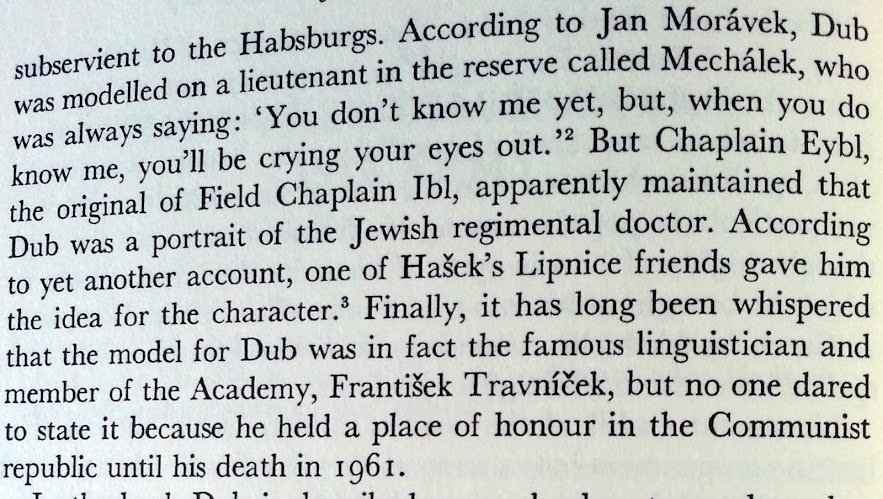
Cecil Parrott: A study of Švejk and the short stories, page 132

František Trávníček
With such vague links between the prototype and the infamous literary figure, several alternative real-life models have been suggested. Radko Pytlík (1998) is of the opinion that no particular model exists, but mentions a few alternatives, apart from Michálek. He notes that Jaroslav Hašek is reported to have told teacher Jakl at Lipnice that the model for Leutnant Dub was some Senior Lieutenant Kreibich, and researchers in Brno have come up with the theory that Dub’s model was the linguist František Trávníček. Pytlík (2003) characterises the rumours about Trávníček as “malicious”. Cecil Parrott (1982) writes: “Finally, it has long been whispered that the model of Dub was in fact the famous linguist František Trávníček”, but no one dared to state it because he held a place of honour in the Communist republic until his death in 1961”.
The Kreibich and Trávníček connections both rest on an even less solid foundation than the Michálek theory. There was no officer called Kreibich in IR. 91. Interestingly, a Kreibich is mentioned in Dobrý voják Švejk v zajetí, but here he is assigned the role of servant of Fähnrich Dauerling and has little that fits the description of Lt. Dub. It should also be noted that Vladimír Stejskal, the source of this reference, was later exposed as a hoaxer.
The Trávníček hypothesis originates from Brno (Radko Pytlík 1998), but it is not known who is behind the rumour. Records in Vienna’s Kriegsarchiv, Reserveoffizierschule Budweis 1915, do indeed reveal that a František Trávníček attended the school at the same time as Hašek, and at first sight this adds some weight to the theory about Leutnant Dub being modelled on the famous linguist. However, a quick comparison of data puts the theory firmly to rest. There were many persons carrying this name in the armed forces, and ten of them later served in the Czechoslovak Army in Russia. Records from VÚA show that the Moravian linguist served in IR8, and he only joined the Legions on 18 January 1918, i.e. shortly before Jaroslav Hašek left it. Although Trávníček may have shared some characteristics with Dub, it is very unlikely that Hašek ever had anything to do with him. Trávníček should therefore be considered "not guilty".
Karel Dub's research
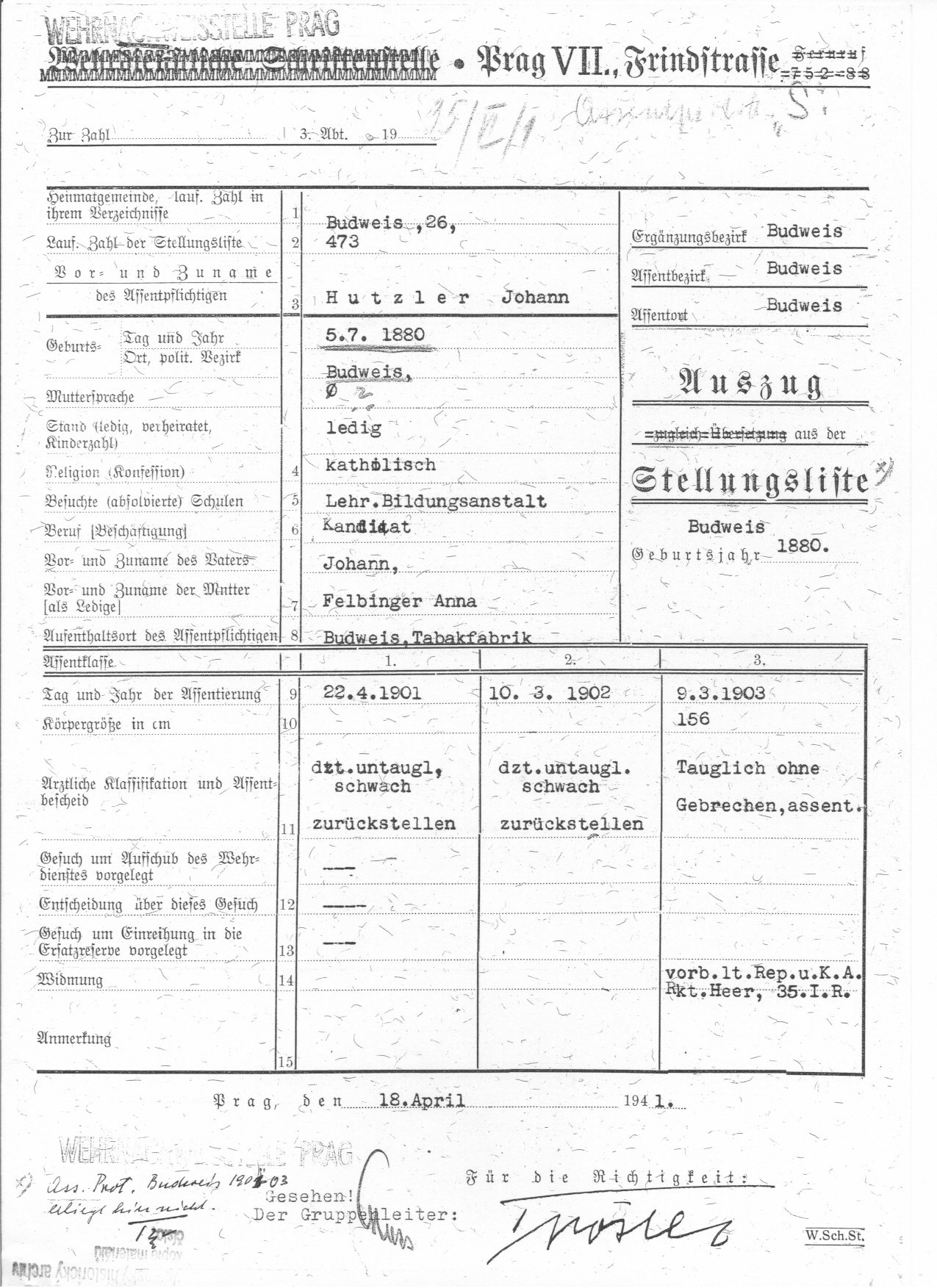
Johann Hutzler
The most solid research on Leutnant Dub has not been done by a renowned Hašek expert, but by Karel Dub. He conducted a remarkably detailed investigation into the background of his namesake. Significantly, he found that no-one with the name Dub served in IR. 91 at the short time Jaroslav Hašek was there, contrary to what others (Jan Eybl) have claimed. In several interviews in his old age, Eybl mentions a regimental doctor named Robert Dub who he claims served in the regiment at the same time as Hašek. Robert Dub was in fact regimental doctor from 5 October 1915, and we have a picture of him together with Franz Wenzel from 1 November 1915. The mystery is that he joined IR. 91 after Hašek had been captured, so it is tempting to dismiss Eybl's version as fiction. On the other hand, there is no doubt that Eybl knew Dub well; he mentions him many times in his diary. Nor can it be ruled out that Robert Dub was in contact with Infanterieregiment Nr. 91 even before he officially joined and that Jaroslav Hašek could have met him some time before he was captured.
Johann Hutzler

Leutnant i. d. Res. Johann Hutzler, a more likely inspiration for lt. Dub than Michálek.
© Spolek Jednadevadesátníci
Karel Dub suggests that Hašek borrowed the name Dub from people he knew from before the war or during his time in Russia (there were eight Dubs in the Čechoslovak Army). He also methodically goes through the lists of reserve lieutenants who served with Hašek and comes up with vital information. He mentions Michálek, but also discusses other persons who may have inspired Hašek: Richard Müller, Ferdinand Black, and Johann Hutzler. Black, who was twenty at the time, was too young to fit the schoolmaster role but may still have lent other traits to Leutnant Dub. Müller is as good as ruled out, but Hutzler has a few striking similarities with Dub.
Hutzler was of the right age (born in 1880), he was a teacher, and had not served at the front before. He was not married, and suffered from sciatica. He was of minuscule stature (156 cm tall), arrived at the front in Hašek’s march battalion, and seems to fit the author's description of Leutnant Dub well. He was squad leader in Hašek's 11. Feldkompanie but was quickly replaced by the much younger Black, presumably for not being up to the task. Otherwise, Karel Dub provides an impressive array of facts, and concludes that Johann Hutzler, rather than Michálek, appears to be the main prototype for Dub.
An entry in Verlustliste from April further underpins Karel Dub's conclusion. In March 1915, Hutzler was hospitalised in k.u.k. Reserve-Spital in Budějovice, at exactly the same time as Jaroslav Hašek. It is therefore very likely that they would have known each other already from then on, and that, time-wise, both men's careers in k.u.k. Heer overlapped almost entirely.
Credit: Karel Dub, Jan Morávek, Radko Pytlík, Cecil Parrott