


Jaroslav Hašek in 1911.
© LA-PNP
Jaroslav Hašek (30 April 1883 – 3 January 1923) was a writer, journalist, translator and satirist from Prague who led a short and extremely turbulent life.
Hašek is first and foremost known as the author of the renowned satirical novel The Good Soldier Švejk (literally The Fates of the Good Soldier Švejk During the World War), but he also wrote over 1,200 short stories, feuilletons, articles, numerous poems, and co-authored several cabaret plays. His literary output may have been even greater than these numbers suggest, as he inundated newspapers and magazines with his stories and used at least 100 known pseudonyms.
Childhood
Hašek's parents were from South Bohemia and had a background in the so-called educated peasant class. His father was an assistant teacher and later an employee of Banka Slavia, but he died in 1896. After his father's death, the family fell into financial difficulties and moved no fewer than fifteen times during Jaroslav's childhood and adolescence.
Education and a budding writer
Despite these changing circumstances, Hašek obtained a higher education, but soon proved incapable of living an orderly life. He graduated from the Českoslovanská akademie obchodní (1899–1902) with good marks and, in the same autumn, was employed by Banka Slavia. He was dismissed within eight months after being absent from work twice without permission. Afterwards, he became a creative and prolific writer and journalist, despite his untidy lifestyle and high alcohol consumption. As early as 1901, while still a student at the commercial academy, he published his first stories in Národní listy, and one of his teachers recognised his literary talent, describing him as a 'Czech Mark Twain'. In 1903, he published the poetry collection Majové vykřiky (The Cries of May), together with his friend Ladislav Hájek.
Wanderings
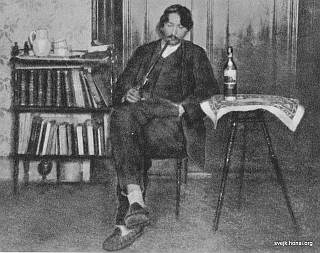
Hašek some time before 1909
© LA-PNP
During the summers from 1899 to 1905, Jaroslav Hašek undertook long journeys in Central Europe, and even into the Balkans. These provided rich material for his short stories and the later masterpiece The Good Soldier Švejk. During these travels, he was often penniless, slept outdoors, and travelled partly on foot. He saw society from its lowest levels, which influenced his writing and political outlook. The region he visited most frequently was Slovakia, but he also travelled to Bavaria, Switzerland, Italy, Galicia, Hungary, Austria, Slovenia, and Croatia. In addition, he visited the areas of modern Romania and may have set foot in present-day Ukraine and Serbia. It has also been claimed that he visited Bulgaria and Macedonia in 1903.
Anarchist and police encounters
Even before writing The Good Soldier Švejk (1921–22), Jaroslav Hašek had a reputation as a prominent satirist, but was also considered controversial due to a period as an active anarchist. Hašek had repeated conflicts with the police and was imprisoned several times, mostly due to drunkenness and public disorder. He was, however, also under surveillance because of his involvement in the anarchist movement. The most serious case was in 1907, when he was sentenced to a month in prison for inciting violence against the police during an anarchist demonstration.
Permanent employment and marriage

,1.1.1909
In early 1909, Hašek succeeded his friend Ladislav Hájek as editor of the popular fortnightly magazine Svět zvířat (The Animal World), where he enjoyed his longest ever period of permanent employment, keeping the job for almost two years.
Stable employment and income finally enabled him to marry Jarmila Mayerová, whom he had been courting since 1906. Her parents had been vehemently opposed to the relationship because of Hašek's anarchist connections and unconventional lifestyle. Nevertheless, they eventually consented after the prospective groom settled into a stable existence. The couple married on 23 May 1910.
The bliss proved short-lived, as Hašek was dismissed from The Animal World in the autumn of 1910. His appearances at the office had become increasingly rare, and, worse still, readers had begun to question the veracity of the information presented in the journal. These two factors were probably the main reasons why the magazine's owner decided to dismiss his editor.
The widespread claims that he wrote about imaginary animals such as werewolves are, however, unsubstantiated. His pranks seem to have been rather innocent, like allowing himself minor jokes at the expense of his friends Josef Lada and Vilém Kún (and perhaps others). That he assigned imaginary attributes to existing species is quite likely, but the extent is difficult to verify. In 1973, Radko Pytlík noted that he and other researchers found nothing in the magazine that, in itself, could justify termination.
After leaving Svět zvířat, Hašek and his wife set up their own dog-trading business called Cynological Institute, but the enterprise soon collapsed. Soon after, he was admitted to a psychiatric hospital, apparently after trying to commit suicide by jumping from the Charles Bridge in Prague.
The early Švejk
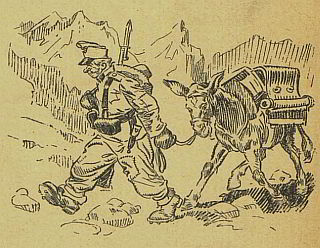
Švejk capturing an Italian donkey.
Dobrý voják Švejk a jiné podivné historky, ,1912
In the spring of 1911, Hašek conceived The Good Soldier Švejk, and five stories about the soldier were published from 22 May 1911 onwards. The stories were mostly set in Trento, and were very different in style and content from the later novel. The stinging satire was absent, Švejk told no anecdotes, and the stories lacked the strong connection to military reality that the author’s experiences in the army lent to the novel.
The name Švejk also appeared in a couple of cabaret plays around this time, again in roles unrelated to the famous novel character. In one of the plays, Švejk was the servant of the Holy Roman Emperor Charles IV!
In 1912, the five stories were published in a book called The Good Soldier Švejk and other Strange Stories. The book was illustrated by Karel Stroff.
A mock party
At the same time as Švejk was created, Hašek, with some friends, founded a mock party called Strana mírného pokroku v mezích zákona. According to its manifesto, this occurred in April 1911. It was partly a forum for ridiculing the political elite and partly established to increase the turnover at the pub where the party meetings were held. Hašek wrote many stories about the party, in which he caricatured politicians and others. Presumably for fear of libel suits, these were not published until after the First World War, and only in part. The complete collection did not appear in print until 1963.
Family breakdown
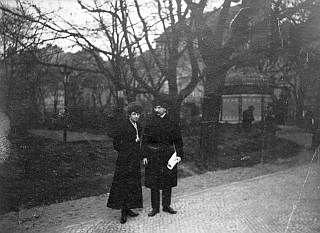
Jaroslav and Jarmila at Karlovo náměstí
© LA-PNP
On 2 May 1912, Jarmila gave birth to their son Richard, but soon afterwards, Hašek left the family, only to see them again in 1921. The constraints and rigours of family life did not suit him, and again, he took up his bohemian way of life. After leaving his family, his life spiralled downwards, and he virtually became homeless, sleeping at friends' houses. Again, he started to travel, but now within Bohemia, mostly together with his friend Zdeněk Matěj Kuděj. At the outbreak of war in 1914, he was staying with the painter Josef Lada.
In the Austro-Hungarian army
The war led to radical changes in Hašek’s life. Never having completed compulsory military service (probably for health reasons), he was deemed fit for duty in 1914. On 17 February 1915, he was enlisted with Infanterieregiment Nr. 91 in Budějovice, was sent to the front in Galicia in early July and was captured by the Russians on 24 September 1915.
His time in the army eventually provided rich material for The Good Soldier Švejk. In the novel, many geographical details and other circumstances reflect the author’s experiences serving with IR. 91. Hašek's time with the regiment is investigated in more detail in the entry Jaroslav Hašek in the Who's who section.
Captivity and the Legions
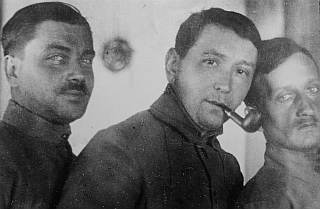
Jan Šípek, Jaroslav Hašek, Václav Menger.
, 29.9.1917
© LA-PNP
In Russian captivity in the Totskoye camp, Hašek contracted typhus, a disease that killed thousands of his fellow prisoners. In the spring of 1916, he volunteered for the Czechoslovak Brigade (later known as the Legions) and was released from the camp in early July; he was formally enlisted on 29 June 1916.
In the Legions, he worked as a recruiter amongst prisoners of war and contributed to the tsar-loyalist Czech weekly Čechoslovan in Kiev. During this period, Hašek voiced strong nationalist sentiments and voiced support for the tsarist regime, seeing it as the strongest guarantor of a future Czech state.
However, after several episodes that embarrassed the Czech volunteers, he was sent to the front as an ordinary soldier in May 1917. His satirical article The Czech Pickwick Club led to further disciplinary measures. On 2 July 1917, Hašek took part in the battle of Zborów, where the Czechoslovak volunteers, for the first time, faced their compatriots as a unit.
Communist

Jaroslav Hašek announcing that he is leaving the Czech Army (Legions), disagreeing with their transfer to France, but promising to still work for the Czech cause. The letter is dated 13 April 1918.
The Russian October Revolution in 1917 and the ensuing peace treaty between the new Soviet state and the Central Powers made continuing the war from Russian soil impossible for the Legions. They were formally placed under French command, and it was decided to transfer them to the Western Front via Vladivostok.
This was a decision with which Jaroslav Hašek disagreed. He preferred his countrymen to remain in Russia, presumably hoping that the front against the Central Powers would be reopened.
From the beginning of 1918, he also became increasingly influenced by communist ideas. Witnessing the Bolshevik occupation of Kiev in February may have contributed to this shift. According to Josef Pospíšil, Hašek judged the Bolshevik leaders as "very capable people". He may also have been influenced by the young communist Břetislav Hůla, his friend and co-editor at Čechoslovan from November 1917 onwards. At this stage, many left-wing groups disapproved of Lenin's Brest-Litovsk peace treaty, and it would have been natural for Hašek to align with those.
In early March 1918, Hašek and Hůla, fleeing from the Germans who were advancing on Kiev, travelled to Moscow and reported to the Czech Social Democrats (communists). In April, Hašek wrote in a letter that he had left the Czech Army (i.e. Legions), stating that he disagreed with their transfer to France. During the spring of 1918, the relationship between the Czechs and the Bolsheviks deteriorated, and at the end of May, an armed rebellion broke out. This led Hašek into direct conflict with his former comrades. He and other Czech communists were branded as traitors, and arrest orders for the more prominent of them were issued, with a particular emphasis on Hašek (Omsk, 25 July 1918). By now, all bridges had been burned, and from October, he worked directly for the Bolsheviks' 5th Army.
In Russia, Hašek's career made rapid progress. He worked for the political department of the 5th Army, and he journeyed all the way to Irkutsk. Hašek was mainly responsible for propaganda and recruitment among the many foreign prisoners of war who remained in Russia. He published in Czech, Russian, German, Bashkir, Hungarian, and Buryat. In Siberia, he married Alexandra Lvova (Šura). This was despite him not being formally divorced from Jarmila. During his time in the Bolshevik 5th Army, he proved himself a capable organiser and also stopped drinking.
Returning home
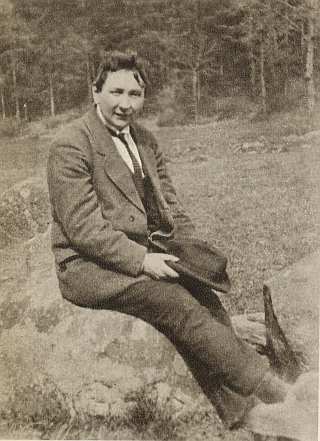
Hašek some weeks before his death. Lipnice 1922.
© LA-PNP
In the summer of 1920, circumstances changed again. The Bolsheviks had won the Russian Civil War, and the many foreigners in their service were no longer needed in Russia. They were deemed more useful as agitators in their home countries, and the Comintern issued directives that they were to be dispatched to help the national communist movements.
On 26 August 1920, the Irkutsk section of the party received a telegram instructing Hašek to relinquish his duties and report to the Central Bureau of the Czech section of the Communist Party. On 24 October, he left Irkutsk for Moscow, where he appeared on 26 November.
He arrived in Prague on 19 December after travelling via Narva, Tallinn, Stettin, and Berlin and having spent a week in quarantine in Pardubice. By then, the communist uprising that he was supposed to take part in had failed, and the organisers had been arrested.
Back in Prague, he soon reverted to his former habits and was of little use to the communist movement thereafter. However, he still contributed to their newspapers and never renounced his convictions. If Hašek was controversial in pre-war Prague, he was even more so now; there was the threat of legal proceedings because of bigamy, and he was widely unpopular due to his Bolshevik past.
Gustav Janouch even claims to have witnessed an attempt to lynch Hašek.
A satirical masterpiece
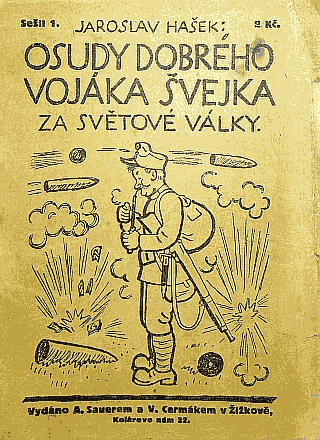
The cover of the first instalment of Švejk (March 1921), drawn by Josef Lada.
Around February/March 1921, Hašek hit on the idea of rekindling his soldier, Švejk, now in the form of a novel, and started to write The Good Soldier Švejk, a book that was planned in six parts. The first part and at least the first chapter of the second were completed in Žižkov, and the text was initially sold in instalments. Although The Good Soldier Švejk sold well, glowing reviews appeared in influential newspapers only after Švejk was performed on stage from 1 November 1921 onwards. Max Brod, Ivan Olbracht, and Alfred Fuchs were the first enthusiastic reviewers, having all written about The Good Soldier Švejk during November 1921. The success of the stage play and the subsequent reviews no doubt enabled Hašek to sign a contract with publisher Adolf Synek for the publication of The Good Soldier Švejk. On 4 February 1922 the parties put pen to paper.
Before the breakthrough of The Good Soldier Švejk in November 1921, Hašek had moved to Lipnice (on 25 August 1921), where he completed Part Two, wrote Part Three, and started on Part Four of The Good Soldier Švejk. Unfortunately, his health took a downward turn; the hard life had taken its toll, and he had also become dangerously overweight. He never completed the fourth part of his epic novel and died on 3 January 1923. The causes of death were stated as pneumonia and heart failure. The claim that he drank himself to death is widespread, and though alcohol was not the primary cause of death, it was undoubtedly a contributing factor.
Books about Jaroslav Hašek

For the international reading public, the most accessible book about Jaroslav Hašek is no doubt 'The Bad Bohemian' by Cecil Parrott (1978).
Jaroslav Hašek is the subject of several biographies, although most are available exclusively in Czech. Autobiographical material is almost non-existent, apart from those elements of his life that he frequently blended into his writing, both in The Good Soldier Švejk and his numerous short stories. This information must, however, be viewed with scepticism, as Hašek was an accomplished mystifier who convincingly mixed truth, half-truths and lies. Almost all that is known about him today is, therefore, based on the accounts from people who knew him and material from various archives and newspapers. The material that his friends and biographers wrote is often unreliable because the source was often Hašek himself. In addition, some of them tended to embellish the stories.
For the international reading public, the best source of factual information is no doubt The Bad Bohemian (1978) by Cecil Parrott, the author of the second English translation of The Good Soldier Švejk. Parrott’s biography is, to a degree, based on Radko Pytlík's de facto standard Toulavé house (1971).
A rare but valuable book is Emanuel Frynta’s Hašek, the Creator of Schweik. It comes with many illustrations and is competently translated into English. It focuses on the artistic view of the author rather than the biographical details that other biographies tend to emphasise.
There is also literature on Jaroslav Hašek in German, for instance, the well-documented but speculative Der Vater des braven Soldaten Schweik by Gustav Janouch (1966). Furthermore, Jan Berwid-Buquoy has written two books in German about Hašek. These are works that are entertaining but of dubious veracity.
The most reliable book about Hašek in German is no doubt Pavel Petr's Hašeks Schwejk in Deutschland (1963). Although only partly biographical, Petr's book is well-researched and it is impeccably documented. At the time it was published, it was arguably one of the most solid works on Hašek that existed, anywhere, in any language.